
Flemish Artists Illustrating Boys' Fashions
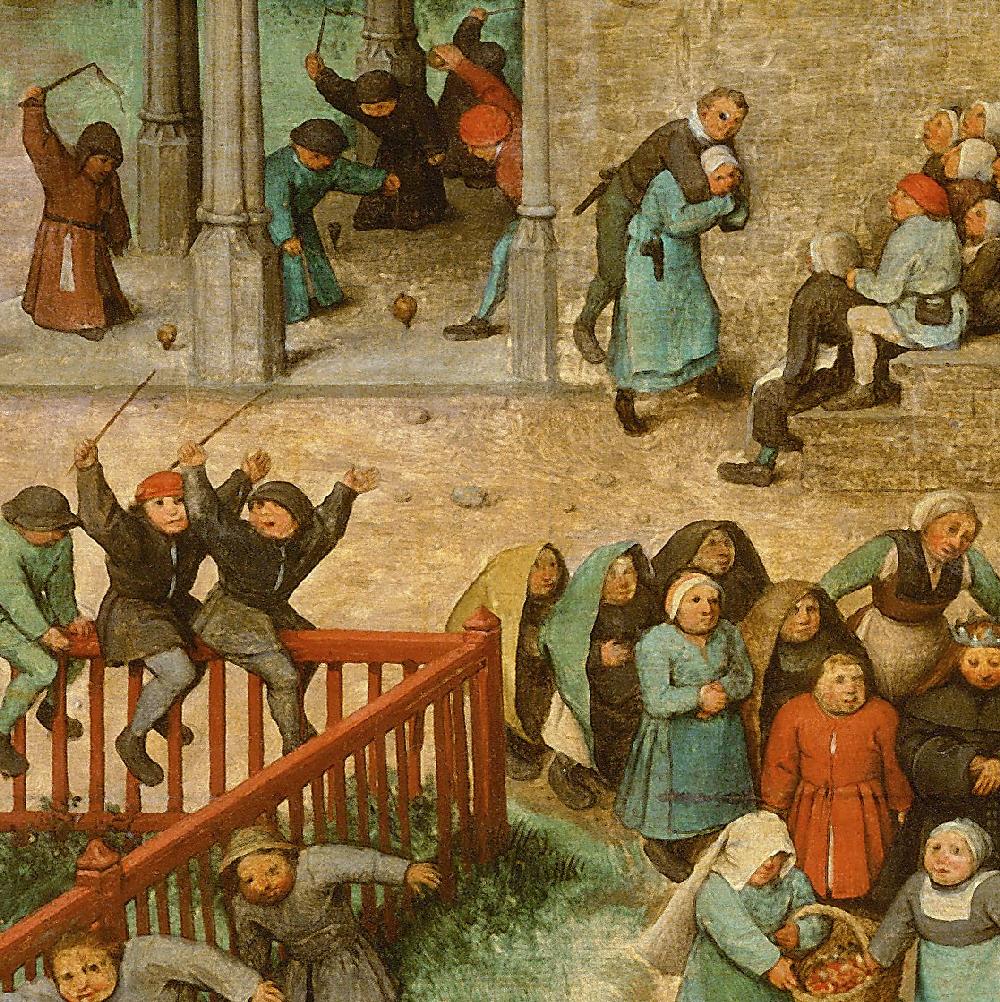
Figure 1.--This detail from Pieter Bruegel the Elder's painting 'Children's games' (1560). The paiting is a wonderful composit of all the different types of children play among peasant children at the time. We see boys spinning tops, playing horsey and a kind of vornnation procession. And thre appears to be a kind of dramatic presentation. Perhaps readers will have some insights on the play depicted here. It is only a few of the many play activities depicted.
|
|
Flanders is the Low Country south of the Netherlands. Organizing artists on the basis of modern national boundaries is frought with difficulties. The Flemish painters area case in point. Since 1830 it has been part of Belgium, so the Flemish artists can be considered Belgians on the basis of modern boundaries. As Belgium did not exist in the 16th and 17th century and because the Flemish School was such an important group of artists, we are creating a separate for them in our national section. Most of the great Belgian painters are in fact Flemish painters from the 16th and 17th century.
Jan Bruegel the Elder is one of the most important artistrs of the Northern Renaissance. He was a noted painter of his time and unlike some artists finally successful. His life and artistic career spanned the 16th and 17th centuries. His father was Pieter Bruegel the Elder. Jan was also known as `Flower Bruegel' and `Velvet Bruegel.' He was noted for the realism and accuracy of his depictions as well as the jewel-like color of his palet. The Bruegel family is wonderfully recorded by a magnicent portrait painted by his friend and colleague, Peter Paul Rubens. Bruegel also colaborated with Joos de Momper the Younger, Hendrik van Balen, Hans Rottenhammer and others. Bruegel addressed a wide range of topics. Some of the most interesting are his village scenes which provide a marvelous record of contemporary Flemish life. He also did landscape and flowers. In addition to his realistic works, he did mythological and allegorical paintings.
Pieter Bruegel the Elder was born in Brenda (modern Netherlands) or Bree (modern Belgium) (about 1525). He was Netherlandish/Flemish Renaissance painter and printmaker known for both landscapes and genre work. He showed a special interest in peasant scenes which is why he is known as 'Peasant Bruegel' as thre are several different members of the Brueghel artistic dynasty. There are different spellings of his name. He dropped the 'h' from his name and started signing his paintings as Bruegel (1559). As a boy he was apprenticed to Pieter Coecke van Aelst, whose daughter Mayken he later married. He traveled in France and Italy, and then spent some time in Antwerp. It was here he was accepted as a master in the painter's guild (1551). He then traveled to Italy again before returning to Antwerp whre he worked for 10 years.
He finally settled in Brussels. Art historians see him as the greatest of the Bruegel clan. His life is almost coincident with the Reformation ans the influence of the Reformation is powerful. This can be seen in the humanizing spirit to traditional subjects and bold innovation, especially the value he gave to individuals, especially those of the lower order. No one embraced the peasantry like Bruegel. He is of special interest to HBC because of his wonderful painting of peasant children playing (figure 1). It is not an actual scene, but a canvas for depicting the varied play activies of peasants in the 16th century.
Rubens is one of the great masters of the Flemish school. He was born in Siegen, Westphalia. In 1599 he was admitted a master of the Brotherhood of St. Luke in Antwerp. He traveled to Italy in 1600 to view the work of the great masters. He entered the service of Vicenzo Gonzaga, Duke of Mantua, as Gentleman of the Chamber and court painter. He was dispatched on a mission to Phillp of Spain in 1605, beginning a diplomatic career for which his keen intelect, polished urbanity, and linguistic achievement qualified him. While in Madrid he painted many Spanish nobels as well as historical subjects. He settled in Antwerp and was appointed court painter to the Archduke Albert and his wife Isabella. His masterpiece, Discent from the Cross was completed in 1614. Marie de Medicis, the French Queen Mother, invited Rubens to France in 1620 to assist in the decoration of the Luxembourg Palace. He undertook 24 large works commemorating her marriage to Henry IV. In the ensuing years he undertook a series of diplomatic mission s that brought him to the English, French, and Spanish courts. In return for these services he was knighted by both Charles I (England) and Philip IV (Spain). His portraits are mostly of adults, but family portraits do provide some insights into the clothes worn by 17th Century children.
Flemish artist David Teniers the Younger was both a painter and engraver. He was born in Antwerp during 1610. He is noted for his genre paintings depicting daily life in the 17th century. He is the best known of the artists in his extended family. He studied art as a boy for many years under his father David Teniers the Elder. Stangely, art experts suggest that his father does not seem to have greatly influenced his son's style. One of his earliest works was the “The Five Senses” (1635). An influence on Teniers was was Dutch artist Adriaen Brouwer who is known for his peasant scenes rather than the genteel depiction of middle-class life often favored by Flemish artists. Other Dutch artists were also influential. Teniers' “The Barn” is a good example of the early phase of his work. Teniers married the daughter of Jan Breughel the Elder (1637). Teniers also knew Rubens who was his wife's guardian and served as a witness at their wedding. Teniers' father-in-law proved to be a strong influence in his art. His genre scenes gradually became more genteel. He became one of the Flemish masters at depicting everyday life. An excellent example is the “Village Fete” (1646). Like other Flemish genre artists, Teniers also did a number of works with religious and mythological themes as well as landscapes. Teniers eventually received an appointment to the court of Archduke Leopold William in Brusseles (1651). Leopold William was the governor of the Spanish Netherlands. Here he served as court painter. But he had others duties, including tapestry designer, art curator, and gentleman-in-waiting to the Archduke. His career and appointment to the Archduke's court brought his considerable wealth. He was even awarded a patent of nobility.
Antoon Van Dyck was born on March 21, 1599 in Antwerp, which was at the time then the main port of the Spanish Netherlands, basically modern Belgium. He was to become one of the most succesful portrait painters of the day and awarded a kighthood by England's Charles I. His brilliant portraits of the Cavalier nobility, resplendent in satin and lace stand to day as our major window into the world of Stuart England. These paintings were also to inspire the elaborate Little Lord Fauntleroy suits of the late 19th Century. Interestingly, Van Dyck's grandfather had made the family fortune by selling luxurious fabrics, velvet, satin,and lace.
HBC

Navigate the Boys' Historical Clothing artistic pages:
[Return to the Main artistic page]
[Chronologies]
[Individuals]
[National]
[Styles]
Navigate the Boys' Historical Clothing Web Site:
[Return to the Main Flemish page]
[Introduction]
[Activities]
[Biographies]
[Chronology]
[Clothing styles]
[Countries]
[Bibliographies]
[Contributions]
[FAQs]
[Glossaries]
[Images]
[Links]
[Registration]
[Tools]
[Boys' Clothing Home]
Created: August 9, 2003
Last updated: 11:19 AM 11/1/2017