|
We do not yet have a great deal of information about Russian art, but we have begun to collect information about Russian art history and individual Russian artists. Some of the artists we have been able to find some information. Others all we have is their name and a painting. Hopefully our Russian readers will be able to provide some information. We note some fascinating images. Most come from the 19th or early 20th century. We do not yet have any images from the Soviet era. They may not be great art, but they would be of historical interest.
We have no information on Russian art before the Christian era. The earliest paintings we know of comes from the Christian era and involved the painting of icons. This was an artistic tradition acquired from Byzantium. There it evolved from an offshoot of the mosaic and fresco tradition wgich was used to decorate early Byzantine churches. Unlike Byzatium, icons were never banned in Russia, but the iconic style became alnost foicilized. Russia began increasing its contacts with the West as European culture influences begab addecting Russian art. The French were very influentisl, esoecisally in court and aristocratic cirlcles. It was obly in the 19th crntury uniquely Russian artistic styles negan to sppear. There are wonderful genre scenes from the 19th century n a realistic style. These artistists depicted in the inquities in Russian life as liberal frces pessed for social reform. By the late-19th century the wind of modernism reached Russia. The Rvolution occurred just as modernism flowered with artists like Cladimir Ratlin and Alexsandr Rodchenko shoeing the influence of Cubism and Futurism. The Revolution harnassed art as a force to showcase the newsociety being created. And it is was not long between the Revolution began not only to dictate subjects, but aklso style. Stalin had no appreciatiion for modern art, he wanted trite, realistic depictions of a Docialist utopisa. He got what he wanted, but the wonderful work of the 19th and earkly 20th century stopped. Soviet art after the rise of Stalin became hack work, serile propagada depictions.
We have begun to collect information about individual Russian artists. Some of the artists we have been able to find some information. Others all we have is their name and a painting. Hopefully our Russian readers will be able to provide some information. We note some fascinating images. Most come from the 19th or early 20th century. We do not yet have any images from the Soviet era. They may not be great art, but they would be of historical interest.
Nikolay Petrovich Bogdanov-Belsky (1868-1945) was a Russian artist. He was born in the village of Shitiki in Smolensk Governorate (1868). He studied art at the Semyon Rachinsky fine art school. He ha a destinctive range of interests. He studied icon-painting at the Troitse-Sergiyeva Lavra (1883). Icon painting was destictively Russian. He then showed his range of intersts by studying modern painting at the Moscow School of Painting, Sculpture and Architecture (1884-1889). Finally he studied at the Imperial Academy of Arts in St. Petersburg (1894-95. He began his career at private studios in Paris (late 1890s). This was part work and part study. His body of work is diverse. We notice portraits, genre work, still lifes, and land scapes. He was especially devoted to genre paintings, especially scenes involving peasant children. He seems to have been especiallyb interested in the education od peasant children. We also did impressionistic landscapes. Bogdanov-Belsky combined en plein-air subject matter, color and stroke into an academic framework. He combined both rural and urban subjects in many of his paintings. We note a painting of three peasant boys dated 1910, just before World War I. He belonged to several respected societies, including the Perdvizhniki (1895). He was a founding member of the Arkhip Kuindzhi Society (1909). He became a pedagogue and academician (1903). He became an active member of the Academy of Arts (1914). Like many other Russian, World War I changed everything. After World War I he apparently fled the Communists, selling in Riga, Latvia. He worked there for the rest of his active life (after 1923). He joined the Russian Fraternitas Arctica in Riga.
Bogdanov-Belsky died in Berlin (1945).
Here is a Soviet artist that we know nothing about. All we have is one paiting done in 1967. It show a little girl in hat looks like a white coat and winter hat on a white hobby horse.
Pavel Andreevich Fedotov was born in Moscow during 1815. His father was a retired military officer. He attended the Moscow Cadet School. It was not common in other countries for artists to come from a military background, but Fedotov served 10 years in the Finland Regiment of the Imperial Guards stationed in St. Petersburg. Fedotov and many of his fellow-officers dabeled in art as amateurs. Fedotov also played the flute. We note many portraits he painted as well as interesting genre works. We note an interesting portrait of the Zherbin Children (1850-51), apparently one of his last works.
Ivan Fomich Khrutsky is a difficukt artist to categorize in terms of modern ntiinalities. He is probably best described today as POolish (Jan Chrucki) or Belarusian (Іван Хруцкі). He can also be associated with Russia (Иван Фомич Хруцкий) and Lithuania. All of these modern countries were part of the Tsarist Empire. Ivan/Jan was born in eastern Poland, modern Belarus (1810). His family was Polish descended from szlachta of Leliwa coat of arms in the village of Ulla, Vitebsk Governorate, once part of the former Polish–Lithuanian Commonwealth. A the time of his birt as aresult of the 18th century Polish partitions, most of Poland had been absorbed into the Tsarist Empire. As an older teenager, Khrutsky went to St. Petersburg, the center of the Tsarist art world to pursue his studies and career (1827). He entered the Imperial Academy of Arts (1830). The first identfiable work began shortly after (1832).
We notice range of works, including an eclectic mix of still lifes, landscapes, genre scens, religious works, and portraits. His works began to be noticed and achieved both public and critical acclaim. In addition to painting, Khrutsky also applied his talents to interior design. He developed a devoted clentel among wealthy home owners. The Academy awarded him its Major Silver medal for still-lifes. Perhaps his most aclaimed work is 'Old Woman Knitting a Sock' which earned him the Academy' Minor Gold medal. He received the Academy's prestigious title of Academician. Khrutsky St. PLetersburg carrer ended with his father's death (1840). He left St. Petersburg and returned to the family estate Zacharnicze Polotsk region. This meant he loss contact with his wealthy St. Petersburg clients. He go commissions for religious art, primarily from Lithuania. He also did portraits of local figures during this period. He died at Zacharnicze (1885).
Elena Mikhailovna Kostenko ( Еле́на Миха́йловна Косте́нко ) was born in Lenningrad, now St. Petersburg (1926). Her father, Mikhail Kostenko, was an important figure in Soviet science, a boted electrical engineer. This gave her access to all the advantages of the Soviet system. And of course Lenningrad was a center of the arts in the Soviet Union.
She entered the Leningrad Secondary Art School operated by the All-Russian Academy of Arts (1938). She studied there with a break during World War II when Kenningrad became a major battlefield, cut off by the invading Germans. She finished her studies after the War (1946). She then moved on to school of painting at the Leningrad Institute of Painting, Sculpture and Architecture named in honor of Ilya Repin. She graduated (1952). She had a special love of children and expressed this in here art. Her graduation piece was the genre painting "Future Builders. Kindergarten". She emerged as one one of the brightest members of the Leningrad school of painting. She is particularly noted for her portraits. We notice some charming images of children. She used relatives as subjects, including her two boys.
Aleksandr Vladimirovich Makovsky was a noted Russian painter. He was born in Moscow (1869). His father was the son of the artist Vladimir Makovsky. Aleksander studied at the Imperial Academy of Arts at Saint Petersburg (1894-95).
He also studied in Moscow School of Painting, Sculpture and Architecture. His career is primarily associated with Tsarist Russia, but he lived through the Revolution and early Soviet period. He was an active member in the Moscow Association of Artists (MTKh) (1890s). Makoovsky next began exhibiting with the Itinerant Movement (turn-of-the 20th century) and becane very active in the movement (1900s-1910s). We notice a range of portraits and genre scenes as well as still lifes. His 'Easter table' is particularly evocative. About the same time he began his association with the Itinerists, he started teaching at the Imperial Academy of Arts (1898). He was appointed a full academic there (1911). He ended his association with the Itinerists (1922). He then joined the Association of Artists of Revolutionary Russia (AKhRR) (1924). Makovsky died the same year. We note a portrait he did of an English boy in Moscow (1922). We are not sure what his parents were doing in Moscow.
Vladimir Yegorovich Makovsky (Влади́мир Его́рович Мако́вский) was born in Moscow (1846). He is known as
an artist, art collector, and teacher. He was as is the case of many artsts born into an artistic family.
His father an art collector, Yegor Ivanovich Makovsky, who helped found the Moscow Art School. Vladimir grew up with two brothers, Nikolay and Konstantin, and onesister Alexandra, each ofwhom became recognized artists in their own right. Vladimir studied at the Moscow School of Painting, Sculpture, and Architecturewhere he completed his studies as a youg man. He quickly became a founding members of the Association of Travelling Art Exhibitions. His travels and scale of work resulted in considerable prominance. His works wre alive with emotion and animated behavior. We see humor, irony and scorn. His fiest paintings suring the 1870s focused with people in small towns. Here he followed in the foosteps of hi older broher, Konstantin who pinted rural scenes. Neither was interested in lucrative portrait painting and provides an outlook into their political and spcial outlook. Some of his early portraits were
'Fruit-Preserving' (1876), 'The Congratulator' (1878), and the 'The Grape-juice Seller' (1879). Gradully his works become more socially conscious and vertly critical of the existing social struture. A good example 'The Convict' (1878). It was a cricism of the Tsarist police and judicial system. It is interesting that Tsarist authortes allowed this. There was nothing like this in Soviet art, it would have been a one-way ticket to the Gulag. Makovsky provides us important images epicting the life of the poor, such as 'The Viilage Children' (1880). He became an academician (1878). It is at this time that he produced many of his best regarded works (1880s). The era produced some of the best of what are called 'democratic' painting. He became professor at the Moscow Art School after the death of Vasili Perov (1882). Especially impressive are 'In the Ante-room of the Court of Conciliation' (1880), 'The Collapse of the Bank' (1881), and 'The Released Prisoner' (1882). Glomierworks followed: 'You Shall Not Go' (1892) and 'On the Boulevard' (1888). Makovsky was appointed Rector of the Preparatory school of the Academy of Art. The Revolution of 1905 brought 'January 9, 1905, on Vasilyev Island' which depicts the Tsarist police firing on unarmed potestors. Another painting, 'The Sacrifices on the Khodyn Field'. This recalls the 1896 coronation ceremony for Nicholas II. After the 1917 October Revolution, Makovsky helped found what would be Soviet Realism. Ironically the actual realism was depicted in the Tsarist era, not the Soviet era.
Konstantin Makovsky is best known as a painter of Russian folk scenes, especially of rural peasant life. As a result he provides us some fascinating depictions of how Russian boys dressed in the 19th century. His paintings are highly detailed and very accurate. He was a founding member of the revolutionary movement known as the "Wanderers". He established himself in an early phase of his career as a champion of Russian subject matter. He had an enormous impact on the direction of art in Tsarist Russia. He advocated freedom from restrictive Academic rules and subject matter.
We note a Russian artist named A.U. Morozov who painted a peasant school in the mid-19th Century. The school was painted in 1865. Morozov was a student of the romantic style of painting. He was one of the 14 artists who protested about what could and could not be subjects for paintings. Tsarist Russia in the 1860s had strict regulations about what artists could paint. We do not have complete details on these regulations, but I think that peasent scenes were not part of what artists were allowed to paint. Morozov's philosophy was to paint refelecting peotry of the soul. His work concentrated on the positive side of life and not its negative aspects. I'm not sure who the land owner was. So often landowners are depicted as being cruel and explotive. This of course was the image promted by the Soviets. It not doubt was accurate in many cases. It is nice to see it was not always the case. The painting is a wonderful depiction of a 19th century Russian school.
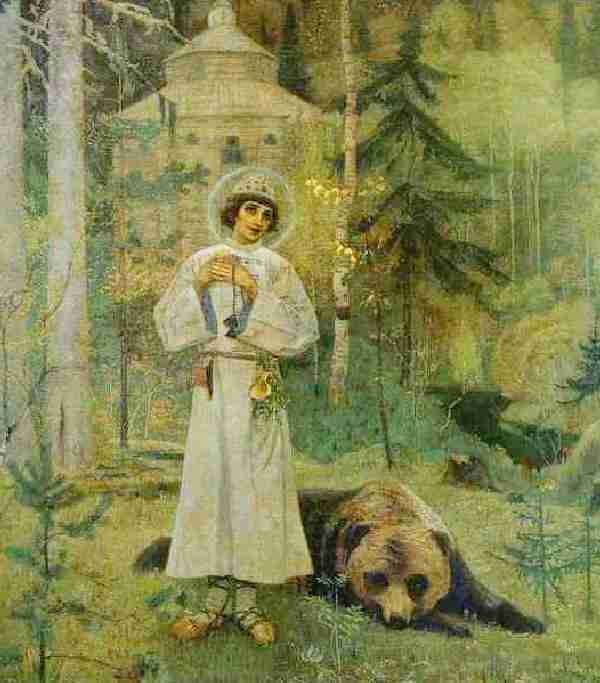
A British reader notes the work of M.W. Nesterov, a noted Russian artist. He painted some intraguing historical ans religious scenes. One scene set in the the 19th Century shows a boy wearing a Russian blouse in the countryside talking to a hooded figure. It seems that the boy is dreaming and in the dream he meets the spirit of death. This spirit will take the boy away to heaven. Despite this being a sombre theme I thought the boy's clothes were interesting as he appears to be in Russian clothes. He is not one of the more useful articts providing clothing depictions, but his images are intreaging.
Vasily Perov was educated in the provincial Arzamass School of Art. During 1853-61 Perov studied at the Moscow School of Painting, Sculpture, and Architecture. He lived in Paris during the early 1860s studying art. Returning to Russia, Perov became a founding member in the Circle of the Itinerants. In 1886 Vasily Perov was awarded the title of member of the Petersburg Academy of Arts. Perov is best known for his sympathetic genre scenes and portraits, including serfs and peasants.
Arkady Plastov ia highly prolific an acclaimd as impftant Russiana artist. He won the Stalin Prize of the first degree (1946) and was made a an Academician of the USSR Academy of Arts (1947). Many other prestigious awards followeds. This is interesting because his work focused on the peasantry. And the peantry was not of any great intetest to Stalin who was acgtually murdering peasants, especially Ukranians peasants, in their millions. We see beautiful images of rural landscapes, portraits of contemporaries, and symolatheric scenes of peasant life. H was was born in the village of Prislonikha, the in the Volga Federal District, south central Russia east of the Urals. He was destined to become an artist, in part because his father and grandfather were the village iconographers and he showed an early aptitude. He was interested in both sculpture and apiantung. He studied at the Stroganov Central School of Industrial Art (1912-14)and then in the Moscow School of Painting, Sculpture and Architecture, the sculpture department (1914-17). Despite the war, he was not deafted. While still at school, , he studied painting Moscow workshops (AE Arkhipov, AS Stepanov, and AM Vasnetsov). He reurned to Prislonikha where he worked. He became one if the freat artists of the Soviet peasantry. Besides painting, hed did both illustration and easel drawing. His works became classics of 20th centutry Russiana art. With is focus on the peasantry during the 1920s-30s, this was quite anchievement. Symoathetic depictions of the peaantry very easily could have got him arrested ny tghe NKVD and a ticket to the Gulag. He apparentky understood the danger. He dutifully painted traditional Soviet pictures with political messages, incuding depictions of Lenin and collective farm holidays. His treaytment of tractors is notable. Stalin wanted to see happy, dancing images of dancing, well fed peasants in Soviet art. Pity the clueless Soviet artist that did not understnd this. As he was producung hese, apparentky this bought space for symnpathetic depctions of peasant life. And some of his best work as after Stalin did (1953). His paitings have been used as illiustratons in school textbooks. These later images are now very popular in Russia.
Jury Raksha, he was a talented Sovietb painter. We have not yet found biographical information on Raksha. So our information is very limited. We have found some of his work. He seems to have done a range of paintings, but included among his work were some powerful historical pieces depicting many different eras from medieval Russia to World War II. A World War II painting was especially powerful. Raksha also worked as art the director on Soviet movies. Raksha tragically died from cancer (1980) at the age of only 43.
Fedora Pavlovich Reshetnikov was a popular Soviet artist. He was born in 1906 and was still a boy at the time of the Revolution. We have few biographical details at this time. Soviet painting was highly realistic. Stalin did not like abstract art. And that view continued even after his death. One of Reshetnikov's most popular paintings was "Poor Grades Again" (1952). It is a social scene that many can identify with. The boy has had many school reports. All are disappointing. The younger boy has a bike. I giuess he is doing ok at school. The only friend the boy has is his dog. His brother and sister and mum are not happy that he has not got a good school report.
Cristina Roberstson was a popular Scotish society portratitst. She worked in Scotland, London, and Paris
Scotland, but it best known for here work in St. Ptersburg here she painted the cream of Tsarist society, including the Rotal Family. She mostly painted socially prominent adults. Her portraits are a wonderful collection of prominent Russians in thev mid-19th century just before photography begn to make a major impact. She thus made a major contribution to Russian portature act. Thus while not a Russian artist, we are including her in out list of important artists. Unlike many women artists, she did not paint many children. We do not even know the name of the children in one of her most popular works -- 'Children with a parrot' (1850). One boy she painted was Nikolay Yusupov (1839). The name is a very a very important one in Russian diplomacy. He was also one of the richest if not the richest Russian of his era. He had 31,000 serfs, not counting the women. The Prince Nikolay that is important, however, is the grandfather of the boy Roberson painted.
Nicholas Roerich became one of Imperial Russia’s most famous artists. In fact he had wide ranging interests. He has been described as a Russian archeologist, painter, philosopher, and theosophist. Much of his art work was about Russian History. He was born in Saint Petersburg to the family of prosperous notary public. Nicholas lived around the world, spending many years in India until his death in the Punjab. His father had him study law, but allowed him to also study art. His interests were very wide ranging, but were strongly oriented toward art. He left Russia with his family after the Revolution, but undewent a series pf anti- and pro-Soviet conversions. Given his conflicting orientation it is good he did not return to Russia during the stalinist era.
Svetoslav Roerich is an important modern Russian artist. His father was the artist Nicholas Roerich (1874- ) He became one of Imperial Russia’s most famous artists. His art work was about Russian History. His mother was Helena Shaposhnikov. Helena was related to the Russian composer Mussorgsky.She met her husband in 1899. There were two sons. Georget the eldest was born in 1902. Svetoslav their youngest son was born in St Petersburg (1904). Svetoslav developed from childhood a lifelong interest in art. His first teacher was father. He and his older brother George followed their everywhere. Several family photographs have survived. They show the boys dressed in sailor at different times throughout their childhood. The family fled Russia after the Revolution. He began to pursue architecture in England (1919). He moved to America and entered Columbia University's school of architecture (1920). He was awarded the Grand Prix at the Sesquicentennial Exposition in Philadelphia (1926). He was attracted to India where he lived for many years. Primeminister Nehru awarded him the International Award and the Padma Bhushan. His paintings of Jawaharlal Nehru and Indira Gandhi are national treasures which are displayed in the historic Central Parliament Hall. He married Indian movie star Devika Rani, widow of producer Himanshu Rai (1945). She is a revered figure in India, referredcto as "The First Lady of the Indian Screen".
He purchased a plantation on the outskirts of Bangalore--Tataguni. He chose it in part because it was near Sri Sri Ravi Shankar's Art of Living Ashram. The family's residence in Manali, India, has been turned into an art gallery, a process he began (1962). He never lost interest in Russia. He was named an Honorary Academician of the Art Academy of the USSR, and was an honorary member of the Bulgarian Academy of Art.
We know nothing about this Russian artist. His name was B. Cepob. A reader tells us this is more likely Serov. The artist appears to be Valentin Alexandrovich Serov. His father was the composer Alexander Serov. Valentin was born in 1865. His father died when he was still quite young (1871). Valetin lived with his widowed mother (née Bergman) in Munich (1872-73) While there Valetin took art lessons from the artist K. Kepping. They then moved tp Paris (1874). Valentin would visited Ilya Repin's studio. He became fond of Valentine. Valentine and his mother lived for a while at Abramtsevo which was the estate of the industrialist Savva Mamontov and a noted cultural center (1875). There Valentine was exposed to a rich cultural mileau--artists, musicians and actors. He was educated by notable Russian artists. At a young age Valetine demonstrated impresive drawing kills. He was able to catch the likeness of an individual with speed and confidence. We note one portrait of a curly haired little boy in a white outfit, painted in 1901. It is a brilliabtlypainted image.
We note a painting by V. Snopov of the Lenin and Petroka with four children. We are not sure just who the children are, The painting is remaravly similar to the photograph here so presumably represents a scene in Gorky, only the children are different. One boy wears a Red Army cap. We know nothing about
the artist at this time. It seems arather cartoonish work, but the subject is interesting. This seems a typical piece of Soviet art work. Any kind of abstraction or impressionist art was dicouraged as part of Stalin's personal taste. This became known as Soviet realism. It continued long after Sytalin's death in 1953.
We have been able to find no information about Vasily Steinberg other than he was a Russian painter in the early 19th century. The name suggests German Jewish origins. He appears to have painted genre scences, incliding one 1839 portrait of a serf sheaperd boy in southern Russia.
Alexey Venetsianov was active in the early 19th century. He painted some wonderful images of early 19th century Russian life. Some of the paintings depict upper-class life. His best remembered paintings, however, are his masterfull images of Russiam peasant life in the years just before the abolotion of serfdom. Some of the paintings include Russian serf boys.
We know nothing about Russian artist Petrov Vodkin. We do know a distinctive portrait of a Russian boy painted by him, probably in the 1960s. It strikes us that the brooding peasant boy is more appropriate for the pre-Revolutionary er that the Socialist utopia of the 1960s. Perhaps the artist was painting a historical imahe, although there is no way of telling this from the painting.
We know nothing about this Soviet artist except that he painted during the 1960s. We are not even sure about his name because of the Cyrilic script. He pains in a realistic style, albeit not the figures are rather stalized. I don't think Soviet artists were allowed to diverge too much from ralisti depictions. Here it looks like two children with their gradmother in an orchard.

Navigate the Boys' Historical Clothing artistic pages:
[Return to the Main artistic page]
[Chronologies]
[Individuals]
[National]
[Styles]
Navigate the Boys' Historical Clothing Web Site:
[Return to the Main Russian page]
[Introduction]
[Activities]
[Biographies]
[Chronology]
[Clothing styles]
[Countries]
[Bibliographies]
[Contributions]
[FAQs]
[Glossaries]
[Images]
[Links]
[Registration]
[Tools]
[Boys' Clothing Home]