|
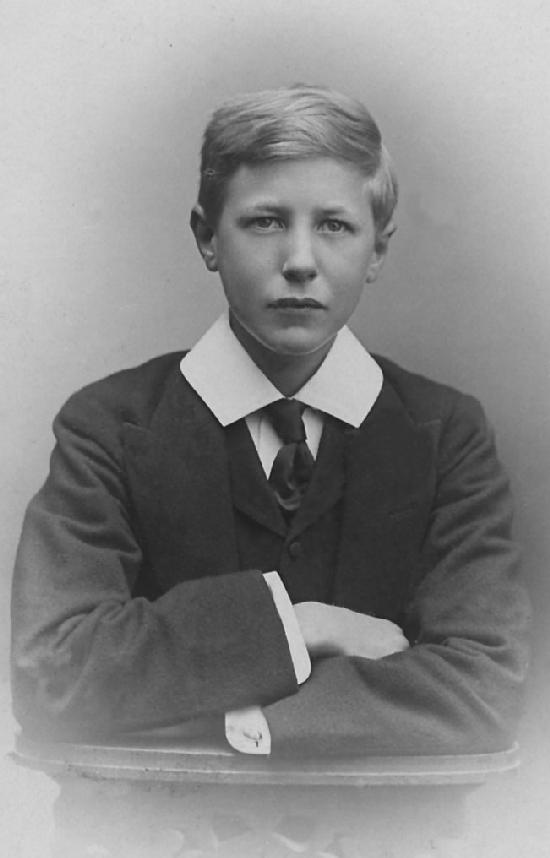
This boy is G.V. Naylor-Leyland. He was about 15 years old when this portrait was taken in his Eton School uniform. Note the crisp Eton collar. Eton is one of the few schools to have important garments named after them, namely the Eton suit and collar. (Rugby is the only other school with Rugby shirts and suits.) The portrait is undated, but we estimate that it was taken about 1907. He was one of a huge list of English soldiers killed in World War I. He was killed in action on Monday September 21, 1914 aged 22 years in France during the early phase of fighting during World War I. He was a Lieutenant with the Horse Guards (the 'Blues'). He was one of the countless Europeand of his generation who died in the Great War.
George Vyvyan's father was Herbert Scarisbrick Naylor-Leyland (1864- ). He was the only son of Thomas Naylor-Leyland and Mary Ann Scarisbrick. Both families were wealthy. Thomas had completed the construction of a grand home called Hyde Park House at Albert Gate. Herbert was twice a Member of Parliament and was named a Baronet by the Earl of Rosebery. Herbert died an untimely death May 7, 1899 of a throat infection at age 35. A distant relative states he is buried at Brompton.
His mother was an American. Jane (Jennie) Willson Chamberlain (1862- )daughter of William Selah Chamberlain and Mary Willson of well-to-do Cleveland, Ohio families. (There were many wealthy Americans who marries into British aristocratic families at the time.) Jennie had private schooling in New York, Paris, and London. By her late teens, she had caught the eye of Edward, Prince of Wales, and was able to maintain a lifelong friendship with the Royal Family, even gaining admiration from Queen Victoria. She was frequently called the "American Beauty" and even "Morning Glory." Jennie Chamberlain Naylor-Leyland remained a widow and died in London March 11, 1932 at age 64. [Chamberlin]
Herbert and Jennie's first son was named Albert Edward Herbert Naylor-Leyland, born Dec. 6, 1890, with the Prince of Wales standing as godfather. Albert Edward Naylor-Leyland survived the War married in 1923 to Marguerite M.H.F. DeBelabre, a daughter of Baron de Belabre of the French diplomatic service. He was their only other child. Their descendants live in England today.
This boy is G.V. Naylor-Leyland. His full name was George Vyvyan Naylor-Leyland. We believe he was born about 1892. Standing as his godfather was George, Prince of York, who became King George V. George was about 15 years old when this portrait was taken in his Eton School uniform. We know nothing about the boy. As an Eton student at the turn of the 20th century, he must have come from an affluent family. Scholarships now help a substantial number of bright boys from middle-class families attend Eton, but this was not the case in the 1900s.
Eton College is one of the best known schools in the world. Americans think of colleges as small universities. Colleges in most of the rest of the world are secondary schools, as is Eton College, albeit a prestigious one. Eton College was founded in 1440, nearly 58 after the founding of Winchester school, by William Waynflete, Bishop of Winchester, under the patronage of Henry VI--the Scholar King, and with
the title of "the College of the Blessed Mary of Eaton
beside Windsor." The buildings were completed between 1491 and 1523. The original buildings consist of two quadrangles
containing the chappel, the upper and lower schools, appartments for officials, the library, and offices. The school has produced
a long list of distinguished former pupils, including Sir Robert Walpole, Robert Hartley, william Pitt the Elder, Horace Walpole,
the Duke of Wellington, Thomas Gray, Percy Bysshe Shelley, William Ewart Gladstone.
Note the crisp Eton collar. Eton is one of the few schools to have important garments named after them, namely the Eton suit and collar. (Rugby is the only other school with Rugby shirts and suits.) The portrait is undated, but we estimate that it was taken about 1907. The Eton collar worn by Eton students, became a standard for properly dressed boys throughout Britain. A boy during the late 19th and early 20th century was not considered well dressed without an Eton collar. It was also widely worn in America. Boys on the Continent also wore Eton collars, but not nearly as commonly as in Britain.
George Vyvyan was one of a huge list of English soldiers killed for God and country during World War I. He was killed in action on Monday September 21, 1914 aged 22 years in France during the early phase of fighting during World War I. He was a Lieutenant with the Horse Guards (the 'Blues'). Looking an images like this, one is reminded by the tragedy. Churches all over England have massive books in which the fallen in the War were listed. The page of this book and the smaller book for World War II are turned daily.
Chamberlin, Donald. E-mail message, May 14, 2010.

Navigate the related HBC pages:
[Return to the Main ordinary bio page]
[Return to the Main Eton School page]
[Bangs]
[Eton school collars]
[Collar bows]
Navigate the Boys' Historical Clothing Web Site:
[Introduction]
[Activities]
[Biographies]
[Chronology]
[Clothing styles]
[Countries]
[Bibliographies]
[Contributions]
[FAQs]
[Glossaries]
[Images]
[Links]
[Registration]
[Tools]
[Boys' Clothing Home]