
Germanic Tribes: The Lombards
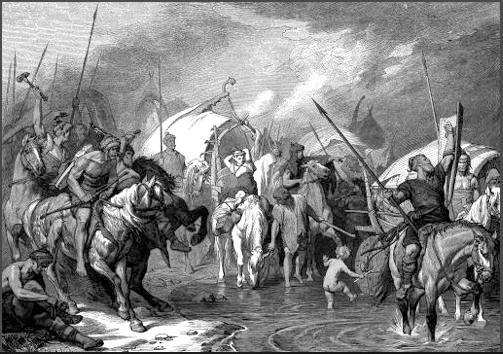
Figure 1.--The Lombards were one of the eastern Germanic tribes. While they were a relatively small tribe, they played an important role in Italian hitory. Unlike other tribes which sacked Rome and moved on, the Lonbards settled in northern Italy. This is an artistic depiction as the Lonbards migranted through eastern Europe toward Italy. Source: Unknown.
|
|
The Lombards were one of the eastern Germanic tribes. They were a relatively small tribe. Little is known about their origins. Tribal myths saw their origins in an island named Scandanavia. The Romans first encountered the Lombards when they settled along the lower Elbe (1st century AD). They wre noted as being particularly ruthless, even for barbarians. Their subsequent migrations are not well understood. Byzantine Emperor Justinian I allowed the Lombards to settle in Pannonia and Noricum (modern Hungary and eastern Austria) (547). The Lombards fought as Roman allies against the Goths. They allied with the Avars to destroy their primcipal enemies--the Guelpi. Rather than take on the Avars, they move west. Under Alboin, a particularly effective war chief, the Lombards invaded Italy and established a kingdom in the north with a capital at Pavia (568). The Lombards seized much of Italy including areas in the south. Some areas continued to be held by the Byzantine Empire (Ravenna, the Pentapolis (Rimini, Ancona, Fano, Pesaro, and Senigallia) as well as much of the eastern coast. Here the Byzantine navy played a major role. Areas of western-central Italy comtinued to be he;d by the papacy. The popes for a while continued to recognize the authority of the Byzantine Empire. Emperor Leo launched a campaign against icons. Pope Gregory III openly broke with the Empire. After Alboin’s death (572?) and the the death of his successor Cleph (d. 575) the Lombard monarchy declined. Lombard-dominated Italy became an area divided among 36 independent-minded dukes. The pope encouraged this increasing disunity. In particulat the duchies of Spoleto and Benevento in central and southern Italy persued sepratist policies. the Lombard nobles united to elect Cleph’s son, Authari, as a new king to resist the encroachments of the Franks, the Byzantines, and the popes (584). The Lombard kingdom dominated Rome for two centuries (7th and 8th centuries). The Lombards were Pagan, but gradually after entering Italy became Christian. Arianism was at first important, but Catholicism eventually predominated. The Lombards were increasingly Romanized and accepted the Latin speech of the larger and more sophisticated Italian population. Catholic bishops gradually became accepted as chief magistrates in cities. Lombard law came to combine Germanic and Roman traditions. King Liutprand (712–44) became the greatest Lombard king. He consolidated the territoral expanse of the kingdom. He brought Spoleto and Benevento back within the Kingdom. King Aistulf sought to complete Lombard control of Italy. He seized Ravenna, long a Byzantire stronghold (751). Aistulf then threatened the Papal states. Pope Stephen II in desperation
appealed to Frankish King Pepin the Short for aid. Pepin invaded Italy.
Pepin seized Lombard territory which he turned over to the pope. This area became known as the Donation of Pepin. King Desiderius, the next Lombard king, renewed the advances on the papacy (772). This time Pepin's successor, Charlemagn, came to pope;s aid. He crossed the Alps with a massive army. He defeated the Lombards and was crowned with the iron Lombard crown at Pavia (774). Charlemagne's rescue of the papacy is ironic in that one of the great conflicts of the medieval era would develop between the German emperor and the pope. Charlemagne's victory destroyed the Lombard kingdom and gave him control of almost all of Italy. The Lombard duchy of Benevento remained in the south. Lombard Benevento was conquered by the Normans (11th century). The iron crown of the Lombard kings appeared again in history. The first Holy Romam Emperor Otto I was crowned with the iron Lombard crown (951). Although the Lombards disappeared with their defeat at the hands of Charlemagne, a rehion of northern Italy came to be called Lombardy.
Origins
The Lombards were one of the eastern Germanic tribes. Tribal myths saw their origins in an island named Scandanavia.
They are believed to have began in southern Sweden and gradually movd toward the Italian Peninsulas Roman power declined in a process tht took four centuries. The Romans first encountered the Lombards when they settled along the lower Elbe (1st century AD). Their subsequent migrations are better understood. The Romans called them the Langobards--the long beards. This eventually became the Lombards.
Tribal Importance
They were a relatively small tribe. Little is known about their origins. They were noted as being particularly ruthless, even for barbarians. They would play a major role in Italian history. Unlike several barbarian groups, they did notjust sack Rome and move on, but settled in Italy. Assuch they woukd become larely Romanized/Italiancized.
Conquest of Northern Italy
More is known about the Lombards obce they come in contact with the Romans. Byzantine Emperor Justinian I allowed the Lombards to settle in Pannonia and Noricum (modern Hungary and eastern Austria) (547). The Lombards fought as Roman allies against the Goths. They allied with the Avars to destroy their principal enemies--the Guelpi. Rather than take on the Avars, they move west. Under Alboin, a particularly effective war chief, the Lombards invaded Italy. By the time the Lombards reached Italy (6th century AD), the Romans had tendured earlier waves of German invaders (most importantly the Goths). A complicating factor was the Eastern Empire or Byzantines which attempted to restablih contol of Italy into the 8th century until finally expelld (751 AD.).
Lombard Kingdom
The Lombards seized much of Italy including areas in the south and established a another Germanic kingdom. They set up their capitl at Pavia (568). Unlike the first Germn kinvaders, the Lombards had not retaintain the ancient Roman forms of government. They exerted a Germanic overlay, but eventually began speaking the developing Italian language. They also became Catholic. Politically northn Italy and some of the south became another Germanic area in medieval Europe. Some areas continued to be held by the Byzantine Empire (Ravenna, the Pentapolis (Rimini, Ancona, Fano, Pesaro, and Senigallia) as well as much of the eastern coast. Here the Byzantine navy played a major role. After Alboin’s death (572?) and the the death of his successor Cleph (d. 575) the Lombard monarchy declined. Lombard-dominated Italy became an area divided among 36 independent-minded dukes. The pope encouraged this increasing disunity. In particulat the duchies of Spoleto and Benevento in central and southern Italy persued sepratist policies. the Lombard nobles united to elect Cleph’s son, Authari, as a new king to resist the encroachments of the Franks, the Byzantines, and the popes (584). The Lombard kingdom dominated Rome for two centuries (7th and 8th centuries). The Lombards were Pagan, but gradually after entering Italy became Christian. Arianism was at first important, but Catholicism eventually predominated. The Lombards were increasingly Romanized and accepted the Latin speech of the larger and more sophisticated Italian population. Catholic bishops gradually became accepted as chief magistrates in cities. Lombard law came to combine Germanic and Roman traditions. King Liutprand (712–44) became the greatest Lombard king. He consolidated the territoral expanse of the kingdom. He brought Spoleto and Benevento back within the Kingdom. King Aistulf sought to complete Lombard control of Italy. He seized Ravenna, long a Byzantire stronghold (751). Aistulf then threatened the Papal states.
Rise of the Papacy
The Lombards primary rival for control of Italy becamnr=e the papacy. At the time thevLombrds entered Italy, the papacy was but one bisopric in the Chrustian wirld, albeit aThis was not axrelgious isdue. But the papacy at the time was alo a tempral power. Areas of western-central Italy comtinued to be held by the papacy. The popes for a while continued to recognize the authority of the Byzantine Empire. Emperor Leo launched a campaign against icons. Pope Gregory III openly broke with the Eastern Emperor/Byzantines. This left the papcy wiuthout a powerful ally. The papacy was a prize every major medieval magnate wanted to possess. It carried a prestige beyond the Italian territiry it ruled. Yhe papacy thriugh sucessive popes understood that it theological position could not be maintained if they were the creatutes of one temporal lord, be he king or emperor. The Islamic outburst from rabia sec=verly weakened the Byzantine Emperor, removing thid major threat to the papcy. But now the Lombards threatened to gain control over Rome and the paoscy.
The papacy turned to the Franks and later the French. The result of skillful ppl diplomacy became the bility to serve as arbiter of Medieval politics in Western Christendim. This would enable the papacy to create a kind of balance of power between the various German kings. This caerved out an independent role for the Church that would last until the rise of thevnattion state. It also hekped create the Hiliy Roman Empire tht wiould dely Germn unification for cseveral centuries. Othrwise a united Germsny woukd have surely diminated Eurooe.
Frankish Invasion
Pope Stephen II in desperation appealed to Frankish King Pepin the Short for aid. Pepin invaded Italy.
Pepin seized Lombard territory which he turned over to the pope. This area became known as the Donation of Pepin. King Desiderius, the next Lombard king, renewed the advances on the papacy (772). This time Pepin's successor, Charlemagn, came to pope's aid. He crossed the Alps with a massive army. He defeated the Lombards and was crowned with the iron Lombard crown at Pavia (774). Charlemagne's rescue of the papacy is ironic in that one of the great conflicts of the medieval era would develop between the German emperor and the pope. Charlemagne's victory destroyed the Lombard kingdom and gave him control of almost all of Italy. Although the Lombards disappeared with their defeat at the hands of Charlemagne, a rehion of northern Italy came to be called Lombardy.
Lombard Duchy of Benevento
The Lombard Duchy of Benevento remained in the south. Lombard Benevento was conquered by the Normans (11th century).
Iron Crown of Lombrdy
The iron crown of the Lombard kings appeared again in history. The first Holy Romam Emperor Otto I was crowned with the iron Lombard crown (951).
Sources
Hallenbeck, J.T. Pavia and Rome: The Lombard Monarchy and the Papacy in the Eighth Century (1982).
Hodgkin, T. Italy and Her Invaders, Vol. V and VI (1895, repr. 1967).
Paul the Deacon.
Villari, P. Barbarian Invasions of Italy (2 vol., tr. 1902).
CIH

Navigate the Children in History Website:
[Return to the Main individual German tribe page]
[Return to the Main Ancient Germanic Tribes page]
[Return to the Main German chronology page]
[Return to the Main Itlin historu page]
[Introduction]
[Animals]
[Biographies]
[Chronology]
[Climatology]
[Clothing]
[Disease and Health]
[Economics]
[Ethnicity]
[Geography]
[History]
[Human Nature]
[Law]
[Nationalism]
[Presidents]
[Religion]
[Royalty]
[Science]
[Social Class]
[Bibliographies]
[Contributions]
[FAQs]
[Glossaries]
[Images]
[Links]
[Registration]
[Tools]
[Children in History Home]
Created: 3:33 AM 3/6/2007
Last updated: 9:47 PM 1/4/2015