|
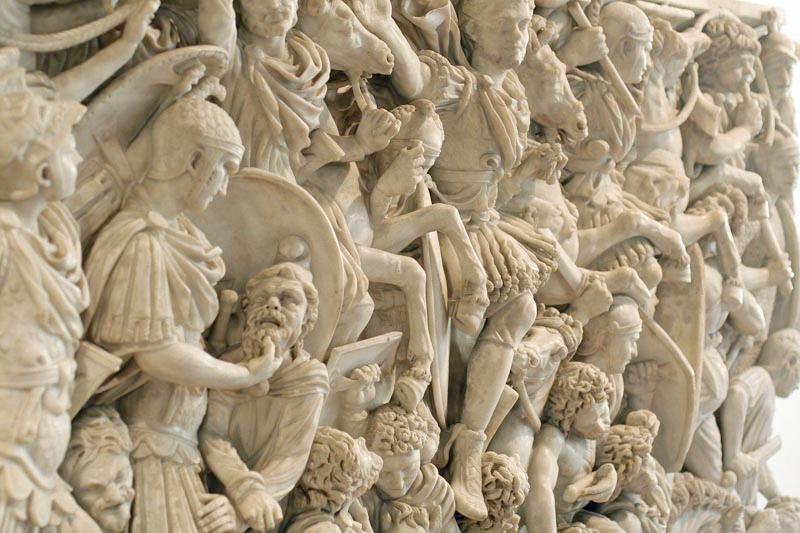
At the time the Germans came in contact with the Romans they were still tribal, and the number of different tribes is very large. They varied greatly in size and in culture. Some had been significantly influenced by contacts with the Romans. They werre Christianized ove a long period. The western tribes became Christian at an early time while others. Another western tribe, however, did not accept Christianity until the medieval era. The relationship between the tribes is not well known. There was extensive warfare between tribes so they obviously was no kinship felt between the different tribes. The primary relationship appears to be linguistic which in the years before DNA was one of the most useful means of assessinging pre-historic relationships. Historians tend to divide the Germanic tribes into three major groups divided along geographic grounds, east, north, and west. It was of course the western tribles that wre best known to the Romans and for which as a result there are the most detailed contemprary accounts. While despariaged by the Romans as Barbarians, these tribes played a major role in laying the foundation for the modern states of Western Europe. Here the role varied from tribe to tribe. Some founded major European states. Others are largely lost to history.
The eastern Germanic peoples were concentrated along the Oder and Vistula rivers. This concept has come down in modern languages, primarily because the Romans were literate, the Vandals were not. The tribes included the Vandals are generally thought to be very brutal. Thus to live like vandals is said in German to mean a very vulgar or brutish exitanance. The English word vandal and vandalize meaning mindless destruction is derived from the reputation of this tribe. Modern research suggests, however, that they probably weren�t much different than other Germanic tribes, especially the other east Germanic tribes. A factor here is that the west Germanic tribes had the greatest contact with the Romans. Some had been partially Romanized or at least influenced by the Romans. Such was the case of Armenius described below. Thus even the west Germanic tribes looked on the east Germanic as less civilized even barbaric at the time. Other east Germanic tribes were the Burgundians, Goths, and Lombards (Langobards). The Goths (often referred to as two different branches--the Ostergoths or Eastern Goths and the Visagoths or Western Goths). The Ostergoths were conquered by the Huns and thus fought with them as allies. The Ostrogoths, after the death of the Hun Attila the Hun and after plundering the Balkans managed to conquer Italy, and Gothic king Theodoric (Diederik) became Roman emperor. The Visagoths resisted the Huns, at times fighting in alliance with the Romans. At other times the Visagoths fought Rome. Their king Alaric fought the Roman armies which, of all people, were commanded by a Vandal named Stilicho. Many Vandals served under Alaric as well. It was Alaric who sacked Rome signalling the fall of the Western Empire. The Lombards play a major role in the last stage of the barbaric conquest of the Empire. The Lombards seized Italy itself.
The Vikings were feared and even envied by some throughout the Medieval Europe. They mastered the seas and were able to strike without warning. They were the northern Germanic peoples found in the southern area of modern Scandinavia. They became the modern Swedes, Danes, Norwegians, Icelandians. The North Germanic tribes were unknown to the Romans, but burst out upon Medieval Europeans in the 9th century as the Vikings and played a major role in the history of Western Europe, especially the British and French. A Scandinavia people known as the Rus also moved east at this time and helped found modern Russia. The northern Germanic an un-Chritianized Germamic people began raiding Christian Europe in the 8th century, first striking the rich monastery at Lindesfarne, an island off northern England. Voyages further into the Atlantic followed, to Iceland, Greenland, and North America. A permanent settlement was established in Iceland. The most important Viking explorers were Erick the Red and his son Leiv Eriksson. Norwegian-born Eirik Thorvaldsson, known as Eirik the Red, sailing from Iceland, explored and colonized southwestern Greenland (986). He named this largely ice-covered island Greenland to attract settlers, His son, Leiv Eiriksson, became probably the first European to reach North America. Little accurate data from the extensive Viking voyages, however, ever appeared on European maps. The Norsemen or Vikings became a major threat to Christian Europe after the death of Charlermagne and the splintering of his domain. The Vikings established Normandy, a dukedom that rivaled the power of the French monarchy and Duke William of Normandy would conquer England (1066). While Danish and Norwegian Vikings struck west and south, Swedish Vikings moved east and played a major role in the development of Russia. The Vikings while devestating large areas also played a role in the spread of commerce and the evolution of democracy in England.
The western Germanic tribes are the ones we know most about, because they are the ones who first contacted the Romans. There are thus a range of contemporary written accounts about the Western tribes. Some of these tribes became more romanized than the estern and especially the northern tribes. The western Germanic people had settled an area from the North Sea east to the Elbe, Rhine, and Main rivers. Some of the west Germanic tribes include Alemanns, Anglii, Bajuwares, Chatten, Franks, Frisians, Jutes, Saxons, and others. They were eventually were given land within the Roman Empire and helped to defend the Empire's borders. Gradually the ballance of power shifted as Roman power declined. The Franks and their leader Clovis layed the foundation for much of Western Europe, at least continental Western Europe. The Anglii, Frissians, and Saxons who invaded Briton layed the foundation of modern England, although the role they played is not very well understood.

Navigate the Children in History Web Site:
[Return to the Main Ancient Germanic Tribes page]
[Return to the Main ancient civilization page]
[Return to the Main German chronology page]
[Introduction]
[Biographies]
[Chronology]
[Climatology]
[Clothing]
[Disease and Health]
[Economics]
[Geography]
[History]
[Human Nature]
[Law]
[Nationalism]
[Presidents]
[Religion]
[Royalty]
[Science]
[Social Class]
[Royalty]
[Bibliographies]
[Contributions]
[FAQs]
[Glossaries]
[Images]
[Links]
[Registration]
[Tools]
[Boys' Clothing Home]