
Medieval History: 11th Century
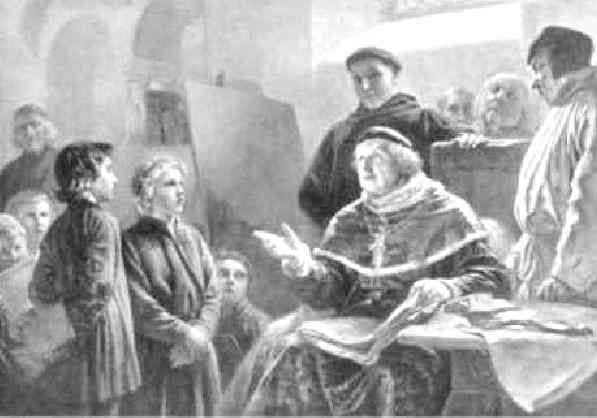
Figure 1.--This modern drawing depicts a scene in Germany about 1000. It shows Bischop Willigis in the Klosterschule (cloister school). I believe that this was a church school to train boys preparing to be monks or priests. I am not sure who the illuistrator was or how accurate the depiction is. Bishop Williggis lived in Mayence and was noted for his piety and common sence. Click on the image to learn more about German education in the Medieval era.
|
|
The Eastern and Western Churches for centuries had been moving apart it was in the 11th Century that the Great Schism occurred (1052-54) Newly crowned English King Harold, son of Godwin and Edward the Confessor's successor, in 1066 rushed north to put down a rebellion by his brother backed by an army of Norwegian Vikings. Harold virtually anialates the Norwegians, at Stamford Bridge. Meanwhile William of Normandy, who had assembled an invasion force, had been waiting imaptiently. Suddenly the winds shift and he crosses theChannel to invade Sussex. Harold rushes his battered force south rather than waiting to rest his men and gather additional forces. The two armies met at Hastings. Norman calvary and longbows prove decissive. The Normans within two decaded disposses England's Anglos-Saxon aristocracy and began the formation of modern England. It was at this time that Leif Ericson reportedly reaced North America. The crusades began in the 11th century. Henry IV, the Emperor of Germany was humiliated by Pope Gregory VII at Canossa in 1077 as monarchs and popes struggled over their temoral and secular authorities. Henry was forced to dress as a pentinent and stand barefoot in the snow for 3 days outside the Castle of Canossa where Pope Gregory was quartered. Women are of little consequence. Few are describe to many extent in the historical record. One historian writes, "marriage, let there be no misunderstanding about it, was a business for the two families concerned". [Fletcher] The merchant guilds began to become important in the 11th century. The Papacy launches the Crusades at the end of the 11th century. The Crusades are to have a profound cultural and economic influence in Europe. One opart of this is to inroduce Western Europe to luxury goods like silk and cotton. Men and boys by the 11th century had begun to wear supertunics. Men and boys wore rather loose, floppy "braies" which were often covered with bandages. Noblemen commonly wore these bandages criss-crossed. Some men wore a pointed cap, but most went without ant head covering. Women still veiled their hair, but girls were allowed to leave their hair uncovered. Babies were normally tightly swaddled, a practice that persists some time in Europe. [Crush]
Emergence of Modern Europe
The 11th century marked the beginning of the second mellenium. And in many ways it marked the emergence of modern Europe. What we call Europe is more than a geographic region. It is also a cultural region created largely by the fusion of classical culture and Christianity. Although there were significant differences between the classical and Christian traditions, the Chritian Church was in lrge measure the vessel in which the cassical tradition was transferred to Europeans. It was not until the 11th century that Christianity had become firmy established in the East beyond the boundaries of old Roman Empire. By 1000 AD boh the Slavs and Magayars has been Chritianized. The only pagans were the surving Polabian Slavs and the Baltic peoples. The pattern of conversion varies. The Roman church was dominant in the West along with the iassocaited, but autocranous Celtic Church. The Roman Church had Chritinized Czechs, Croats, Hungarians, Slovaks, and Poles. The Eastern Chuch had Christianized the Kievian Rus and southern Slavs. Thus Europe was essentially Christinized, although there were significant differences bwtween the Eastern and Western Church. There was also substantial differences between the cultural and economic levels of East and West. Western Europe was more populated than Eastern Europe with a highter density of population and a more developed economy. The heart of Europe at the time in termns of population was France (9 million people) and Italy (7 million). Italy had greatest density of population. Germany (5 million people ) was also important, but less densely populated. England (2 million people) was still a relatively small kingdom on the perifery of Western Europe.
The Great Schism (1052-54)
The Eastern and Western Churches for centuries had been moving apart it was in the 11th Century that the Great Schism occurred. Pope Sergius wrote a confession of faith which included the controversial filioque in the creed (1009). The Church in Constantinople removed the pope the Roman Church from the diptychs, the official list of sister churches and bishops. The division between the Churches had reached crisis proprtions by mid-century. The major issues were the filioque, the authority of the pope, and varying liturgical practices. The issues had been simmering for some time. The differences reached crisis proportions. The Pope suppressed Eastern (Greek) liturgical practices in southern Italy and Patriarch Michael Cerularius of Constantinople suppressed Latin practices in the East (1052). The Pope dispched a mediator (1053), but mediation failed and the Pope excomunicated the Partirach (1054). Most historians date this as the formal split in the Christian Church. Although the Eastern and WesternChurches were essentially separatre Churhes before the Great Schism, after 1054 there were in fact as well as practice a Western Catholic and a Eastern Orthodox Church.
National Developments
Newly crowned English King Harold, son of Godwin and Edward the Confessor's successor, in 1066 rushed north to put down a rebellion by his brother backed by an army of Norwegian Vikings. Harold virtually anialates the Norwegians, at Stamford Bridge. Meanwhile William of Normandy, who had assembled an invasion force, had been waiting imaptiently. Suddenly the winds shift and he crosses theChannel to invade Sussex. Harold rushed his battered force south rather than waiting
to rest his men and gather additional forces. The two armies met at Hastings. Norman calvary and longbows prove decissive. The Normans within two decaded disposses England's Anglos-Saxon aristocracy and began the formation of modern England. It was at this time that Leif Ericson reportedly reaced North America.
The Investiture Controversy
There were efforts to reform the church prior to the election of Pope Gregory VII. Hildebrand became an inmortant figure in the Church and was elected Gregory VII. ), rise to power. Why is he significant? Hildebrand was one of the major figures in the Investiture Controversy. German Emperor Henry III was largely responsible for the events that led to the Investiture Controversy. It was Henry's son, Henry IV that would confront Pope Gregory in the struggle for power. This was part of struggle over temporal and secular authority waged by various monarchs and the papacy. The struggle plsayed out differently in each European country. Henry IV, was humiliated by Pope Gregory at Canossa (1077). He was forced to dress as a pentinent and stand barefoot in the snow for 3 days outside the Castle of Canossa where Pope Gregory was quartered.
The Crusades are the series of religious wars launched by the Medieval kingdoms of Europe during the 11th-13th centuries to retake the Holly land from Islamic rulers. Christian pilgrims after the Arab conquests of the 7th and 8th centuries had to travel through Islamic lands to venerate the great shrines in Jerusalem and other Biblical sites in the Holy Land. In addition the Ottoman Turks were increasingly encroaching on the Eastern or Byzantine Empire. The Turks apparently preyed upon Christian pilgrims. Byzantine Emperor Alexius Comnenus, perhaps concerned about the plight of the pilgrims, more likely seeking allies against the Turks, wrote to a friend Robert, the Count of Flanders, in 1093. He recounted the alleged atrocities inflicted on the pilgrims by the Turks. Count Robert forwarded Comnenus' letter to Pope Urban II. Pope Urban like Emperor Comnenus perhaps concerned about Christian pilgrims, more likely seeing a political opportunity, decided to promote a military crusade to seize the Holy Land from the infidel Turks. European Christians at the time were locked in intractable dynastic wars in England, France, Italy, and other domains, destabilizing large areas of Europe. The Pope sought to redirect the fighting to an infidel adversary. Pope Urban's crusade, the First Crusade, was launched in 1095.
Women
Women are of little consequence. Few are describe to many extent in the historical record. One historian writes,
"marriage, let there be no misunderstanding about it, was a business for the two families concerned". [Fletcher]
Merchant Guilds
The merchant guilds began to become important in the 11th century.
Education
Education was still the province of the Church. There was virtually no schooling outside the Church and often even the nobility were illiterate even in the 10th
century.
Clothing
Men and boys wore rather loose, floppy "braies" which were often covered with bandages. Noblemen commonly wore these bandages criss-crossed. Some men wore a pointed cap, but most went without ant head covering. Women still veiled their hair, but girls were allowed to leave their hair uncovered. Babies were normally tightly swaddled, a practice that persists some time in Europe. [Crush]
Sources
Crush, Margaret. Piccolo Book of Costume (Pan Books: London, 1973). The book has vert nicely done illustrations by Faith Jaques.
Fletcher, Richard. Bloodfeud: Muder and Revenge in Anglo-Saxon England (Oxford Universuty Press, 2003), 231p.
CIH

Navigate the Children in History Website:
[Introduction]
[Biographies]
[Chronology]
[Climatology]
[Clothing]
[Disease and Health]
[Economics]
[Geography]
[History]
[Human Nature]
[Law]
[Nationalism]
[Presidents]
[Religion]
[Royalty]
[Science]
[Social Class]
[Bibliographies]
[Contributions]
[FAQs]
[Glossaries]
[Images]
[Links]
[Registration]
[Tools]
[Children in History Home]
Navigate the Historic Boys' Clothing Web chronological pages:
[Return to the Msain medieval chronology page]
[Return to the Main chronology page]
[Return to the Main medieval page]
[The 6th century]
[The 7th century]
[The 8th century]
[The 9th century]
[The 10th century]
[]
[The 12th century]
[The 13th century]
[The 14th century]
[The 15th century]
[The 16th Century]
Created: August 27, 2003
Last updated: 5:23 AM 6/3/2014