
Medieval History: 9th Century
|
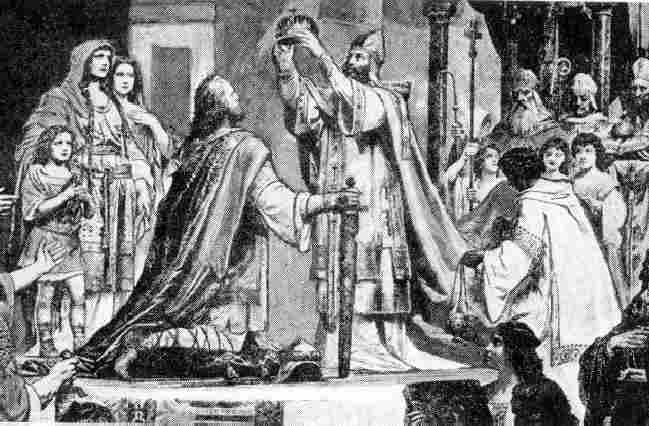
The Viking attacks on Western Europe began in the 9th century. They sack the famed monestary at Iona in 802. The famous Oseberg ship was buried in the 9th century. The schism between eastern and western Christain Churches occur (863-879). The Carloingian Renaissance in many ways signaled the end of the Dark Ages and ended four centuries of fragmentatin that had followed the fall of Rome. Europe was nore united in the 9th century than any other time since the fall of Rome in the 5th century. The Carolingian Empire according to one historian produced modern Europe's first technocrats. [Brown]. Charlemagne in France dominated Western Europe. Charlemagne was crowned Holy Roman Emperor by Pope Leo III in Rome during 800. He defeats the Moors and takes Barcelona in 801. Nicephorus I of Byzantium and Charlemagne agree to the boundaries between their empires. The Byzantines recognizes the independence of Venice. Alfred the Great (849-900) in England save the Anglon Saxons from complete domination by the Vikings (Danes). While the Norwegians and danes turn west, the Swedes turn east. The Swedish Rus (Vikings) by the mid 9th century are becoming dominant along the Volga trade routes. Nearly a millennium after the Chinese invented crank handles for turning wheels , they appear in Europe. The first images of a rotary grindstone is noted in Europe. Suleiman travels to China and publishes an account, centuries before Marco Polo describes China to Chritain Europe. At the end of the century the Magyars arrive in Carpathian Basin. Clothing in the 9th century was was little changed from earlier centuries. People wore very simple, plain garments. The basic garment was a sack-like tunic. There were no special styles for children. Women and girls, but not men, wore a a kind of supertunic and modestly covered their hair with long veils. Homes were cold and drafty during the winter. Clothes were often wrinkled up into cosy folds. Out doors both gender wore wool cloaks to keep warm. [Crush]
Population
The Germanic invaders of the 5th and 6th centuruies had by 800 largely amalgamated and been adsorbed by the Roman and otherlocal populations. Eure was now a largely homogenous society. The new Euroopean society was largely Chritinized and much for culturally advanced than that of the original Germanuic invaders. It was, however, much less advanced cultuyrally than the Roman civilizatioin that it replaced.
The Vikings
The northern Germanic peoples were found in the southern area of modern Scandinavia. They became the modern Swedes, Danes, Norwegians, Icelandians. The North Germanic tribes were unknown to the Romans, but burst out upon Medieval Europeans in the 9th century as the Vikings and played a major role in the history of Western Europe, especially the British and French. A Scandinavia people known as the Rus also moved east at this time and helped found modern Russia. The northern Germanic an un-Chritianized Germamic people began raiding Christian Europe in the 8th century, first striking the rich monastery at Lindesfarne, an island off northern England. Voyages further into the Atlantic followed, to Iceland, Greenland, and North America. A permanent settlement was established in Iceland. The most important Viking explorers were Erick the Red and his son Leiv Eriksson. Norwegian-born Eirik Thorvaldsson, known as Eirik the Red, sailing from Iceland, explored and colonized southwestern Greenland (986). He named this largely ice-covered island Greenland to attract settlers, His son, Leiv Eiriksson, became probably the first European to reach North America. Little accurate data from the extensive Viking voyages, however, ever appeared on European maps. The Norsemen or Vikings became a major threat to Christian Europe after the death of Charlermagne and the splintering of his domain. The Viking attacks on Western Europe began in the 9th century. They sacked the famed monestary at Iona (802). The famous Oseberg ship was buried in the 9th century. While the Norwegians and danes turn west, The Vikings while devestating large areas also played a role in the spread of commerce and the evolution of democracy in England. The Vikings in the West established Normandy, a dukedom that rivaled the power of the French monarchy and Duke William of Normandy would conquer England (1066). While Danish and Norwegian Vikings struck west and south, Swedish Vikings (the Rus) moved east and played a major role in the development of Russia. The still pagan Rus by the mid-9th century are becoming dominant along the Volga trade routes.
Religious Schism
The schism between eastern and western Christain Churches occur (863-879).
Charlemagne (768-814)
The Carloingian Renaissance in many ways signaled the end of the Dark Ages and ended four centuries of fragmentation that had followed the fall of Rome. Europe was more united in the 9th century than any other time since the fall of Rome in the 5th century. Charlemagne (Carolus Magnus Charlemagne or Charle the Great) dominated Western Europe. He conquered Germany with his booted Missionnaries in defeating Witikind who had no choice than to be baptised with all the Saxons of Germany. He conquered too the Friesens of Norway, Sweeden and Northern Germany as well as Bavarai (Bayern). He defeated the Moors and took Barcelona in 801. He fixed the limits of the Empire with Spain in Navarra at West, Danes marks (which became Denmark) at North and Rome at South after having conquered Lombardy. The capital of the Empire was Aix-Lachapelle. Achen is in Germany and it was the favorite residential city of Charlemagne. This city was the place were German emperors were crowned. This Western Empire was the largest Christian territory ever constituted. Every Emperor or King dominating Europe was always seeking to reconstitute this Empire. The Carolingian Empire according to one historian produced modern Europe's first technocrats. [Brown]. Charlemagne King of the Franks (768-800) was crowned Holy Roman Emperor by Pope Leo III in Rome during 800. This began an effoirt by tyhe Papacy to attemot to influence the selection of seculat rulers which was to become a major issue in Medieval history. Nicephorus I of Byzantium and Charlemagne agree to the boundaries between their empires. The modern European nations can trace their national beginnngs to the desendents of Charlemagne. The Emperor died in 814. His son Louis I the Pious. Upon his death, the Empire was divided among his sons (840). Lothair became the Emperor (840-55), but with limited authority. More importantly he , and had Italy and a varirty of provinces including Burgundy, Belgium,Netherland, Alsace, Lorraine, France Comt�, Provance, andc Lyonnais. Pepin before his father's daeth became King of Aquataine (817-38). Louis II in an arrangement with his older brother became King of Germany (843-76). Charles I became King of France (840-77). Gusela's son Berengar became King of Lombardy (898-924).
Byzantium
The Eastern or Byzabtine Roman Empire survived at Constantinople. The Byzantines relenguished control and recognized the independence of Venice during the 9th century.
England
Alfred the Great (849-900) in England save the Anglon Saxons from complete domination by the Vikings (Danes).
China
Suleiman travels to China on the Silk Road and publishes an account, centuries before Marco Polo describes China to Christian Europe.
The Magyars
At the end of the century the Magyars arrive in Carpathian Basin.
Technology
Nearly a millennium after the Chinese invented crank handles for turning wheels , they appear in Europe. The first images of a rotary grindstone is noted in Europe.
Clothing
Clothing in the 9th century was was little changed from earlier centuries. People wore very simple, plain garments. The basic garment was a sack-like tunic. There were no special styles for children. Women and girls, but not men, wore a a kind of supertunic and modestly covered their hair with long veils. Homes were cold and drafty during the winter. Clothes were often wrinkled up into cosy folds. Out doors both gender wore wool cloaks to keep warm. [Crush]
Sources
Brown, Peter. The Rise of Western Christendom: Triumph and Diversity, A.D. 200-1000 2nd edition (Blackwell paperback: 2003), 625p.
Crush, Margaret. Piccolo Book of Costume (Pan Books: London, 1973). The book has vert nicely done illustrations by Faith Jaques.
CIH

Navigate the Children in History Web Site:
[Introduction]
[Biographies]
[Chronology]
[Climatology]
[Clothing]
[Disease and Health]
[Economics]
[Geography]
[History]
[Human Nature]
[Law]
[Nationalism]
[Presidents]
[Religion]
[Royalty]
[Science]
[Social Class]
[Bibliographies]
[Contributions]
[FAQs]
[Glossaries]
[Images]
[Links]
[Registration]
[Tools]
[Children in History Home]
Navigate the CIH chronological pages:
[Return to the Main medieval century pages]
[Return to the Main chronology page]
[[Return to theThe medieval era]
[The 6th century]
[The 7th century]
[The 8th century]
[]
[The 10th century]
[The 11th Century]
[The 12th century]
[The 13th century]
[The 14th century]
[The 15th century]
[The 16th Century]
Created: August 6, 2003
Last updated: 6:15 AM 3/20/2009