|
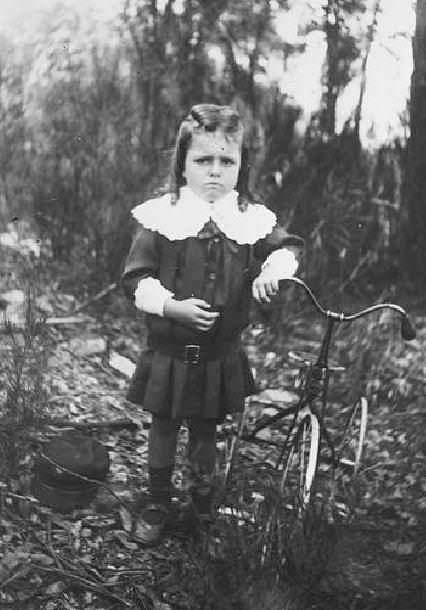
Australian boys like English and other European boys in the 19th century commonly wore dresses until breeched at about 5 years of age. This varied somewhat from family to family and socio-economic factors had an impact on the age of breeching. At this time HBC knows of no destinctive styles of dresses worn by Australian boys. Basically the same style of dresses were worn in Australia as in England. HBC is not sure if this was more or less common in Australia than England or if there was any difference in the conventions for boys wearing dresses. We rather suspect that social class was an important factor. It is likely that boys from affluent families might wear dresses longer than boys from working class families, bu wearing dresses was common place for most young boys. Clothing collected by the Australian National Library clearly shows that it was quite common for younger boys to wear dresses as was the case in England. We still have, however, only limited information on the dresses worn by Australian boys. We note some dresses worn in the late 19th century that look rather like the tunics that were also popular in America at the time. Presumably this was also an English fashion, but we have less information about English tunics at the time. The tunic-looking garments buttoned in front and thus have to be considered dresses rather than tunics. HBC has few details on chronological trends at this time. While we have noted some 19th century garments, unfortunately many of the available inmages are undated.
Australian boys like English and other European boys in the 19th century commonly wore dresses until breeched at about 5 years of age. This varied somewhat from family to family.
Socio-economic factors also had an impact on the age of breeching. We rather suspect that social class was an important factor. It is likely that boys from affluent families might wear dresses longer than boys from working class families, but wearing dresses was common place for most young boys.
HBC is not sure if this was more or less common in Australia than England. Clothing collected by the Australian National Library clearly shows that it was quite common for younger boys to wear dresses as was the case in England.
HBC is also unaware of any differences in the the conventions for boys wearing dresses between England and Australia.
At this time HBC knows of no destinctive styles of dresses worn by Australian boys. Basically the same style of dresses were worn in Australia as in England. We still have, however, only limited information on the dresses worn by Australian boys. We have noted quite a range of styles and colors. Many dresses worn by boys appear to be little different than the ones worn by their sisters. We note some dresses worn in the late 19th century that look rather like the tunics that were also popular in America at the time. Presumably this was also an English fashion, but we have less information about English tunics at the time. The tunic-looking garments buttoned in front and thus have to be considered dresses rather than tunics.
HBC has few details on chronological trends at this time. Our Australian archive is still fairly limited. The number of early photographs was limited in Britain nd even more so in colonies like Australia. While we have noted some 19th century garments including dresses, unfortunately many of the available inmages are undated. We know that Australian boys wore dresses throughout the 19th century, especially boys from affluent families. European boys of course only began arriving in Australia during the early-19th century and the numbers were still limited by mid-century. Only with the apperance of the 1860s do we begin to get ny number of images. After the turn of the century, especially by the 1910s, it became less common for boys to wear dresses when they were little--following the overall European pattern.

Navigate the Boys' Historical Clothing Web Site:
[About Us]
[Introduction]
[Activities]
[Biographies]
[Chronology]
[Clothing styles]
[Bibliographies]
[Contributions]
[FAQs]
[Glossaries]
[Images]
[Links]
[Registration]
[Tools]
[Boys' Clothing Home]
Navigate the Boys' Historical Clothing Australian pages
[Australian choirs]
[Autralian movies]
[Australian orphanage clothing]
[Australian school uniform]
[Australian television]
[Australian youth groups]
Navigate the Boys' Historical Clothing Web Site:
[Return to the Main Australian skirted garment page]
[Return to the Main Australian garment page]
[Return to the Main country page]
[Australia]
[Canada]
[England]
[France]
[Germany]
[Ireland]
[Italy]
[New Zealand]
[Scotland]
[United States]