**
English boys clothes -- chronology Edwardian Era
English Boys' Clothes: Edwardian Era
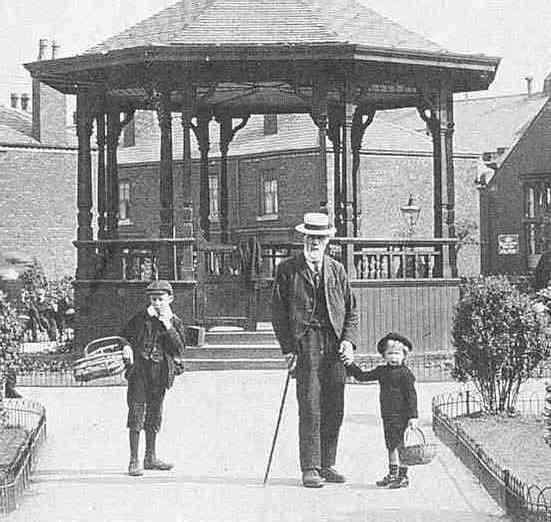
Figure 1.--Sailor suits were worn throughout the early 20th century, but by increasingly younger boys. They were nostly a middle-class fashion. Working class boys wore them less than in many other countries. A Lancashire reader writes, "I have looked at a large number of photographs showing Lancashire scenes between 1900 and 1914. Many of these pictures show children. I was struck by how few of them wore sailors suits. It does not seem to have been something that was worn for every day wear. Here is a scene from Light Gardens in the center of Wigan Lancashire during 1902. I'm not sure what the boys have in their baskets. It has flower gardens and the band stand you can see here. The clothing the boy at the left wears were very common during the early 20th century. A War memorial was built there after World war I and II to honor the veterns. It is off Church street and opposite the Main Post Office.
The Edwardian Era was much shorter than the Victorian Era. The Edwardian Era stricly speaking is from Queen Victoria's death in 1901 to King Edwards's death in 1910, but more useful is to simply view it from the new century to the beginning of World War I in 1914. For organizational convience, we have included the World War I era as well, as the fashion changes were especially notable after the War. The Edwardian Era is perhaps the most idealized eras in English history, perhaps because it seemed so "golden" in comparison to the horrors of World War I. Many of the fashions of the late Victorian era such as boy dresses, kilts, sailor suits, Fauntleroy suits, and Eton collars continued into the Edwardian Era. Major changes, however, ocurred during this era. While little boys in the early Edwardian Era wore dresses, they were increasingly styled differently than those worn by their sisters. This custom, however, changed during the 1910s and World War I Era. By the 1920s it had become rare to dress even very little boys in dresses. Sailor suits were worn throughout the Edwardian era, but by increasingly younger boys. Kilt suits were worn at the beginning of the era, but by the 1920s only Highland outfits were worn and not the kilt or skirted suits once so popular. Fauntleroy velvet suits were still popular for party wear,
butblace collars were giving way to ruffled collars and kneepants for short pants. Some boys would wear white kneesocks or stockings and strap shoes. New fashions such as romers for little boys appeared. Tunics were worn with wide, white collars and floppy bows. Knee pants and long stockings went out of style and were replaced with knickers and short pants
worn with knee socks.
Definition
The Edwardian Era was much shorter than the Victorian Era. The Edwardian Era stricly speaking is from Queen Victoria's death in 1901 to King Edward VII's's death in 1910. Of course Edward began affecting Englsh fashion well before the death of his mother. A more convenient and useful approach is to simply view it from the new century to the beginning of World War I in 1914. For organizational convience, we have included the World war I era as well, as the fashion changes were especially notable after the War. The Edwardian Era is perhaps the most idealized eras in English history, perhaps because it seemed so "golden" in comparison to the horrors of World War I.
World War I was actually a largely European war. What made the war so important were
the huge casualties caused no only by the duration, but the introduction of new weapns,
including poison gas and rapid advances in the lethality of weapons. A whole generation of
European men was largely killed in the fighting. The consequences were enormous.
Empires and ruling families fell. Long held social systems collapsed. The Bollshevivks
seized power in Russia. New countries based on nationality were created in Eastern
Europe out of the old empires. The national hatreds that wee spawned errupted in an even
more destructive war 20 years later.
Many of the fashions of the late Victorian era such as boy dresses, kilts, sailor
suits, Fauntleroy suits, and Eton collars continued into the Edwardian Era. Major changes, however, ocurred during this era. While little boys in the early Edwardian Era wore dresses, they were increasinglybstyled differently than those worn by their sisters. This custom, however, changed during the 1910s and World War I Era. By the 1920s it had become rare to dress even very little boys in dresses. Sailor suits were worn throughout the Edwardian era, but by increasingly younger boys. Social class was also a factor. Interestingly, sailor suits do not seem to have been nearly as common in England as some continental countries (France and Germany) and Amerca. The Royal Family of course dressed the children in salor suits. Prince George who became king in 1911 believed it was the perfect outfit for children. Everyone has seen the images of te princes wearing sailor suits. This may give, however, a misleading impression about the popularity of sailor suits. A Lancashire reader writes, "I have looked at a large number of photographs showing Lancashire scenes between 1900 and 1914. Many of these pictures show children. I was struck by how few of them wore sailors suits. It does not seem to have been something that was worn for every day wear. Of the photographs I saw there was only one in which a sailor suit can clearly be seen. The photograph was of a class of school children. The second picture shows the type of clothes worn as depicted in the photograph.
The only photograph I found of a boy wearing a sailor suit outside of a school situation was taken in Scarborough about 1913. There had been a fire and the boys had stopped to watch the drama." Kilt suits were worn at the beginning of the era, but by the 1920s only Highland outfits were worn and not the kilt or skirted suits once so popular. Fauntleroy velvet suits were still popular for party wear, but lace collars were giving way to ruffled collars and knee pants for short pants. Some boys would wear white kneesocks or stockings and strap shoes. New fashions such as romers for little boys appeared. Tunics were worn with wide, white collars and floppy bows. Knee pants and long stockings went out of style and were replaced with knickers and short pants worn with knee socks.
The fashions and life style of the late-19th century crossed over the turn-of-the century. There was still the same formlity and elaborate dress up fashions. We also note many of the same styles, but there were shifts. Both Fauntleroy suits and kilt suits rapidy decline. And the centuries old convention of dressing young boys in dresses notably declines. This did immeditely disappear, but was largely gone by the end of World War I and the beginning of he 1920s except for the youngest of boys. We do see one new fashion trend--tunics suddenly becoming important. Perhaps not important as America, but important none-the-less. Tunics wre worn in the 19th century, but became especially stylish in the early-20th century. This was more of a class-based fashion in Britain than America. We do not yet have enough information to destinguish between the 1900s and 1910s. We see many of the same styles, it is more a matter of relative prevalence. As far as we can tell there was considerable similarity between the 1900s and at least the early--1910s. Boys mostly wore suits for everyday wear, not just when dressing up, although we do see some boys wearing sweaters. We still see knickers suits in the 900s, but by the the 190s we mostly see knee pants suits making the transition to short pants. Just the opposite was occuring in America.
Girls wore pinafores over their dresses. Headwear was common. We do see the beginnings of informality, but this was not really notable until World War I began (1914). Many modern fashion trends propelled forward by the horrors of World War I and the need to mobilize the economy for the pressing War effort. There was a need to end waste and concentrate on the practical. Suddenly we see practicality becoming an important aspect of fashion. This was a shocking change from the formality and fussy fashion of the Edwardian era. Another factor that had aon boys' fashion was Baden Powell's Boy Scouts which began to organize (1906). It had an important impact on boys' fashions, especially by the 1910s, also emphasizing practacality and not an inch of fussy formality.
One important development during the Edwardian Era was the appearance og the Boys Scouts in 1906. The Scouts were not the first uniformed youth group in Britain, that was the Boy's Brigade. Baden Powell's Scouts, however, with their secular approach proved much more popular with British boys. While intitally a kinf of British patriotic group, the Scouts developed an international outlook and quickly spread to other countries. The Scouts played an important role in popularizing the style of short pants and kneesocks.
Edwardian Children
We notice a lovely little book by Janna Smith titled Edwardian Children. The dust jacket introfuction reads, "The years between the death of Queen Victoria and the outbreak of war in 1914 are often regarded as a Golden Age, and in many ways they were, at least for the children of the middle and upper classes, still living in a world of deep security
but free from the more excessive restrictions of the Victorian age. It was a world of
nannies and nurseries, sailor suits and sun bonnets, donkey carts and hansom cabs, a world in which the motor car was still a rare sight on the country roads and the muffin man and the organ grinder enlivened the city streets. Memories of growing up in the Edwardian era,
especially when recalled across the great divide of the First World War, can still evoke
the dream of what seems like an ideal childhood, now lost forever." The book is full
of photographs and illustrations pertaining to that era. Information is also sourced from
tape recorded interviews of folk who grew up before World War I. Of course while the Edwardian Era may have been a kind of Golden Age for the privlidged. It should be remembered that the very large population of working-class British children did not share in the privlidged life and nostalgic views of the Edwardian Era has to be put in perspective.
Througout fashion history there has been notable differences between the clothing of different social classes. This continued to be the case in Edwardian England. This was, however, the last decade in which this was so obviously the case. World War I set in motion social and political forces that addressed the inequities in European society. After World War I it became increasingly difficult to identify children by the clothes they wore. During the Edwardian era the differences were still quite apparent. Working class children in Britain still commonly went barefoot during the early 20th century. After the War this was much less common. There were many other differences, but this was the most obvious difference.
The Rag and Bone Man was an institution in the 19th century and did not entirely disappear until the 1960s. The rag an nones man was real recycler. The rag and bones man collected as the title indicates rags and bones. He did not just take these items, but other cast offs like scrap metal as well. This was a valuable service. Most had push carts, the more prosperous had a horse and cart. He would come down the street yelling ragn-bone" and householders would offer anything that they no longer wanted, whatever condition. Rarely were usable gatrments cast out, at least until after World War I. Mothers would keeo outworn clothes that could no longer be mended to create patches for other clothes. The rags could be used in the manufacture of paper. Bones were used to make bone china or glue. He would have items to incourage children to bring him the family's unwanted items. Some rag and bone men gave out goldfish. Others might have a little puppet show.
Sources
Smith, Janna. Edwardian Children (Hutchinson and Co. Ltd., 1983).