|
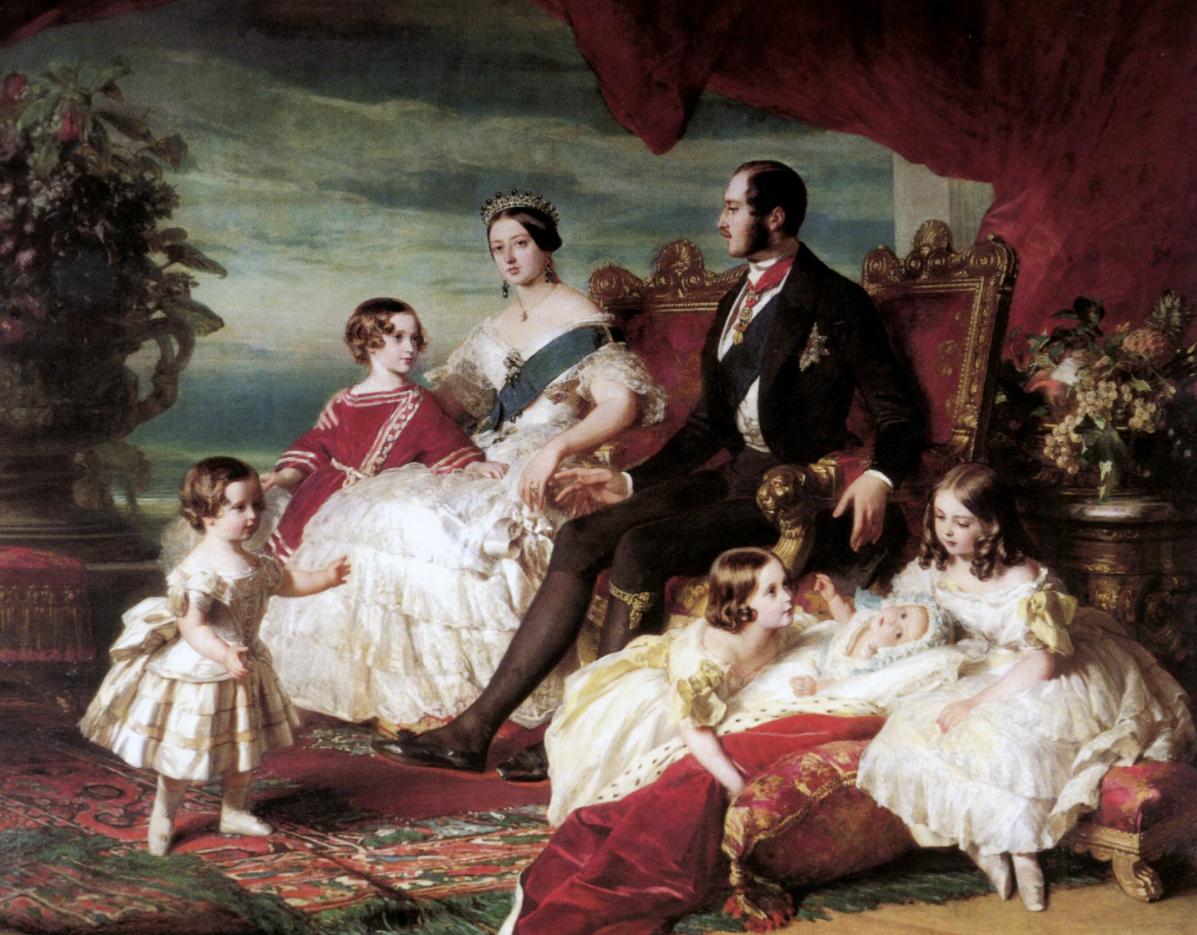
It was in the Victorian age that many modern social values as wll as modern fashions began to appear and Queen Vicoria and her family was at the center of it all. Fashionable English boys at the turn of the Century wore
skeleton suits and tunics. Younger boys wore pantalettes, older boys long trousers. Major changes occurred during the Vicorian Era. The young Queen and her engaging family popularized the sailor suit and kilt which were to become major fixtures of the 19th century boys' wardrobe. After mid-century knickers and knee pants became more common. The Eton collar became the standard dress for formal occasions. Major societal changes were at work in the Victorian era. Some of these changes included growing urban life, compulsory mass education, changing concepts of childhood and home life, changing work and leisure patterns, expanding fashion industry, developing mass media, falling rel prices for clothes, formation of youth groups, changing class patterns, growth of rescue and welfare agencies, and other trends.
It was in the Victorian age that many modern social values as wll as modern fashions began to appear and Queen Victoria and her family played an important part in all of it. Many eras of British history are defined primarily by the dysnasty nane, such as Tudior or Stuart. But the Vicoria Era was so important that it is naned after a single monarch.
In the 20th century, the tem Victorian took on the meaning of backward and old fashiin along with stuffy, prudish, and hypocritical. This is unfair. Theywere old fashioned in comopared to the 20th centyury, especially the 20th century Riaring Twenties. But is is always the case by a modrn generation looking back. The Victorian Era was one of the most imprtant iom British history. In fact, the Victorian Era dominated the 19th century and was a period of enormous political change and economic, scientific and cultural achievement. The actual chrnological period is the Queen Victoria's reign (1837-1901), but often because of Victoria's importance, it is realistically the period from the Napoleonic Wars to World War I. Edward VIII's reign (1901-1910) was so short that it was bacically an adjunct to the Victorian Era. Traflgur and the eventual defeat of Napoleon established the British as the most powerful and stable empire in the world. Germany did not yet even exist and America dus nt burst out on the scene as an ibdusrial giantb intil late in the 19th centyry. Politically, the Victoria Era was the point that Britain made the transition from a ruling to a largey ceremonial monarchy, a change of historuic proportions. Parliament had been imprtant in Britain for a centuries, but the sufrage was limited. It is during the Victiorian era that Britain emrrged as a democracy. The Industrial Revolution began (mid-18th century), but it was in the 19th century that Britain became the workshop of the world and the indistrial/merchant claas would creplace the airistocracy as the dominant force in soiety Steel began relacing iron and other metal industries becanm important. Railroads were invented and by the end of the era criss crossed Britain. Huge advances in science occurred, icluding Darwin's theroy of evolution. Major advances were made in meducine and oubklic health with the development of germ theory.
Queen Victoria ruled for over 6 decades, an incredible reign. While much of it after Prince Albert's death was done from seclusion, she left an enormous impact on Victorian society. Not the least was the impact in fashion, including boys' fashions. Given that the Queen was so young when she ascended the throne and lived such a long life any analysis of the era has to separate her reign into that covering mid-19th century (1840-70) and late 19th century (1870-90) Britain. May of the fashion inovations introduced or influenced by Queen Victoria in the mid-19th century, such as sailor suits and kilts, had becone accepted fashion conventions by the late 19th century. Through the development of photograph we have an incredible record of fashion, especially dutring the late 19th century.
Younger Engish boys during the Victorian era wore a range of skirted garments, including dresses, pinafores, tunics and to a leser extent smocks and kilts. This was a long establihed convention that only began weakening in the 1890s. The youngest boys wore dresses and pinafores affected somewhat by social class. Somewhat older boys wore tunics. Tunics were worn with various pants. Younger boys wore pantalettes, older boys long trousers An example of that can be seen in a painging by Rebecca Solomon of an idealized Victorian family in the early-1850s. The skeleton was was the first actualy boy's garment. It introduced long pants at a time tha men were wering knee breechs. It appeared at the turn of the 19th century and by the time Pincess Victoria rose to the throne was beginning to go out of style. Major changes occurred during the Vicorian Era. The young Queen and her engaging family popularized the sailor suit. This began as a style for the ryal family and thevaiticacy. It acught on as an expresion of national spirit. The sailor suit became a major fixtures of the 19th century boys' wardrobe--one of he most popular boys' garment of all time. The royal family also helped popularize the kilt, although here there was a strng v\class element. The kilt in Engkland was won primarily by the afflueht classes. Reflecting the inluence of the skeletin suit, boys mostly wore long pants in the early Victorian era. At mid-century we begin to see younger boys from fashionanle families wearing shortened-lentgh pants, both knee pants and bloomer knickers. As tine went on these shortened-length pants became increasing common and less influenced by socail class. The Eton collar appeared at mid-century and increasede in popularity throughout the Victorian era. Eton collars became the standard dress for formal occasions. Norfolk styling began to become popular by the 1870s. Than he Fauntleroy crae exploded onto the fashion cene (1885). It was never as as popular as in America, but influenced Bitish fashions or the rest of the Victorian era.
The parctice of age grading garment selection became very common in the Victorian era. Mothers would select and vary clothes on a pattern connected with the age of the child. Children of different ages were dressed destinctively. Some times like dresses for the younger children were quite obvious. OLther times the differences were minor such as the size of a bow or collar. The age grading appraoch continued to be popular into the Edarding era. Another appriach was to dress all of the children alike.
Major societal changes were at work in the Victorian era. Some of these changes included growing urban life, compulsory mass education, changing concepts of childhood and home life, changing work and leisure patterns, expanding fashion industry, developing mass media, falling rel prices for clothes, formation of youth groups, changing class patterns, growth of rescue and welfare agencies, and other trends.
An enormous body of literature exists on Victorain society. One of the best assessing children is Pamela Horn's The Victorian Town Child. As 19th-century Britain became increasingly urbanized and industrialized, the number of children living in towns grew rapidly. In The Victorian Town Child, Horn examines the lives Victorian children led: the schools they attended; the jobs they performed; their health and welfare; and their leisure pursuits. At the same time, Horn considers the increasing divisions within urban society, not only between market towns and major manufacturing and trading centers, but spatially within individual towns, as rich and poor became more segregated. The better-off, Horn finds, moved to the suburbs, and this affected the education and lifestyles of their offspring. Drawing on contemporary accounts and original research, The Victorian
Town Child describes in detail the changing lives of all classes of Victorian town children, from those of prosperous business and professional families to working-class families, where unemployment and overcrowding were particular problems. Dr. Horn also examines the issue of juvenile labor and exploitation, and how factory work and education were combined; how crime and punishment were dealt with among children; and the changes in health and infant death rates over the period. Using anecdotes and first-hand accounts, and including a wealth of photographs and illustrations, The Victorian Town Child will appeal to historians as
well as to general readers with an interest in the Victorian period.

Navigate the Boys' Historical Clothing Web Site:
[Return to the English 19th century chronology page]
[Return to the Main English chronology page]
[Introduction]
[Activities]
[Biographies]
[Chronology]
[Clothing styles]
[Countries]
[Bibliographies]
[Contributions]
[FAQs]
[Glossaries]
[Images]
[Links]
[Registration]
[Tools]
[Boys' Clothing Home]