
English Boys' Dresses: Chronology
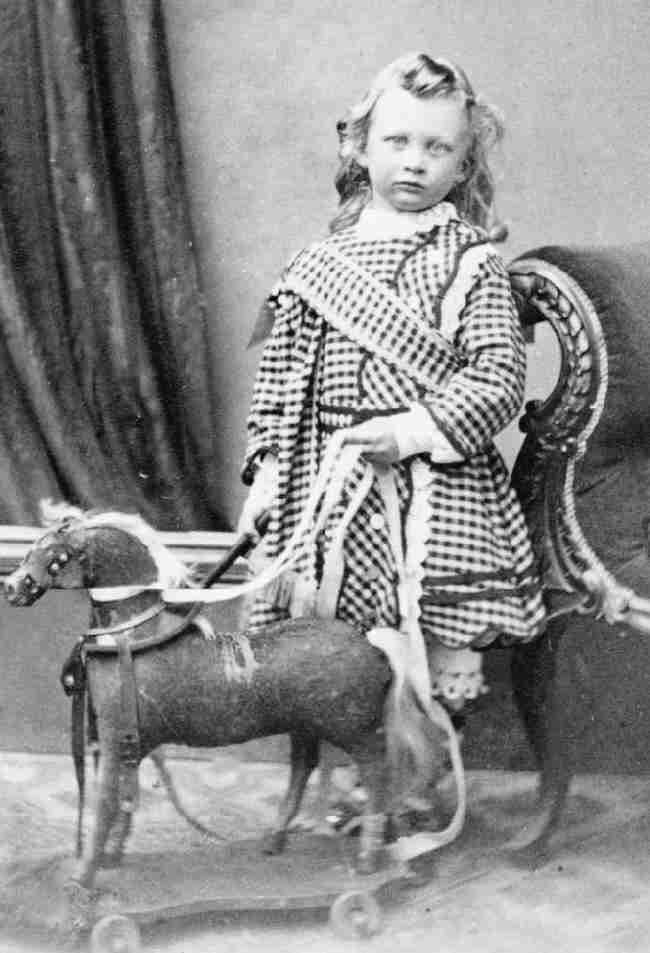
Figure 1.-- This CDV was taken at the Studio of R. Totherwick, Berwick upon Tweed in the late 1860s. This boy wears a dress made to look some whatlike a plaid kilt. He also wears pantalettes. The subject is unidentified, but looks to be about 5 years old. Image courtesy of the MD collection.
|
|
HBC has not yet been able to identify chronological trends associated with dresses in England. We have very little chronological information at this time, but we hve begun to collect some information. Younger English boys wore dresses and other skirted garments throughout the 19th century, although this practice varied widely from country to country. Both boys and girls appear to have worn the same style dresses in the early 19th century. Later in the 19th century boys began wearing more dectintly styled boy dresses. This was increasingly common by the 1880s, but again many mothers had their own very personal idea about what was suitable for boys. While some mothers continued to prefer fancy dresses, other mothers like sailor or plaid dresses. We do have an image from the 1880s
with a boy wearing a sailor dress with wide-brimmed hat. Plaid was also a popular pattern for boys, presumbly because it appeared somehat like a kilt, which was a male garment. Likewise kilts and kiltsuits were also worn by boys.
We do not have a lot of information on the 1830s yet. The era before photogrphy was developed is much more difficult to research than the era beginning in the 1850s when photographs begin to appear in large numbers. In addition, some of the images we have been able to obtain are not dated or identified. This complicates our assessment, but as best we can determine the dresses worn by boys were essentially the same as those worn by their sisters. Rhe empire dresses popuilar in the early 19th century began to be replaced by more fuilly cut styles and bright colors were very popular. We also notice dresses with low cut bodices and bows at the sleeves.
The 1840s
We note a well-to-do English family, the Boyd family, in 1848. The youngest boy wears a bright red dress with a low neckline. Note the sleeves are very short and plain. As he is so young, he wears a short dress and bare legs. His older sister wears a white sprigged-muslin dress tied with a pink silk sash, with trimmed pantalettes (pantaloons) and black pumps. W note a Thornbirn painting with three unidentified children wearing dresses with low necklines. The painting, probably a minature is not dated. We thought in perhaps dated to the 1840s, but the baloon sleeves could mean the 1850s. We are not yet sure if the balooon sleeves were a dependable chronological variation as opposed to a fashion variable.
The 1850s
Another Thornburn painting, the grandchildren of the Duke of Wellington, is dated. It was painted in 1852. So we know that childen in the early-1850s were wering drsses with low necklines and puffed sleeves.
We note quite a few images of younger English boys wearing dresses in the 1860s. Some of them suggest a beginning attempt to differentiate boy and girl dresses. Sone of these images are easy to identify as boys, especially the ones in wgivh the child has short hair. Some are more difficult. Here we see an example of a 1860s boy. This CDV was taken at the Studio of R. Totherwick, Berwick upon Tweed ,probably in the late 1860s (figure 1). This boy wears a dress made to look some whatlike a plaid kilt. The choice of plaid was an effort to make the outfit look more boyish. The outfit here is clearly not a kilt, but a dress. Dresses worn by boys earlier in the 19th century were essentialy the same as those worn by their sisters. Here we see an effort to create a boyishly styled dress. The boy also wears pantalettes. The boy is unidentified, but looks to be about 5 years old. Notice the stick he is holding which would be a kind of riding crop or whip. This is one of several indicators that the child is a boy.
Boys wore dresses that were similar or identical to the omes girls wore, including dresses with low neck limes. Agood example is Godfrey Arthur Harding Rendall , an English boy that lived near Harrow. He had a low neckline dress. We believe these went out of style in the 1860s, but the fashion may have persisted into the early-70s. We notice an unidentified Wellington boy who we believe was photographed during the 1870s. (The dealer thought it wa a 1880s image.) He wears a dress with a large ruffled collar. The dress looks somewhat like a tunic, but the skirt flares out mote than is common for tunics. The detailing is somewhat similar to tunics, but we have not seen tunics with rulled collar like the boy here is wearing. We have no idea about the colors.
We do not have a lot of dated portraits of English boys wearing dressess in the 1880s. We believe this reflects our limited 19th century English archive more than actual prevalence. This makes assssing decade dress trends difficult. We have found one portrait which we have no idea how to describe, It has so many elements that we are guessing because it was such a patch-work quilt that motherprobably sewed it at home. Features include the lace collar, balloon sleeves with lace trim, and a kind of defined waist. Note he also has lave-trimmed pantlaettes and socks rather than long stockings. The boy's name was Bertie. If we did not have the child's name and prop clues we would not have known it was a boy. He looks to be about 4-years old.
The 1890s
We still see younger English boys wearing dresses in the 1890s. We notice fewer examples and fewer older boys. This was particularly true in the lare-1890s. We believe that social class was becoming an increasingly important factor. We notice a 3-year old wealthy boy, Count Louis Vorow Zborowski, wearing a lacy dress with a eide green sash.
After the turn of the 20th century the fashion of dressing boys in dresses declined rapidly. We still see some boys wearing dresses, but only very young boys. Not boys by age 4 or even 3 years were wearing kneepants. This varied from family to family. Boys that did wear dresses tended to wear plain ones, not the frilly ones their sisters might wear. This varies somewhat for boys from rich families.
HBC

Navigate the Boys' Historical Clothing Web Site:
[Return to Main English dress page]
[Return to Main English toy page]
[Introduction]
[Activities]
[Biographies]
[Chronology]
[Clothing styles]
[Countries]
[Photography]
[Topics]
[Bibliographies]
[Contributions]
[FAQs]
[Glossaries]
[Images]
[Links]
[Registration]
[Tools]
[Boys' Clothing Home]
Created: June 30, 2003
Last updated: 7:02 AM 4/26/2019