|
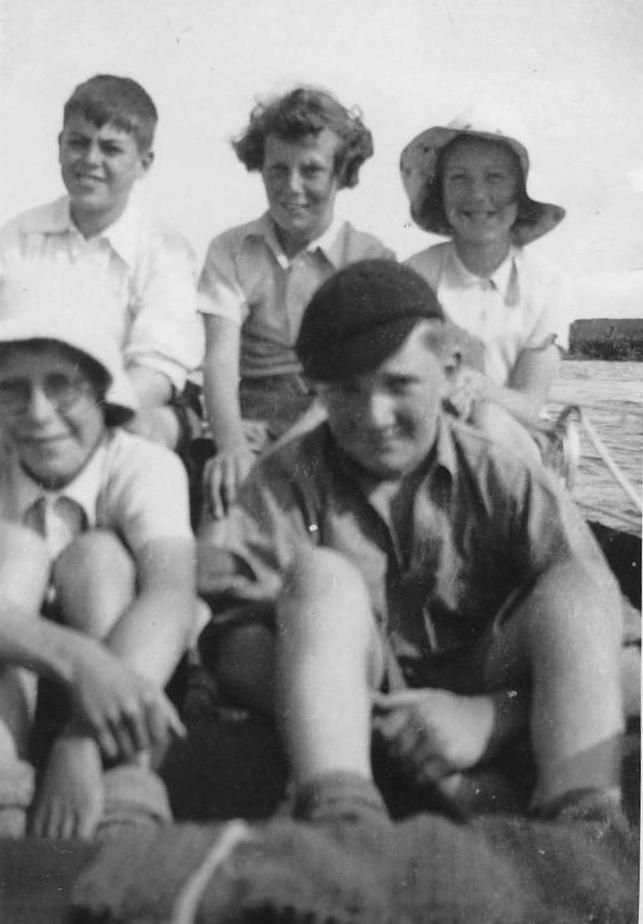
We have begun developing information on many different headwear styles worn by English boys. These styles have varied over time as well as the boy's age. Some styles are especially associated with English boys, although as Britain is so important in boys and men fashions, they also becme popular in other countries. The wide-brimmed sailor hat is one such example. English boys also wore different styles of sailor caps. Perhaps no headwear is more associated with British boys than the peaked school cap in different colors and patterns (Circles and pie sections). Many boys also wore flat caop. Youngr boys also wear tams. We have also noted stocking caps and a variety of other styles. In recent years we have also seen English boys wearing baseball caps.
Up until the early to mid 70s Balaclavas were quite a common addition to young childrens winter wardrobe but were rarely worn by those over about ten. Previously they were worn by boys until at least their mid-teens.
The beret was commonly perceived as a French fashion and thus not widely worn by English boys. While the beret was not widely popular in England, some wealthy families thought it fashionable to adopt stylish French fashions. These families were likely to adopt French childrens clothing, including berets and smocks. One such family was the Llewllyn-Davies family of Peter Pan fame. Few English boys, however, would wear berets after leaving for boarding school, usually at age 8 years. The English appear to have begun the military fashion of wearing berets. The beret gained considerable fame during World War II, especially after Monty adopted it. The English Boy Scouts adopted it as part of their uniform in 1969.
Bonnet is a term for headwear in use since the middle ages. It has been used for a wide range of headwear for both men and women. In Scotland the medieval usage persisted and contunued to be used. In England the more modern usage was for women's headwear. It also referred to 'baby bonnets'. Baby was added because because bonnet was a generic term used for womens's hats. A standard dictionary definition is, "a cloth or straw hat tied under the chin and worn by women and children." This is now rather dated asneithrer children or women commonly wearsuch hats. Baby bonnets were worn by babies and some todlers. Many were simple and small, but some were elaborate and and huge. We see frilly ones for special occasions. Here social class was a factor. The well to do were fond of huge baby bonnets. Baby bonnets were for both boys and girls, although we think that the older toddlers wearing them were mostly girls. They covered the head and depending on the size provided some shade for sun protection. They were generally done in white. Good examples are the elaborate bonnets worn by two Worcester toddlers at the turn-of-the 20th century.
Caps are a complicated category because they are so many of them. They are an important garment strongly associated with boyswear. Strangely it was the youngest boys who were most likely to wear hats. Most boys wore caps. The peaked school cap was for many years an iconic symbol of English boyhood. Girls did not wears caps nearly as much, more commonly wearing hats and tams/berets. The major exceptions was sailor caps, although even here sailor hats were more common with the girls. Scottish styles were another exceotion, although to a lesser degree. Men did wear caps, but not as commonly and their were social-class conventions associated with men's caps. Boys of all social classes wore caps. Popularity has varied over time. The chrinology affected both the popularity of headwear as well as the styles worn. We see a lot of hats in 19th century, although not nearly as many as in America. And we see mostly caps for schoolwear. By the 20th century caps dominated. We rarely see English boys wearing hats. Capo popularity anbd the styles worn has varied from country to country. Several hat styles were created in Britain, both England abd Scotland. Some styles, especilly the peaked school caps are strongly associated with English boys. Another issue is that we are not always able to find names for all of them. Our approch here is to describe the characteristics until we find a proper name. As with mny styles for men and boys' wear, here is a military influence with some cap styles. We see both army and sailor styles, although the sailor styles were the most populsr. Popular usage does not always follow the precide definition even if one exists. The cap is strictly speaking, headwear with a partial brim. Normally this means a front brim or bill, sometimes called a peak. Coloquially, we note the term cap used for a variety of often informal headwear without brims, such as stocking caps. Sometimes berets and tams are also included as types of caps. The cap is the headwear most associated with boys and is generally seen as an informal type of headwear. Scottish styles are all called caps, although somettines bonnets, even though there is no brim.
We notice Engish boys over time wearing qite a range of different hat types. The hat wear types changed considerably over time. Most 18th century images shows boys wearing tri-corner hats. This would have been a reltively expensive item. We are not sure how many boys would have had them. We see many new styles in the 19th century. We do not have much information on the early-19th century, but we know a great deal about the mid- and late-19th centuy. We see range of rounded-crown hats with brims of varios widths. Younger boys fom middle- and upper-class families in the late-19th century wore wide-brimmed hts with streamers. We also mtice boaters which could be wtn bby younger and older boys as well as girls. Some boys, mostly teenagers, wore bowlers. Caps became increaingly importnt but we see some boys wearing boasters for school and more formal outings and sun hats for informal occasions during the 20th century. More commonly boys wore caps.
A tam as best we can tell is a type of beret, but generall done as fuller bodied than a standard beret. My mother in America, a teen ager called her standard beret a tam. The term 'tam' comes from tam o' shanter, a name given to the traditional Scottish bonnet worn by men. The name derives from Tam o' Shanter, the eponymous hero of the 1790 Robert Burns poem. But the tam existed long before the name. The original name was 'blue bonnet' (16th century) derived from the typical color used by bonnet-makers in Scotland. Reports suggest that these bionnets were the normal fashion of men and servants (late-16th/17th centuries). The Scottish bonnet was similar to the berets worn in northwestern Europe at the time. The later tam o' shanter is distinguished by the woollen 'ball' or 'toorie' decorating the center of the crown. Tam o' shanter came into common usage in the early-19th century. It is reklated to the Bslmoral cap which was sometimes called a tan o' shanter. Some were done in felt, but unlike the continental beret they were often knitted. We are not sure when the tam crossed the border south to England. We suspect it was the mid-19th century as things Scottish became popular in Engkland. Here Queen Victoria played a role. We see them being commonly worn by girls in England (late-19th centurty). Younger voys also wore them. For several centuries they were done in blue and other easily available natural dyes. Woad or indigo (which explains the term 'blue bonnet') were the major colors. This began to change as chemists developed inexpensive synthetic dyes. They were done in other fabrics like serge. But the knitted tam seems tob have been the most popular because they ciuld be done at home. In England they were most commonly called a 'tammy' or 'tam'.
Engish boys have worn a wide range of headwear. The sailor hat became popular style in the 1840s when thge Royal Family began dressing the princes in sailor suits. The fashion became popular in England and soon spread to other countries. It was the broad-brimmed sailor hat that was first worn, but gradually boys began wearing sailor caps as well. There were many popular styles of sailor hats and caps. The large number of sailor styles were in part due to the long period in which sailor fashions were popular for boys, about 100 years. We notice sailor hats with various size brims. There were sailor caps with flat tops, soft crowns, tams, and other styles. The styles usually followed the standard uniform styles of the Royal Navy, but some like tams were specifically for children. These were notable in that sailor headwear was often worn by boys and girls.
There were also a variety of school headwear, including both peaked caps and boaters. The styles were not exclusively worn for school, but they were primarily worn as school caps. Peaked caps were especially common and also adopted for Cubs. Some schools like Eton had destinctibe hats, but these generally disappered during world war II. School girls began wearing boaters, but never peaked caps. There were many other school headwear styles for girls, including berets and other styles. School caps went out of style in the 1950s, but were retained at many private schools.
Baden Powell's choice of the Smokey Bear or Lemmon Sqeezer hat set a style which still serves as a virtual symbol of Scouting around the world. I'm not sure what the inspiration was for the hat. It looks more American and British and was in fact the hat worn by the American Army at the time. It was adopted by most other national Scout associations. It continued to be widely worn in Britain and other countries through the 1940s. The British army adopted the beret in the late 1930s. Scouts were still wearing smokey bear style hats, which weren't that popular and were considered a bit old fashioned and impractical. So the British Scouts copied the army and adopted the beret as part of their uniform. Photos show that in the 1940s and 1950s both styles of headgear were worn in tandem but by the late 1950s the old scout hat was more or less extinct. The peaked cap worn by Cubs and now Beavers was almost as widely seen as a symbol of Scouting as the old lenon-sqeezer
hat.

Navigate the Boys' Historical Clothing Web Site:
[Return to Main English headwear page]
[About Us]
[Introduction]
[Activities]
[Biographies]
[Chronology]
[Cloth and textiles]
[Garments]
[Countries]
[Topics]
[Bibliographies]
[Contributions]
[FAQs]
[Glossaries]
[Images]
[Links]
[Registration]
[Tools]
[Search]
[Boys' Clothing Home]