|
A suit is a set of clothing intended to be worn together. The term took ovrr a new meaning meaning a dress up outfit for formal wear. Of course in the 19th and early-20th century, suits werev much more commomly wirn than the later-20th century. Normally suit garments came to be made of the same material, but there there are some exceptions. Matching garments were not dominnt befor the 1860s, although this is a littl difficult to assess ncus the numbers of imges re reltivly limited. The basic suit garments were the jacket or coat and matching trousers. While this was the basic compnents of the suit, they were of course done in many different styles. There were also three-piece suits. The three-piece suits came with vests (waistcoats). The vests were normally made of the same material as the jacket and trousers, but some 19th century vests were made to contrast with the rest of the suit. There were also suits with matching caps, but this was much less common. These caps were primarily see in the 20th century and were done as peaked caps in the style of English school caps. Other garments were worn with the suit, but not part of it. Thery were purchased separately at mother's disgression and thus varied enormously.
Headwear was not normally made as part of a suit. They were usually purchsed separately. Rather the parents purchased what they thought was appropriate and fashionable to be worn with the suit. An exception was the peaked cap, generally referred to in England as a school cap. There were suits with matching caps, but this was much less common than headwear purchsed separately. We see these caps being commonly worn in the second half of the 19th century and the first half of the 20th century. They were primarily school caps, but we see some matching suit caps. But mostly we see caps purchased separately. Actually it was very common for English boys to wear their school caps with suits. Many boys did not have separate suits, but wore their schoolwear which was often a blazer or suit. Wearing headwear was much more common in he 19th century and first half of the 20th-centry than is the casetoday. The pearked hat was not the only cap worn, but it was by far the most common. This was especially the case for standard sack suits worn by school-age boys. There was some diversity in the 19th century, but by the 20th century the peaked cap was uniquitous. We see this even more pronounced in America where the peaked cap was not strongly asociated with schoolwear.
Collars and neckwear were not part of the suit, but cerinly affected the look. Collasrs varied greatly in size and style over time. This was especilly true of the Fauntletoy and Eton collar. The Funtleroy collars were for younger boys over a short period (about 1885-1905). The Eton collar was won over a much longer period for a wider age group and was the mainstay of British boys' fashion. Neckwear was also important and largely but not exclusively worn with suits.
One of the basic suit garments, probably the most important, is the jacket or coat. The styles of the jacket suits varied substantially over time. Age was another factor although this also varied over time. Skleleton, sailor, and cut-away jacket suit jackets were generally for younger boys. Other jackets might be worn by boys of a wider age range. The first important suit type was the slelleton suit. We do not have a lot of information on the early-19th century, but with the invention of photography more information becomes available (1840s). We note a lot of American boys did not wear jackets in the first half of the 19th century. We think jackets were more common in England, but our English archive is much more limited so we can not yet make any conclusive assessments. We do not see large numbers of English images during the 1840s and 50s. Compared to Anerica there were relatively few Daguerreotypes, Amnbriotypes, and other early photographic tfyprw. The appearance of the CDV chsanges this (1860s). And we have large numbers of images to assess suit trends. The jacket or coat is usually the most destinctive part of the suit. Suits were done in many different styles. The type of suit was primarily determined by the jacket. Many if not most boys' suit styles originated in England, including the sailor, Eton, and Norfolk suits as well as several other importat styles. Suits with cut-away jackets were popular in the mid-19th century for younger boys. A good example is Cyril Bickersteth in 1865. Older boys wore sack suits and these gradually became the sandard style. Boys wore single and double breasted suit jackets. Single-breasted coats have been the major style worn by boys in England.
There were also three-piece suits. The three-piece suits came with vests. The British used the term waistcoats. Vdsts meant undershirts. Weare not sure this was the case in the 19th cebtury. Vests were, however, especially common in the 19th century. Quite a large portion of the boys wearing suits wiore them with vests in the 19th century. Our English archive, however, is not large enough to make any valid estimate as to prevalence, but we would say more than half. Our information on the early-19th century is limited. We first notice jackets and vests at mid-century. Many of the mid-19th century vests were done in bright colors and patterns that contrasted with the suits. This changed (1860s). We see suits with matching jackets and pants aswell as vests. The vests by this time were normally made of the same material as the jacket and trousers. Vests were very common both for regular wear and school uniforms. (In the 19th century it was only private schools that had school uniforms.) After the turn-of the 20th century we see fewer boys wearing vests with suits. And they entirely disappearted at school after World War I. We are not entirely surch why this change occcurred, but suspect it was peimarily aart of the general trend toward informality that evolved in the 20th century.
Suits were worn with several different types of trousers. This varied substantially over time. English boys have worn knee breeches, long pants, knee pants, bloomer knickers, knickers, and short pants suits. We see boys in the 19th century wearing both long pants, bloomer knickers, knee pants and knicker suits. Various factors affected the type of trousers, including chronological fashion trebnds, age, social class and others. Long trouses were mostly worn at the beginning of the decade, but several different types of trousrs were common in the second hlf of the century. Many English boys after World War I wore short pants suits. The popularity of short pants suits began to decline in the late 1950s. They were still available for younger boys in the 70s, but rarely seen since except as part of school uniforms. By the 1960s suits except for very little boys were generally made with long pants.
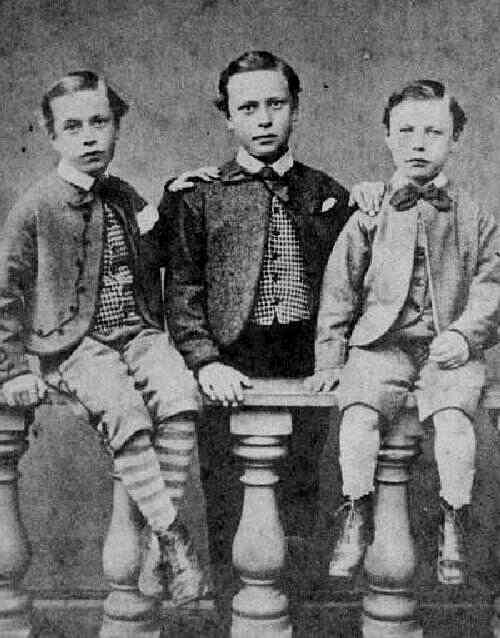
We are not sure about the hosiery worn with suits in the 18th century. The moden suit first appeared at yhis time asnd was worn with knee breeches. Boys at thed time wore small, cut down versions if their fathers' suits. For the affluent his men hite long stickings. For the less affluen this meant stockings in natural colors. At gthe turn of the 19h century, boys begn wearing skeleton suiys with long pants. Thus we do not know a great deal about the hosiery. The art work suggdests white hosiery, but we are not sure just how common this was or the length of the hose. Once photography appered (1840s) we begin to have extensive information on fashion. And this is about the same time, that shortened-length pants for boys began to appear, at least for very young boys (1850s). The general pattern we see with English suits is that boys wore long stockings in the 19th century (figure 1). We do not see suits worn with bear legs to any extent in the 19th cntury. Light-colored long stockings were prvalent at mid-century. Striped long stockings were popular (1870s) and toward the end of the century, dark colors prevailed (1880s-90s). After the turn-of-the 20h century we begin to see some bare knees--we think mosdtly turned doen long stockings. And we mostly see knee socks as long as shorts pants were prevalent through mid-century. Girls continued wearing long stovkings little longer than the boys. While we mostly see knee socks, we do see some ankle socks during the summer or even sandals without socks. After mid-century short pants nd knee sovks began to become less preavlent, but so did suits in general.
We see both low-cut and high-top xhoes in the 19th century. High top shoes were commoinly worn in tghe second half of the 19th century (figure 1). They were, however, not mearly as common as in Americawhere high top shoes were almost unib=versal in the second half of the 19th cenbtury. We also see strap shoes. They were vey common with Faunteltiy suits in the late-19th century. -We continue to see high-top shoes after the turn-of-the 20th century, but they disappear by the 1930s. We see mostly see boys wearing low cut shoes in the 20yth century. Some younger boys wore sandals with suits, especially during the summer with sandals, sometimes even without socks. Here a factoe that boys wore sduitsd to a greater exten than uin America, to bith school and many casual occassioins. Boyswear in sanbdaks with suits seem especially common with families on vacation.

Navigate the Boys' Historical Clothing Web Site:
[Return to Main English suit page]
[Introduction]
[Activities]
[Biographies]
[Chronology]
[Clothing styles]
[Countries]
[Photography]
[Topics]
[Bibliographies]
[Contributions]
[FAQs]
[Glossaries]
[Images]
[Links]
[Registration]
[Tools]
[Boys' Clothing Home]