|
French families have of course changed significantly over time. The most significant change has surely been the size of the family with moderm families much smaller than was the case in the past. The roles of the father and mother hav also changed. The dominate family patriarch is now more likely to share family decissions with the mother. He is also much more involved in raising the children, especially younger children, than in the past. The family portraits sometimes subtely reflect these changes, but they show very clearly how the fashion styles of the entire family changed over time. One major change has been the increasing informality of family dress, not only the children but parents as well.
We have only a few images of French families in the 19th century and can not yet make any real assessment.
Here we have a French family scenr from 1851. It is a posed scene, but represents what might be seen in an affluent family in the 1850s. The children are beiung educated at home rather than going to school. This is because the children are mostly girls and the family is affluent. The image depicts a geography lesson. Presumasbly the man is the tutor rather than the father. This is an early stereoscopic daguerreotype by A Claudet. Unfortunately we do not know who the children are. They may even be his own children.
Here we se the three children of the Le Bon family, Claire, Marie and Louise. We see them in two rare Daugerreotypes taken outside. I'm not sure how to date the images, but would guess the early 1850s although the late 40s is possible. Two of the girls have short hair. The girls all have rather plain outfits. Had they not been mentioned I might have thought that Claire was a boy. Come to think of it, Claire in America was sometines used as a boy's name. I'm not sure how the name was used in France. Claire lseems to be wearing a plaid dress. Claire's hair in one of the portraits has a side part.
These French children had their CDV portrait taken in Metz, France during 1863. We see two little girls and their brother. The names are something like Louis, Maurice, and Lucie Pésardin. We at first thouht the name might be Réazatin. The handwriting is a little difficult to read. Louis and Maurice are boys. Lucie is a girl. Lucie wears a fashionable dresses with a cape-like top and plain panalettes. Unfortunately we do not know what colors the dress was. Maurice wears a plainer dress, but notice his side-parted hair. A French reader writes, "In 1863 when this portrait was taken, little boys less than 3 years old wore dresses and had their hair styled like little girls. The gender colors convention still hadn't been introduced. Boys might be destinguished by their toys and Christian name. Often these children could not be distinguish by gender. During the French Restoration (1815-50) even older boys up to about age 6 might wear dresses like the girl. Louis wears a light-colored knee pants suit, but it is difficult to make out the details. He holds a flat top hat by the chin strap. All the children wear white long stockings.
The Vicomte de Lesseps was one of the most famous Frenchman of the mid-19th Century because of his role in building the Suez Canal. He was not an engineer, but a great promoter. Even the failure of his Panama project and resulting financial crisis in his old age did not totally eclipse his great success at Suez. I am not sure
how he was dressed as a boy, but the clothes wore by his prodigious family provide a glimpse of French boyhood fashions in the late 19th Century.
We have a number of French family images during the 20th century. There are not enough images to draw any conclusions, but they provide some interesting glimpses into the French family and developing fashion trends over time. We notice a lot of boys wearing sailor suits in the early 20th century. The convention of younger boys wearing declined in popularity, especially after World War I. A new fashion appeared for younger boys, rompers. We see knee pants and nloomer knickers in the early 20th century. Short pants became more common after World War I.
We note an unidentified Parisian father and young son. The father looks to be prosperous, either a civil servant or professional. They live in a nice house. We see them both inside and in the back garden. The boy wears a sailor suit. He has a button-up sailor jacket and bloomer knickers. I'm not sure about the color. The V-collar is done in contrasting white. He looks to be about 7-8 years old. He looks to be wearing a flat cap with the suit. He has ankle socks and high-top shoes.
Here we see a French military family in the 1900s. We would guess thatvit was taken in 1913, just before World war, but it could have been taken during the War (1914-18). The father wears a infantry officer's jacket (model 1913). The photograph was taken at the David studio in Châtellerault. The jackets worn by the two oldest children was a popular style at the time. Military styles often influence men's and boys' wear. The jackets resembles the military jacket of their father (collar, pocket, and belt). These styles disappeared after the War.
This is a photograph of a wealthy French family at the end of World War I in 1918. They are the Trogoff family and they owned the Château de la Giraudaye. Pictured here are Yves (age 47), Raymond (age 12), Cath (age 13), Suze (age 7), Elisabeth dite "Pépée" (age 10), and Cécile (née Pontbriand de la Caunelaye, age 44). Not pictured is an another family member who inherited the Château. The two youngest girls wear pinafore-type dresses. Two of the girls have hair bows. Raymond wears a collar buttoning kneepants suit. He has a detachable stiff, white collar made in the Peter-Pan rather than Eton style and worn with a small floppy bow. I am not sure what he is holding. One of the girls and mother for some reason holds a can. You can see Pierre's family in 1930 at the Château.
The postcard here is an idealized French family during the 1920s. It is a posed scene, but was probably an actual family. They probably dressed up for the photograph. A French reader tells us that the clothes were probably what the family wore. Post card studios did not have large budgets for costuming their subjects. We are not sure how common such outfits were, especially the starp shoes. The hair styles are quite carefully done. We suspect that they are more elaborately done than was common for the family. There are four children. The oldest two look to be a boy and girl.
This is a another wealthy French family. Trogoff doesn't seem to me a French name, perhaps our French readers will know more. They are a branch of the Trogoff family that we first see at the Château de la Giraudaye in 1918. We believe it is a brother's family, but we are not yet sure.
The individuals in the photographare Patrick (age 17), Elie (age 6), Alain (age 21), Odile (age 11), Pierre
(age 52), Yves (age 8), Noémie (age 45), Hervé (age 13), Charles (age 16), Guy (age 7), et Bernadette
(age 20). More clearly liked sailor suits. This is a good illustration of the social class conventions. I'm not sure what Elie is wearing. Two boys wear standard sailor suits. Herve wears a rather destinctive outfits. I'm not sure if it is a sailor suit, but we have seem similar jackets being worn, mostly for formal occassions.
The family snapshot is unidentified. We believe it was taken in France during the 1930s, probably the late 30s just before World war II. It looks to be a family outing. I don't think it is a picnic as the family is rather formally dressed and mother has her purse. They look to be out in country somewhere along a road. Rather an unusual place to take a photigraph. Picnic photogrpha are normally taken off the road. Perhaps they had a country home. Photographs here are usully taken with the home in the backgound. The men all wear business suits and ties and the ladies dresses or skirts. The girl wears a short white dress and white knee socks. Girls still wore dresses with few exceptions. The boys all wear various short pants outfits, two also with white kneesocks.
Here we see a French family during World War II. Unfortunately the fmily is unidentified. The photograph was taken in 1943. By this time in France clothing was becoming hard to get. Much of what was produced was shipped to Germany. Despite the shortages the family is reasonabably dressed. We suspect that mother has made the clothes. The outfits are all coordinated. There re slight differences in the dresses for the older and younger girls. The boy ad baby wear rompers with the sane styling as the dress, both smocking and baloom sleeves.
Here we see a French family in the late 1940s after World war II. Unfortunatelt the image quality is very poor. It looks to be a mother who has dressed the children up in summer outfits. The snapshot was probably taken by father in the family's back yard.
After World War II the photographs often are poor quality. The boys at the left were often dressed in rompers throughout the year. They had both Summer and Winter rompers. Here they are wearing Summer rompers. Tey often wore the classic barboteuse style rompers. Practically all French boys through the 1950s were dressed with rompers from infancy to about age e years. Some boys wore rompers longer to about age 6 years. The classic style romper was very common in the 1940s.
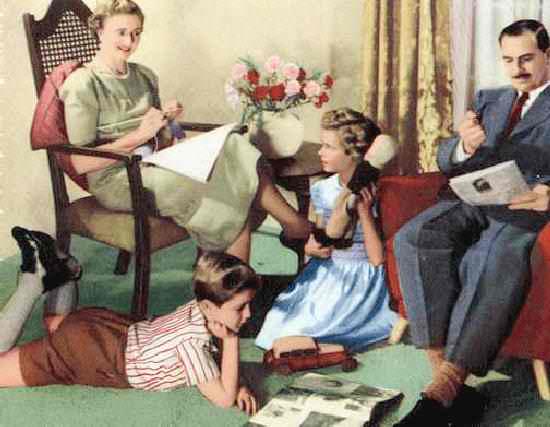
The postcard here is an idealized French family scene about 1950 (figure 1). It is a posed scene, but was probably an actual family. They probably dressed up for the photograph. We believe that this was an actual family. How common was it to dress like this at home in 1950 I am not sure, but many French families weree still quite formal, even at home.
Here we see a French family in 1950. We are not entirely sure that is a precise date or just an estimate, but the clothing and background look about right for 1950. We are not entirely sure about the family. We think here we are seeing the grandprents and daughter who is the mother of the two boys who are close in age. Perhaps the father is taking the photograph. One boy wears bib-front shorts and his slightly older brother wears shorts held up with suspenders. They clearly live in the city, but we are unsure as to what city. It looksd to be a working-class neighborhood.
Here we see the Breuitelle family in 1950. We know nothing about the family, but based on the size we would say they probanly are a devout Catholic family, likely living in a rural area. Rural families tended to be larger than rural families. The older boys wear suits. One boy wears a short pants suit. The younger boys wear a shorts set and rompers. The Breuitelles have an impressive 12 childre and given that the children seem to come once a year there may be more to come. This is one of the largest families archived on HBC.
HBC has acquired several images of an obviosly middle-class family. The images are undated and unidentified. We believe that the photographs were all taken at the same time during the early 1950s. One photograph inclues a family car so we should be be able to date the image. We know the photographs were taken at the same time because the children were all dressed the same. We do not know where the family lived because the photographs were taken on a family picnic. There appear to have been five children and their clothing reflects the various styles worn at the time by various age groups. The father apparently took the photographs. There are two ladies one photograph which look like the grandmothers.
Here we have a formal portrait of a French family. The parents are dressed casually. There little boy Michele who is 4 years old is dressed in a classic romper suit with with baloon sleeves. The suits also had back tieing bows, but you can't see it in the portrait. Michel's romper suit looks to be a patterened one.
Navigate the Boys' Historical Clothing Web Site:
[Introduction]
[Activities]
[Biographies]
[Chronology]
[Countries]
[Clothing styles]
[Theatricals]
[Bibliographies]
[Contributions]
[FAQs]
[French glossary]
[Images]
[Links]
[Registration]
[Boys' Clothing Home]
Navigate the Boys' Historical Clothing French pages:
[Return to the Main French family page]
[French art]
[French choirs]
[French movies]
[French royalty]
[French school uniforms]
[French school smocks]
[French sailor suits]
[French youth groups]
[Difficult French images]
[French art]
[French Movies]
[French ethnics]