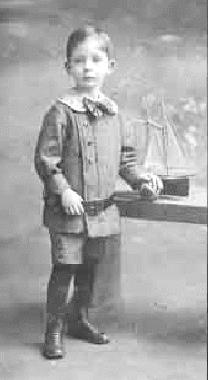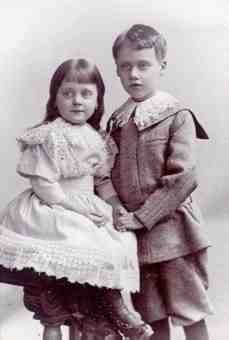
Figure 1.--These German children were photographed in Cologne. I'm not sure about the date. The boy's lace collar suggests the 1890s while the knickers suggest the 1900s. Botice the sailor styling on the jacket. |

|
No country took to photography more keenly than the Germans. Perhaps the Americans, but only because Americans had higher incomes than the Germans. As a result, there is a wealth of photoigraphic material showing us popular fashions throiughout the 20th century. The conventions of younger boys wearing skirted garments declined, except fir tunics. We see a range of popular styles. Sailor suits stand out in popularity. We see boys wearing other suits, especially collar-buttoning suit jsckets. Shortened-length pants were common, including both knee pants and knickers. Short pants began to appear, but were mostly long like knee psnts. We see both socks and long stoclings worn on a seasonal basis. Hight-top shoes were standard, but we also see strap shoes. Images of German royalty before World War I suggest that less restrictve, less confining styles were becoming popular after the turn of the 20th Century. Kaiser Wihelm's sons for example wore short pants satin suits with square open collars. (These suits can be viewed at the European royalty site.) Hair styles in Germany had some differences with the rest of Europe. I have limited information on this topic at this time. Long hair and curls for boys appear to have been less common than in the rest of Europe. Older boys in school might have their hair shaved. This was a reflectiin of the great esteme in which the German Army was held.
The German Empire was one of Europe's newest countries. It was formed as a result of wars with Austria and France. The Empire was declared in 1870? after the defeat of France. It was formed from a large number og German states with Prissia at its core. The Prussian inlfluence and the role of the Army made military styles very popular. The Empire's decsion to build a modern Navy soon made the sailor suit even more popular. The 1900s saw rising tensions with its neighbors as the unified Germany began to assert its new power. The close relations that Prussia had traditionally maintained with England began to disapate as the Germans built an increasingly poweful highseas fleet. These tensions erupted in 1914 in World War I which among many more important consequences would have a great impact on fashions.
|
Few destinctive German boys clothing styles appeared after the turn of the century. Girls and younger boys wore dresses, but the conventions of dressing little boys in dresses was going out of styles. The only skirted garment of any importance was tunic suits. We do not notice kilts. Styles appeared to have followed trends in the rest of Western Europe. The one destinctive style was tracht, garments like lederhosen leather pants. We see both blouses and shirts. We notice knee pants and knickers as well as long pants for the older boys. Knne pants were evolving into short pants. The lederhosen were most done as short pants. We see various kinds of suits. Collar buttoning suit jackets were popular for youngrer boys. We see a few Fauntleroy suits, but sailor suits were much more common. Dark long stockings were very common in the early 20th century, especially during the winter. They were worn with both knee pants and knickers. Three-quarter socks were more comon during the summer. We note most boys boys wearing boot-like high top shoes. We also see strap shoes. Only a few boys wore sandals.
Images of German royalty before World War I suggest that less restrictve, less confining styles were becoming popular after the turn of the 20th Century. Kaiser Wihelm's sons for example wore short pants satin suits with
square open collars. (These suits can be viewed at the
European royalty site.)
Hair styles in Germany had some differences with the rest of Europe. I have limited information on this topic at this time. Long hair and curls for boys appear to have been less common than in the rest of
Europe. Older boys in school might have their hair shaved. This was a reflectiin of the great esteme in which the German Army was held.
We do not yet have any information on the German conventions for
wearing the various styles.
HBC at this stime has only limited information that can be attributed to specific decades. Many of the available early 20th century images are undatd. Available school portraits, however, do provide some insights as many are dated. Sailor caps and hats were popular in the 1900s. Some boys wore militar-style peaked caps. Another popular style were flat caps. Some boys wore Fauntlroy suits, but they were not as popular as in France and England. We notice many German boys in the 1900s wearing sailor suits. Germany at the time was involved in a naval arms race with Britain and a country' navy, especially battleships, were he hallmark of a great power. We also notice tunic suits and Russian blouse outfits. Boys also wear a variety of suits, most with kneepants and long stockings. Some boys wore short pants and kneesocks which the Scouts and Wandervogel help popularize. HBC has only limited information or photographs that can be specifically attributed to the 1910s. Some of the avaialble school photographs, however, do provide some information that is either dated or for which HBC has estimated the dates. Sailor suits were still very popular for Germany boys. World War I broke out in 1914 and after the War in 1918 major changes behan in German boys wear.
Unfortunately I have little information on German clothes
during this period, but would greatly appreciate any information visitors to this web site could offer.
We would like to acquire articles on boys' clothing during the early 20th century. Here we are interested in both contemprary articles as well modern historical research.
A Polish resercher has assessed boys' fashions in what was at the time the German city of Breslau. The city is now the Polish city of Worclau. He has reviewed early 20th century Breslau publications. While he has focused on Breslau, the results are a good reflection of German fashions in general at the time. One of the principal styles assessed is the sailor suit.

Navigate the Boys' Historical Clothing Web Site:
[Return to the Main German page]
[Introduction]
[Activities]
[Biographies]
[Chronology]
[Clothing styles]
[Countries]
[Bibliographies]
[Contributions]
[FAQs]
[German glossaries]
[Images]
[Links]
[Registration]
[Tools]
[Boys' Clothing Home]