
German Boys' Clothes: Garments--Short Pants
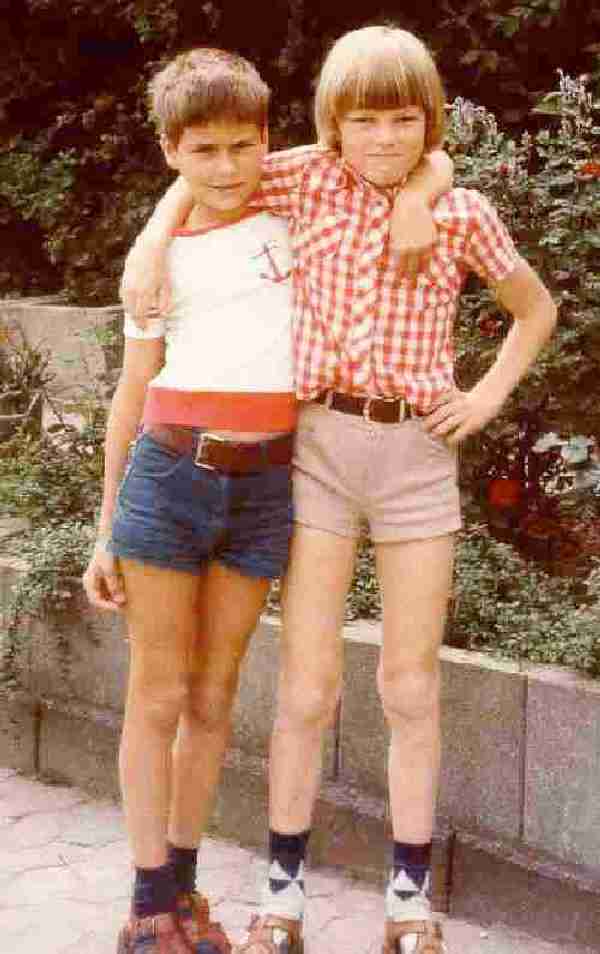
Figure 1.--These two Germany boys wear the brief cut play shorts that were popular throughout Europe in the 1970s. This is a good example of how shorts had become casual, summer wear. One boy wears denim shorts. Note the open-toe sandals which were typically German.
|
|
Short pants appeared in the late 19th century, they were initially worn by younger boys. They were worn in the 1890s beginning with the Wandervogel before the turn of the century and then the Scouts and other youth groups after the turn of the century. After World War I (1914-18) by the 1920s, short pants were very commonly worn by Germam boys including some older teenagers. Corduroy shorts were common. Lederhosen were primarily worn in Bavaria. One German reports, "
In the fall of 1933 a new student named Horst came to our third grade class and was seated at a desk across the isle from me. Horst had recently moved to our village. He lived in a duplex in a newer area, nothing like our homes which were old farmhouses. Horst was different. He didn't talk in the local dialect, he was Protestant, his father was a railroad official who had been transferred to our local station. In many ways his behavior and language were foreign to me. He dressed differently, wearing Bavarian lederhosen while I wore corduroy kneelength pants." [Louis Maier, In Lieu of Flowers.] Shorts were still very common in the early 1950s, in part because of economic conditions, but by the 1960s German boys were increasinly wearing long pants. German boys still wore shorts in the 1970s and 80s, but they were increasinly seen as cassual summerwear. Many boys still wore shorts, coomonly very brief cut shorts in the 1970s and 80s. Denim shorts became a popular type of play shorts. Similar styles were worn in other countries. A British reader writes, "My denims shorts were maybe a bit longer, not much, and came from Marks and Spencers. I had a similar belt to the boy on left, wouldn't fit thru my shorts belt loops. I think you have to look at the width of a snake belt for that."
Short pants appeared in the late 19th century, they were initially worn by younger boys. They were worn in the 1890s beginning with the Wandervogel before the turn of the century and then the Scouts and other youth groups after the turn of the century. After World War I (1914-18) by the 1920s, short pants were very commonly worn by Germam boys including some older teenagers. They were essentially the same length as knee pants. Short pants were most common during the inter-War period and post-War period. Most boys during this period wore short pants until about 15 years of age, although this varied from family to family. Shorts were still very common in the early-1950s, in part because of economic conditions, but by the 1960s German boys were increasinly wearing long pants. Here the appearance of jeans had a major impacr, esopecially among teenagrs. They began to decline in popularity in the late 1950s, especially as ordinary or dress-wear. As in other European countries they began in the 1960s to be seen as casual summer wear.
We note a wide range boys boys wearing short pants, but this varied substntially over time. Shortpants were primarily a 20th century style. Boys in the second half of the 19th century wore shotened-length pants, including both bloomr knickers and knee pants. Knee pants in the early 20th century evolved into short pants. We see mostly pre-school boys wearing short pants in the 1900s, often with tunic-like outfits. This style was popular with the Imperial family. After World War I (1914-18) we see short pants becoming a major style as knee pants gradually went out of style. We see almost all primary-age boys wearing short pants during the 1920s and 30s. They were also very common for younger teens. Beginning about age 15 years we see boys shifting from shorts to knickers or long pants, but this varied from family to family. Here we see two teenagers still wearing shorts (figure 1). Shirt pants were till standard, but we see more knickers and long pants during World War II years, in part because many boys were wearing the Hitler Youth winter uniforms which consisted of ski pants-- a kind of long knickers. After the war we see many teenage boys wearing short pants, in part becaue many families were so pressed by the collapse of the German economy. Short pants were still very common during the 1950s, especially the early-50s, but by the end of the decade we see fewer teenagers wearing shorts as economic conditions improved and jeans began to become popular. Some parents refused to but jeans at first, but they were so popular with boys that this gradually changed. We see fewer teenagers wearing short in the 1960s, but primary-age boys commonly wore them for casual summer wear. We see fewer boys wearing shorts during the 1970s, except during the summer as casual wear. We rarely see them during the winter months any more, even on younger boys. Shorts increasingly became a garment for pre-teen boys.
Material
Corduroy shorts were common in the early 20th century through the World War II period, although we do not have a precise chronology. Jean shorts becme popular in the 1970s.
Probably the best known German short pants are Lederhosen. They were primarily worn in Bavaria. One German reader reports, "In the fall of 1933 a new student named Horst came to our third grade class and was seated at a desk across the isle from me. Horst had recently moved to our village. He lived in a duplex in a newer area, nothing like our homes which were old farmhouses. Horst was different. He didn't talk in the local dialect, he was Protestant, his father was a railroad official who had been transferred to our local station. In many ways his behavior and language were foreign to me. He dressed differently, wearing Bavarian lederhosen while I wore corduroy knee-length pants." [Maier] German boys still wore shorts in the 1970s and 80s, but they were increasinly seen as cassual summerwear. Denim shorts became a popular type of play shorts. Similar styles were worn in other countries. A British reader writes, "My denims shorts were maybe a bit longer, not much, and came from Marks and Spencers. I had a similar belt to the boy on left, wouldn't fit thru my shorts belt loops. I think you have to look at the width of a snake belt for that."
Styles
Short pants were very common in the early 20th century. They were generally worn at knee length, rather like knee pants. It is often difficuklt to destinguish between short pants and knee pants. This began to change after World War I. The length gradually began to become sjorter, although still generally long in the 1930s. The 1930s sas a variable decade. Boys increasingly were wearing shorter-cut shorts, althogh we also see some boys wearing knee-length shorts. Most boys by the 1940s were wearing shorts well ablove the knee. We no longer see the longer-cut sjors of the early-20th century. Some plder boys wore rather short shorts, basivally shorts they had outgrown. Clothing was in short supply during the immediate post-War era and familes had little money even for food and other basics. Boys mostly wore mid-length shorts in the 1950s ad 60s. Many boys still wore shorts, comonly very brief cut shorts in the 1970s and 80s. By this time shorts had become primarly casual, summer wear.
We note German boys wearing a variety of hosiery with short pants. We know more about the hosiery worn with short pants because it is easily observable in the photographic record. Determining what hosiery boys wearing long pants are is much more difficult to determine. We note boys wearing ankle socks, three-quarter socks, knee socks, long stockings, and tights. Long stockings and knee socks were very popular in the eary 20th century. We note ankle socks increasing in popularity during the 1950s. Tights were not commonly worn with shorts, largely because by the time tights appeared, short pants were becoming warm weather, casual wear. We do note tights beuing worn with shorts for sport. The popularity of these different types varied over time. We also note age and seasonal variations which also affected the type of pants worn. There were differences from family to family, but ocial class seems a minor factor, except for long stockings.
Sources
Maier, Louis. In Lieu of Flowers.
HBC

Navigate the Boys' Historical Clothing German pages:
[Return to the Main German pants page]
[German choirs]
[German youth groups]
[Hitler Youth]
[German school uniforms]
[German royalty]
[German sailor suits]
[Lederhosen]
[Ethnic]
[Tights]
[Long stockings]
Navigate the Boys' Historical Clothing Web Site:
[Return to the Main country short panrs page]
[Introduction]
[Activities]
[Biographies]
[Chronology]
[Clothing styles]
[Countries]
[Bibliographies]
[Contributions]
[FAQs]
[Glossaries]
[Images]
[Registration]
[Tools]
[Boys' Clothing Home]
Created: April 28, 2004
Last updated: 1:41 AM 1/20/2015