|
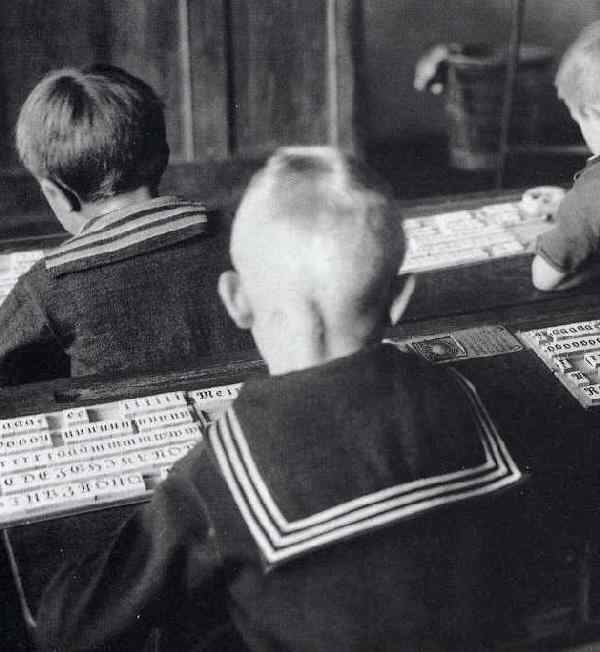
Germany has been a world leader in education and today operates one of the world's outstanding educational system. The German educatuon system dates from the middle ages. With the exception of the NAZI era when the education system deteriorated severely, the country has cobnstantly been at the forefront of European educational development. German schools have never required school uniforms as in Britain and other European countries. Even during the height of the military's popularity in Imperial Germany or the NAZI years, there was no great interest in uniforms for school children--a fact some observers find curious. A specific school uniform seems to be more an Anglo-Saxon/Brtitish Empire institution. Except at military schools, German boys have not generally worn school uniforms. German boys in the early 20th Century wore a variety of clothes to school. Sailor suits and suits were the most common, but some boys also wore smocks like French boys. Since World War II, uniforms have been unpopular in Germany. Boys commonly wore shorts and knee socks, even secondary age boys in the 1950s. After the early 1960s, shorts are not commonly worn, except for casual summer wear. As a result, there is no traditional German schoolboy dress as is the case of British schoolboy caps and blazers or Italian and French schoolboy smocks. Two different school systems developed in Germany after the war, a democraric sysrem in the the Russian occupation zone and a democratic system in the American, English, and French zones. Post war Germans have been especially ill-disposed toward school uniforms. Some parents, faced with rising school discipline problems are beginning to reevaluate their long-held opinions on school uniform. The two post-war systems were merged after the fall of the Berlin Wall and the unification of Germany in 1989-90.
We are compiling information on German schools over time. The task is somewhat confusing as until modern times there was no one Germany, but rather a conderation of German speaking states. German was an early leader in public education. but this varied from state to state with curious mixtures. Prussia gave consuiderable attention to public education, but some children esspecially the Poles if East Prussia into the 19th century grew up on still largely Fedual estates. In the German Empire (1870-1918) education was a function largely related to the different Landen or states. Only with Weimar (1918-33) and more importantly the Third Reich (1933-45) did Germany begin to build a national educational system. This effort was truncated by World war II and the post-war division of Germany between East and West that did not end until after the fall of the Berlin Wall in 1989.
German school are orgnized along the primary, secondary, and tertiary system that developed in other countries. The Germans were leaders in sponsoring state supported primry school, significantly ahead of the British. The Germans are also notable for the development of pre-school Kindergardens. The academically selecive seondary schools called grammar schoolsin Britain were the gymnasium in Germany. Germany is also notable fir the development of some of the most prestigious universities in the world. The American Ph.D. is a degree derived from the German university tradition. One of the notable development of the German universities beside their academic prestige was the development of the university drinking clubs or brotherhoods.
There are in Germany the same kind of schools as found in the rest of Europe, although our information is still very limited on the different types of schools. One point to keep any mind is that unlike America and Britain, well to do people in Germany (and many other Continental countries) did not always send their children to private schools. The state schools in Germany were of a quality and prestige that upper-class children attended them. Of course at the time few working-class children until after World War II went to secondary school. Actually many private schools were for children from affluent families that were no academically capable of making the grade in the state schools. This has begun to change in Germany today. One question we have concerning Germany is the role of the parochial schools, especially the Catholic schools. We also note military schools in Germany. Gender had an impact on both the type of schools and the names used. A German reader tells us, "Academic boy's sevondary schools might be called Gymnasiums. Cpmparable girls schools were called Oberlyceums. They were not allowed to use the designation gymnasium. Amost all of these schools before world war II were single fender schools. Humboldt Gymnasium in Berlin, for example, was still a boys school up to 1950 when it became coed. Likewise Oberlyceum were all girls schools. German gynasium had a long history going back to the early-19th century. At the time it was not considered importnt to educate girls beyond the primary level. They had high academic standards and prided themselves on these standards and their history. As more attention was given to girls education, eucational authorities believed it was a good idea to have separate gender schoolsbecause it avoided the distractions caused by interaction between genders. A German reader writes, "My mother's sister was enrolled in Uhland Oberlyceum. but when the school was damaged during the War, she was transferred to another Berlin secondary school -- Steglitz Oberlyceum. They always incorporated the type of school into the name of the school, making it easier for a parent to locate the possible school for admission they would consider enrollment at for their son or daughter once they got through the qualifying examination at the end of primary school that would determine if they were to continue their academic education or be offered an opening at a trade school. Those who graduated from a trade school.. were taught to be able to step right into the work force upon graduation after their 6 years of apprenticing."
Age has been a very important factor affecting how German schoolboys were dressed. Our information on the 19th century is still limited. This seems an especially important factor in the first half of the 20th century, but began to decline in importance in the 1960s. Here a key age is 6 years old. This was when children began schools. Which is helpful because we can easily identify the age of the children in their First Day portraits. Some children began school earlier by attending Kindergarten. This included children 3-5 years of age. This was, however, a minority of the children even in major cities. Most children began attending school at age 6 years. Volksschule had a 4 years after which the children's academic track and type of school varied. This depended bpoth on the child's academic capabilities and social class. Before World War II, few working-class children attended secondary school. Most children continued attending some kind of school through age 13 years. A minority of children pursued seconfary education and remained in various types of secondary school until about 18-19 years of age.
German boys have worn a wide variety of school clothes. Unlike British and French school boys there is no destinctive style assocaited with German school boys. Many German boys beginning in the 1920s seem to have worn lederhosen to school, but this from available images appears to have usually been a minority of the boys in most classes. Wearing lederhosen also varied regionally in German, being most common in Bavaria. HBC has little information on schoolwear in Germany during the 19th centuty. We note that many younger school boys in the early 20th century wore sailor suits to school. Sailor hats were also common, although many boys also wore an army-style peaked cap. Sailor suits declined in popularity during the NAZI era (1933-45). Suits were commonly worn in the 1920s and 30s. Hitler Youth uniforms were sometimes worn to school. I am not sure if there was a specific day for this, as was common for Scouts in many American schools through the 1950s. Casual shirts and sweaters had become nmore common by the 1940s. Suits by the 1950s were rarely worn to school.
German children for the most part did not wear uniforms to school. There were a few exceptions, primarily military cadet schools. Much more common in Germany were conventions. We note many imahes woth the children similarly dressed. There seem to have bWen conventions generally followed at many schools. These conventions varied over time and regionally. Until after World War II there were differenes between rural and urban schools. This was a common pattern in mny countries. Conventions also varied between primary and secondary schools. As far as we know, these conventions wee basiclly simply created by popular attitudes toward school and schoolwear. Therevmay have been some school rukes such as boys in secondary schools were expected to wear suits. We arevnot entirely sure about tht. We do not see common gyles of colors, but there seem to have beem an understanding that boys in secondary schools should wear suits at least through Worlod war II. After vthe war this convention quickly declined discarded. and was dicarded. The difficult economic situation after the Warvjmay have been factor.
German boys had satchels and cases to take their supplies and equipment to school and we rarely see the supplies and equipment that they carried to school and used there. The major uitems of course were books. Younger boys had slates in their satchels. This could be used rather than paper at school. Note the rags and sponges hanging from the satchels. These were to clean the slates. There must have been chalk to use on the slates. Boys also had copy books. tThey used pens that were dippened in ink wells. Copy books were more common in Europe than America. I am not sure precisely how they were used. Some boys may have had fountain pens. Some classes has abacuses. We are not sure if the children brought abacuses to school in their satchels. Presumably there were also rulers and protractors.
The hair styles worn by German boys over time have varied substantially. As far as we can tell, school hair styles generally reflected popular hair styles of the day. What we do not jnow if the schools imposed any rules about hair styling. We suspect that there may have been some school intervention in the 19th century, but more for sanitary reasons than stylistic reasons. Head lice was a real problem in the late 19h and early 20th century when many German families did not have the bathrooms and running water that make high personal hygene standards so common today. This was a problem in other countries as well. We suspect that the military ethos of Wilhimite Germany may be another factor in making clse-cropped hair for boys so common. This changed after World War I, especially by the mid-20s. Boys still war shirt hair, but not short that it could not be combed. Rarely do we see boys with long hair until the 1960s. German boys by the 1970s were adopting the same pan-European hair styles that we see in clothing styles.
German schools were highly academic. We do not see many of the activities like sports, art, music, drama, and others in available images of German schools. These activities apparently were not important school in German schools, although we have little information on this topic at this time. We believe that this has changed somewhat at German schools since World War II, but again our information is limited. Hopefully our German readers will provide ome information here.
HBC has begun to collect information on German schools during different time periods which will include Imperial Germany, the Weimar Pepublic, NAZI Germany, East and West Germany during the Cold War, and modern unified Germany. We only have a few schools at this time, but hope to add tp our list. We hope that some of the large number of German visitors to HBC will provide us some insights into the uniforms and clothes that they wore to school so that we can add to our list.
School in America and Englamd begins in September. This was in part because children were needed on the farm until the haevest was in. The German school year until recently was different.
The German school year until the 1930s began after Easter. I am not entirely sure why Easter was chosen, but many German schools were associated with the Church which may be a factor. Also Germany did not have a centralized school system like France. The various states retained responsibility for education, although some effort at centralization was made by the NAZIs. So there made have been differences within Germany. I am not sure about what happened in East Germany after World War II. German readers, however, tell us what happened in West Germany.
It is a tradition on a child's first day of school in many countries to take a photograph. Sometimes this was done formally, but more common a snapshot was taken at home. The photographs show not only the child's clothing, but often book bags and even flowers or other gifts for the teacher. We suspect the child in figure 2 above may have been photographed on his forst day of school. This tradition is less formal today, although children are much photographed than ever before. We also notice portraits in subsequent years--"Zur Erinnerung an Mine Schulzeit". These portraits seem much less common than the first day portraits.
Germany in the early 20th century had perhaps the premier education system in the world. The system was eroded by the NAZIs during the Third Reich, but Germany continueds to have one of the best education system in the world. Perhaps no other quality education system has had to adapt to such wide swings in educational philosophy as the German syste. Educarors have worked under a conservative monarchy, a liberal democracy, the Third Reich, foreign military occupation, Communism and today's uninted democratic Germany. Throughout all of this the state has been the center of German education. Private schools have never been as important in Germany as in Britain and America. Tooday there is a debate in Germany over educational philosophy. The same debate is being persued in America and other Western European countries, but there are some unique aspects to the German debate because of the unqiue German historical expeuence as well as social attitudes.
e have archived a few accounts submitted by readers of experiences in German schools.
We have begun to acquire som information about the experiences of foreign children in German schools and the experiences of German children in foreign schools. This is quite an extensive topic and is it has varied greatly over time because of the substantial political changes that have occurred in Germany during the 19th and 20th century. The German Empire (1871-1918) had substantial ethnic minorities. The largest were the Poles in eastern areas of the Empire. After World War I, substantial numbers of Germand found themselves in foreign countries, especially in Poland and Czechoslovakia. The NAZI conquests brought large numbers of foreign children within the boundaries of the Reich. After World War II, large numbers of Germans fleed or were driven from neigboring countries. Many of these Germans came from families thatb had little or no contact with Germnany for centuries and were thus in many ways like foreign immigrants. At the same time, foreign countries built bases in Germany and eventually families came to Germany. As the German economy expanded, foreigners were recruited ti serve as guest workers and they eventually brought families. Many of these guest workers were Turkish. West Germany participated inn exchange programs sending German students abroad and hosting foreign students in Germany. I believe the East Germans offered scholarships to foreign students, but at the university level.
Many Germam schools organize cultural experiences for the students after the school year in the summer. The primary purpose of these experiences seem to be cultural. Itvaffords the children t learn someething about other areas of the country. Often it incvolves city children spending time in more rural ares of the country. It also has something of an American summer camp experience, excet that the setting and accomodations are ormally not rustic. Usually a teacher from the school will accompany and supervice the children and youth.
We have found some German photographs that we do not understand. Normally we are able to archive images in the school section so as to illustrate trends and features of German education. But some images fail to illustrate what we know about German education and schools. Rather thn discard them, we thought we might post them here and perhaps our German readers will be able to explain just what these variois images illustrate.
Ekkehard Ossowski and Winfried R�sler. Ed., Kindheit: Interdisziplin�re Perspektiven zu einem Forschungsgegenstand.
Related Links: Careful this will exit you from the Boys' Historical Clothing web site, but both sites are highly recommended
Apertures Press New Zealand eBook: New eBook on New Zealand schools available: Vol. I
Apertures Press British eBook: New eBook on British preparatory schools available: Vol. I
Boys' Preparatory Schools: Lovely photographic essay of British preparatory schools with some over 200 color and black and white photographs depicting the schools during the 1980s
Apertures Press British eBook: New Apertures Press e-book on Brotosh preparatory schools in progress--Vol. II

Related Chronolgy Pages in the Boys' Historical Web Site
[Main Chronology Page]
[The 1880s]
[The 1930s]
[The 1940s]
[The 1950s]
[The 1960s]
[The 1970s]
[The 1980s]
Related Style Pages in Hustorical Boys' Clothing Website
[Main school page]
[Main country page]
[Long pants suits]
[Short pants suits]
[Socks]
[Eton suits]
[Jacket and trousers]
[Blazer
[School sandals]
Navigate the HBC Country School pages
[Return to the Main country school page]
[Return to the Main School Page]
[Australia]
[England]
[France]
[]
[Italy]
[Japan]
[New Zealand]
[Scotland]
[United States]
Navigate the HBC School Section:
[Activities]
[Chronology]
[Clothing styles]
[Countries]
[Debate]
[Economics]
[Garment]
[Gender]
[Hair]
[History]
[Home trends]
[Literary characters]
[School types]
[Significance]
[Transport and travel
[Uniform regulations]
[Year level]
[Other topics]
[Images]
[Links]
[Registration]
[Tools]
[Return to the Historic Boys' School Home]