Figure 1.--This wonderful painting by Nikiforos Lytras , "Ta kalanda" (The carols) shows boys wearing traditional costumes from different regions of Greece. |

|
Greece is a small country, but there traditionally have been meant destinctive regional differences. Some important regions are northern Greece, the Aegean Islands, and Crete. These differencs today are most apparent in folk costumes. HBC is not sure of just how clothing styles varied in different regions. We do know that as in other countruies, traditional fashions generally tended to persist in the rural areas and small villages. After World War II these differences began to decline. Today with television and modern media, there are few differences, except in folk costumes among clothing styles in different regions.
Macedonia is located in northern Greece. It borders the now independent country of Macedonia which was once a part of Yugoslvia. Some Greeks think that Macedonia should be part of Grece. Macedonia is perhaps best known as the birthplace of Alexabder the Great. The Macedonians spoke Greek, but many of the Greek city states did not think that the Macedionians were true Greeks, that is until King Philip and his son Alexander conquered them. Again we know little about destinctive Macedonian clothing styles, but a museum display provides us a look at the inside of a Macedonian church in the early 20th century.
Thessaly (Thessalia) is the geographical department that occupies the central section of mainland Greece. It is surrounded by high mountain ranges encircling a low plain. It borders Macedonia to the north, Sterea Ellada to the south, Epirus to the west, and its eastern shoreline is on the Aegean. It has a higher percentage of flat, arable land than any other district in Greece. The climate is continental; the winters are cold and the summers hot and the temperature differential between the two seasons are large.
|
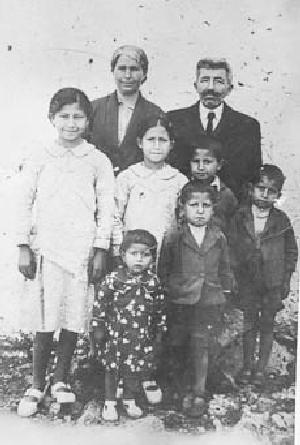
We have little information on Crete, a large elongated Medditerean island south of the mainland, Crete is the birthplace of Minonean civilization and many believe to be the cradle of Greek culture. The photograph here shows a Crete family in 1929 (figure 1). They look much like similar families would look in rural areas of Grece itself. Hopefully as we learn more about Crete we will learn more about destinctive clothing trends on Crete. The noted Swiss photographer
Fred Boissonnas traveled around Greece and photographed almost all it's regions. One photoraph shows the Mandaka family. A HBC reader reports, "I have seen other photos by Boissonnas of the family in photo expositions. I guess that it was a big and wealthy family.
The Ionoian Islands are located in the Ionian and Mediterreanan Seas west of the Greek mainland and make up one of the six major geographical regions of Greece. The principal islands are Corfu, Cephalonia, Zante, Ithaca, Cderigo, Leukas, and Paxos. The islands are very mountainous and the climate more temperate than the Greek mainland. There is a band tradition in Kerkyra island (Corfu, with influences from Italy) and Asia Minor (up until 1922). This tradition has probably to do with the strong influences of Italy in this part of Greece. The Ionian islands are an interesting part of Greece because many were not part of the Ottoman conquest and rather under Venetian control. Venice was a major naval power in the eastern Meiterreanan which fought to contol Ottoman expansion. This is part of the reason that many early Greek poets and artists came from the Ionian islamds.
The Aegean Islands are a diverse group of islands in the Aegean Sea between mainland Greece on the west and north and Turkey on the east and Crete to the south. The ancient Greek name for the Aegean Sea was Archipelago (ἀρχιπέλαγος) which gradually became the term used for the islands in the Aegean. Over time it has become the the generalterm for an island group. The history of the islands varies. The were part of Hellenic Greece and then part of the Roman Empire. After the fall of Rome, they were controlled bt first the Byzantine Empire and then a variety of different groups including Venice, the Papacy, the Normans, Genoa, the Ottoman Empire, Fascist Italy, NAZI Germany, and other lesser powers. This varied from island to island. Each individual island has its own fascinating story. The Aegean Islands since the First Balkan War (with an Italian/German interlude) have primarily been Greek. The Italians acquired some of the islands after the Italo-Turkish War (1912)--the Dodecanese, including Rhodes and Kastelorizo. They were returned to Greece after World War II. Mussolinmi attempted to Romanize the populations, but the islands remain largely Greek. Turkey has a few islands in the northeast (Imbros and Tenados) as well as various smaller islets along the country's coast. The Greek Aegean Islands are traditionally divided into seven groups: Northeastern Aegean (thasos, Limnos, Lesbos, Vhios, Icaria, and Smos), Sporades, Euboea, Argo-Saronic Islands, Cyclades, the Dodecanese (with some exceptions), and Crete.
The Greek or Hellenic diaspora is referred to as Omogenia (Ομογένεια) in Greece. Greece is none of the few ancient peoples that exists as a modern state. Egypt is another state, but has no significant diaspora. Persia (Iran) is another state, but modern Iran is ethnically destinct. The early Greeks after moving south into what is now modern Greece, influences by the Minoans, from an early point were a trading people. And they traveled throughout the Mediterranean, including the Black Sea, and beyond to trade, often setting up colonies which became more thn trading posts. Omogenia is often used by the Greeks to mean the communities of Greeks established outside the homeland throughout the Mediterranean world. This meant the Balkans, southern Ukraine and Russia, Georgia, south Caucasus, the Pontus (northeastern Anatolia), and eastern Anatolia. The Greek duaspora predates the Jewisg=h diaspora by centuries. There is ann unbroken presence from Homeric times. There was a seimic change in the 20th century with the rise of new natioanal states. The Greek diaspora is of some historical importance. Greeks fleeing the Ottomans helped spark the Renaisssance in Italy. The liberation of Balkan Christians began in Greece, to present. Examples of its influence range from the instrumental role played by Greek expatriates in the emergence of the Renaissance, various liberational and nationalist movements implicated in the dismantling of the Ottoman Empire.
Rising nationalism and Soviet Communism , in the Balkans, Russia, and Turey much reducd Greek comminities in the traditional Omogenia. As a result, the largest overseas Greek community today is in America some 3 million people. That is over 25 percent of the Greeknpopulation. And depending on how you classigy Crete, Anerica is helf of the modern diaspora. The American Greek communities is bery moderm, a result of the European emiigration behinning in the late-19th century. Other importantbmodern communities include Australia, Germany, Canada, Britain, France, albani, Ukraine, and Russia.

Navigate the Boys' Historical Clothing Web Site:
[Introduction]
[Activities]
[Biographies]
[Chronology]
[Clothing styles]
[Countries]
[Bibliographies]
[Contributions]
[FAQs]
[Glossaries]
[Images]
[Links]
[Registration]
[Tools]
[Boys' Clothing Home]
Navigate the Boys' Historical Clothing Greek pages:
[Return to the Main Greek country page]
[Greek choirs]
[Greek folk costumes]
[Greek movies]
[Greek royals]
[Greek schools]
[Greek youth groups]