|
The most important Iron Age people on the Italian peninsula were the Villanovan culture out of which the Etruscans developed. The most notable pre-Roman culture in Italy itself was the Etruscans which dominated central Italy. The Etrusans are not a very well known people, but Rome itself was essentially built on an Etrusan base. Historians disagree as to the origins of the Etruscans. The origins of the Etruscans have been a subject of discussion since the most ancient times. The Greek historian Herodotus, who lived in the 5th century BC, upheld the theory that they came by sea from Lydia, a region in Asia Minor. According to other historians of the classical age, the Etruscans were believed to be a population of Italic origin, who had lived in the peninsula since remote times. However, the theory that has emerged in modern historiography is that of groups from the eastern Mediterranean, who brought with them a technically and culturally advanced society and who mixed with the resident Italic population around the 10th century BC, giving rise to a new civilization. The men�s clothing in ancient times was a loincloth. Women, and men in more recent times, wore a tunic. Slaves are often depicted without any clothing. They developed out of settlement in Etruia and Campania. There was no centralized Etruscan state which is one reason they could not resist Roman incursions. The Estrucans were a group of culturally related city states. Modern Bologna is one of the Estruscan city states. They were innovative builders and Roman architecture has Etruscan roots (stone arches, paving, aqueducts, and sewers). Rome derived more than arcitecture from the Etruscans. Etruscan actors staged the first theatrical performance in Rome (365 BC). The first Samnite War was fought (343-41 BC). The second Samnite War was fought (327-04). The Third Samnite War was fought (298-290 BC) This left the Etruscans completely subjected to Rome.
The most important Iron Age people on the Italian peninsula were the Villanovan culture out of which the Etruscans developed. Archeologusts have found connections with both the Hallstatt and Urnfield cultures. The Villanovan culture was prominant in northern and north-central Italy (1100-700 BC). Their origins have been traced to the Eastern Alps, but the Villanovan people almost certainly migrated from various locations further east, There seems to have been some association or contacts with the Celtic-influencedf Hallstatt Culture of the Bronze Age and early Iron Age.
Archeologists divided Villanovan culture into two basic phases. First was a proto-Villanovan culture--Villanovan I (1100 - 900 BC). The classic Villanovan culture--Villanovan II (900 - 700 BC). This was when Etruscan cities began to be founded. The Villanova culture derives its name from the village of Villanova (Castenaso), located near Bologna. Here the first first characteristic cemeteries were found in 1853. The culture has been connected with Eastern European peoples from the cememetaries and pottery urns with cremated remains known as the Urnfield culture. the Villanovan villages such as Veii eventually developed into Etruscan settlements. Most of the larger Villanovan settlements were built-over during subsequent Etruscan times.
The most notable pre-Roman culture in Italy itself was the Etruscans which dominated north-central Italy. The Etrusans are not a very well known people today, but Rome itself was essentially built on an Etruscan base.
Historians disagree as to the origins of the Etruscans. This has been a subject of discussion since abtiquity. The Greek historian Herodotus (5th century BC), believed that they came by sea from Lydia, a region in Asia Minor. According to other historians of the classical age, the Etruscans were believed to be a population of Italic origin, who had lived in the peninsula since remote times. The theory that has emerged in modern historiography is that of groups from the eastern Mediterranean, who brought with them a technically and culturally advanced society and who mixed with the resident Italic population gave rise to a new civilization (around the 10th century BC). Most researchers believe the Villanovan people appeard in Italy, branching from the cremating Urnfield cultures of eastern Europe (10th or 9th century BC). Estruscan culture emerged as the Villanovan culture was increasingly affected by Greek and oyther Mediterranean cultural patterns.
Etruscan culture began to sevelop during the Villanova II period (900 - 700 BC). The Villanovan cultural base was gradually influenced by Greek-influenced eastern Mediterranean cultural patterns fond in central Italy. This transition was basically seamless. As the transition becomes more pronounced, archeologists begin to label Etruscan eather than Villanovan. The Estruscan civilization gradually becomes the dominant civilization in central Italy (about 800 BC).
The Etruscans developed out of settlements in Etruia and Campania. Their civilization flourished in three confederacies of cities: 1) Etruria, 2) the Po valley and eastern Alps, and 3) Latium and Campania. Rome was located within the area dominated by the Etruscans. There is evidence to suggest that the early Romans were controlled by Etruscans until the Romans sacked Veii (396 BC).
There was no centralized Etruscan state which is one reason they could not resist Roman incursions. The Estrucans were a group of culturally related city states. Modern Bologna is one of the Estruscan city states.
The Etruscans were innovative builders and Roman architecture has Etruscan roots (stone arches, paving, aqueducts, and sewers). The Romans of course are best known for their imposing archetecture and at the heart of it is the arch. While the Romans are famous fot their arches, but it was not the Romans who developed the arch--it was the Etruscans. br>
Roman cultue is essentially built on an Etruscan base. This is especiallt true od art. Tragically very little of theat artistic heritage has survived. The Romans even describe destoying Estruscan art works. This was not done out a cultural vendetta, but because many artifacts were destroyed in war and had intrincic value. Metal in particular was great value. The Romans describe the destruction of Volsinii and melting down 2,000 Etruscan bronzes to produce bronze coins. As a result, what we have now is funery art that the Romans never found. Thus we do not have a full picture of Etruscan art. Important finds have been found at Murlo, Roselle, and other Italian city sites. And it is clear that art was an important part of Etruscan culture. The finds at Murlo are particularly important. Arceologists found an entact Etuscan villa dating to the 7th century BC. This gives us a view of Etruscan art other than funery art. We see painted terracotta panels which decorated the entrances. Necropolis art includes polychrome reliefs and frescoes suggest that the Etruscans like color and used it extensively from the very beginning. Much better known because of the many findings are funery art--especially painted tombs. Of course such tombs were for the elite in Etruscan society that could afford to build and embelish such tombs with beautiful frescos.
Etruscan actors staged the first theatrical performance in Rome (365 BC).
The Greeks and subsequently the Romans did not hold the Etruscans in very high regard. The Greek historian Theopompus of Chios durung the 4th century BC wrote of Etruscan morality, ".... Further they dine, not with their own husbands, but with any men who happen to be present, and they pledge with wine any whom they wish. They also drink excessively and are very good looking. The Etruscans rear all the babies that are born, not knowing who the father is in any single case
..."
Scholars are convinced that the Etruscan language was an isolate. No one has been able to connect its origins with any other important known languge. Some authors speculate about connections with sparsely attested extinct languages. There appear to have been some related languages. The most important is Raetic, an Alpine language. Lemnian from the island of Lemnos in the northern Aegean appears to have some similarities with Etruscan.
The first alphabet appearing in Etruscans society was the 'Model' alphabet. It is essentially the Euboean Greek alphabet, and was apparently not actually used but probably learned as part of a literate person's education and thus influenced the first true Etruscan alphabet.
We know that the Etruscans became a sea power. Camunic may have been related, although evidence is limited, was spoken in northwestwrn Italy and was written in the Etruscan alphabet. Etruscan ceased to be spoken as Latin had become dominant by the time of imperial Rome. Priests and scholars studied it. Emperor Claudius ( -54 AD) wrote a history of the Etruscans in an impressive 20 books, unfortunately now lost. He used a range of sources that the Romans had still preserved .
We know from the Romans that there was corpus of Etruscan literature, including religious works, literary, and drama works. Tragically all are lost. What we have are about 10,000 inscriptions. Archeloogists are still finding new ones/
While little is known about the Etruscan alphabet, archeologists have pieces together the origins of their aphabet. The
first alphabet was invented by Semitic peoples in the ancient Near East--Mesopotamia. The Caananite developed their version based on the Sumerian alphabetand. The related Phoenician alphabet had only consonants and no vowels. As a seafaring people, the Phoenicians played a key role in spreading the written alphabet. The Greeks developed their alphabet from the Phoenicians, but added vowels. as a result, this is oftrn seen as the first true alphabet. There were various variants. The Euboean Greeks from the Aegean carried a version of the Greek alphabet to Italy. It is thus often described as a western version. It was here that the Etruscans developed their alphabet. The original Villanova culture was a pre-literate society. This also proved to be the foundation of written Latin as the Romans acquired their alphabet from the Etruscans.
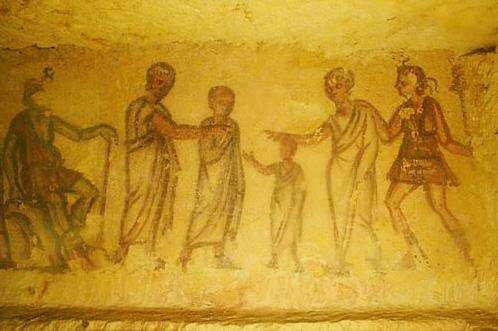
We know about Etruscan clothing because of Etruscan art, both paintings and clothing. There is no surviving Etruscan literature, only incripotions. Thus our knowldge of Etruscan art comes entirely from art work with no intertive text. Those various images show that the Etuscans had well-developed fashion traditions. There are notable Greek and Asian influences. These may have come from the Villanovan origins, especially the Asian influences. The Greek influences which seem the most important may have come from the Greek colonization of Italy or seafaring contacts. Estrucan dress appears to have had a major influence on Roman fashions. Wealthy Etruscans appear to have dressed very well. They appear to have given more attention to fashion than the Greeks. Their clothes were made of fine wool and linen. Some sources mention cotton, but we are not sure about this. Their clothing was often colorful. Both men and women in more recent times, wore a tunic, probably showing the growing Greek influence. Men�s clothing in ancient times during the summer was a loincloth or skirt when working with a Greek-style tunic. In cooler weather men wore a lacerna, a short woolen cloak. We begin to see a more destinctive and longer cloak--the tebenna (mid-6th century BC). This becamne the standard male Etruscan garment. It was quire similar to the Greek chlamys. the tebenna was draped over the left shoulder and then carefully wrapped around the torso under the right arm. It was held in place with various devices, including belts and gurdles. We see it decorated with clavi, colorful stripes which broacast the wearer's social status or rank. Costume experts believe that the tebenna is the inspiration for the Roman toga. The Romans also adopted the clavi. Women commonly wore a gown called a chiton under a shawl called a himation. Both garments were dyed in bright colors. Elaborately patterned garments were popular. Especially striking in the Etruscan image is the use of jewelry. The Etruscans developed a marvelous gold-working technique called granulation. This involved soldering tiny grains of gold on a smooth background to create a glittering effect. Etruscans wore a variety of jewelry, including bracelets, necklaces, earrings, clasps and pins, and other types of jewelry. Fibula were used to hold draped clothing in place. They could be beautifully worked. Etruscan women gave great attention to their physical appearance. Theywore makeup and braided their hair into complicated creations. Early Etruscan men commonkly wore beards, but gradually a clean-shaven face became more common. We do not know much about children's clothing. Young children and slaves are often depicted without any clothing. Older children and youth seem to have dressed much like their parents.
We know that slavery was a part of Etruscan culture, but we know very little about it. Authors largely extrapolate Etruscan slavery based on what is known of slavery in the wider Mediterranean world. They tend to believe that slaves were widely employed in a wide range of tasks, including household servants, field labor, mining, quarry work, artisan manufacture, and entertainers. We are not sure about soldiers. It is believed that slaves were used in the same manner as in Rome and obtained in the same way. They were taken in the same way: war prisoners including civilians of conquered cities, trade, and probably also criminals and debtors. One sources identifies Trasalpine Europe a an important source. [Briggs] It is likely that Etruscan slavery was common. What we do not know is how common it was nor the status of the slaved. We suspect that it was much less common then in Rome, largely because the Etruscan city states did not have huge empire won by military conquest and thus access to huge numbers of conquered peoples. A rare , source of information on Etruscan slavery is the tomb paintings, but they mostly depict only household slaves. Slaves can be distinguished from servants because they are pained naked. The fact that they are some tines named, suggesting their status may have been higher than was the case in Rome. The distinction between slaves, freed slaves, and laborers as well as social status is largely unknown. This is very different from Rome where a great deal is known. The only known written sources are Greek and and only address Etruscan silvery indirectly. Dionysius of Halicarnassus, for example, notably described those disenfranchised in Etruscan society as free men who were treated like slaves. This is similar to the other references. All are indirect and often refer to what is often see as abnormal circumstances. This has caused some historians to speculate that Etruscan slavery was more humane than Greek or Roman slavery. [Benelli]
Rome begn its conquest of the Etruscans (late-4th century BC). By this time Rome was building its formidable military orowess. The Etruscans had risen to a large extent because of commerce. This involved both maritime commrce and landcroutes between the Celtic north and the rest of the peninsula. Sea commerce had been adversel affected by Suyracuse naval strength. The tyrants of Syracuse ruled the island and the surrounding Mediterranean (5th century BC). Celtic tribes iunvading the peninsula also harned theTruscans (5th to 3rd century BC). The deckling threat if the Celts was replaced with 200 years of intermittent warfare wiuth Rome. There was no one climatic battle as Estruscia was not a unified state. Instead there was a izzing mix of peace treaties, alliances, and temporary truces along with battles and sieges. Rome coducted a 10-year campaign on Veii (beginning 406 BC). They besieged Chiusi and fought the Battle of Sentinum (295 BC). It was Rome's unity and professuinal army as well as the declining Etruscan economy that eventually led to defeat. Rome achieved major victories (280 BC). Tarquinia, Orvieto, Vulci, and iher cities fell. Cerveteri held out for a time, but fell (273 BC). The end for the Etuscabns came wth the Roman Civil War. Many Etruscan cities supported Marius. Sulla who prevailed put them to the sword fora second time (83-82 BC). Rome completed the inliteratiin of their culture and history. As a resultsomecauthors refer to the 'enigmatic' Etruscans. Virtually all we know about them today is from their tombs and what the Romans had to say about them. Even their language is not well understood.
Many Italian peoples struggled to control the peninsula. Rome was only one and not by far the most important as the struggle for conyrol began. The Etruscans were the primary power on the Italian Peninsula north of Rome. To he south it was the Saminites. Samnium was already made up of a Samnite League of four peoples (the Caudini, Hirpini, Caraceni and Pentri). Their territory was bigger than any other contemporary state in Italy. The Samnites were generally landlocked between the mountains in eastern Campania and the plains of Puglia on the other side of the peninsula, but at their greatest territorial expansion reached both coastlines on both sides. They were bordered by Lucania in the south and Latium in the north. The first known official dealing between the Samnites and Romans was a treaty (354 BC). The text is lost but probably was an alliance against the Gauls. Rome manage to survive the Celtic Gauls who invaded abd sacked Rome (early-4th century BC). The Republic having successfully repulsed the Gauls began to use its military prowess to expand (mid-4th century BC). Their first target was the Latin and Etruscan towns that had shifted aliegence he Gallic occupation. They also conquered other nearby towns that had never been apart of Rome. This made Rome the most powerful force no only in Latium, but all of central Italy. Once this had been accomplished the Romans looked toward the rich farm lands of Campania to the south. The Samnite Wars were along with the Punic Wars perhaps the most important in Roman history. The Romans were often scornful of the people they conquered. They refer to the 'fat' Etruscans. The Samnites were different. The Romans respected them. They refered to the belliger Samnis--the Warrior Samnites. There were three Samnite wars (343-290 BC) as well as intervening Latin War. The first Samnite War was fought (343-41 BC). The second Samnite War was fought (327-04). The Third Samnite War was fought (298-290 BC). Victories in Samnite Wars established the Roman Republic as the supreme power on the Italian peninsula.
Benelli, Enrico. The Etruscan World (2013). There is a chapter on "Slavery and Manumission".
Briggs, Daphne Nash. (2002) "Servants at a rich man's feast: Early Etruscan household slaves and their procurement," Etruscan Studies Vol. 9, Article 14.

Navigate the HBC Italian pages:
[Return to the Main pre-Roman Italian history page]
[Return to the Main ancient history page]
[Return to the Main Itlalian page]
[Return to the Main European history page]
[Italian school uniforms]
[Italian youth groups]
[Italian choirs]
[Italian movies]
[Italian royalty]
Navigate the Children in History Website:
[About Us]
[Introduction]
[Biographies]
[Chronology]
[Climatology]
[Clothing]
[Disease and Health]
[Economics]
[Freedom]
[Geography]
[History]
[Human Nature]
[Ideology]
[Law]
[Nationalism]
[Presidents]
[Religion]
[Royalty]
[Science]
[Social Class]
[Bibliographies]
[Contributions]
[FAQs]
[Glossaries]
[Images]
[Links]
[Registration]
[Tools]
[Children in History Home]