|
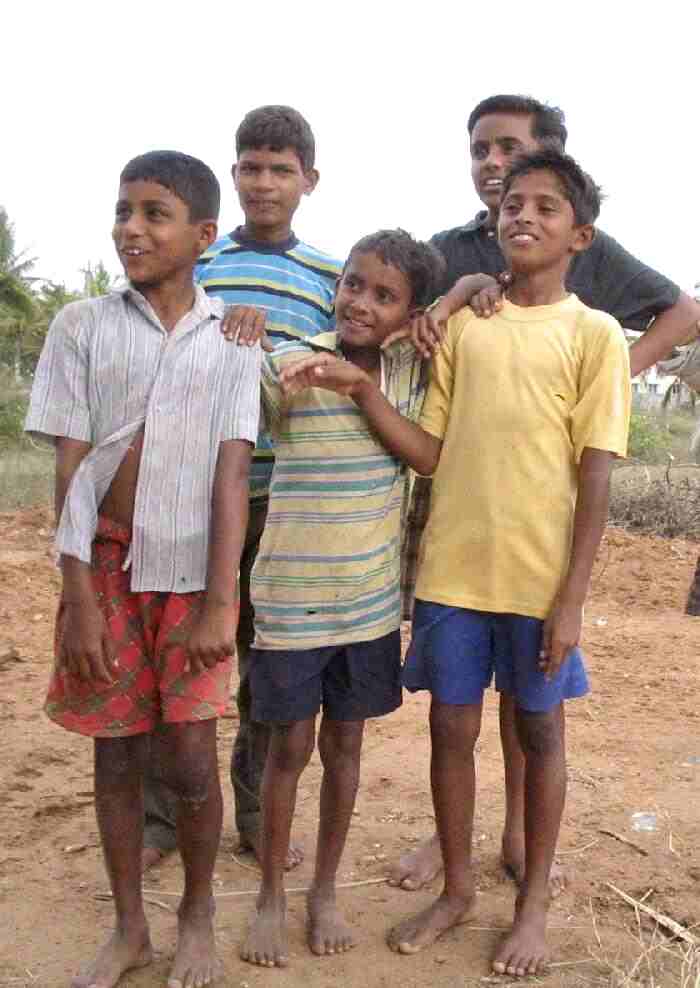
Traditional clothes men and boys wear are normally a lungi and at the most a towel hung over one shoulder, and women also a lungi plus a short blouse. You see there is not much difference between children´s and grown ups´ clothes - apart from a little more freedom children observe. Here school is often an influence promoting Western dress. HBC plans to develop a glossary of Indian garments. Traditional clothing was still commonly worn in the 1960s, especially in regional areas. We note that by the 21st century that Western-style clothing is becoming increasingly common, even in rural areas. Traditional clothing has not disappeared, but is much less common than it once was. A factor here is the economic prosperity that India is experiencung. This seems even more the case for children, in part because Western styles are normally worn at school. We are not sure if the children's preferences are a factor here.
Going barefoot is especially common in the poorer developing countries where parents often can not afford to buy even inexpensive footwear for their children. Climate is also a factor as these countries are primarily located in tropical areas where footwear are not needed for cold weather. Many children even go barefoot to school. It is especially common for younger children to go barefoot. One observer reports that most boys in Kerala went barefoot in the 1960s, especially from pooer families. He is not sure how common this is now.
We do not yet have a lot of information on Indian traditional clothing. Hopefully our Indian readers will provide some informstion on traditionazl clolthing. The traditional clothes men and boys wear are normally a lungi and at the most a towel hung over one shoulder, and women also a lungi plus a short blouse. There are presumably regional differences. You see there is not much difference between children´s and grown ups´ clothes - apart from a little more freedom children observe. One reader noted traditional clothing was still commonly worn in the 1960s, especially in regional areas. When the author visited Kerala in the 1980s, we noted traditional clothing being widely worn. We note children, especially boys, commonly wearing Western clothes. We are not sure why that is. We suspect it is the practicality. School uniforms are for, example, almost always Western styles. A few girls schools had traditional styled uniforms. Very young boys may wear waist laces. This is the case even with Westernized middle-class families.
We seen an increasing number of Indian children wearing Western dress. Before World War II, few Indian children wore Western dress. Since the Wat there has been a slow, but steady increase in the use of Wester-styled clothing. At first this was smong the educated elite in the cities. Gradually this has spread to other classess and in the 1990s increasingly affected the countryside. School gas surely been an influence promoting Western dress. We note that by the 21st century that Western-style clothing is becoming increasingly common, even in rural areas. The garments involved are primarily "T" shorts and short pants. Prosperous city children have more emaborate Western wardrobes. Traditional clothing has not disappeared. Girls in particular are more likely to wear traditiinal styles. Traditional clothing is, however, much less common than it once was. Another factor here is the economic prosperity that India is experiencing. This seems even more the case for children, in part because Western styles are normally worn at school. We are not sure about the children's preferences or if this was a factor here.
HBC plans as we develop more informarion on Indian clothing to develop a glossary of Indian garments. Perhaps one of our Indian readers would like to assist with this.
Footwear is a little complicated because our categories here, traditional and Western, are not helpful. The traditional approach to footwear for children is going barefoot, but this still very common in modern India. Going barefoot is especially common in the poorer developing countries where parents often can not afford to buy footwear, even inexpensive footwear like flip-flops for their children. Climate is also a factor as these countries are primarily located in tropical areas where footwear are not needed for cold weather. Many children even go barefoot to school. It is especially common for younger children to go barefoot. One observer reports that most boys in Kerala went barefoot in the 1960s, especially from pooer families. And as far as we can tell this is still very common in India, depite the enormous economic progress being reported. We see many children going barefoot. This is especially true in rural areas, but we also see it in the cities.
India is ine of the cradles of civilization. While we know little about the Indus Valley civilization. The adornmenr with jewelry is notable in all subsequent civilizationms for which information is available. One source writes, "It is rare to find any woman in India who may not have ever loved to decorate herself with jewelry." The emphasis may have been on adorning women, but Indian male potentates were also among the most heavily adorned rulers. Indian is famed for its jem stones, especilally rubies and diamomds, but we also see emeralds, pearls, and sapphires. We believe that no know ruler in history possessed such richs in precious metals and jem stones than the great Moguls (16th-17th centuries). But it is not just the ruling class that appreciatede and wore jewlry. Jewelry was appreciated not only for its traditional value and beauty, but for the common people was a source of security in uncertain times before banks and other investments existed. And the quantity of jewelry owned by a woman was an expression of her and her husband's status. Jewelry was used tom accentuate a woman's beauty. Dancers performed with exquisite sparkling Indian jewelry. The rtpes of jewelry is huge. There was essentially an an ornament for virtually every part of her body beginning with the hair, including the ears and nose, down to her toes. Indian jewlry has been traditional heavy, includuing voluminous gold pieces. The ordinary people turned to silver. More modern jewlry is lighterr, probably because as India becomes more porosperous, more people can aford gold, but not large heavy pieces. HBC of course is primarily concerned with children amd we see laces, neckaces, pendents, rings, waist bands, and bracelets (for both wrists, and ankles). Much of this jewelry for children is done in gold. India continues o be ine if the worls's impprtant bmarkets for gold.

Navigate the Boys' Historical Clothing Web Site:
[Introduction]
[Activities]
[Biographies]
[Chronology]
[Clothing styles]
[Countries]
[Topics]
[Bibliographies]
[Contributions]
[FAQs]
[Glossaries]
[Images]
[Links]
[Registration]
[Tools]
[Boys' Clothing Home]
Navigate the Boys' Historical Clothing national pages:
[Return to the Main Indian country page]
[Return to the Main countries page]
[Return to the Main country garment pge]
[Return to the Main Indian page]
[Return to the Main Asian page]
[Afghanistan]
[Bangladesh]
[Bhutan]
[Burma]
[China]
[Iran]
[Nepal]
[Pakistan]
[Sri Lanka]
[Tajikistan]
[Tibet]
[Turkmenistan]
[Uzbeckistan]