|
Scottish boys participate in the same range of activities as do boys in other countries. Here there is a graet similarity with England. Scottish boys will dress simalrly with English boys for church, dance, holiday celebrations, music, play, school, Scouts, sport, and a host of other activities. Sport is especially important and the clear preference among boys is football (soccer). One difference would be the kilts that Scottish boys wear for Highland dancing at either Highland gatherings or other events. One difference from England is the absence of important coirs. Some cottish boys also used to wear kilts for church, but this is now less common except for boys at private schools. Scottish Cubs tend to dress like English Cubs, bit some Scottish Scouts wear kilts when dressing up for special occassions. This includes religious services and special events like weddings.
Scottish boys participate in the same range of activities as do boys in other countries. Here there is a graet similarity with England as noth countries are part of the United Kingdom. We mention this because more work has been done on England. Scottish boys will dress simalrly with English boys for church, dance, holiday celebrations, music, play, school, Scouts, sport, and a host of other activities. Sport is important and the clear preference among Scottish boys, as in England, is football (soccer). One difference would be the kilts that Scottish boys wear for Highland dancing at either Highland gatherings or other events. One difference from England is the absence of important choirs. Some Scottish boys also used to wear kilts for church, but this is now less common except for boys at private schools. Scottish Cubs tend to dress like English Cubs, but some Scottish Scouts wear kilts when dressing up for special occassions. This includes religious services and special events like weddings.
Scotland is a small country with an extensive coastline. And there are also numerous offshore islands. No place in Scotland is more than an hour or two from the coast. There are beautiful wide beaches in Scotland as well as isolted rocky coves. Much of the coast is unspoiled. The beaches have dunes and golden, sands. While the beaches are beautiful, the water is rather cold, even for hardy beach goers. There are notably beautiful nature sites, untouched pine forests. Tghere are rugged cliffs covered with gannets to delight bird waters. Marshland attract migrating geese. While the beaches if one wants to swim have limited appeal to vacationers, Scotland's wildlife opportunities have considerable appeal. There are numerous beautiful beaches which have a very special charm. These are not the beaches crowded with warm water seeking tourists. Rather than hectic, the Scottish beaches are calming and a wonderful nature experince. Often there is not another beach goer in site, but you might see a seal or on a lucky day an otter. Many of Scotland's best beaches are hidden away in isolated, remote areas and thus require considerable effort if ones wants to see them. And of course there is always the chance of experiencing an Atlantic or North Sea gale. When the sun shines, however, the Scottish beaches are spectacular.
One difference from England is the absence of important choirs. This ids lrgely because the Anglican Church that sponsors most English choirs is the English Church of Englnd. The Reformatuioin went much further in Scotland and therev is no boy choir tradituion in the more austere Calvanist tradition of the Scottish kirk.
One difference would be the kilts that Scottish boys wear for Highland dancing at either Highland gatherings or other events.
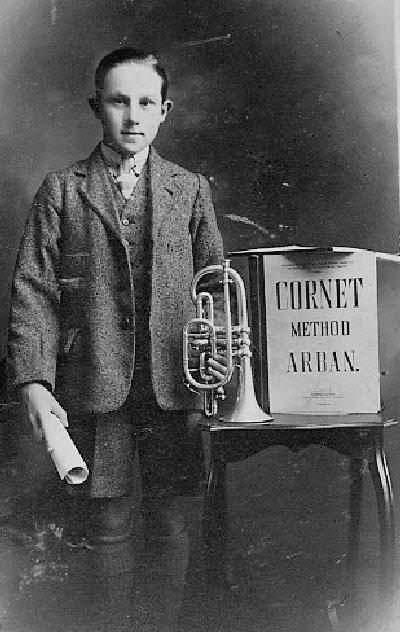
This postcard features a boy with a coronet. There is a book beside him titled Coronet Method Arban. It was taken by Johnston of Motherwell in Scotland. Presumably the boy is testifying to using the book to study the coronet. He looks rather an okdr boy, perhaps 17 or 18 years old and wears a short pants suit. I am not sure about the date, but would guess about the early 1920s. Scottish children play the same instruments other European children play. The only major difference is that many Scottish children learn to play the bagpies.
There are only two major cities in Scotland, Edinburgh and Glasgow. Both have beautiful city parks. The parrks there are fairly well known. With over 90 parks and formal gardens of various size dotted around Scotlands most industrial city. Some of the best lovd parrks are: Kelvingrove, Pollock Gountry, Rouken Glen. Mugdock Country, Victoria, Linn Grove, Alexandria, Botanic Gardens, Auchinlea, and James Hmoltom Heritage. Some of the favorite parks in Edinburg are Calton Hall. WespRincess Street Gardens, East Princess Street Gardens, Inverleith, Royal Botanic Gardens, Holyrood, The Meadows, Edinburg Castle, nd many others. There are other parks in in Scottish cities, but not as well known. They provide wonderful places for city families to enjoy a little nature. And recreation in spots close to home. Each of the parks have their own spcial history and character.
We know very little about per-Christian religious practices in Scotland. The Picts and Celts were per-literary societies. All that has survived are place names. Christianity was first brought to Scotland by the Celtic Church, but as in England was evetually overwealmed by the Roman Church. The Reformation converted the vast mahority of Scotts, but Catholcism survived in isolated northern areas, especially the islands like Uist and Barr. Scotland is a largely Protestant country. The Scottish Reformation and Kirk had had a major influence on Western thought. The Scottish Reformsation played an impprtant role in English Reformation. The Scottish enlightment through men like John Locke and Adam Smith had a powerful impact oin both England and America, a remarable development for such a small country. There were a few isolated areas of Scotland that remained Catholic. And in the 19th century Irish emigration brought many Irish Catholics to Scotland, many went to Glasgow where there were industrial jobs.
Scotland as part of the United Kingdom has basically followed prevailing British school uniform styles. Standard school uniform styles in England and Scotland are esentially the same. It would not be possible be difficult to identify British and Scottish school boys. There have been, however, some differences. In addition, as a more traditional part of the country, changes often occur more slowly in Scotland than in England. The major difference is of course the kilt. We are not sure to what extent the kilt was worn in the 19th century at bloth state and private schools. We do know that in the 20th century that most Scottish private schools adopted the kilt as their dress uniform.
Sport is important and the clear preference among Scottish boys, as in England, is football (soccer).
The world's first uniformed youth group was born in Scotland--the Boys'Brigade. The Boys'Brigade soon became primarily an English group and Scouting with its more secular appeal became the primary uniformed youth group in
Scotland. The Scottish Cub and Scout uniforms were quite similar, the primary difference being that Scouts wore kilts. Cubs could also wear kilts. bit it was not as common. Scottish Scouts, but not the Cubs, also wore destinctive headwear. We do not know, however, how popular these groups were in Scotland. HBU knows of no other important Scottish youth group. Scottish Cubs tend to dress like English Cubs, but some Scottish Scouts wear kilts for formal occassions.
As in othr countries there are a wide range of outings in which children are involved. Thes can includ bisits to parks, picnics, hikes and much more. One activir=ty especially associated with Scotland are the Highland Games.

Navigate the Boys' Historical Clothing Web Site:
[Return to the Main Scottish page]
[Introduction]
[Activities]
[Biographies]
[Chronology]
[Clothing styles]
[Countries]
[Bibliographies]
[Contributions]
[FAQs]
[Glossaries]
[Images]
[Links]
[Registration]
[Boys' Clothing Home]
Navigate the Boys' Historical Clothing kilt pages:
[Main kilt page]
[Kilt suits]
[Scottish kilts]
[Scottish boys clothing]
[Scottish school uniform]
[Highland dance]
[Pipeband]
[Irish kilts]
[Irish boys clothing]
[Irish step dancing]
[Greek kilts]