|
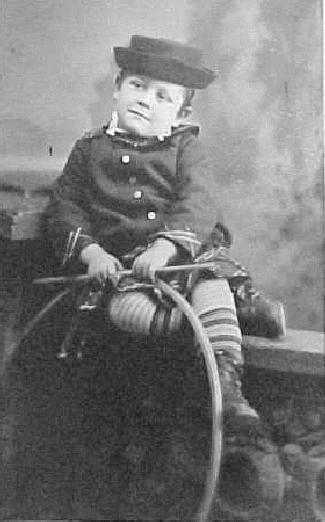
America was still a fashion backwater in the 1870s. Fashions were still largely imported from Europe, largely England and France. Americans might rework European fashions. Thus while the Highland kilt never proved greatly popular in America, the reworked kilt suit proved to be a very important style until the turn-of-the century. Little Americam boys in the 1870s, as in Europe, continued to wear dresses. The kilt suit appered in the 1870s. Thios was a fashion inovation based on the Scottish kilt that Queen Victoria had helped popularize for boys. While American boys did not wear Highland outfits, the kilt suits became very popular. Some were worn with tartan kilt skirts rather than the more muted materials more common in subsequent decades. Sailor suits appeared in many forms, but were not yet the dominate style for boys. Fancy velvet suits for boys appaered showing a French influence, but they were not yet called Faintleroy suits. Some had fancy collars and bows, but generally not the huge collars and bows that appeared in the 1880s. Many styles of hats appaered for boys. Collars began to increase in size as did bows by the end of the decade. Boys were increasingly dressed in kneepants rather than long pants. By the end of the decade, kneepants had become a widely accepted fashion for boys, although they were generally not yet commonly worn by teenage boys, except for the very youngest. Boys wore long stockings with knnepants. Stripped stockings were considered stylish.
America was still a fashion backwater in the 1870s. Fashions were still largely imported from Europe, largely England and France. Americans might rework European fashions. Thus while the Highland kilt never proved greatly popular in America, the reworked kilt suit proved to be a very important style until the turn-of-the century. We see it in the 1860s, but they were especially common in the 1870s and 80s. Older, school-age boys wire cut-away jackets with long or shoetehned-length pants. Some older boys eore lapel-jacketrs, usually with long pants.
Little Americam boys in the 1870s, as in Europe, continued to wear dresses. The Mint Museum of Art in North Carolina displayed a young boy's dress with a rosette "bustle" purchased in 1879 in Chicago for 4-year old James Cromwell. Such garments
were worn over flounced petticoats with lace-trimmed or plain pantaletts beneath. The kilt suit appered in the 1870s and was enormously popular for younger boys. This was a fashion innovation based on the Scottish kilt that Queen Victoria had helped popularize for boys. While American boys did not wear Highland outfits, the kilt suits became very popular. And no where was it more popular than in America. Some were worn with tartan kilt skirts rather than the more muted materials more common in subsequent decades. Sailor suits appeared in many forms, but were not yet the dominate style for boys. Fancy velvet suits for boys appaered showing a French influence, but they were not yet called Faintleroy suits. Some had fancy collars and bows, but generally not the huge collars and bows that appeared in the 1880s. Many styles of hats appaered for boys. Collars began to increase in size as did bows by the end of the decade. Boys were increasingly dressed in knee pants rather than long pants. By the end of the decade, kneepants had become a widely accepted fashion for boys, although they were generally not yet commonly worn by teenage boys, except for the very youngest. Boys wore long stockings with knnepants. Stripped stockings were considered stylish.
The combination of industrial expansion and agriculutral productiviy along with the fall in the cost of photography meant that the photograaphic record was an increasingly valid indicator of popular trnds. Ther was still poor Americans that were underepsentative, but they were an increasingly small sector of the population. Thus we believe that the images we see are an incresingly accurate depiction of fashion and social trnds like breeching. There was no clear definative age at which boys were breeched. There were substantial differences from fanily to family. And we have no idea to what the differnces can be attributed. We see most parents breeching boys at about age 2-4 years. Smaller numbers were breeched at age 5 years. As most boys were now attending school, beginning at age 6 years, alnost all boys were breeched by that age. And beginning in the 1870s we begin to see the school portait becoming a new popular phenomenon, creating a useful addition to the photographic record.
Articles on style and fashion in contemprary magazines are very important in understanding contemporary fashion trends and terminology. They help understand the phphographs archived on HBC. We can make outmany clothing details in the photographs, but the stlistic conventions are often more elusive. We are constantly looking for these articles addressing boys' fashions. We note a brief article on "Small Boy's Clothes" from Harper's Bazar Magazine. We are not yet sure when it appeared in Harper's. The copy we found was in the Waterloo Courier (July 18, 1877, page 2). This was the Waterloo, Iowa newspaper. It describes the fashionable styles for young boys to wear before they are breached.
We see American boys commonly wearing their hair down to their ears and often covering a good bit of their ears. Here we are not talking about pre-school boys who might still have their curls, in some cases ringlet curls. We are talking about fully school age boys and teenagers. This was not a child's cut. Adult men also wore their hair long. This continued in the 1860s, althoughh we see more boys with short cuts. This was the situstion in the 1870s, but as the decade progressed, we see fewer and fewer boys with longer cuts. We see more and more boys with modern-looking short cuts. While the lengths of the cuts vsries, one aspect did not change--the part. Boys tended to have side parts and and girls center parts. This was not an absolute matter, but it was very common convention. It thus becomes an especially valuable in assessing the gender of younger children. Pre-school boys look much like girls. Only by school age do the more pronounced gender appearance differences become pronounced. This it is virtually impossible to identify boys wearing dressesm especially as some long or longish hair. It should be stressed that not all girls had long hair. Thanks to CDVs and cabinet cards we have a huge photographic record. Unfortunalely, mom and and dad neglected to write the names of the children on the back. Unlike Dags and Ambros, there are quite a numner of portraits with the children identified, but most do not. But the hair parts offere one of the few ways of determining gender with a fair degree of actuaracy.
We are collecting individual accounts from the 1870s. In some cases we have details. In other instances we can only assess images that we have found without any provinance.
Van Husen bioys (1870)
William Henrick Chapman (1870s)
Robert Stanley Mitcheson (1870s)
?????? Lincoln (1870s)
Mark mI. Harris (early-1870s)
Lembecke brothers (1871)
J.T. Chatterton (about 1870)
Navigate the Boys' Historical Clothing Web Site:
HBC

[Return to the Main U.S. late-19th century decade chronology page]
[Return to the Main U.S. late-19th century chronology page]
[Return to the Main 1870s chronology page]
[Introduction]
[Activities]
[Biographies]
[Chronology]
[Clothing styles]
[Countries]
[Bibliographies]
[Contributions]
[FAQs]
[Glossaries]
[Images]
[Links]
[Registration]
[Tools]
[Boys' Clothing Home]
Created: April 13, 2002
Last updated: 12:42 AM 3/22/2020