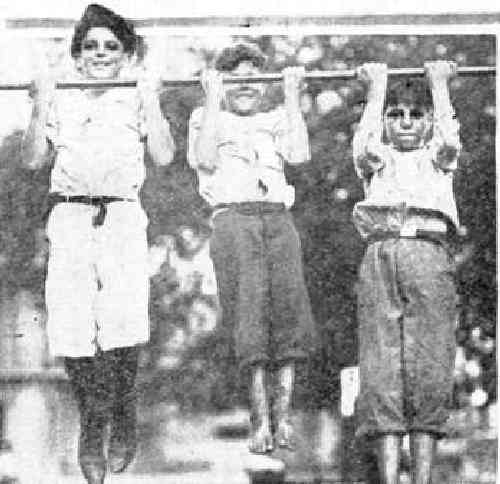
Figure 1.--This playground scene comes from New Orleans in 1920. Going barefoot in the summer was especially common in the South. |

|
American experienced economic prosperity after World War I. That prosperity meant that American children had more leisure time than ever before. Baseball was the big sport for American boys in the 1920s. Football was also popular, but basketball was not nearly as popular as today. Soccer was almost unknown. Most middle class boys were Cubs and Scouts and there was a substantial growth in the Scout movement after the War. Scouting was the only siuzeable uniformed youth group in which boys participated. Play grounds were very popular and often in walking distances from homes. There were substantial differences in the facilities. The move to the suburbs had just begun. Mothers strongly incouraged boys to take music or dance lessons. The United States is a large country and thus there are substantial differences among regions. Northern states tended to have winter sports like skating and skiing which were virtually unknown in the Southern states. This of course had an impact on clothing styles.
American boys in the 1920s had all kinds of conveyences to play with. A great scene from the 1920s is a Texas boy wearing a beanie and button-on sailorcsuit playing wiyh his wagon.
Mothers strongly incouraged boys to take dance lessons. Most middle class boys were sent to social dance lessoins, but some artistic mothers also tried to involve their sons in other dance orms like interperative dance.
Mothers strongly incouraged boys to take intrumental music lessons. Piano was a popular first choice, but of course many fanilies could not afford a piano. Small instruments like violins were much more fordable. Many children took up the violin. The violin for decades was a primary instrumental choice. We seem to note more boys than girls learning the violin. We are not sure why. There was a major shift in instrumental music during the 1920s. The decade is of course known as the Roaring 20s and also the Jazz Age. Jazz as not born in the 1920s, but it is when it made the big time. Several factors brought this about. Commercial radio broadcasting began after World War I. In additionn RPM 78 records became popular. Another factor was the Great Migration wiyh rural soyhern blacks coming to the big cities of the Mid-West and North East, bringiung their music with them. The shocking improvisation, syncopation, and a strong rhythm was as shocking as the new fashions. All of this affected the instruments boys chose to learn. Jazz relied more on brass and woodeind instrumnts than string instruments. Brass instruments were not new. They were popular with the marching bands at the turn of the century. Woodwinds like the clarinet were newly popular. Many parents did noit approve of the new music. So they often pushed the violin over other choices. But vgradually they all became accepable choices.
Play grounds were very popular and often in walking distances from homes. The move to the suburbs had just begun. There were substantial differences in the facilities. Jungle gums, slides andswings were very common.
Most children walked to school in the 1920s. The patrol boys became a standard institution at most schools. Children at city schools either briought their lunches or went home for lunch. Not many schools had cafeterias. Many elementary schools adopted a special day for Scouts to wear their uniforms. Boys commonly dressed in suits for school in the 1910s. We still see that after World War I in the 1920s, but not as commonly. Especially by the end of the decade we see many boys wearing more casual clothes for school. The youngest primary (elementary) boys might wear shorts pants for school, but knickers were much more common, especially by about the 3rd grade. Knickers replaced kneepants in the 1910s and were quite common even in secondary school. Knickers continued to be standard schoolwear for boys in the 1920s, although we no longer see older highschool boys wearing them. Sweaters and corduroy knickers were a popular combination. The 1920s were the first decade in which sweaters became a major school item. Knickers were worn mostly with long stockings until the end if the decade when we begin to see brightly patterned knee socks. Boys almost never wore knickers with ankle socks. We also see a shift from high-top to low-cut shoes over the decade, Sneakers were becoming popular durung the 20s, but were not commonly worn to school. We continue to see differences between city and rural schools. Girls almost always wore dresses or blouses and skirts to school. Readers can view scenes at individual schools during the 1920s. Highschool girls often middy blouses and bloomers for gym in the 1910s. We still see that in the early-20s, but we begin to see girls at some schools wearing short pants for gym. We also see romper suits. We continue to see quite a number of 8th grade graduations. Many chikdren still did not go on to high school after the 8th grade in the 1920s, although it was becoming more common. Thus 8th grade graduations were still an important event.
Most middle class boys were Cubs and Scouts and there was a substantial growth in the Scout movement after the War. Scouting was the only siuzeable uniformed youth group in which boys participated. The American Scout movement was relatively small until after World War I (1914-18). The War gave the movement a tremendous boost as patriotism soared. The movement grew significantly in the properous 1920s. A new uniform was adopted in 1922 to better diferentiate Scouting and the military. It was rapidly becoming an excepted part of an American boyhood, at least in small towns and cities to join the Boy Scouts. The organization became increasingly popular throughout the country and was supported by both schools and churches. The American Cubbing program had not yet been created in the 1920s. Unlike England and Europe, short pants were not commonly worn. Shorts were worn to some extent at jamborees, but for the most part American Scouts wore the knicker uniform when not at a camp or jamboree.
Sports as we know them today were either invented in the 19th century or had their rules codified at the time. We also see professional treansforming. nd with the growth of public education we see high schools and universities forming teams.
These trends were well established after World War I in the 1920s. Some call it the Golden Age of Sports. To the earlier trends the 1920s brought economic prosperity and higher wages. This meant the average American family had higher earnings and was bette able to afford more recreation and boys had more opportunities for sports at school. And suddenly commercial radio appeared. This meant that fans could follow their favorite teams and players even if they could not visit the ball parks. This was the deade of Babe Ruth and Lou Gherig. City teams became regional teams. Teams built large new stadiums. Yankee Stadium was the 'House tha Ruth built. People flocked to the new stadiums in large mumbers. And one sport among all others dominated. Baseball was the 'national passtime'. More people went to baseball games and followed baseball teams than any other sport. The Babe was the perfect sports hero for the Roraring Twenties. Not only did he out slug every other hitter in baseball, but he had a lrger than life personality to go along with it. He was raised in a children's home because his parents could not control him. He drank and ate to excess and womanized. But he had asift spot for children and orphans. Baseball was the dominant sport, but not the only one. College football also became popular. One of the most popula teans was Notre Dame, perhaps becuse of the Catholic association, but also because of an exciting style of play. The Irish were coached by Knute Rockne. Illinois star Harold “Red” Grange became a national hero.
The best college teams began competing in bowl game. Boxing was also popular. Heavyweight champion Jack Dempsey became nearly popular as Ruth. Other popular passtimes included horse racing, golf, and tennis. Basketball was played in colleges and high schools, but professional football and basketball were just begining to develop. Baseball was the big sport for American boys in the 1920s, but places to play were limited. The urban form becme stick ball. But Henry Ford's Model-T was beginning to trandform America. Transposed to the suburbs there were places to play. football was also popular with boys, but basketball was not nearly as popular as today. Soccer was virtually unknown. The United States is a large country and thus there are substantial differences among regions. Northern states tended to have winter sports like skating and skiing which were virtually unknown in the Southern states. This of course all had an impact on clothing styles.

Navigate the Boys' Historical Clothing Web Site:
[Return to the Main U.S. 1920s page]
[Introduction]
[Activities]
[Biographies]
[Chronology]
[Clothing styles]
[Countries]
[Bibliographies]
[Contributions]
[FAQs]
[Glossaries]
[Images]
[Links]
[Registration]
[Tools]
[Boys' Clothing Home]
Navigate the Boys' Historical Clothing U.S. pages
[Return to the main United States chronology page]
[Return to the Main U.S. Inter-war year page]
[Return to the Main U.S. activities page]
[The 1900s]
[The 1910s]
[The 1920s]
[The 1930s]
[The 1940s]
[The 1950s]
[The 1960s]
[The 1970s]
[The 1980s]
[The 1990s]
[The 2000s]