
America during World War II: Work
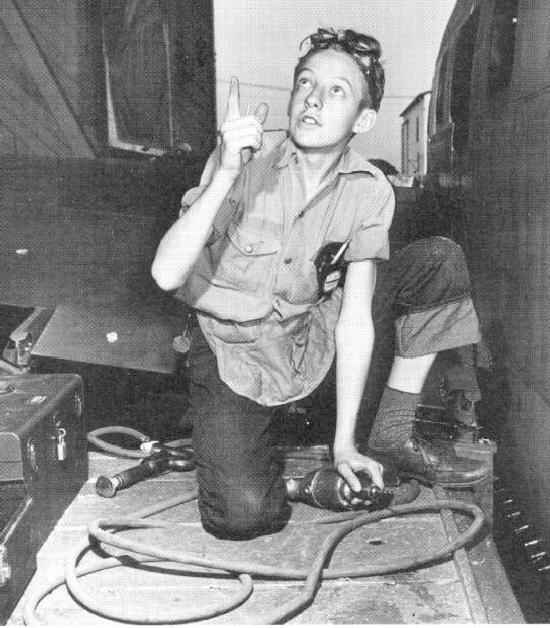
Figure 1.--American boys like 16-year old Roy Popp joined the labor force after the Japanese attack on Pear Harbor. Roy is working on the fuselage of a transport plane at a west coast shipyard. Hitler dominated Europe with the Luftwaffe in the late 1930s. He and other ranking NAZIs had no concept of the ability of America to produce planes.
|
|
American factories geared up for the War effort and many new factories were opened. The unemployment so severe during the Depression was no longer a problem. In fact there was now an increasingly severe labor shortage. This was not only a matter of increasing production, but also the draft that begun in 1940 began to take men out of the work force. This was increadsingly important after Pear Harbor (December 1941), war production was increased to unprecedent levels and millions of men were drafted or enlisted in the military. The vacancies in the work force was made up with youths, women, and minorities. Sometimes older children worked part time along with their mothers to support their families. Child labor laws were suspended during the war. Millions of children between the ages of 12-17 years were employed in a wide range of jobs. Even in factories it was common to see boys of 16 and 17 years of age working. It was not just mom in the form of Rosey the Riveter that went to work during the War. Jobs were opened to minorities, especially blacks, that were formerly excluded from many jobs. Both the British and Russians adopted similar policies to mobilize the civilian population for War work. The Germans took a very different approach. Instead of women and youths, they employed slave labor to keep their factories going.
Beginning with the Stock Market crash in October 1929, American industry wa crippled with the Great Depression. At the height of the Depression as President Roosvelt descibed, "One-third of a nation is ill-fed, ill-housed, and ill-nourished". With work hard to get, youth, women, and minorities has especially severe difficulties obtaining work. FDR's New Deal combined with war orders from Europe in the late 1930s finall began to bring America out of the Depression. American factories geared up for the War effort and many new factories were opened. The unemployment, so severe during the Depression, was no longer a problem.
In fact there was now an increasingly severe labor shortage. This was not only a matter of increasing production, but also the draft that begun in 1940 began to take men out of the work force. This was increadsingly important after Pear Harbor (December 1941), war production was increased to unprecedent levels and millions of men were drafted or enlisted in the military.
Expanded Work Force
Building a huge military to fight the War meant taking millions of men out of civilian jobs through volunteers and conscription. This created a major problem faced by other indistrial countrieds during World War II. Waging war required massive armies, but conscripting workers meant reducing the labor force needed to create the weapons of war. And World War II was an industrial war in which ships, planes, tanks, and other motorized vehicles played critical roles. The United States eventually mobilized more than 11 million Americans, mostly men. Most were young men of working age who woild have otherwise been in the work force. This meant that to maintain, let alone increase production, millions of new workers had to be recruited for war work. At first as a result of the Depression, there were large numbers of unemployed that could be brought to work, Even before Pearl Harbor, however, the unemployment roles had fallen substantially and a labor shortage developing. After Pearl Harbor a severe labor shortage devedloped.
The American answer to filling vacancies in the work force was to hire 1) women, 2) youth, and 3) minorities. Even with conscription, the United States increased the work force from 56 nillion (1939) to 65 million (1945) an increase of nearly 10 million workers. This number, however, understates the American indiusdtrial mobilization. It soes not measure the number of people already in the work force, but not employed in industrial factories. A major part of America's industrial mobilization was shifting workers into the industrial work force. All of these groups were in part motivated by patriotism, but well paying factory jobs were also a powerful inducement drawing these groups into the work force. There was a fourth sourse of workers. In some cases the military used its people in key industries or allowed draftees to return to the labor force after basic training.
Allied Labor Programs
There were three other major allied countries during World war II (Britain, France, and the Soviet Union). Each had varied labor experiences. France was defeated and occupied by the Germand early in the War (June 1940). The French Army was interned and used for labor by the Germans, mostly agricultural labor. After the War began to turn against the Germansd, they forced the French to consript French wiorkers to work in the Reich. Thanks to the English Channel and Royal Air Force, Britain defied the Germans. It adopted a labor program much like the American effort. The Soviet Uniion began as a German ally, but became a key part of the Allies effort against German when the the NAZIs invaded (June 1941). The Germans advanced to the gates of Moscow, but a Red Army offensive caused enormous losses and first the Germans back. Thus the Germans never held the Russian core of the Soviet Union. So the Russians who moved their armaments factories east had both the population to not only sustain and increase war production. The Germans did hold on to the former eastern territories of th Poland which had been seized by the Soviets in 1939 aswll as the Ukraine. Here the Germans recruited large mumbers of workers or fircibly seized them for work in the Reich. The Soviets not only employed youth and women in their factories, but like the Germans used slave labor--the vast Gulag.
The Germans took a very different approach. Instead of women and youths, they employed slave labor to keep their factories going. Nuremberg procedutor Thomas Dodd declared, "The NAZI foreign labor policy was a policy of mass deportation and mass enslavement ... of underfeeding and overworking foreign laborers, of sibjecting to every form of degradation,
brutality, and inhumanity ... a policy which constituted a flagarant violation of the laws of war and the laws of humanity." The NAZIs during World War II implemented a slave and forced labor program to supply needed labor to the German war industry. This program was approved by Hitler months before the 1939 invasion of Poland. The German program
as it evolved during the War had two purposes, The primary purpose was two provide workers for German factories and farms as German manpower was to be directed into the armed forces. This was especially important as NAZI idelopgy resisted imploying married women in factories.
HBC

Navigate the Boys' Historical Clothing Web Site:
[Return to Main American World War II children page]
[Return to Main American 1940s page]
[Introduction]
[Activities]
[Biographies]
[Chronology]
[Clothing styles]
[Countries]
[Bibliographies]
[Contributions]
[FAQs]
[Glossaries]
[Images]
[Links]
[Registration]
[Tools]
[Boys' Clothing Home]
Created: May 30, 2003
Last updated: 1:55 AM 9/6/2010