|
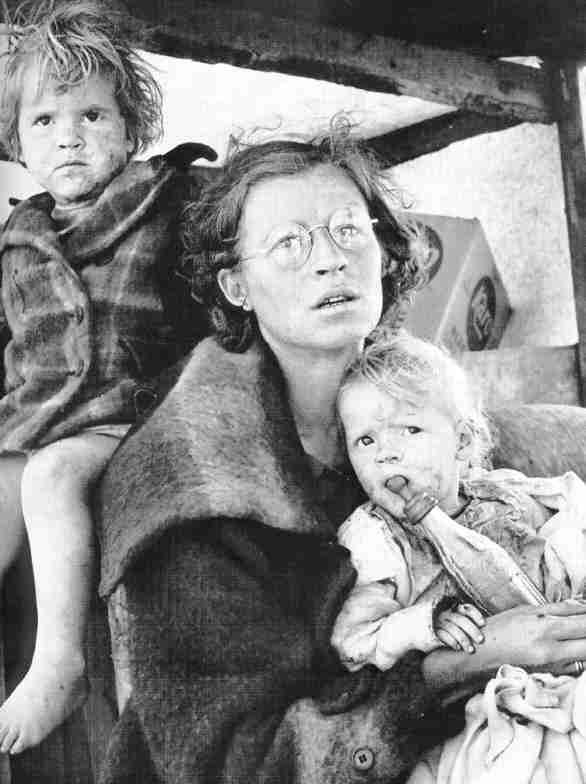
The Great Depression of the 1930s was the worst economic slump ever to affect the United States. It was not just a
national economic crisis, but one which spread to virtually every country. The greatest calamity to befall Americans in
the 20th century was the Great Depression--a worse calamity than even two world wars. The Depression began with the Wall
Street stock market crash in October 1929. Soon business were going under and Americans were losing their jobs. All
Americans were affected. Eventually about one-third of all wage earners were unemployed and many who kept their jobs saw
their earnings fall. President Hoover who had engineered a humanitarian miracle in Europe during World War was unable to
break away from the mindset that the Government should not intervene in the economy. President Roosevelt was elected by
a landslide in 1932. He brought energy and new ideas to Washington and the Federal Government initiated programs that
would have been rejected out of hand only a few years ago. Roosevelt was willing to use the Government to solve economic
and social problems besetting Americans. The people loved him, electing him to an unprecedented third and fourth term.
The propertied class or "economic royalists" as he called them, hated him. Roosevelt's program was called the New Deal
and the many programs initiated help change the face of the United States: Social Security, the Tennessee Valley
Authority, rural electrification, the Works Progress Administration (WPA), protection for union organizers, and many
others. The conservative-dominated Federal Courts struck down WPA, but many New Deal programs endure to this day. The
great novel to emerge from the Depression was John Steinbeck's The Grapes of Wrath which addressed to problems of
rural Americans and the dust bowl. Urban Americans of course also suffered. While the New Deal brought relief to many
desperate Americans, the Depression lingered until orders for war material from Europe began to flood into America in the
late 1930s. The rest of the world was also affected by the Depression. Britain and France also struggled with the
economic down turn. The response in Germany and Japan was totalitarian, militarism, and finally war.
The Depression began early in rural America. World War I created an enormous demand for agricultural products.
Farmers and farm workers were conscripted for military service. Fertilizer factories were converted for munitions
production. This and the the destruction of War substantially reduced agricultural production. The Central Powers could
not import from Russia, the European breadbasket or from overseas because of the Allied naval embargo. The Allies,
especially Britain did import and in large quantity. American farmers thus played an important role even before America
declared war on Germany (1917). After the War, the United States fed a prostrate Europe, averting widespread starvation.
Herbert Hoover and U.S. Food Administration played a major role in that effort. American food not only saved defeated
Germans but also millions in the new soviet Union. As European agricultural production recovered, the market for American
farm products declined. Thus as urban Americans reveled in the Roaring Twenties, American farmers experienced an economic
decline which reached depression levels. The reluctance of power companies to run lines into rural areas impeded needed
efforts to modernize farm life and operations. And the situation was made even worse by the terrible dust storms which
began at the end of the decade--turning the Midwest into the Dust Bowl.
The 1920s had experienced a gigantic bull market. The economic expansion was one of the greatest in American history
(July 1921-August 1929). America experienced low unemployment and significant increases in the Gross Domestic Product (GDP). Fortunes were made in the booming economy that followed World War I. There were new industries like radio and automobile manufacturing. Inexperienced investors with no knowledge of finance eventually began investing. The center of this activity was the New York Stock Market. Stocks were bid up to unrealistic price-earnings level. There was little government regulations of companies and financial markets. Finally prices reached unsustainable levels. The United States began to experience a minor economic decline (August 1929). The New York Stock Market peaked and prices began to decline (September 1929). Then the crash came in October. As prices plummeted, investors began to panic. Investors began to see for what ever they could get to salvage something. And to make matters worse, many investors had bought on margin, essentially investing money they did nit have. Prices fell precipitously. The worse day was October 24 known as Black Tuesday. It was the worse stock market crash in American history. Some companies were not financially strong. But even major companies like Ford and General Motors also plummeted. The Crash was only the beginning of the decline, the Market continued to decline for 3 years, although at a less precipitous pace. The Dow Jones Industrial Average incredibly fell nearly 90 percent from a high of 381 to only 41. The stock Market Crash did not by itself cause the Depression. What it did was to turn a minor economic downturn into the Great Depression. The magnitude of the Crash and the publicity it received created uncertainty in the minds of many Americans, not only investors but Americans far removed from Wall Street. [Galbraith, p.1] It shook the confidence of many in their
economic future.
Economists still debate what caused the Great Depression. Several factors certainly played roles in the economic disaster. The unequal distributions of wealth throughout the 1920s was a factor. The excessive stock market speculation and vulnerable financial system in the late 1920s was another factor. The persistent weakness of the farm sector also played a role. Perhaps what turned an economic down turn into the Great Depression was Government mismanagement of the crisis. President Hoover and Congress enacted the Smoot-Hawley tariff which imposed high protective tariffs (1931). As a result of the tariff increases, foreign countries unable to sell to the United States, were also unable to buy. They enacted their own protective tariffs and international trade spiraled down, causing the economic down turn to intensify. The Federal Reserve was created to regulate the money supply. The Fed in response to the Stock Market Crash and economic decline severely cut the money supply by more than 25 percent. One noted economist believes that this was a very important factor not widely recognized at the time. The cause of the Depression is still a matter of economic debate. There is wide agreement on several important factors. The debate today is more about the relative importance of these
major factors.
The Republican presidential candidate Herbert Hoover during the 1928 presidential campaign made a number of statements about prosperity that would come back to haunt him once the Depression began soon after he took office. Hoover was known as the Great Engineer because he he had engineered a humanitarian miracle in Europe during World War was unable to break away from the mindset that the Government should not intervene in the economy.
The greatest calamity to befall Americans in the 20th century was the Great Depression--a worse calamity than even two world wars. Of course the Depression was related in many ways to World War II. The Depression began with the Wall Street stock market crash in October 1929. The most immediate impact of the Stock Market Crash was on investors, especially those who had invested carelessly or on margin. The Crash soon, however, began affecting for larger numbers of Americans who had never invested in the stock market. In the difficult economic environment, people began to economize and as sales declines, companies began cutting back and laying off workers. Miners were affected by declining demand for raw materials and were affected as well. Business began going under and Americans were losing their jobs.
Economic production by 1932 had declined over 50 percent. Millions had lost their jobs. Unemployed workers had no money to spend. But even those still with jobs cutback. Some because wages declined. Others because of the uncertainty. This created a self-perpetuating downward economic spiral. It was not only industrial America that was affected. Farmers had not experienced the great prosperity of the 1920s. And now with consumers strapped for cash, they had little to spend even for necessities. With people spending less on groceries and farm produce, farm prices also fell as well as farm land values. And if that wasn't serious enough , farmers in the Mid-West had to confront the Dust Bowl. America had experienced other economic down turns earlier. There were serious down turns in the 1830s and 1890s as well as smaller downturns, but note approached the magnitude of what came to be called the Great Depression. All Americans were affected. Eventually about one-third of all wage earners were unemployed and many who kept their jobs saw their earnings fall. As the economy continued to decline, banks which were weekly regulated began to fail. People began losing their life savings. By the time Franklin Roosevelt was inaugurated large numbers of banks teetered on financial solvency.
People in 1929 before the New Deal had a very different attitude toward the role of Government. The Government was there to provide national defense and to maintain law and order as well to administer the legal system. The Progressive Era had introduced laws to provide government regulation in economic areas such as labor laws to protect women and children and food and drug legislation to protect the public. The Government was, however, not seen as responsible for the economic well being of individuals. This was seen as a private responsibility. There was no unemployment insurance or old age retirement systems. Nor were there programs to assess the poor. Poverty and unemployment were seen as character flaws and not the result of economic fluctuations beyond the capability of individuals to deal with. Some
state Governments attempted to address the problem, but the crisis was beyond the ability of state government to handle. Ironically President Hoover was noted for his humanitarian efforts in Europe during and After World War I. His ideological mindset, however, his ability to address the challenge of the Great Depression. Private charities struggled to provide food and other support. The dimensions of what was needed went far beyond the capabilities of charity to address. Hoover's initial response was to cut Government spending and balance the budget. Hoover announced that while he would keep the Federal budget balanced, he would cut taxes and expand public works spending. In would be wrong to suggest that Hoover was unfeeling or that he did nothing to address the Depression. Repercussions from Europe by 1931 were deepening the crisis, even though the President presented to Congress a program asking for creation of the Reconstruction Finance Corporation to aid business, additional help for farmers facing mortgage foreclosures, banking reform, a loan to states for feeding the unemployed, expansion of public works, and drastic governmental economy. At the same time he reiterated his view that while people must not suffer from hunger and cold, caring for them must be primarily a local and voluntary responsibility.
The Depression began in the United States and because of the centarl role America was playing in the international system, both in finanace and trade, it quickly spread to other countries around the world. At the time the Depression was commonly seen as a failure of capitalism. There are a range of contrinuting factors
, but economists now believe that the Federal Reserve's decision to tighthen the money supply was the major reason that the a normal economic contaraction was turn from a recession into the Graet Depression. [Bernanke] The Governor of the Federal Reserve was Roy A. Young (1927-30), he was only te Third Fed Chairman. Neither Young or the Fed itself was prepared to deal with an economic crisis of the dimension they encoutered. At the time, the Head of the Federal Reserve Bank of New York had considerable autonomy. Benjamin Strong, the important head of the Federal Reserve Bank of New York, Strong, died unexpectedly (1928). Strong was relaced by George L. Harrison who differed with Young as to Fed policy. Young was relaced by Eugene I. Meyer (1930-33). Other important central bankers and financil figures were left to try to deal with the develooing crisis, but without the needed resources. Britain whivh had been the center of world finance, but had been weakened by World War I. Montagu Norman was head of the Bank of England. Winston Churchill was Chancellor of the Exchequer. Norman had a close relatiinship with the head of Germany's Reichbank, Hjalmar Schacht. He was a an ardent nationalist and would play a major role in Hitler's Rearmament Program. Schacht helped to deguise the enormous level of NAZI borrowing. Emiile Moreau headed the Bank of France. A major effort was made by most of the imrtant figures to save the Gold Standard. John Maynard Keys was a rare voice for scrapping the Gold Standard and for monetary measures to stimukate the econony. [Ahamed]
A key economist in any assessment of understanding the Depression and efforts to end it is John Maynard Keynes. Once asked if there had ever previously been anything like the Great Depression. Keynes replied, "Yes. It was called the Dark Ages, and it lasted 400 years." Keynes is considered by many to be the the "Father of modern Economics". He was the first economist to develop useful insights into the causes and develop remedies for financial down turns, recessions and depressions. Keynes theorized that in a normal economy there is a circular flow of money. In essence any individual's
spending becomes part of another individuals your earnings. Thus income increases by some individuals can cause others to benefit, especially if those increases are widely shared. By the same token low income (such as blacks in the South until the Civil Rights movement can depress the economy of an entire region). For a variety of reasons, the normal circular flow of money can become distorted. People lose their jobs or start hoarding money rather than spending it when times become tough. Excessive concentration o0f wealth also has this effect by taking money out of the hands of people most likely to spend it. Thus economic down turns feed on themselves. Tough times cause people to spend less thus throwing more people out of work and further depressing business investment. Thus modest economic downturns can turn into recessions or in the case of the 1930s a massive world-wide depression. Government actions of reducing spending and balancing the budget just made matters worse according to Keynes. These actions restricted money supply and further restricted the money flow. Keynes solution was for the governments to act to reestablish the circular flow of money. Keynes suggested that the central banks, the Federal Reserve in the United States, should actively expand the money supply. He felt that such action would put more money in people�s hands, inspire consumer confidence, and encourage them to resume spending once more. Keynes saw a depression, as a particularly severe recession in which people continue hoarding money no matter how much the central bank tries to expand the money supply. In such circumstances his remedy was for the government to do what the people were not doing, namely spend money and a lot of it. He called this "priming the pump" of the economy. Liberal New Deal officials took Keynes to heart and did just that. Conservatives were aghast at the resulting deficits and expansion of the Federal Government. Most economists believe that only World War II (1939-45) finally got America out of the Depression, first orders from the Allies and then even larger U.S. defense spending that finally ended the Depression.
President Roosevelt was elected by a landslide in 1932. He brought energy and new ideas to Washington and the Federal Government initiated programs that would have been rejected out of hand only a few years ago. Roosevelt was willing to use the Government to solve economic and social problems besetting Americans. The people loved him, electing him to an unprecedented third and fourth term. The propertied class or "economic royalists" as he called them, hated him.
Winston Churchill at the time still out of favor in Britain wrote of the new American president who took office in 1934, that Franklin Roosevelt had "genuine sympathy" for those most serious affected by the Depression. More importantly, with capitalism verging on collapse, Roosevelt was a beacon and a beacon "which as it glows the brighter may well eclipse the lurid flames of German Nordic self-assertion and the baleful unnatural lights which are diffused from Soviet Russia". As the two men would go on to save Western Democracy in one of the great partnerships in world history, this comment was prophetic. There were in the 1930s different approaches to the Depression, including German Nazism
(Hitler), Italian Fascism (Mussolini), British Tory Socialism (Baldwin and Chamberlain), and the American New Deal (Roosevelt). As Soviet Communism shielded Russians from market forces, many at the time were converted to or flirted with Communism. Some have assumed that the history of these countries and the character of their people pre-ordained these varying national responses. In fact it was the leadership of these strong, capable men that created the distinctive national responses.
Franklin Roosevelt's program in America was called the New Deal and the many programs initiated help change the face of the United States: Social Security, the Tennessee Valley Authority, rural electrification, the Works Progress Administration (WPA), protection for union organizers, and many others. The conservative-dominated Federal Courts struck down WPA, but many New Deal programs endure to this day. The new president undertook immediate actions to initiate his New Deal. To halt depositor panics, he closed the banks temporarily. Then he worked with a special session of Congress
during the first "100 days" to pass recovery legislation which set up alphabet agencies such as (Agricultural Adjustment Administration (AAA) to support farm prices and the (Civilian Conservation Corps (CCC) to employ young men. Other agencies assisted business and labor, insured bank deposits, regulated the stock market, subsidized home and farm mortgage payments, and aided the unemployed. These measures revived confidence in the economy. Banks reopened and direct relief saved millions from starvation. But the New Deal measures also involved government directly in areas of social and economic life as never before and resulted in greatly increased spending and unbalanced budgets which led to criticisms of Roosevelt's programs. However, the nation-at-large supported Roosevelt, electing additional Democrats to state legislatures and governorships in the mid-term elections. Another flurry of New Deal legislation followed in 1935 including the establishment of the Works Projects Administration (WPA) which provided jobs not only for laborers but also artists, writers, musicians, and authors, and the Social Security Act which provided unemployment compensation and a program of old-age and survivors' benefits. Roosevelt managed to achieve needed social legislation in a still very conservative country. His genius was in pursuing "noble objectives within the tactics of the feasible". [Freidel]
The great novel to emerge from the Depression was John Steinbeck's The Grapes of Wrath which addressed to
problems of rural Americans and the dust bowl.
The Depression changed the lives of people who lived throughout rural America. The Depression in rural America actually began a decade before the Great Depression. The United States experienced after World War I experienced recession (1918-19) followed by a severe depression (1920-21). Urban America quickly recovered and enjoyed a decade of economic expansion and growth. Rural America never recovered. And this was made even worse when the farmers on the Great Plains had to contend with a severe drought. Unappreciated by the pioneers that settled on the Great Planes after the Civil War, they were settling down on a fragile environmental system. The term eco-system had not yet entered the vocabulary. This was suddenly brought home by the dust storms and the new term Dust Bowl. The New Deal was particularly concerned about rural America. A majority of Americans now lived in cities, but there was still a very substantial farm population, much larger than is the case today. The New Seal included several programs to both assist rural Americans survive during the Depression as well as to try to correct the endemic farm problem. While the drought and resulting dust storms were the most visible problem, farmers experienced other problems, including insects, summer heat and winter cold. Mos farmers still did not have heat, light or indoor bathrooms as were now standard in the cities. Farm families raised most of their own food � eggs and chickens, milk, meat from their own pigs and cows, and vegetables from carefully tended gardens. This put them at an advantage from many city families when their fathers lost their jobs--as long as they didn't lose their land. Tragically many farm families did, this include both farm owners and share croppers. Many farm families moved away. The best known are the Oakies hard hit by the the Dust storms, many of whom headed West. Many black share croppers headed north, part of the Great Migration which began after World War I. Some young men found government jobs building roads and bridges. Others found work with the CCC or WPA. One of the earliest New Deal efforts was the Agricultural Adjustment Act (1933) which was ultimately ruled unconstitutional by the Supreme Court. The Farm Security Administration (FSA) combined a range of disparate programs to assist farmers. Many of the AAA and FSA programs are controversial with economists still debating the impact. Some attempted to reform the free market. Other embraced collectivist approaches. Efforts to boost farm prices are especially controversial. One program which undeniably improved farm life and productivity was the Rural Electrification Administration (REA). This made farm life not only easier and safer, but American farmers vastly more productive. And efforts to improve farming methods also had an important impact. Ultimately it was the weather and Adolf Hitler who revived the fortunes of rural America. Normal rainfall patterns resumed allowing farmers who managed to keep their land to resume normal operations (1940). And Adolf Hitler by launching World War II created a vast demand for farm products with European and Asian agricultural production
disrupted by the War.
Urban Americans of course also suffered.
No group in America were more adversely affected by the Depression than Blacks. Few Blacks had any financial savings to cushion them from the full affect of the Depression. Blacks who had difficulty getting jobs in prosperous times had ever more problems as competition for a dwindling number of jobs intensified. As a result, while the New Deal did not address lynching and other issues of great concern to Black-Americans, many Blacks benefited from the the overall New Deal relief programs. Mrs. Roosevelt in particular was concerned about the special difficulties encountered by racism. She worked to make sure that Black Americans were included in and benefited by New Deal programs. For the first time since Reconstruction, Black Americans began to feel they had friends in the White House. As a result, Blacks in the North began voting strongly Democratic for the first time. Blacks in the South were still largely prevented from voting by a variety of legal subterfuges (such as the "grandfather clause" and poll taxes) an extralegal terror.
Both urban and rural Americans of course suffered during the Depression. While the New Deal brought relief to many desperate Americans and initiated important reforms (Social Security, labor reform, and agicultural advances), the Depression lingered on. And reductioins in unemplyment were reversed in the Roosevelt recession (1937-38). The Congressional mid-term election of 1938 essentilly ended the New Deal and the Depression was not yet ended. The NAZI remilitarization and agression in Europe generated defense orders. Orders for war material from Europe began to flood into America. The Allied (Britain and France) response to the NAZIs was belsted, but began to impact America (1938). When Hitler and Stalin launnced World War II by invading Poland (September 1939), European orders reached an unprecedented level. This and increased American defense spending set the Arsenal of Democracy in motion. This finally created jobs that temporarily ended unemployment and the Depression. The Japanese carrier attack on Pearl Harbor. Congess which had so severely limited defense spending suddenly approved spending at uprecedented levels. Suddenly unemployment was no longr a problem, finding workers for the war indudtries, including many new factories, was the main problem. America turned to women and youth to replsce the wokers conscripted for military service. The resulting Arsenal of Democracy was key to winning the War. American indudstry exceeded all expectations, including the American military, America's allies, the Soviets, and the Axis. American industry not only equiped its own military, but that of its allies as well through Lend Lease. Many modern liberals are under the impression that the New Deal ended the Depression. This is simply not true. We do see many accounts of the Depression that recognize the role that World War II and war industries played in generating employment and economic recovery. The story did not, however, end there. War was not a permsanent end to the Depression. When the War ended, the United States was faced with a massive war debt. At the end of the War II, the U.S. Government�s debt had grown from $22 billion in 1933 to nearly $260 billion in 1945. Thst may not seem like a large amount today, but it was a huge smount in constant (inflation adjusted dollars). War spending far exceeded New Deal spending. Some 80 percent of the expanded deby was war spending. The problem at he end of the War was that as the war plants closed and expanded agricultural production was no longer needed, unemployment would grow and other Depression conditions would return. And unlike the Federal Governmenhts finalcial position in 1933, continued massive borrowing was no longer possible. What finall brought America out of the drpression was growth the same groth that had created American industry in the late-19th and early-20th century. In essence turning loose the same capitalist enrrgies that created the Aesenal of Democracy. The end of demonizing business was a factor. Another fsctor was all the new technologies that had been developed during the War. Ameican industry turned them into whole new industries (nuclear, jet aircraft, computers, microwaves, tranistors, telelevision, medical advances, and much more). This was all in sharp contrast to Britain which had developed many of the new technoilogies, but was more internt on creating a socislist economy. Expanding an excellent education system as well as imporoiving access to unoversity education was another fsctor. And expanding opportunities for women began in the Wor;d War II emergency was another factor. The result was not only a dynamic economy, but Goivernment revenue that vhelped pay doen the nation debt. The Kennddy tax cuts helped to bfurther the economic growth.
The rest of the world was also affected by the Depression. Britain and France also struggled with the economic down turn. The response in Germany and Japan was totalitarianism, militarism, and finally war. The American answer to the Depression was President Roosevelt's New Deal. This and his leadership before and during World War II have lead some historians to classify him as the most important statesman of the 20th century. He was widely popular in America as through his Fire Side Chats, many Americans felt as though they knew him personally. He was at the time, however, and continues to be highly controversial as does the New Deal. The New Deal was criticized from both left and right. Many Americans on the left saw Soviet Communism as a way of avoiding such severe economic swings and maintain a more socially just distribution of wealth. Many young people, especially college students joined the Communist Party or front organizations. There was also support among immigrant communities, especially Eastern European Jewish immigrants. There was also opposition from the right. Important politicians like former President Hoover formed the Liberty League which assumed the President of trying to establish a dictatorship. Some on the right looked enviously at European Fascists because of their suppression of unions and other decedents. Some even saw the German NAZIs and Italian Fascists as
progressive. Especially impressive at the time was the fact that they seemed to be putting people to work.
Quite a number of personal accounts exist on the Depression. This includes accounts of individuals with children as well as adults looking back on their childhood. The accounts of course do not deal with the Depression in a macro sense of causes and public policy. They do graphically describe what the Depression meant in real terms to actual people and are very valuable social documents. We have just begun this section and would appreciate references to any of these books HBC readers have noted.
The Depression is a topic that many of our student readers have asked about. One reader would like to collect information from individuals who lived through the Depression. He has prepared a questionnaire and would greatly appreciate any interested HBC readers filling it out. HBC will forward the results on to him as well as post them here in the Depression section.
Ahamed, Liaquat. Lords of Finance: The Bankers Who Broke the World.
Bernanke, Ben. Essays on the Great Depression (Princetoin University Press). Bernanke is a former Princeton University economist appointed to chair the Federal Reserve by President Bush. He is widely considered the pre-eminent living scholar of the Great Depression.
Freeman, Milton.
Galbraith, John K. The Great Crash (Boston: Houghton Mifflin Company, 1979).
Fridel, Frank. Franklin D. Roosevelt: Launching the New Deal (Little Brown: Boston, 1973), 574p.
Hanby, Alonzo. For the Survival of Democracy.
Powell, Jim. FDR's Folly: How Franklin D. Roosevelt and the New Deal Prolonged the Great Depression. Powell's book is a popular summary of a number of economists who have challenged prevailing opinions on the New Deal.
Wells, H.G. The Outline of History: The Whole Story of Man (Double Day: New York, 1971), 1103p.

Navigate the Children in History Website:
[Return to Main 20th century economic crises]
[Return to Main economics page]
[Return to Main specific war and crisis page]
[Introduction]
[Biographies]
[Chronology]
[Climatology]
[Clothing]
[Disease and Health]
[Economics]
[Geography]
[History]
[Human Nature]
[Law]
[Nationalism]
[Presidents]
[Religion]
[Royalty]
[Science]
[Social Class]
[Bibliographies]
[Contributions]
[FAQs]
[Glossaries]
[Images]
[Links]
[Registration]
[Tools]
[Children in History Home]