|
President Roosevelt was elected in a landslide (November 1932). It was 4 months before he was inagurated (March 1933). During that time, the econony continued to spiral downhill. He took control of a country experiencing an economic catastrophe. Roosevelt's program to address the crisis was called the New Deal and the many programs initaited help change the face of the United States: Social Security, the Tennessee Valley Authority, rural electrification, the Works Progress Administration (WPA), protection for union organizers, and many others. The conservative-dominated Federal Courts struck down WPA, but many New Deal programs endure to this day. The new president undertook immediate actions to initiate his New Deal. To halt depositor panics, he closed the banks temporarily. Then he worked with a special session of Congress during the first "100 days" to pass recovery legislation which set up alphabet agencies such as (Agricultural Adjustment Administration (AAA) to support farm prices and the (Civilian Conservation Corps (CCC) to employ young men. Other agencies assisted business and labor, insured bank deposits,
regulated the stock market, subsidized home and farm mortgage payments, and aided the unemployed. These measures revived confidence in the economy. Banks reopened and direct relief saved millions from starvation. But the New Deal measures also involved government directly in areas of social and economic life as never
before and resulted in greatly increased spending and unbalanced budgets which led to criticisms of Roosevelt's programs. However, the nation-at-large supported Roosevelt, electing additional Democrats to state legislatures and governorships in the mid-term elections. Another flurry of New Deal legislation followed in 1935
including the establishment of the Works Projects Administration (WPA) which provided jobs not only for laborers but also artists, writers, musicians, and authors, and the Social Security Act which provided unemployment compensation and a program of old-age and survivors' benefits. Roosevelt managed to achieve needed
social legislation in a still very conservative country. His genius was in pursuing "nobel objectives within the tactics of the feasible". [Freidel]
President Roosevelt's program to fight the Depression was collectively called the New Deal, based on his call for a newd deal for the American people. The many programs initaited help change the face of the United States: Social Security, the Tennessee Valley Authority, rural electrification, the Works Progress Administration (WPA), protection for union organizers, and many others. President Roosevelt also restoted a degree of optimism and impression that the Federal Government was attempting to deal with the Depression. This is often forgotten, but without this the American people could have turned to more radical approaches that could have threatened the foundation of American democracy. Roosevelt also managed to achieve needed social change in a still very conservative country. His genius was in pursuing "nobel objectives within the tactics of the feasible". [Freidel] This was done by pursuing issues that could be addressed and leaving other issues, such as Civil Rights which would have split the new Democratic coalition, for the future. The New Deal is a subject of condiderable scholarly debate. We have heard liberal politicans claim that the New Deal was a unmitigated success. Any non-idelogical assessment would conclude that this simply is not true. The New Deal had many very positive achievements. It stopped the economic spiral downward. Through the stepps taken in the First Hundred Days, it resurected the financial system (Bank Holiday) and stopped defltion (taking America off the gold standard). It expanded needed relief programs and moved in many social areas such as Social Security. What it did not do, however, was end the Depression. The Depression measured in high unemployment was still continuing in America at the end of the decade when war orders from Europe and domestic defense spending finally ended the Depression. This and the fact that only in America did the Depression last 10 years. Both Britain and France dealt with the Depression in a much shorter period. Authors with ideological minsets tend to ignore either the successes or failures of the New Deal are either poorly informed or dishonest.
America less than a year after Commerce Secretary Herbert Hoover's impressive victory was struck by the Wall Street Crash (1929). President Hoover's misjudged the seriousness and nature of the economic decline. He also showed an unwillingness to act decisevely. As a result America lapsed into the Great Depression. The Republicans stuck with President Hoover, but withoyt enthusiam--in sharp contrast to 1928. The economic devestation virtusally preordained that the Democrats would win the 1932 election. The question was only who would win the Democratic nomination. Following his reelection as governor in 1930, Roosevelt began to campaign for the presidency. While the economic depression damaged Hoover and the Republicans, Roosevelt's bold efforts to combat it in New York enhanced his reputation. The Democrats met in Chicago. They nominated Roosevelt on the first ballot. Roosevelt broke with tradition and flew to Chicago to accept the nomination in person. The Republicans renominated President Hoover. Govenor Roosevelt campaigned energetically calling for government intervention in the economy to provide relief, recovery and reform. President Hoover's campaign was lackluster. This was in parrt areflection of his personality, but the deepening economic crisis was also a factor. Despite the situation, President Hoover continued to resist massive Federal envolvement in the ecoinomy. Roosevelt's activist approach and personal charm helped to defeat Hoover in November 1932 by 7 million votes. The land-slide Democratic election victory resulted in a major realignment of American politics. A great deal has been written about President Roosevelt's New Deal. At first historians were mosly lauditory, but in recent years some economits have claimed the New Deal prolonhed the Depression. That is difficult to assess. What many New Deal critics fail to pappreciate is how bad the econonomic situation was when President Roosevelt took office. Tge social fabric of the nation was fraying. The danger that more radical figures might have gained influence if bold action had not been taken.
Faced with the enormity of the national crisis, he showed as Govenor of New York that he was prepared to experiment with social legislation more than any other president in American history. He had. however, some very conservative advisors who stressed the importance of reducing Federal spending. It was unclear just what the new president was going to do. And the President probably was not entirely sure himself. The New Deal was the creation of President Roosevelt.
Roosevelt was elected in a land slide (November 8, 1932). The Depression worsened after the election. Four months separated the election and Roosevelt's inaguration. Roosevelt and Hoover met to discuss European debt repayment (November 22). There was virtually no cooperation between the two. Roosevelt was nearly assasinated in Miami February 15, 1933). The most serious problem was the virtual collapse of the country's banking system. On the day that Roosevelt was inagurated, the govenors of Illinois and New York closed their banks (March 4).
The new president undertook immediate actions to address the most pressing priblems and rally the nation. The idea was to restore confidence and jump-start a faltering economy with emergency action. To halt depositor panics, he closed the banks temporarily. Then he worked with a special session of Congress during the first "100 days" to pass recovery legislation. It was the most productive 100 days in Congressionl history. The Congress was willing to follow the President's lead as few times in history. The result was the alphabet agencies, some of which continue to play major roles in American life. The Agricultural Adjustment Administration (AAA) was created to
support farm prices. The (Civilian Conservation Corps (CCC) employed young men. The Federal Emergency Relief Administration (FERA) was created to deal with the the emergency needs of those most severely affected by the Repression. The Home Owners Loan Corp. was created to help avoid evictions and make new home mortgages possible. The Public Works Administraion (PWA) was established to create jobs for needed public construction projects. The Securities and Exchange Commission (SEC) was created to regulate the stock market. Wall Street strenuously resisted te bill creating the SEC. The fight was led by the omperious President of the New York Stock Exchange, Richard Whitney. A few years later, Whitney was arresed when his investment company collapsed. He was found to have been looting the accounts of clients and convocted of embezzlement, receiving a prison sentence. Other New Seal agencies were created to assist business and labor, insure bank deposits, subsidize home and farm mortgage payments, and assist the unemployed.
The Great Depression of the 1930s was the worst economic slump ever to affect the United States. A new era of the American presidency was initated on Sunday evening, March 12, 1933. Most Americans sat down after dinner in their living rooms to listen to the newly inagurated president. Most were worried. The Depression was rapidly paralizing the country and the Government seemed unable to take effective action. With all this gloom, a calm, reassuring voice came through the radio exuding confidence in the future. President Roosevelt explained in understandable terms just how the Depression had come about and what he planned to do to get the country out of the Depression. The radio seems almost made for President Roosevelt. It offered the ability to speak directly to the whole country with out the complications of visual images. The fireside chats were a revolution in communication and in many ways profoundly change the office. The presideny was a much more formal office before FDR. The fireside chats seem very casual and informal. They were of course swrewdly calculated. Primarily previous presidents communicated with the public through the press. Many important newspapers, however, in the 1930s were oriented toward the Republicans. Homey, "down-to-earth" language was carefully adopted so that the major issues of the day could be explained to the proverbial "common man". FDR had a wonderful feel for the power of words and phrasing. Terms like "lend lease" and the "arsnal of democracy" were used in the fireside chats to help win public acceptance of the administration's policies. Most of the fireside chats were dilivered from the White House, but a few were made at Hyde Park as well. They were carefully times. May were on Sunday knowing that the whole family would be home. Almost always they were in the evening, timed to catch the family after they had dinner and were gathering around the radio in the living room to listen to the evening programs. To many it was almost as if they were inviting the President into their living room for a personal chat. No other president had ever attempted talked to the average voter in this way. And none had the voice that the president possessed.
These measures revived confidence in the economy. The Bank Holiday saved the financial sydtem. Banks reopened and the savings of millions of Americans were protected. Direct relief saved millions from starvation.
The New Deal measures involved government directly in economic areas that had never before been contemplated. Thev National Recovery Act ivolved steps toward a planned economy. The Works Progress Act invplved the Government into virtuly every area of the economy. Jobs were found for virtually every area of employment. There was also major steps made in Government social programs. The Tenessee Valley Authority sought to remake the physical ans social envirmoent of an entire area. These and other New Deal programs resulted in greatly increased spending and unbalanced budgets. This led to increasingly criticisms of Roosevelt's programs. He became, as a result, one ofthe most contriversial president's in American history. Before the New Deal, the American people had very very limited expectations. After the New Deal, Americans began expecting much more from the Federal Government. Each of the New Deal programs need to be evaluated on their own merits. Some such as the REA and CCC were clearly beneficial. Other agencies are more controversial. Many social reforms such as Social Security were clearly needed. Few will deny that greatly required relief programs were needed for those in need. And Government refulation of banks and the security indistry was clearly involved. But one question is to often ignored by liberal historians for which the New Deal is a virtual icon. Did the New Deal help end the Depression or did it actually prolong it. Often ignored is the fact that the Depression in other countries such as England and France, although the continuing Depression in Aneruca was a drag on other economies. New Deal defenders might argue that conservative and business interests were oposed to basic changes and unsettled by the more invasive government role. Support for labor in particular required adjustment on the part of industry. Some may argue that the oponets of the New Deal attemoted to sabatoge it. This is rather a streach because it would mean financial sames to themselves. But it surely would have affected the invesrment climate. New Deal critics argue that Government spending and defecit spending absorbed available credit and thus crowded out or made it more difficult for the private sector to recover. This is a very difficult issue which is still a matter of economic discussion.
Elenor Roosevelt was involved in the political process more than any other First Lady in American history. To a large degree this was because President Roosevelt was sevely handicapped and could not walk. He did not want this to be widely known and thus his political appearances had be carefully coreographed and were thus limited. Elenor was also the soul of the New Deal. She was deeply committed to progressive reforms. Many of these reforms became an important part of the New Deal, but many especially Civil Rights were not, primarily because the President did not believe that they were politically feasible.
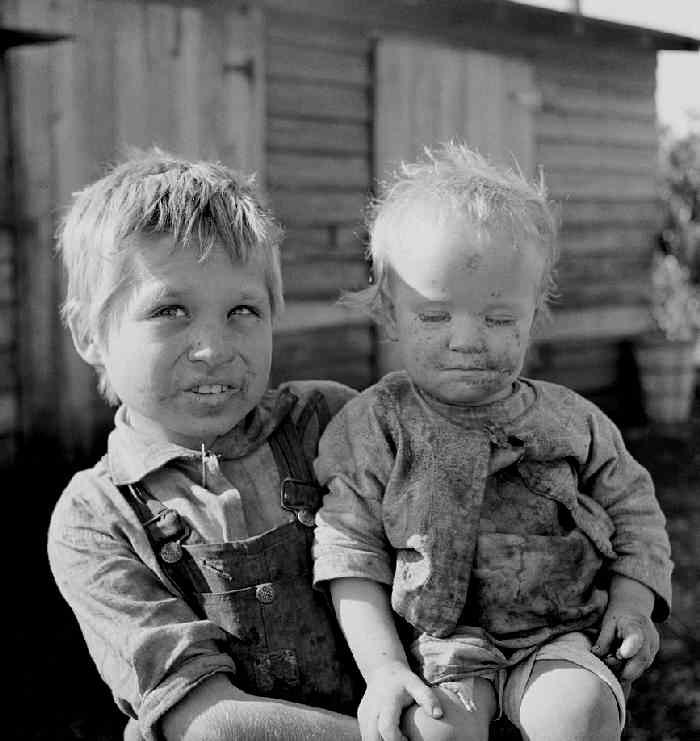
Children benefitted directly and indidirectly from many New Deal programs. The greatest benefit was the jobs provided by New Deal programs, allowing parents, usually men, to adequately support their family. Millions of malnourished school children benefitted by the WPA school lunch program. WPA provided 0.5 million lunches daily in 10,000 schools located throughout the country. Many WPA programs included nursery schools for pre-school children so their parents could work. Mrs. Roosevelt was especially interested in issues involving young people. Her lobbying efforts and advocacy helped to establish the National Youth
Administration (NYA--1935). Youth benefitted from the Civilian Conservation Corps (CCC--1933). The CCC was for boys who had finished schoola nd couldn't find jobs. They worked in national parts and forests throughout the country. They were lodged in camps and provided good food and medical care as well as a small stipend. Other agencies helping children and youth included: the Federal Emergency Relief Administration (FERA--1934), the National Recovery Act (NRA--1934), and the Fair Labor Standards Act (1938).
The nation-at-large, despite the controversies surrounding the New Deal, supported
Roosevelt, electing additional Democrats to state legislatures and governorships in the mid-term elections. Fresident Roosevelt forged a new political coalition in the Unites States. The South had traditional voted strongly Democratic. The Democrats had also traditionally done well in the big Northeastern cities dominated by political machines organized around immigrantoften Catholic ethnic minorities. Roosevelt added to this base the large numbers of individuals adversely affected by the Dpression, organized labor, Blacks, Jews, and farmers. This coalition was to dominate American politics until the Republicans began to carry Southern states in the wake of the Civil Rights movement during the 1960s.
An important part of the First Hundred Days was expanding relief (money and food) programs to the unemployed and other afflicted groups. Relief was, however, a stop gap measure to allow Americans to survive the Depression until jobs once more became available. The Depression persisted. Here economists differ on why this was. Some might say that business had not adjusted to hiher taxes and an expanded Federal regulatory role. Others might say that the Administration did not adequately apealed to business. There are also questions of financial and monetary policy. While economists debate these questions, it is clear that the private sector did not recreate the jobs that had been lost. The Roosevelt Administration's answer was a flurry of New Deal legislation in 1935. This was in part possible because of the Democratic Congressional victories in the 1934 by-election. The new programs included the Works Projects Administration (WPA) which provided jobs not only for laborers but also artists, writers, musicians, and authors. The WPA became in large measure the public face of the New Deal. Another critical piece of New Deal legislation was the Social Security Act which provided unemployment compensation and a program of old-age and survivors' benefits. The WPA and Social Security became the centerpieces of the New Deal. The WPA did not survive as a permanent agency. Social Security of course did.
Presiden't Roosevelt's New Deal untroduced concepts that were new and seen as radical at the time. The result was intense oposition to The opposition was a minority, but it took on a character different than yhje normal two party infighting. There was support from the left, but not the extreme left. The Communists wanted America to fail and thus saw moderate reforms as postpoing their ultimate victory. Anarchist Giuseppe Zabgara even attempted to assasinate the President. There was also populist opposition manifested by Huey Long and Father Father Charles Coughlin. Here the left-right ideological message was commonly muddled. The most intense and vitriolic opposition came from the right. There were even charges of a Wall Street Putsch, assigned the tghe German term because of developments there. The history of the New Deal has been largely written by historians with a liberal orientation. One such author writes, "Formed by diapleased moguls [note the pejorative terminology] of finance and industry, the Liberty League attacked Roosevelt for 'fomenting class hatred' .... Butler read the list of the League's 156 sponsors with a combination of disbelief and trepedation ... [It} read like a who's who of American capitalism and reactionary politics, of organizations and individuals long associated with avowed anti-labor and pro-Fascist policies .... For the first time it struck [General] Butler that MacGuire's revalations about a plot to seize the White House were no crackpot's fantasy." [Denton] There is no doubt that the opposition to President Roosevelt abnd the New Deal was intense, but standard liberal assessments like the one here are simplistic. The Liberty League assessment that Roosevelt was trying to create a distatorship were misplaced, but the idea was no precisely a 'crackpot' vission.
he totalitarianism of the 20h century. One author writes, "It is absurd to claim, as a few have done, that the New Deal, the basis of what we now know as 'liberalism', was identical to wither Grman Nazism or Italian Fascism. But it was equally absurd to ignore, as all our textbooks do, the fact that the New Deal and European Fascism grew from the same ideological roots, produced strikingly similar policies, and fostered national cultures that, if not identical, bore the resemblence of siblings. Though we think of Hitler's and Mussolini's regimes as pathological, even pycholtic, and entirely alien to our political tradition, in fact, hey werw organically connected to the most influential American political movement of the twebntieth cebntury." [Russel, p. 240.] While the author focuses on Fascism, we would generalize totalitarinism, including the Communists.
The Depression and the New Deal had a huge impact on the United States. And the individuals associated with both pursued ideas and policies that still resonate in American society for good and bad. As a result, it is useful to look at the individuals involved. There were both administrative New Dealers as well as Congressional figures/ There were also sympatheic academics who spread the idea that the New Deal had ended the Drepression which what ever uts merits, it did not. Here we will include not only New Dealers, but those who played an important role in opposing the New Deal like Huey Long and Father Coonklin. The New Dealers were of course mostly Democrats, but not all. The most prominent Republican New Dealer was Mayor Fiorello H. LaGuardia, New York's beloved 'Little Flower'. The New Del eventually ended with World War II. Few of the important New Deal figures would play an important role in the American war effort. In fact many New Dealers were uncomortable with Presidents transition from New Dealer to war leader. Some like Agriculture Secretary anbd Vice President Henry Wallace were sympathetic to the Sovies. An exception was Harry Hoplins who played a key role in the war, especially the gight to save Britain.
President Roosevelt's New Deal succeeded in stabilizing the financial system, but it did not end the Depression. Important steps were taken to ameliorate the suffering and enact social reforms enacted--especially Social Security. The major reason for the New Deal--the Depression continued. Despite this, President Roosevely continued to be emensly popular with the American people. The Democrats at their convention in Philadelphia enthuiastically renominated President Roosevelt. The President had not solved the Depression, but most Americans believed he was concerned about them and making things better. The Republicans in Cleveland nominated Kansas Governor Alfred M. Landon. Landon and the Republican attacked the New Deal while supporting its objectives. President Roosevelt conducted an active campaign, traveling by train and speaking on the radio. The President's use of radio was nothing short of masterful. His Fire Side chats had made a personal connection with the American people that would remain unbroken throughtout his presidency. Most Republicans failed to understand that their had been a sea-change in how Americans viewed government. They made a major issue out of the New Deal, focusing on Social Security. It was passed in 1935 and due to go into effect in 1937. The Republicans charged that Social Security was a fraud. This was the first time the Republicans took on Social Security, but it would not be the last. Roosevelt resonded with a robust defense of Social Security just a few days before the election. A Literary Digest poll predicted a Republican victory. The poll was conducted over the telephobne and no one thought of correcting the results for Democratic voters who could not afford a telephone. The President easily defeated Govenor Landon in one of the greatest landslides in American political history. Along with his personal victory, the Presidebt helped widen the Democratic margins in the House and Senate.
Labor made huge gains as a result of President Roosevelt's New Deal. The 1932 Presidential election of 1932 not only brought Presidebtial Roosevekt to poer, but maby liberal Democrats to Connfess. The 1934 Congessional electioins brought more liberal Democrats to Congress. One result was the National Labor Relations Act (NLRA) commonly called the Wagner Act (1935). It was a turning point in Americam labor relations policy. It more than any other New Deal actioin commited Federal policy from a government policy of autonomy to involvement in spcietal issues. The Supreme Court struck down the National Inbdustrial Recovery Act (NIRA) which had included labor provisions. The NLRA was a reinstament of these provisions. At its heart the right of worlers organize trade unions to promoite their interests and engage in collective bargaining as well as industrialmactioinsd such as strikes. Cooprations no longer had the right to supress unions. Theodore Roosevely had moved Federal policy from supporting coporate supression to mediation. President Roodsevelt's New Deal to support of the union and protection from copporate domination. This was vital becuause the Depression and high unemployment had seriously weakened union organizing and bargaining power. New Deal labor law provided the legal protections needed to organize unions and to negotiate for higher wages and benefits as well as safer working conditions. Niotice that these were porivate sector unions, nor oublic secror unions. The New Deal helped estanlish a floor under labor standards in the United Srtares. It created a minimum wage and overtime protections that help lift the incomes of the lowest paid industrial workers. The Sicial Security Act helped establish unemployment insurance, guarantees for home mortgages, and financial support for poor families with children. Federal ppolicy thus combined labor organizing and Federal standards to expand the American middle class. These were for the most part important ans needed sreos. There was less understandfing that Amerucan workers were already the best paid workers in the world. And the ability of corpoearions to increase those wages and bebefits depended on the success of the corporations involved. The New Deal did much to imporive tge first part bof that proposition. It was far weaker on the second part of the equaion.
The New Deal's labor policy is fairly straight forward. The business policy is more complicated and difficult to understand. The New Deal's business policy was not as radical and unprecedented as is often suggested, but in one way more radical. The United Strates had the world's fastet growing economy propelling the country from a backwater agricultural frontier nation hugging the Atlantic seaboard to a continental power and the world's leading industrial power (19th century). This was accomplished becauase: 1) the United States more than antbother country embraced free marrket capitalism, 2) avoided spending vast sums on expensive armies, and 3) created an fine oublic education system. The Federal Government began to interfere with business during Progressive era. The major strep taken was attack the great trusts. Major trust busting actions were taken during both the Roosevelt (1901-09) and Taft Administration (1909-13). The Roosevelt Administrarion introduced the Prue Food and Drug Administration, a major step in regulating business for the public good. In this case the regulation was clearly in the oublic good. As the Fovernment regulatory authority increassed, the rgularory agencies gradually begam to use their authority fpr purposes beyond that intended and for ideological purposes. The trust busting actions might be seen as anti-business actions and were so depicted at the time. In actuality they were pro-business, helping to promote competition which is essentially to the proper functions of the free narket system. The Wilson Administration (1913-19) introduced what it called the New Feeedoms, many Progressive actions, including much needed actions protecing child and women workers. It is imporant to note that such protections are not only moral matters. For millenia children and women have woeked. This was an economic necesity, only with the advent of capitalism did the economy become sufficently productive that children no longer needed to work. Another major reform was the creation of the Fderal Reserve (1913), but at a time that ecconomic and finance theory were not well understood. The United States entered World War I (1917) abd as part of the war effort introduced wide spread administrative actions to the direct the economy. The War ended before these actions had a major impact, but set precedents. The post-War era was one if generally unregulated, rapid growth. Bur the idea of reducing comoetitipn was not just an idea pursued by colletivist progressives, but business people. ThevUnited States at thevrime of the Great Depression had ome 7,000 tradev associatiins, almost all enveroeing to elimate competitiion to varying degrees. And Hoover as Secretary of Commerce cooperated in this effort thinking that it would be more efficent. [Martin] This of course was the business thinking at the heart of the New Deal anf the Works Progress Administration (WPA). The major departure wascthe vhostility many New Dealers had toward buiness.
Tax policy was not a major feature of the Mew Deal's early phase. The tax policy of the early phase of the New Deal was set by the Hoover Administration. Unfer Hoover's guidance, Congresspassed the Revenue Act of 1932 (June 1932). Governor Roovelvet won his presidential bid 5 months later (November 1932). This set up some of the major features of Federal financial policy during the New Deal. There were many progressive features of the new tax law which received strong Democratic support, necessary aftervthe 1930 byelection. . There were also regressive consumption taxes. This act was the largest peacetime tax increase in American history. Congresssional expectations were to raise anout $1.1 billion in new revenue, primarily by increasing taxes on the rich. Income tax rates increased across the board. Top marginal rate, however, more than doubled, from from 25 percent to 63 percent. The overall effective rates on the really rich (top 1 percent). [Brownlee] Congress also sharply increased estate taxes. The standard expemption was cut in half. There were also regressive excise taxes included in the Act. New taxes were instituted on gasoline and electricity and rates were increased on existing excise taxes. Excise taxes were not progressive and thus fell mosdt heavily on low-income Americans. And the New Deal suprisingly made no real effort to change this policy. Excise taxes would produce something like a third to half of Federal revenue throughout the New Deal. The Roosevelt Administration as the New Deal progressed did begin to look at tax policy. This occurred for two reasons. First, the Administration needed money to fund the relief efforts and expanding Federal programs. Second, many New Dealers saw it as a matter of social justice, in particular looking at the concentration of wealth in America. President Roosevelt seems to have accepted both of these goals over the advise of economits who were concerned that tax increased would discourage economic activity. There was also the political factor with Louisiana Senator Huey Long advocating soak-the-rich taxation. The Admininistration began to address tax policy and were bolstered by gains in the Congressional byelection (1934). At this stage of the New Deal, President Roosevelt was able to achieve a degree of bipartisan support. Ten of the 25 surviving Senate Republicans were Progressive supporters of the New Deal who helped overwealm conservative Democrasts. [Lazarowitz, p. 342.] The result was the Revenue Act of 1935. Congress in the what became known as the Wealth Tax Act raised statutory rates on a progressive scale. Senator Hiram Johnson was one of the leading Repunlican progressives and saw this as part of a critical crusade against "monied interests". Congress in the Revenue Act of 1936 created a new tax on "undistributed" corporate profits which was designed to reduce tax avoidance among wealthy shareholders. Share holding in the 1930s was much more concentrated with the wealthy than is the case today. (And labor unions, state emnployees, and other worker grouops did not have pension programs with large share holdings.) This was followed by the Revenue Act of 1937 which was designed to close the the nost egregious loopholes. The three primary New Deal tax laws substantially increased taxes on wealthy Americans. One estimate suggests that the income tax rate increases raised the effective rate on the top 1 percent from anout 7 percent (1932) to 16 percent (1937). [Brownlee] Because of the increases in regressive taxes, some historians describe the high rates on the wealthy as "symbolic". [Leff] At no time in the New Deal was a tax system considered that would set rates at levels that would maxinize revenue. New Deal critics, both Republicans and conservastive Democrats, elected in the 1938 Congressional by-election promted by business leaders moved against the undistributed profits tax.
President Roosevelt had proven himself to be one of the most gifted politicans in American history. His 1932 election victory had created a political coalition that would reverse the Republican Party's domination of American politics that had begun during the Civil War. The elections of 1932-36 had fundamentally changed American politics. The Democratic power with few exceptions (Cleveland and Wilson) had been out of power siince the Civil War. While these elections transformed the Presidency and Congress, the Federal juduciary was a bastion of conservative thought deeply hostile to the New Deal. Today conservatives complain about activist liberal judges. Liberals in the 1930s faced activist conservative judges. Some authors describe the Supreme Court in the 1930s as persuing judicial imperialism. The Preident expanded democraties majorities in both houses during the 1934 Congressional byelections. The President's 1936 reelection was one of the greatest landslides in American history. This must have affected President Roosevelt's outlook as he proceeded to make a rare political error--an effort to pack the Supreme Court. The President while pleased with the 1936 electiion results, was increasingly frustrated with the Supremne Court composed of many conservative Republican appointees. Not one vacancy came open in the Court during his first term (1933-37). The Court at first had accepted most New Deal programs.
Chief Justice Hughes had, howeverm began to lead an anti-New Deal coalition which suceeded in striking down some of the most important New Deal progtrams. The Court decided in a series of rulings that the President had unconstitutionally assumed powers reserved for the Congress. The Court in Schecter v. United States ruled against the price-fixing powers of Title I of the NIRA. Then in U.S. v. Butler the Court rejected the Bitumonious Coal Conservation Act (BCC), sometimes called the Little NIRA. The Court also ruled against portions of the Agricultural Adjustment Act (AAA). These rulings were some of the most important New Deal programs. The President was not only concerned about the impact of these rulings on the New Seal, but he was probably rightly concerned about how the Court would rule in impending decisions on the Wagner Act (National Labor Relations Act) and the Social Security Act. Several justices delayed retirement realizing that FDR would appoint liberal justices to replace them. In frustration seeing the New Deal being eviserated by the Supreme Court, FDR attempted to expand the court so he could appoint new justices. It was the greatest political mistake of his presidency. The President announced a plan to Congressional leaders that would reform the Federal judiciary. He suggested that it would reduce the backlog faced by "aged, overworked justices," Roosevelt's plan was to appoint one additional judge to the Federal judiciary (including the Supreme Court) for every justice who reached the age of 70, but decided not to retire. This would enavle the President to appoint several new justices to the Supre Court and create a New Deal working majority. There was a groundswell of resistance to what became known as his effort to pack the court. The resistance included many Democrats that had supported both the President znd the New Deal. While FDRs efforts to expand the Supre Court failed, justices finally began to retire. Finally FDR beginning in 1938 was able to appoint new justices to the Supreme Court. FDR in the last 6 years of his presidencvy appointed eight justices which along with appointments to lower Federal coutrts fundamentally transformed the character of the Federal judiciary. Finally the New Deal was safe although the innovative phase of the New Deal had largely past. Although the New Deal's efforts in civil rights was limited, it is this transformed Federal judiciary that would issue the land mark decessions on civil rights that would transform America in the 1940s-50s.
There is a popular myth that President Roosevelt ended the Depression and solved the unemployment proble, We hear Congressmen and other talkibng heads commonly expressing this opinion in TV intervon television. There is no doubt he want to and enacted program after program backed by massive defecit spending to do so. In fact he failed. The Roosevelt Administration which took office in 1933 did made substantial economic progress, although the statictics can be and often are manipulated for partisan purposes. Considerable economic growth was achieved. GDP growth averaged an impressive 9 percent. This was, however, from the severly dressed levels that existed when the President assumed office. The New Deal also reduced unemployment from from 25 to 14 percent, although a substantial part of that employment increase was Government jobs programs like the Worls Progress Administration (WPA). President Roosevely as the economy began to improve decided that he had to address the problem of rising defecits. He thus decided to balance the budget and cut deficit spending. At the same time, the Federal Reserve raised reserve ratio requirements for member banks which contraction the monetary base. The economy soon slumped back into recession. The most often sited reason for the recession which became known as the Roosevelt recession was the Presuident's attempt to molify conservative critics by cutting defecit spending. Commonly partisans site this as the reason for the recesion. In fact there are probably three major causes of the recession: 1) Administration cutting defecit spending, 2) the Federal Reserve contracting the monetary base, and 3) sharp Administration tax increases. The causes of the Roosevelt recession hae been studied at some length by economists. There is general agreement that these were the three major factors. There is no agreement as to the relative importance of these three factors. Milton Freedman has focused on the Federal Reserve’s tight monetary policy. [Freedman and Swartz, pp. 493-545.] The issue is complicated and can not be easily answered. What is important to bear in mind in addressing the literature is that some economists and even more politicans will draw conclusions based on ideology. Often Kensyean economists will fail to mention the tax increases. And free market ecomomists will down play the imporance of the spending cuts.
The 1938 Congressional By-election was in many ways a repudiation of President Rooselvelt, largely because of the so-called Roosevelt recession. It essentially marked the end of the New Deal. The Court-packing fisco may have been another factor. What ever the cause, it brought to Washington Republicans who with the southern Democrats created a conservative Congressional majority eager to oppose the President on liberal domestic issues. And perhaps even more ominously, many of those Republicans were prone to oppose the President's efforts to stand up to the Dictators that were threatening world peace. This greatly complicated President Roosevelt's ability to challengee the Dictators and aid the Allies uin the developing European crisis. The election resulted in the defeat of many liberal New Dealers and the return to Washington of many conservtive Republicans--many with strongly isolantist views. The Democrats retained majorities in both houses, but a substantial part of that majority was conservtive Southern Democrats. The President's pne area of maneuver was that the Southern Democrats while opposed to liberal New Deal legislation and suspious of foreign entaglements were supportive of natinal defense measures. This enabled the President to move ahead on needed measures such as rearmament and the repeal of the Neutrality Act, although his Congressional margins were often narrow. His measures could only be passed with the support of the southern Democrats and they were also dead set against immigration reform.
Presiden Roosevelt thought after his massive 1936 reelection victory that he would be able to both pack the court endinng judicial uncobstitutional rulings of his prograns as well as enact a full agenda of new liberal programs. Unfortuntely for the President, the court pcking effort caused an unanticipated reaction in Congress. A coalition of Republicans and conservative Democrats formed to vote down the court packing proposal. And feeling their influence they also oppossed other liberal iniatives. The new coalition prevented the passage of the bills that the President had hope to enact. There were only two accomplishments of ny importance: the Second Agricultural Adjustment Act (February 1938) and the Fair Labor Standards Act (FLSA0, often called the Wages and Hours Act (June 1938). And even without the cuort packing neither were struck down by the courts. Shifting attitudes nd the weight of Roosevelt apointees had transformed the Court. The Second AAA included provisions for the storage of surplus crops in government warehouses and providing loans to farmers in years with high harvests to compensate for falling market prices. What became the FLSA encountered significant judicial opposition. Eventually the FLSA survived, but after over a year of Congressional changes. The FLSA provided for minimum wage and maximum hour (40 hours per week) requirements for businesses involved in interstate commerce. It mandated time‐and‐a‐half for overtime work. The statute also expanded child labor protections. It prohibited work children under the age of 16 and restricted those under 18 to non‐hazardous work. The Federal minimum hourly wage at 25 cents, and the maximum workweek at 44 hours. The FLSA in particular is considered a landmark labor law.
The 1938 Congressional By-election was in many ways a repudiation of President Roosevelt, largely because of the so-called Roosevelt recession. It essentially marked the end of the New Deal. The Court-packing fiasco was a factor. Another factor was the President's attempt to purge the Democratic Party of recalcitrant conservatives. Not only did he fail, but the voters voted out many liberal loyalists. What ever the cause, it brought to Washington Republicans who with the southern Democrats created a conservative Congressional majority eager to oppose the President on liberal domestic issues. The major issues dominating the election was the faltering domestic economy. Ominously, the election took place just after the Munich Conference in Europe. many of those Republicans were prone to oppose the President's efforts to stand up to the Dictators that were threatening world peace. This greatly complicated President Roosevelt's ability to challenge the Dictators and aid the Allies in the developing European crisis. Ironically, many of the southern Democrats he attempted to defeat proved to be valuable allies as the President shifted from domestic New Deal politics to international efforts to stop the march of Fascist dictators and increase defense spending. The election resulted in the defeat of many liberal New Dealers and the return to Washington of many conservative Republicans--many with strongly isolationist views. The Democrats retained majorities in both houses, but a substantial part of that majority was conservative Southern Democrats. The President's one area of maneuver was that the Southern Democrats while opposed to liberal New Deal legislation and suspicious of foreign entanglements were supportive of national defense measures. This enabled the President to move ahead on needed measures such as rearmament and the repeal of the Neutrality Act, although his Congressional margins were often very narrow. His measures could only be passed with the support of the southern Democrats and they were also dead set against further liberal measures, includingimmigration reform.
The Congressional mid-term election of 1938 essentilly ended the New Deal. The Democrats retained control of Congress, but the Republicans gained seats in both the House and the Senate for the first time since 1928. And conservative Democrats retained their seats. As a result, President Roosevelt decided not to offer any new liberal programs in his State of the Union address (January 1939). Instead he concentrated on the threat that aggressor nations were posing to international peace. And the President and First Lady began to focus on lfe after the presidency. The United states at the time had a tradition of two term presidencies set by none other than President Washington. It was a tradition and not a legal requiremnt, but the Roosevelts and Washington political establishment began to prepare for the 1940 election and a new president. In the end, it wou;d be the War and not the New Deal that ended the Depresion. nd the Presudent's focus chaznged entirely from liberal activism and Dr. end the Depression to Dr. Win the War. Mrs. Roosevelt continued to chmapione liberal causes, but for the President opposing the Axis dictatorsbecane his mission. In the end it would be NAZI dictator Adolk Hitler that would keep President Roosevelt in office. The shatering NAZI victory and the fall of France also shattered the Three Term prohibition. The American people decided they wanted a steady hand on the helm. To Mrs. Roosevel's tsurprise and disappointment, she and her husband were not going anywhere. .
The Depression in America did not end until late 1938/early 1939 when war orders began to poor in from Europe, primarily Britain and France. Prime-Minister Chamberlain though he could reason with Hitler and precent another War. After Hitler seized Czrchoslovakia (March 1939), it was clear he could not. There has always been a strong isolationist streak in American political life. Americans separated by two great oceans resisted involvement in the war that broke out in Europe. NAZI and Japanese barbarities gradually and President Roosevelt's leadership gradually changed American sentiment. It was the surprise Japanese carrier attack on Pearl Harbor, however, that brought a suddenly united and outraged America into the War. The Japanese attack was a superbly executed military operation and one of the greatest blunders in world history. Neither Japan or Germany had any appreciation for the ability to wage war that American industry brought to the allied war effort. America became truly what President Roosevelt proclaimed, the Arsenal of Democracy in a miraxle of industrial production. Within a year of the Japanese attack, America was involved in offensive operations that began to change the tide of the War. America in the end rescued Europe not only from Fascism, but after the War from Communism as well. Most surprisingly of all was not only how the War changed America, but America's success in fundamentally changing the nature of German and Japanese society.
The G.I Bill might be considered the capstone of the New Deal. And unlike much of the New Deal legislation, it was not contrioversial nor was there any doubt about its effectuveness.
President Roosevelt and the New Deal were extreemly controversial during the 1930s. The voters consistently returned him to office but by the 1938 elections were beginning to have doubts. In the aftermath of the War and the President;s untimely death, historians tended to speak lauditorily of the Nrw Deal afirming that President Roosevelt brought us out of the Depression. More recent historians have discussed the New Deal in less lauditory terms. With greater reflection it can I think, be fairly seen that it was World War II that finally ended the Depression. Some recent historians have even charged that the New Deal even prolonged the Depression. I am not entirely sure of that, but even if true it does not mean, however, tht the New Deal was a failure or that it did not have many beneficial impacts.
Brownlee, Elliot.
Denton, Sally. The Plots Agaonst the President: FDR, A Nation in Crisis, and the Rise of the American Right (2012), 288p.
Friedman, Milton and Anna Schwartz. A Monetary History of the United Statesp
Freidel, Frank. Franklin D. Roosevelt: Launching the New Deal (Little Brown: Boston, 1973), 574p.
Lazarowitz, Arlene. "Hiram W. Johnson: The Old Progressive and New Deal Taxation," California History Vol. 69, No. 4 (Winter, 1990/1991), pp. 342-353.
Leff, Mark.
Martin, James. "Business & the New Deal," Reason (December 1975).
Powell, Jim. FDR's Folly: How Franklin D. Roosevelt and he New Deal Prolonged the Great Depression. Powell's book is a popular summary of a number of economists who have challenged prevailing liberal opinions on the New Deal.
Roose, Kenneth D., "Federal Reserve Policy and the Recession of 1937–1938," The Review of Economics and Statistics Vol. 32, No. 2 (May 1950)
Russell, Thaddeus.
Navigate the Children in History Website:
CIH

[Return to Main Great Depression page]
[Introduction]
[Biographies]
[Chronology]
[Climatology]
[Clothing]
[Disease and Health]
[Economics]
[Geography]
[History]
[Human Nature]
[Law]
[Nationalism]
[Presidents]
[Religion]
[Royalty]
[Science]
[Social Class]
[Bibliographies]
[Contributions]
[FAQs]
[Glossaries]
[Images]
[Links]
[Registration]
[Search]
[Tools]
[Children in History Home]
Created: October 12, 2003
Last updated: 12:34 PM 4/19/2020