|
An important part of the First Hundred Days was expanding relief (money and food) programs to the unemployed and other afflicted groups. Relief was, however, a stop gap measure to allow Americans to survive the Depression until jobs once more became available. The Depression persisted. Here economists differ on why this was, but the private sector did not
recreate the jobs that had been lost. As a result, another flurry of New Deal legislation followed in 1935. This was in part possible because of the Democratic Congressional victories in the 1934 by-election. The new programs included the Works Projects Administration (WPA) which provided jobs not only for laborers but also artists, writers, musicians, and
authors. The WPA was in large measure the public face of the New Deal. The WPA along with Social Security became the center pieces of the New Deal. WPA also became perhaps the most controversial New Deal Agency.
President Roosevelt created the Works Progress Administration (WPA) as a relief measure by executive order (1935).
Harry L. Hopkins was a noted New York social worker. Governor Roosevelt brought him into the effort to fight the Depression in New York (1931). Then after winning the presidential election (1932) brought Hopkins to Washington. He appointed him to head different New Deal agencies and then to head WPA. It put Hopkins at the center of the New Deal relief effort. Hopkins in his first five minutes as director spent $5 million, quite a large amount at the time. He told a
friend, "I'm not going to last 6 months here, so I'll do as I please." Hopkins would become the President's closest adviser, an intimate who eventually moved into the White House. Hopkins is probably the most poorly recognized American statesman.
The purpose of the WPA was to put people back to work. Much of the WPA work projects were designed to improve the country's physical and social infrastructure.
The initial congressional appropriation was $4.9 billion. The total cost over 8 years was $11 billion. That does not sound like much today, but it was a huge expenditure in the 1930s, both as a portion of the budget and adjusted for actual dollar values. One reason that the New Deal could afford such expenditures was the financial restraint of the Republican
Administrations during the 1920s.
WPA offered work to unemployed Americans on an unprecedented scale. It is notable for both the number of jobs and the diversity of the jobs program. WPA rapidly began hiring. Rolls reached 3.4 million (March 1936). As the economy began improving in 1938-39, in part because of war orders from Europe, many WPA recipients left for better paying jobs in the private sector. WPA also began cutting its rolls. There were about 2.3 million recipients (June 1939).
WPA was finally ended (June 1943). By that time in the midst of World War II, jobs were easy to find and many war plants had trouble finding workers. The WPA over its 8-year life employed 8.5 different Americans and for a time was the country's largest employer. WPA seems like a preferable approach then simply handing out relief checks. WPA should, not be confused
with real jobs created by the private sector. WPA employed people, but only by using money paid in taxes from people that were working o borrowed money that working people would eventually have to pay back through their taxes. We do not say this to attack the PA as a wasted effort, but when assessing WPA jobs this should be born in mind.
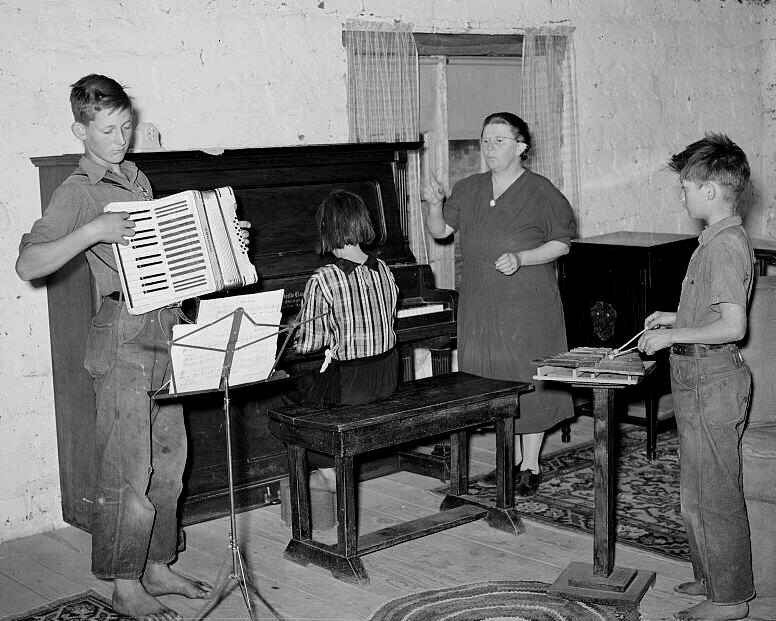
There were 1.4 million different WPA projects. Much of the WPA involved physical labor and construction, but was not limited to these areas. WPA projects included: highways and building construction, slum clearance, reforestation, and rural rehabilitation as well as programs to employ actors and artists. Construction projects included roads and bridges. There were also government buildings, libraries, and schools. There were many projects in the National Parks where the CCC was also active. One notable project was National Airport in Washington, DC. There were many service projects, including school lunches and kindergartens. Many children with unemployed fathers got their most important meal of the day at school. Most primary school children in the 1930s went home for lunch. The number of elementary (primary) schools offering school lunches as a result of WPA sharply increased. WPA was not only for laborers, but also artists, sculptors, writers, musicians, and authors. As a result, there were plays and concerts--even circuses. The WPA culture efforts were particularly novel for the Federal Government. The Federal Writers' Project produced a wide range of booklets and engaged
in a range of academic activities. They prepared state and regional guide books. The Project also developed into a variety of archives, organizing them and indexing newspapers. There were also sociological studies and historical investigations. The Federal Arts Project employed artists to decorate public buildings, including post offices, schools, and other public
buildings with murals, canvases, and sculptures. Musicians were employed to organized symphony orchestras, and community singing. The Federal Theater Project experimented with untried performance modes, and scores of stock companies toured the country with repertories of old and new plays. This brought stage performances to communities which had only been exposed
to theatrical performances through books and radio. Some plays had a strong political focus which proved controversial.
WPA became perhaps the most controversial of all the New Deal Agency. Almost all New Deal agencies were controversial, but WPA came in for special criticism, in part because of the amount of money spent. Such a massive undertaking almost inevitably was accompanied by confusion, waste, and political favoritism. Just how much is difficult to assess. Critics charged it was inefficient. Some named it, "We Piddle About". Especially galling to conservatives was the Writers Project which produced some left-wing plays, essentially attacking the basic American free enterprise system. Here it is not a matter that writers do not have every right to criticize the capitalism or other elements of American society. The question is whether the Government has the right to take tax payer monies and finance such criticisms. Despite all the
criticism, Hopkins stayed as Director and President Roosevelt continued to support him and WPA. The President maintained that even more costly would be to allow the country's human capital to go idle.
Any assessment of WPA has to pursue to elements. First, were the WPA projects beneficial and an an effective use of money. Certainly highway and other construction projects when properly run were beneficial. WPA built 651,087 miles of highways, roads, and streets; and constructed, repaired, or improved 124,031 bridges, 125,110 public buildings, 8,192 parks, and 853 airport landing fields. Other WPA projects are more difficult to assess, such as the history and sociological studies or the murals in post offices. We do not say this in the sense that such efforts were wasteful, only that the benefit is more difficult to prove. The second issue is the impact of WPA with Government efforts to end the Depression. New Deal proponents maintain that WPA and other 'pump-priming' programs stimulated the economy by putting money into the hands of workers who spent it thus creating demand and generating jobs. The mythology of the New Seal is so entrenched among many authors that we see on articles about WPA statements like "... the 'pump-priming' effect stimulated private business during the depression years."
Unanswered if this was the case is why the Depression persisted 10 years in America despite enormous pump priming. The Depression did not end until war orders from Europe revived the economy. It is true that people were hired by WPA, but they were not permanent jobs. They did, however, get money into the economy and did temporarily assist many low income Americans. Assessing WPA as a relief effort to aid the unemployed is very different from assessing it as a program that helped end the Depression. At the same time, however, to pay for WPA and other New Deal projects, President Roosevelt began massive tax increases, primarily targeting upper-income Americans. This began with the Revenue Act of 1935. The effect of these tax increases was to remove money from the economy, negating the impact of pump priming programs like WPA. This meant that the private sector did not generate jobs that it might otherwise hve done. Some economists believe that this delayed America's recovery from the economy. Unfortunately this debate is largely unanswered. Opinions are largely determined by the authors
ideological mindset.
WPA was redesigned when it was transferred to the Federal Works Agency (1939).
Taylor, Nick. American Made: The Enduring Legacy of the WPA--When FDR Put the Nation to Work (Bantm, 2008), 630p.

Navigate the Boys' Historical Clothing Web Site:
[Return to Main New Deal agency page]
[Return to Main New Deal page]
[Return to Main Depression page]
[About Us]
[Introduction]
[Biographies]
[Chronology]
[Clothing]
[Disease and Health]
[Economics]
[Environmental issues]
[Feminism]
[Geography]
[History]
[Human Nature]
[Law]
[Nationalism]
[Presidents]
[Religion]
[Royalty]
[Science]
[Social Class]
[Bibliographies]
[Contributions]
[FAQs]
[Glossaries]
[Images]
[Index]
[Links]
[Registration]
[Search]
[Tools]
[Children in History Home]