|
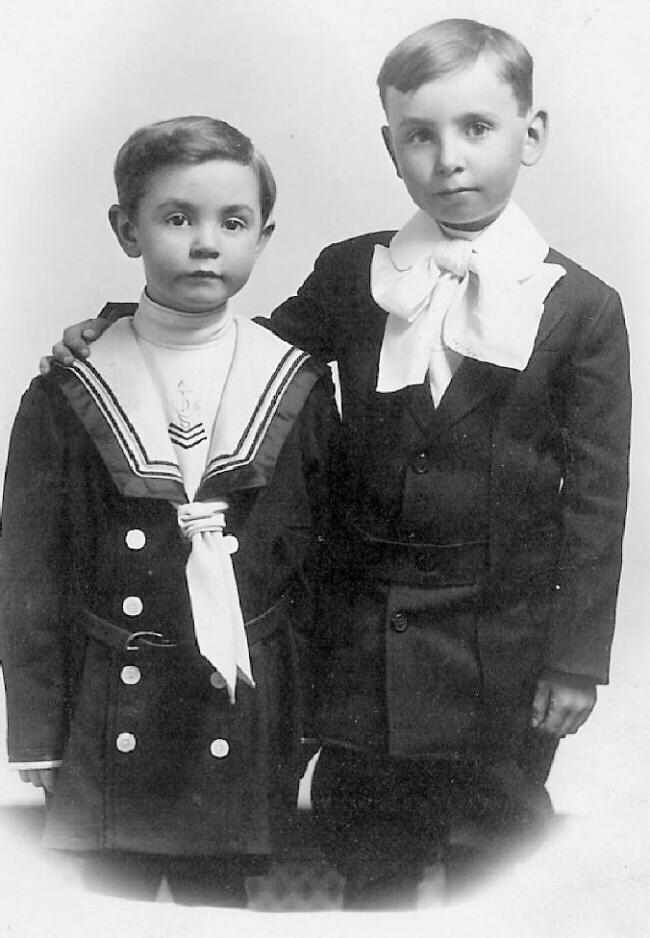
We notice American boys wearing several different types of neckwear. Neckwear was not always worn, but it was fairly common until the 1940s. We note many different styles. Some quite elaborate. The stock was worn for many years and was common in both America and Europe, but it was not a boys' style. It was worn by both boys and adults without differentiation. One of the most destinctive styles of neckwear worn by Ameican boys was the floppy bow. This was a style worn by adults at the turn of the 19th century. It was popular during the Regency in Britain where it was worn by Beau Brummel. I thibk it was less common in America. When the floppy bow reappeared beginning in the late 1870s, it seems to have been a style particular popular in America. They were also worn in Europe, but we seem to see many more examples in America, especially the large floppy bows. And floppy bow at this time were a distinctly juvenile style. They were worn with equally large collars of various descriptions. Neckties and bow ties becone common neckwear after the turn of the 20th century. Thes syles of neckway reverted to the mid-19th century convention of being for both adults and boys. We also note a variety of other styles like string ties and cross ties, sometimes called butterfly ties.
The stock was oneof the most enduring forms of men's neckwear. We first notice it in the waely-18th century. One source dates it from 1715, but we do not understand the specifics of such a specific date. It of course was a European import. The first stocks were a simple piece of muslin cloth folded into a narrow band and wrapped a few times round the shirt collar. It was then secured from behind with a pin. We are not sure about the origins of the term "stock". I think it may have just meant that basic stock cloth was at first used. EArly stocks appear to have been white. The stock was not fancy neckwear. There was no bow to tie. It was simply wrapped around the collasr. The stock was worn for many years and was common in both America and Europe. We are not entirely sure when black stocks became standard. We think it was the early-19th century, but that needs to be confirmed. White stocks might still be worn for formal occassions. At the time men and boys wore the same clothes. Wearing stocks were more a social class matter. The well-to-do were more likely to dess well. So boys from affluent familes would wear stocks as well as men. The stock was still widely worn in the mid-19th century. It was by this time almost always black. Many examples are archived on HBC. Our information before the invention of phorography is limited, but with the appearance of Faguerreotyoes in the 1840s wehasve more information. A good example is Clarence E. Summer, we think in the 1840s. We note boys wearing stocks with destinctive bows, not just neck wrapping. In some cases they are primarily stocks with a hint of a bow, other examples have a much more noticeable bow. We are not sure if they were still called stocks or they were referred to as bows. We are not yet sure about the 1840s, but we definitely see these stocks with bows in the 1850s. The stock went out of style in the 1860s. We still see it in the early-60s, but not commonly by the end of the decade.
We begin to see cravatas reappearing in the late-18th century. The cravat was reintroduced by the "macaronis". These were fashionablr young Englishmen who traveled on the Continent and returned hoome with famboyant fashions--many encounteted in Italy. Staid Englishmen with more conservative fashion ideas made fun of them bu calling them "macaronis". In the same way, the English made fun of Americans, calling them the "Yankee Doolde Dandies". The French called similar young dandies the Incroyables. The cravat became very popular and a good deal of fashion discussion concerned how to tie a cravat knot. There were several publications. The first was Neckclothitania which included detailed instructions and illustrations on precisely how to tie cravat knots. There were several different options. This book included the first use of the term �tie� in reference to neckwear.
One of the most destinctive styles of neckwear worn by Ameican boys was the floppy bow. This was a style worn by adults at the turn of the 19th century. It was popular during the Regency in Britain where it was worn by Beau Brummel. I thibk it was less common in America. When the floppy bow reappeared beginning in the late 1870s, it seems to have been a style particular popular in America. They were also worn in Europe, but we seem to see many more examples in America, especially the large floppy bows. And floppy bow at this time were a distinctly juvenile style. They were worn with equally large collars of various descriptions. Wearing floppy bows with fancy blouses was an optional matters. Some mothers insiste on the bows while others did not. They were worn with more plainly styled bows like Eton collars, but this was less common.
We are not entirely sure of the origins of the bowtie. Neckwear in general seems to have evolved from the cravat. The steps in that process are not clear. We note bpys wearing bowtie-like garments in the mid-19th century that seem to be associated with stocks. Large floppy bows were of course especially popular for American boys in the late-19th century. Just how thde bowtie is rekated to these forms of necklwear we are not sure. We notice bowties being worn in the early 20th century just as large floppy bows were going out of style. We are also not sure of the relationship between neckties and bow ties. They seem to have becone popular at about the same time. We do not know, however, if they evolved independently or id ome evolved out of the other. We beleve that the bow tie is an especially American fashion. Bow-ties for formal wear have been worn globaly. Bow-ties for day to day wear are much less common. I have seen foreigners wearing bow ties, but not nearly to the extent that American wore them. The bow-tie was not a uniquely boyish style. They were also worn by men. The bow-tie was, however, widely worn by American boys during the 1940s-60s. They were especially popular fir younger boys wearing Eton and other short pants suits. Regular ties were considered a bit too grown up looking for these boys.
Neckties and bowties becone common neckwear after the turn of the 20th century. We see neckties before the turn of the century, but they did not become an important item for boys until afterwards. We note men wearing ties in the late 19th century, but they were large bulky ties. These were not commonly worn by boys. The ties that boys began wearing were more narow versions. Not all boys wore ties or other neckwear, even for formal occassions. We see boys both wearing and not wearing ties with Eton and other detachable collars. Gradually the tie became standard when dressing up. The syles of neckwear reverted to the mid-19th century convention of being for both adults and boys. As floppy bows disappeared we see more and more neckties. The early ties we see were mostly solid colors. Soon a range of patterns developed. Diagonal striped ties seem to have been particularly popular. We see stripes in both directions as well as hoeizontal stripes. Grafually very loud patterns appeared. We see solid-colored ties as well. We notice modern-looking neckties in the 1910s. A good example is an American boy, Robert Hubbard, with a diagonal striped tie in 1917. We see an unidentified New York boy wearing a horizontally striped tie in the 1910s. A good example from the 1940s is Arian Viring in 1941. Some necktieswere worn with Eton collars, but most were worn with soft collars.
We note snall bowws tied from narrow ribbon. We are not sure what these bows were called at the time, but we will use the term ribbon bows until we cam find a better term. They seem to have been popular in the 1870s, but we do not yet have a detailed chronology. We notice an unidentified New Jersey boy wearing a ribbon bow in the 1870s. Floppy bows became more populsr in the 1880s.
We also note a variety of other styles like string ties and cross ties, sometimes called butterfly ties.

Navigate the Boys' Historical Clothing Web Site:
[Return to the Main U.S. neckwear page]
[Return to the Main U.S. country garment page]
[Introduction]
[Activities]
[Biographies]
[Chronology]
[Clothing styles]
[Countries]
[Bibliographies]
[Contributions]
[FAQs]
[Glossary]
[Images]
[Links]
[Registration]
[Tools]
[Boys' Clothing Home]