
United States Elections: Presidential Elections (1924)
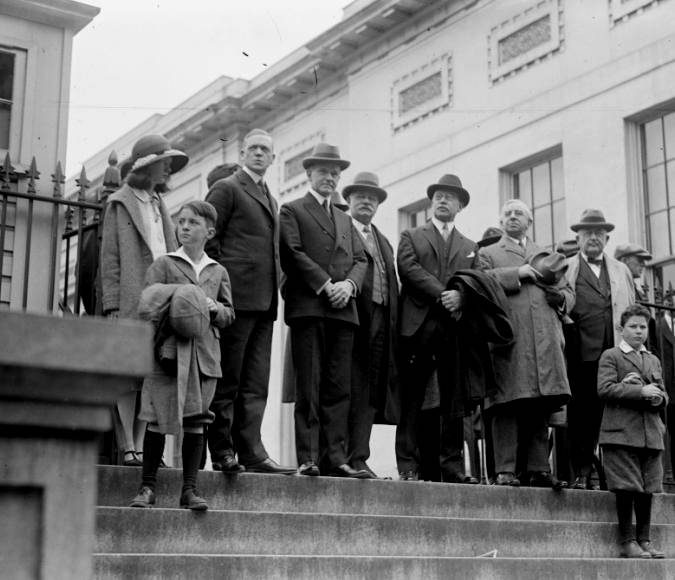
Figure 1.--Vice-President Cooldidge became president when President Harding died in 1923. He decided to run in 1924 to become president on his own. Despite a rather dour demeanor, becoming known as Silent Cal, he proved very popular with the voting public. Like presidents beginning with Teddy Roosevelt, Coolidge liked to be photographed with Boy Scouts and at Boy Scout events. Here President Coolidge reviews a Boy Scout parade in Washington on April 21, 1924.We do know who the boys are, they are too old to be the President's teenage sons.
|
|
The Republicans were worried about their prospects for the 1924 elections. After Hardings's death scandals had tarnished the Republicans. To the suprose of many, the laconic Coolidge was an instant hit with the public. The Roaring 20s had brought good times to many and the public saw it as the "Coolidge Prosperity". The Party remominated him on the first ballot at their Cleveland Convention. They also nominated Charles G. Dawes of Illinois for vice-president. The Party emerged from the Convenbtion united and confident about the election. The Convention was notable for being the first to be broacast on radio. The Democrats met in New York. They still maintained a two-thirds vote rule which made it virtually impossible to achieve agreement on a nominee. The leading candidate was the progressive govenor of New York--Alfred E. Smith. Franklin Roosevelt who had been stricken by polio made his first appearance in public since his illness when he delivered a stirring nomination speech for Smith. Govenor Smith was opposed by the southern Democrats who saw Smith as a Yankee, a Catholic, and the product of corupt political machine politics. His leaading opponent was William G. McAdoo of Tennessee who was less outgoing, but was a Protesant. He generated little enthusiasm among the northeastern delegates. The Democrats held over 100 ballots, a convention record. The Ku Klux Klan became an especially devisive issue at the Convention. John Davis of West Virginia eventually emerged as compromise candidate. Robert LaFollete of Wisconsin ran a third party campaign as the candidate of the Progressive party. The Republican's campaign slogan was "Keep Cool With Coolidge". The heady properity of the 20s along with the division of the Democrats helped ensure a Coolidge victory. The Harding Administration scandals did not affect Coolidge. He received 54 percent of the popular vote and a massive Electoral College victory.
The Roaring 20s
The election took place in the middle of the Roaring 1920s. It was a decade of tremnemdous social change. Similar in many ways to the 1960s. World War I helped to generated tremendous change in America. Many soldiers drafted into militry had never traveled beyond the narrow confines of their local comminities, They were exposed to other parts of the United Sttes and or Europe. Demand for workers by war industries helped jump start the black exodus from the rural South to the Urban North. As in Europe, the War helped to dilute the old social certainties. This combined with the progressive impact of immigration and urbinization acted to open up American society. Women finally achieved the vote and while social limitations continued, women had never been so free. This was reflected in short skirts and skimpy bathing suits. It was also a decade of economic expansion providing many Americans the pportunity to indulge their passions and desires. And the country enbarked on one of the great moral crusades in its history--prohibition. It proved to be a dissater resulting in the growth of organized crime and gangster legends. As with all periods of social change, there was also a traditional reaction, a particularly ugly one--the Klu-Klux-Klan.
Political Background
President Harding had by 1923 began to learn of the inproprities and criminal behavior of the friends he had appointed to positions in his administration. He exclaimed to a colleague, "My ... friends ... they're the ones that keep me walking the floors nights!" Harding decided on taking a train journey westward during the Summer (1923). With him he took Secretary of Commerce Hoover. Harding during the trip asked Hoover, "If you knew of a great scandal in our administration,would you for the good of the country and the party expose it publicly or would you bury it?" Hoover advise Harding to expose any such wrongdoing. Harding could not face up to exposing his friends with the resulting political consequences. As fate would have it, he never had to take the difficult step . Harding while still on his western trip suffered a heart attack in San Francisco and died (August 1923). Surely the wrongdoing of his friends must have been a factor in his death. And it is the resulting scandals, especially Teapot Dome that the Harding presidency is today best remembered. The American public which was not yet aware of the scandals was shocked. At the time of his death he was still very Popular with the public. Vice-President Coolidge became president. He was at the time, still largely unknown to the punlic. The Republicans were worried about their prospects for the 1924 elections. After Hardings's death, details on the Tea Pot Dome oil leasing scandals emerged and arnished the Party. Scandals of this nature had in the past had a significant impact on the election. To the suprose of many, the laconic Coolidge was an instant hit with the public which did not attach responsibility for the scandals to Collidge. The Roaring 20s had brought good times to many and the public saw it as the "Coolidge Prosperity".
Tea Pot Dome (1922)
Oil companies found important oil fields on land owned by the Federal Government at Elk Hills, California and Teapot Dome, Wyoming (early-20th century). Huge areas of the Western states are owned by the Federal Government. Much of this land is rugged wildrenes, in many cases arid of no interest to farmers and ranchers. President Taft decided that this land and its oil reserves should be set aside for the use of the United States Navy (1912). Congress passed a bill empowering the the Secretary of Nany to oversee the development of this reource (1920). The resulting Act signed by the President read, that the Secretary would have the power "to conserve, develop, use and operate the same in his discretion, directly or by contract, lease, or otherwise, and to use, store, exchange, or sell the oil and gas products thereof, and those from all royalty oil from lands in the naval reserves, for the benefit of the United States." President Warren Harding upon assuming office appointed Albert Fall as Secretary of the Interior. Secretary Fall persuaded Edwin Denby, the Secretary of the Navy, that the Department of the Interior had more expertise in developing resources and that he should take over responsibility for the Naval Reserves at both Elk Hills and Teapot Dome. Secretary Fall chose two perrsonal friends, Harry F. Sinclair (Mammoth Oil Corporation) and Edward L. Doheny (Pan-American Petroleum and Transport Company) to lease part of these Naval Reserves. There was no public bidding. Snd his associates attempted to keep this arrangement secret, but rumors began to circulate in Washington. Reporters found that Fall was spending large sums of money. The Wall Street Journal published a story with some information about the leases (April 1922). President Harding came to falls defense, claiming that he had approved the arrangement. Apparently he had not. Senators Robert La Follette and John B. Kendrick called for a Senate investigation into Secretaryb Fall and the Naval Reserves. It is at this point that Presidebt Harding unexpectedly died (August 1923) and Vice-President Collidge becomes president. The Senate Committee on Public Lands and Surveys opened hearings on the Teapot Dome oil leases began (October 1923). Senator Thomas J. Walsh, a Montana Semocrat oversaw the committee's investigation. The Cimmittee investigation lasted several months asnd was widely reported in the press. The Committee called many wi\tnessed. Finally Edward Doheny admitted that he had lent Secretary Fall $100,000 (January 1924). The Senate then passed a resolution stating that the leases to the Mammoth Oil Company and the Pan American Petroleum Company "were executed under circumstances indicating fraud and corruption". Both Fall and Edwin Denby were forced to resign from office. Criminal prosecution followed.
Congressional Mid-term Election (1922)
The Democratic made sizeable gains in the 1922 midterm elections. This suggested to many Democrats that the Republican weep following World war I had ebded (1920). May hoped that appealing candidate like William Gibbs McAdoo of California, could garner support from labor, ethnic minorities, and Wilsonians and would haveaood chance of running a sucessful presidential election. The Teapot Dome scandal was tarnassing the Republicans, butvas it vdevelped Democrats were also involved.
The death of President Harding (August 1923) chnged thedynmics of theelection campaign. President Coolidge despite his lack of harism, proved popular with the public. And he had nothing to to with Tea Pot Dome. Even so, many Democrats continued to think that thy had a good chance of winning the White House back.
Republican Convention
The Party remominated President Coolidge on the first ballot at their Cleveland Convention. There was no serious opposition. The Republicans also nominated Charles G. Dawes of Illinois for vice-president. The Party emerged from the Convention united and confident about the election, largely on the back of Coolidge's popularity. The Convention was notable for being the first to be broacast on radio.
The Democratic Convention was a very different affair than the rather decorous Republican Convention. The Democrats met in New York--Madison Square Garden. The Washington Post described the delegates as "Tammany shouters, Yiddish chanters, vaudeville perforners, Sagwas Indians, hulu dancers, street cleaners, firemen, policemen, movie actors and actresses, bootleggers, ....". They still maintained a two-thirds vote rule which made it virtually impossible to achieve agreement on a nominee. There were 15 candidates, but two leading candidates. One was was the progressive govenor of New York--Alfred E. Smith. The other major candidate was William NcAdoo, a California lawyer. He had been a fixture in the Wilson Administration. He served as Secretry of the Treasury and innaddition was the president's son-in-law. The two men could not have been more different, personally and politically. Smith was outgoing and affable, Catholic, wet (opposed to prohibition) and came from big city ethnic politics. McAdoo was tacitern, Protesant, dry (stroing supporter of prohibition), and was supporte by the conservative rural West and South. Before beginning with the nomination process, the Democrats had a bruising plafform fight. The two most difficult platform issues centered on prohibition and the Ku-Klux-Klan both of which divided Smith and McAdoo suppoters. The delegates managed to reach a compromise position on prohibition--the Democrats committed to enforcing all laws, but did not specifically mention prohibition. The Klan issue proved much more difficult. There were many Klan members among the McAdoo supporters and they hated Catholics like Smith only slightly less than Blacks and Jews. The issue was a plank condeming violent secret socities. The issue was wether to specufy the Klan. The debate in the platform committe spread to the floor and became physical. Pro- and anti-Klan delegated brawled over control of the state banners, The govenors of Kentucky and Colorado were involved in the resulting fist fights. And as the Convention was covered by radio, the American people had a ring side seat go the comotion. Eventually the Convention decided by 1 vote not to name the Klan. The platform was finally settled, but many delegated were unhappy--some down right angry. This left the seething Convention in no mood to compromise on their choice of candidates. One author described a "torrent of oratory" with few equals in American history. In the midst of enumerable, lengthy, and windy nominating and seconding speeches was one bright spot. A crippled Franklin Roosevelt who was recovering from polio made his first appearance in public since his illness when he delivered a stirring nomination speech for Smith--with the memorable phrase describing the govenor as the 'Happy Warrior'. A notable feature of the Convention was the gallery. Smith as govenor of New York with a large following in New York City suceeded in packing the gallery with his supporters. Not only were the several thousand Smith gallery contingent loud, but they armed themselves with drums, tubas, trumpets and anything else they could find to make noise. This included the sireeens off New York City fire trucks. With the Smith gallery wa in full cry, they actually drove delegated out of the Convention hall because of the ear-splitting noise. The Washington Post reported, "It sounded like 10,000 voodoo doctors in a tropical jungle beating 10,000 tomtoms made of resonant washtubs." Govenor Smith was opposed by the southern Democrats who saw him as their worst nightmare--a Yankee, a Catholic, and the product of corupt political machine politics. His leaading opponent was William G. McAdoo of Tennessee who not a personable candidate like Smith, but at least was a safe Protesant. McAdoo was not viewed as an anethma by the northeastern delegates, but he did not inspire enthusism either. The Democrats held over 100 ballots, a convention record. The Ku Klux Klan became an especially devisive issue at the Convention. John Davis of West Virginia eventually emerged as compromise candidate.
Progressive Party
Robert LaFollete of Wisconsin ran a third party campaign as the candidate of the Progressive party.
Campaign
Whatever chances Davis and the Democrats had of winning the 1924 presidential election were lost as a result of the disaterous Conventions. The Delegates left New Your exhausted and badly divided. The American economy was booming and with prosperity in the air, most Americans were satisfied ith Coolidge and the Republicans. Rural areas did not share in the prosperity, but the Davis does not seem to have picked up much support because of it. The Republicn slogan, 'Keep Cool with Coolidge', caught the temper of the day. The LaFollete campaign drew a lot of Wilsonian Pogressives for whom the conservative Davis had no appeal.
Radio began to reshape America after World War I. Commerrcial radio began to develop after the Waer with huge consequences for the economy and popular culture. Unlike the debelopment of radio in Europe, the Government played a minor role. And politics was one of the many aspects of american life that was affected. This began in a very minor way in 1920. Radio station KDKA in Pittsburgh, Pennsylvania, announced that Harding was the official winner of the 1920 election (November 1920). It was the first time that election returns were broadcast live. The new president was very interested in technology, perhaps because of his newspaper background. Harding recored a speech on an early 'phonograph' that recorded and played back sound on wax discs. Harding became the first president to atually own a radio and have one installed in the White House. There wasn't nuch to listen to at the time, but this very rapidly changed. President Harding addressing a crowd at the dedication of a memorial for Francis Scott Key, the composer of the 'Star Spangled Banner' and the event was broacast on radio, the first presidential speed to be broadcast (1922). The next major step was taken by President Coolidge. It was a huge step for the American presidency fundamentally changed with how presidents communicated with the American public. Previously a president could only address a small group or have his words convyed by the press. With radio a president could address the ebtire county without any filtering by the press. President Collidge was the first president to have his innagural address broadcast (1925). He was the first president to deliver a radio address and not an address simply carried by radio. President Hoover experienced a very different situation. By the time he was elected (1928), radio wasalready a major commercial activity. But Presidebt Hoover did not have a voice that conveyed well over radio. His sucessor President Roosevelt had a suited for radio and his radio addrsses called fire side chats would become a major part of hos presidency (193). Inthe same year President Roosevelt was inngurated, annother master of the medium seized power--Adolf Hitler. After President Roosevelt, the radio era ended and television began.
Election Results
The heady properity of the 20s along with the division of the Democrats helped ensure a Coolidge victory. The Harding Administration scandals did not affect Coolidge. He received 54 percent of the popular vote and a massive Electoral College victory. Davis managed to carry the traditional Democratic Solid South, only adding Oklahoma, primarily becaise progressive (liberal) Democrats gve their support to La Follette. Only Warren Harding in 1920 performed better in contested presidential elections. Coolidg dis so well that the Republicans even managed to carry the Democratic stronghold of New York city, the last time they accomplished this.
CIH

Navigate the CIH American History Pages:
[Return to the Main U.S. 20th century election page]
[Return to the Main U.S. presidential page]
[Return to the Main U.S. political party page]
[Return to the Main U.S. history page]
[Introduction]
[Biographies]
[Chronology]
[Climatology]
[Clothing]
[Disease and Health]
[Economics]
[Geography]
[History]
[Human Nature]
[Law]
[Nationalism]
[Presidents]
[Religion]
[Royalty]
[Science]
[Social Class]
[Bibliographies]
[Contributions]
[FAQs]
[Glossaries]
[Images]
[Links]
[Registration]
[Tools]
[Children in History Home]
Created: 3:34 AM 3/5/2008
Last updated: 1:16 AM 7/31/2014