|
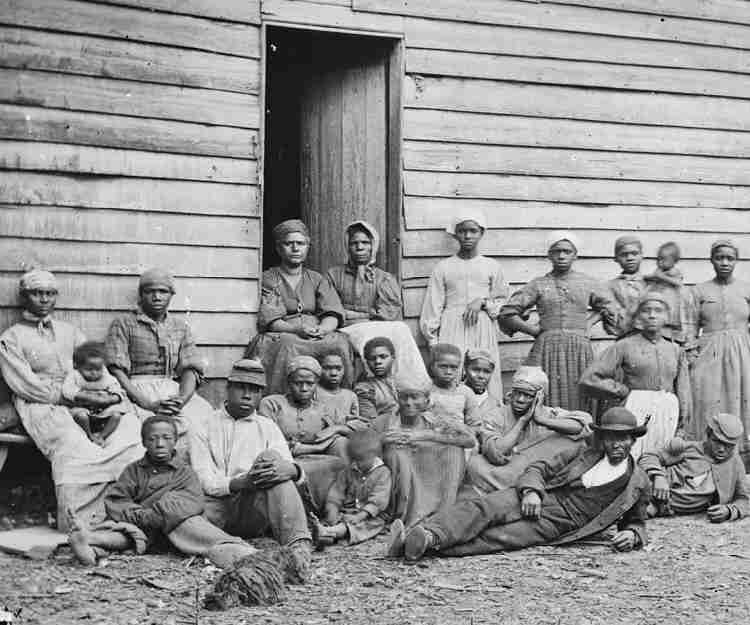
After the Civil War erupted, large numbers of slaves flocked to Federal lines. Federal troops also occupied substantial areas in the rebelious states, primarily in the areas of the south along the Mississippi River and Tenessee. The slaves who ran away and began reaching Federal units were at first referred to as "contaband". Federal law at the time before issued the Emancipation Proclmation became effective (January 1, 1863) required run away slaves to be returned to their masters. Most of their masters, however, were in rebellion and such an action would have alienated northern abolitionists who were strongly supporting the Federal war effort. It would have also hurt the Federal cause in Europe where diplomats were struggling to keep Britain and France from recognizing the South. Both countrues had strong economic ties to the South which was their primary source of cotton. This is much more important than it sounds today. Cotton was a critical commodity in the 19th century and in fact central to the emerging industrial economies of Britain and France. Yet anti-slavery sentiment made it difficult for either government to recognize the Confederacy. The runaways were not at first accepted as soldiers. Federal units began, however, using them as laborers, both to construct fortifications and in daily camp chores like laundry and cooking.
Much has been written about the Underground Railway. This did provide freedom for several thousand slaves. Most of those who reached saftey in the North or Canada, however, fled from the border states. The possibility of slaves in the Deep South to f reach the North were very limited. And it was in the Deep South where most slaves were held in bondage. As aesult only a small fraction of slaves managed to escape. The real impact of the Underground Railway sas that it angered Southern slave holders. Espcially galling was the support the increasing runaways received in the Northern Free states. It convincd mny in South that they needed to secede from the Union.
The Civil War began when Conderate batteries fired on Fourt Sumter in Charleston harbor (April 1862). It was a huge mistake on the patn of the Confederacy beause it meanthat in northern eyes the South had started the war. And it gave President Lincoln Lincoln ghe opportunity to keep yhe Biorder States in the Union. For the slves it also mant the real possibility of freedom. Now the opportunity for freedom significantly increased as Federl troops advanced into Confederate territory. The opportunity to run away changed markedly with the onset of the Civil War. The Underground Railway provided the opportunity for handful of slaves to escpe, albeit with a long, arduiys and very dangerous journey. The Confederate Army of Northern Virginia stimied Federal Armies in the eastern campaign. Federal Armies had much more success in the western campaigns and reached the Deep South, especiallyalong the Mississippi River.
After the Civil War erupted and Federal armies began to move south into slave states, large numbers of slaves flocked to Federal lines. This was at first just in northern Virgina, but soon the Fedral armies under Grant and sherman made substabtiual inroads in the West. Areas along the Mississippi River (western Tennesee, and Louisiana) where Federal troops first entered the Confederacy encounterned large numbers of runaway slasves. The Fedrals lost batle after battle in Virginia, but their presence there offered the possibility of runaways reaching Fedral lines. The Federals experiencd more success in the West because of better leadership, namely Grant and Sherman. Also the Misissippi provided support from Federal gunboats which were constructed in substanial numbers.
Runing away was dificult unless Federal troops were nearby. The greater the distance involvd, the greater the chances of being captured an returned to owners. Thiswas why before the wat that espaping from Deep South states was virtully impossile. As Federal troops penetrated deeper into the Condeferacy, more and more slaves were able to run away. The slaves who ran away and began reaching Federal units were at first referred to as 'contabands'. Befor the Emasncipastion Proclmation, the status of runaways was unclear. Under state law, they were considered property and the Federal Government had no asuthority to seize property. and Lincoln was still concerned about keeping the Border States in the Union. Slome slave owners even approached Federal commanders demanding their slaves back.
Federal law at the time of the Civil War before issued the Emancipation Proclmation became effective (January 1, 1863) required run away slaves to be returned to their masters. The Compromise of 1850 had included the Fugative Slave Act which was still in force when the Civil War broke out. And the Supreme Court has clearly ruled that African Americans could not only not become citizens, but slaves were property. And property was protected by the Constitution. Most of their masters, however, were in rebellion and such an action would have alienated northern abolitionists who were strongly supporting the Federal war effort. On the other hand, freeing the slaves would have aliented the critically important Border States. This put President Lincoln in a quandry and required creative thinking. The interim sollution was the First Confiscation Act (August 1861).
The initial Federal answer to the legal status of the runaway slaves was to classify them as 'contraband of war'. This is not a very inspiring term for what was in fact the initial step toward the towering achievement of emancipation. After Fort Sumter and the onset of the War, Federal officers with abolitionist leanings began freeing slaves. Lincoln was horrified, not because he was not sympathetic, but because of the political implications. One of his first priorities was to hold the critically important Border States in the Union. These were slave states which had not succeeded, but each was teetering. If the War was proclaimed to free the slaves, he would have lost some if not all of them. By making the war an effort to preserve the Union, he held each of them. The same was true of the northern free states. There were abolitionists in the North willing to fight to end slavery. But there were also many who had no desire to risk life and limb to free the slaves. On the other hand, there was widespread support for preserving the Union. Thus Lincoln not only engineered the South firing the first shots of the war, but making the Union cause the preservation of the Union. This frustrated many Federal officers who felt a moral obligation to free the slaves. Lincoln was forced to reprimand them and even dismissed Jonn C. Freemont who had been the first Republican candidate for president. (Freemont may have been morally right, but he lost the 1856 election. Lincoln won his election and because of it was in a position to free the slaves.) General Benjamin Butler faced with the problem of how to deal with runaways at Fort Monroe, Virginia devised an ingenious answer to the problem and one that would not undermine Lincoln's war policy. Butler is one of the most intriguing figures of the Civil War. He also became the most hated figure in the South--at least until Sherman's March Through Georgia. He became know as 'Beast Butler'. Beast or not, Butler had the political skills that many other abolitionist officers lacked. He understood Lincoln's dilemma and devised a politically astute policy. When a local slave owner demanded the return of his three slaves that had escaped into Fort Monroe, Butler adamantly refused. He did not free the three runaways, but refused to turn them over on the grounds that they were persons (the Confederacy called them property) being used to wage war against the Federal Government. He did not use the term contraband, but Lincoln did not reprimand him or countermand his action. And the term 'contraband of war' soon became widely used to describe the escaped slaves that reached Federal lines. It was commonly shortened to just 'Contrabands'. Congress saw this as the best way of addressing the issue and passed the First Confiscation Act. Lincoln was somewhat reluctant, but signed the bill into law (August 1861). The law provided that if slaves are (as Southern states maintained, in fact, property and if this property is owned by any person in active rebellion against lawful Federal authority, then the U.S. military has every right to deny its use to any such person. Any slave that could be wrested from the Confederacy would therefore become the property of the United States Federal Government. This opened the floodgates, within days, hundreds of runaway slaves were sheltering under the protective guns of Gen. Butler at Fort Monroe. And in the West, Federal victories mean that thousands and then tens of thousands of slaves flocked to Federal lines. And in the North as the war progressed, public opinion toward slavery began to change as voters who had not been abolitionists began to take issue with slavery. This would save the Union in the elections of 1862 and 1864. It us not entirely clear why this occurred, but apparently acrimony toward the Confederacy and its leaders gradually transformed into support for emancipation. The former slaves began arriving in such numbers that they set up camps near Union encampments and followed Federal field armies as they moved. This provided Union forces with needed labor support as given the increased lethality of arms, entrenchment became vital. The Army even helped support and educate both adults and children among the Contrbands. by the end of the War, more than 100 contraband camps were functioning throughout the South.
Returning the runaways would have also hurt the Federal cause in Europe where diplomats were struggling to keep Britain and France from recognizing the South. Both countrues had strong economic ties to the South which was their primary source of cotton. This is much more important than it sounds today. Cotton was a critical commodity in the 19th century and in fact central to the emerging industrial economies of Britain and France. Yet anti-slavery sentiment made it difficult for either government to recognize the Confederacy.
The runaways were not at first accepted as soldiers. Federal units began, however, using them as laborers, both to construct fortifications and in daily camp chores like laundry and cooking. We note quite a number of runaway slave boys taken in as personal servants by Federal officers. The photographic record also suggests that boys also became attached to enlosted soldiers. It is not alwats clear if they were separated from their parents, but it should bd rembered that one aspect oc slvery was selling off children and parents and separating families. The unpredentled lethlity of Civil War weapons made fortifications increasinly imprtant. Fortifications allowed relatively small garrisons to hold important positions against much larger attacking forces. Federal forces were for the most prt on the offenive =during the war, but even here laborers were needed to help up temporary emplacements in the field. This meant that both men and women as well as children were of military value to the Federal forces. The runaways were used primarily as labor at first. They proved so valuable that they began to pay them wages. The payments were from both the Federal Givernment as well as fromn the soldiers fir services rendered like laundry and cooking. After the Emancipation Proclmation, the Federal Government began accepting enlistments for combat units. This would eventually have a substantial impact on the War. Thousands of men from the Contrabnd Camps enlisted in the United States Colored Troops. Black soldiers swelled Federal ranks as it was becomong increasingly difficult to recruit more soldiers. About 10 percent of the Federal Army was black soldiers by the end of the War.
Children also arived at Federal camps. When long distances were involved, nost of the runaways were men. It was virtully impossible for an entire family to escape, especially if there were young children. Of course many familkies were split by selling individuals, but many families were intact. As Federal armies moved further south more childen wre able to run away, either with their families or for older botys on their own. This ws especially true of boys that had been separated from their families. Boys who joined the union camp following could assist their parents or run errands or do favors for the soldiers. We see younger boys serving as servants to officers or perhaps or mascots to units. It is not always clear just who they are. And rgere is only limited literature about them. Some of the boys may have served as drummer boys for the black regiments. We think that many if not most of the black drummer boys were runaways. We think that most were probnly runaways rather than boys recrioted from the free northern black population. This needs, however, to be confirmed. Hopefully readers will know more about this.
At the time of the Civil War, America was still a ;argely rural, agricultural country. This was especilly true of the South, but was also true of the North. The North at the time of the Civil War was industrializing, but a majority of the popularion still lived in rural areas nd on farms. This was important in the War. One limitation in rcruiting soldiers was thzt men ere needed to work the. farms. If he volunteered or drafted, the family could be left in direcircumstances. Here the Confederacy had an invantage. Slaves could continue to work yhe lsnd even if mem were at the front. Emancipting the slsves and encouraging them to run away not only undercut the Confederate economy, but significntly reduced food producion. This dversely affected the families at hime, but the Cinfederatec field rmies. Confederated armies by the end of the War were essehtilly starving. Gen. Lee;s Army of Northern Virginia was in such desperate condition at Appomstox Court House after surrendring that Grant ordered food to be delivered to them.

Navigate the CIH Civil War Pages:
[Return to Main Emancipation page]
[Return to Main American slavery page]
[Return to Main Civil War page]
[Biographies]
[Campaign]
[Causes]
[Emancipation]
[Families and youth]
[Fiscal policy]
[Formations and units]
[Law]
[Railroads]
[Reconstruction]
[Slavery]
[Soldiers]
[Uniforms]
[Weaponry]
[Lost Cause]
[Civil Rights movement]
[Return to CIH Home page]