**
war and social upheaval: the American Civil Rights Movement
The American Civil Rights Movement (1954-65)
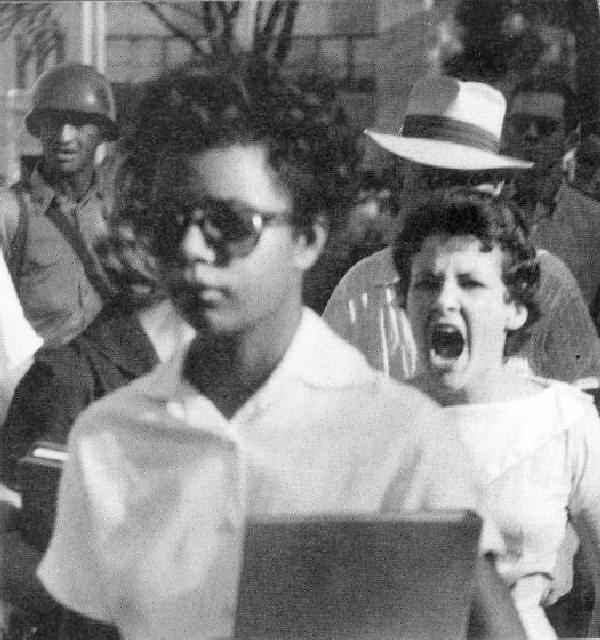
Figure 1.--The courage of the Black children who faced racist mobs to integrate Southern schools made them heros who helped change their country. Here 15 year-old Elizabeth Eckford endures ugly racist taunts in Little Rock. Arkansas on her way to Central High School in 1957. The girl yelling at her later as an adult was to ask Elizabeth to forgive her. It was said at the time that you cannot legislate morality. But that is just what the Civil Rights Movement pushed the courts and the Congress to do and America is a very different country becaudse of it.
The American Civil Rights Movement is one of the most momentous epics in the history of the American Republic. I date it from the Brown vs. Topeka Supreme Court deseggregation decission (1954) to the passage of the Voting Rights Act (1965), but of course the struggle began long before that and continues today. The hope of real freedom for the emancipated slaves after the Civil War was quashed by racist state governments after the withdrawl of Federal trops in the 1870s. The gains achieved by blacksere gradually eroded by racist Jim Crow legislation and extra legal terror fomented by the Klu Klux Klan. Lynchings and mob vilolence througout the South cowed blacks into submission and precented them from voting. The economic deprivation and terror caused a small numbers of blacks to migrate north and after World War I (1914-18) this migration increased significantly. The Supreme Court countenced segreagation in the Plessy vs. Fergusson decission (1898) and a system of racial apartheid enforced by law and the lynch rope ruled the American South until after World War II (1939-45). President Truman prepared the groundwork for the Civil Rights movement when he desseggregated the military (1948) and took other steps which led to the landmark Supreme Court Brown decission. Brown Although the Brown decission did not immediately desegragate Southern schools, it did help foster a decade of nonviolent protests and marches, often carried out by teenagers and youths. These ranged from the 1955-1956 Montgomery bus boycott to the student-led sit-ins and Freedom Rides of the 1960s. These protests were finalized by a massive March on Washington (1963). The Civil Rights Act (1964) which provided a frange of legal protections including access to public accomodations. The Voting Rights Act (1965) was the capstone of the movement, guaranteeing access to the voting booth and in the process fundamentally changing America.
Chronology
The American Civil Rights Movement is one of the most momentous epics in the history of the American Republic. I date it from the landmark Brown vs. Topeka (1954) Supreme Court deseggregation decission to the passage of the Voting Rights Act (1965), but of course the struggle began long before that and continues today.
Racism
America from the arrival of the fitst Africans at Jamestown (1619) developed as a racist society. Even after the Resvolution when slavery was gradually abolished in the northern states, most Americans held rasist views. Racism was even prevalent among many abolistionists. The view that Blacks were inferior was widespread among White Americans before and after the Civil War. After the Emancipation of Blacks most White Americans continued to view Blacks as inferior in a wide range of human endevors. A new doctrine became increasingly popular in America and other countries--Eugenics. Eugenics provided what was though to be scientific grounding for racist doctrines. Eugenics did not specifically target Blacks. Generally speaking, however, a dominant racial group usully finds spperior attributes from itsown group. That was precisely what happened in America. Laws were passed in many states that used eugenics theories to steralize substantial numbers of mostly Black and poor Americans. Eugenics was later adopted by the NAZI as a pseduo-scientific justification for anti-Semitism.
The suppression of black Americans and the denial of the civil rights was of course the aftermath of slavery, an institution which has a continuing impact on American society. The debate over slavery in the United States did not begin with the Constitutinal Convention (1787), but it was here that the issue first came to the fore. Some northern delegates were opposed to it. Southern delegates were committed to it. It became clear that there would be no Constitution without a compromise. The compromise was that a decission on the future of slavery wold be deferred. The issue was never resolved poltically, but was in fact finally settled by the Civil War--the greatest blood letting in American history. It was not The American Civil War has been called the first modern war because of the number of men involved, the sweeping movements, the use of trains and telegraphs, and the increasing sophistication of the weaponery including rifled artillery, repeating weapons and iron-clad ships. The Civil War was the defining epoch of the American nation. After the Civil War, the Federal Government began a process of Reconstruction. The Federal Government despite Southern critics, persued a soft peace. White southerners attepted to intoduce a legal system which kept the freed slaves in a state of servitude. Their primary instrument was the Black Codes (1865).
White southerners formed a secret paramilitary white supremacist organization, the Ku Klux Klan (KKK). The KKK terrorized blacks with beatings, whippings, burning of homes and lynching. Radical Republicans in Congress persue a policy aimed at protecting southern Blacks. The hope of real freedom for the emancipated slaves after the Civil War was quashed by racist state governments after the withdrawl of Federal trops in the 1870s. The gains achieved by blacks were gradually eroded by racist Jim Crow legislation and extra legal terror fomented by the Klu Klux Klan. Lynchings and mob vilolence througout the South cowed blacks into submission and precented them from voting. >No group in America were more adversely affected by the Depression than Blacks. Few Blacks had any financial savings to coution them from the full affect of the Depression. Blacks who had difficulty getting jobs in prosperous times had ever more problems as competition for a dwindling number of jobs intensified. As a result, while the New Deal did not address lynching and other issues of great concern to Black-Americans, many Blacks bnefitted from the the overall New Deal relief programs. American factoiries began expanding production when war broke out in Europe creating many new jobs. At first Blacks were excluded from most of these jobs. A. Philip Randolph, heads of the International Brotherhood of Sleeping Car Porters, began planning a march on Washington for jobs in 1941. He used the threat of such aarch to get President Roosevelt to issue an executive order prohibiting racial descrimination in the expanding war industries.
[Bass] The United States went on to fight World War II with a seggregated military. The Roosevelt Administration is often criticised for its lack of action on Civil Rights. But in fact great steps were taken. A priority of the New Deal was bring the South back into the national economy and mainstream. The Administration's Civil Rights record has to be assessed with the need to hold southern democrats in the New Deal coalition. A push on Civil Rights in the 1930s would have failed and it would have threatened the many accomplishments of the New Deal.
Law throughout history has been a central issue in any civilization. It has been a force for both good and evil. Perhaps Rome's greatest contribution towrd civilization is law. Yet Rome was a civilization based on military power and slavery. A key component in the emergence of Europe and America as modern successful nations had been the rule of law. The law in America for four centuries has been used to supress minority groups, especially blacks. Perhaps the most distressing decession in the history of the Supre Court was the Dread Scoitt decession. Only with the New Deal in the 1930s did laws and court decessioins begin to offer blacks real legal protection. The turning point in this strugglke was the Suopreme Court Brown v. Topeka which struck down segregation in public schools (1954). There have, however been many important laws and legal decession both before and aftewr.
Legal Challenge
Walter White at the NAACP brought Charles Hamilton Houston (1895-1950) into the organization. Gouston was the grandson of fugative slaves who escaped north. Although his name is not widely known outside the Civil Rights movement, he is one of the most important lawyers in American history. He devoted his career to undoing the Plessy decission which served as the nasis for Jim Crow in the South. Houston worked tireslessly toward that end. Houston was the legal mastermind behind the NAACP's challenge to segregation after World War II. He was appointed dean of the Howard University Law School in 1939 and in effect trained an entire generation of Civil rights lawyers. He told his students that a lawyer "is either a social engineer or he is a parasite on society". He was tough and extremely demanding on his students, but in the end turned out lawyers that proved more than a match for the White lawyers from prestigious Southern universities. It was Huston who recruited Thurgood Marshall. Marshall led a small team of brilliant lawyers, many trained at Howard University, which honed in on the school segration issue at a time when many thought the movement should focus elsewhere, such as lynching, marriage laws, and other issues. Later after Marshall's victory in the Brown decission, Marshall remarked, "We were only carrying (Houston's) bags, that's all."
President Truman
President Truman prepared the groundwork for the Civil Rights movement when he desseggregated the military (1948). His court appointments were also critical to the Civil Rights movement. These and other steps which led directly to the landmark Supreme Court Brown decission.
The slave codes passed by Southern states varied from state to state. Most made it illegal to teach a slave to read and write. They were variously enforced. A few kind hearted owners did so anyway. Other owners did so because educated slaves were more valuable. These were, however, isolated incidents. At the time of emancipation the vast majority of the slaves in the South were illiterate. The Freedman's Bureau set up schools to educate the freed slaves. There were blacks in the North, but a very small proportion of the population. The situatuon in the North varied over time. Some communities excluded blacks from public schools, overtime blacks were admitted although the time frame varied from state to state. Even after emancipation, some states northern and western states still excluded black children. In the South there was a very limited public school system before the Civil War. As public school systems were established following the Civil War, sparated systems were set up for black children. Segregation did not only involve separating black children, but they were the primary target. Nor did segration only occur in the South, although this is wear the vast majority of segregated schools existed. These schools were poorly funded abnd the facilities abd equipment were far below the standards of he white schools. There were cost associated with running two school systems. White children were often bussed. Black children normally had to walk. After World war II, several southern states began improving the black schools, realizing that they were vulnerable to legal challenge because they were so obviously inferior.
President Roosevelt and the New Deal have often been criticized for the lack of attention to New Deal. Actually there were some important advances and none were more important than appointments to the Federal judiciary. This came to fruition when black parents in several states challenged school segregation. The land-mark Supreme Court decission that turned the tide in the Civil Rights struggle was Brown vs. Board of Education Topeka. Several similar cases were united for consideration by the court. The best known is the Brown case which concerned Linda Brown--a little Black girl in Topeka, Kansas. There were also cases from the South, including one from South Carolina. The state of South Carolina realising that the Seoarate but Equal doctrine could be challenged by the obvious inequality of Black and White schools, had embarked on a major building program to construct Black schools. evenso, any fairminded cort would have found unequal facilities. Thurgood Marshall decided, however, decided to persue the principle that separate schools were inherently unequal. Chief Justice Earl Warren carefully guided the Court so that a unanimous verdictv was reached. President Eusenhower who had earlier opposed deseggregatioin of the military was to later say that his appointment of Warren was the biggest mistake he made as president.
Most Americans during the 1950s were not particularly interested in the Civil Rights movement. They were also for the most part not aware of the vilolence and brutalization of Blacks in the South. It was a Chicago teenager, Emmet Till and his mother that began the process of educating America. Emmett was a 14 year old boy endearingly called Bobo by his mother. Emmett was from Chicago and had gone to Mississippi for a short period to visit relatives during the summer school break. . was barbarically killed by two Mississppi men on August 28, 1955 a few days before he was to return to Chicago to begin the new school year. His muder was grusome. His mother bravely decided to keep the casket open to expose to the nation what was happening to Black people, even boys as young as Emmett, in Mississippi and other Southern states.
The Black South
The Civil Rights movement was strongly supported by Blacks in the North. This was not the case in the South. Galup Poles in 1954 revealed that only slight more than half (53 perscent) of Black Southerners supported school desegregation. Here I am not sure about the validity of these polls. If they were collected by White poll takers, many Blacks might not have answered frankly. The Klan terror was so frightening, many Blacks probably feared any kind of change and especially expressing their oipinions frankly. In addition, a not inconsiderable portion of the Black middle class bebefitted from Segregation. Black teachers and other professionals for example were undoubtedly fearful of losing their jobs in integrated schools and other facilities such as hospitals. What ever the reasons, this lack of support limited the ability of the Movement to act in many communities. It also meant that many comminity leaders were hesitant to get involved. In Montgomery for example, Dr. King was asked to address the issue of the public transportation when more establish Black leaders refused to get involved. The movement was to be kead by a new generation of youthful leaders and the most faithful supporters were youths--often school and college students.
Although the Brown decission did not immediately desegragate Southern schools, it did help foster a decade of nonviolent protests and marches, often carried out by teenagers and youths. These ranged from the 1955-1956 Montgomery bus boycott to the student-led sit-ins and Freedom Rides of the 1960s. These protests were finalized by a massive March on Washington (1963). The Montgomery Bus Boycott thrust Dr. King in the national limelight. It was to lead to the first important victory over Jim Crow in the South when the Federal Courts the desegragation of Montgomery buses. Less publicised was a series of actions organized by teenagers and university students all over the South, at first without any kind of national coordination. It was dangerous and many went to jail because thy were violating state laws that had not yet been overtuned by the Federal courts or the Civil Rights Act of 1964. Some Black leaders thought the Sitins to provocative, but Dr. King supported the students. Out of a need to coordinate these actions, the Student Non-Violent Coordinating Committee (SNCC) was established. Perhaps more important than the specific accomplishments of these actions was the the non-violence of the protestors in contrast to the often brutal suppresion tactics used by the police. These actions brought the issue of Civil Rights to the public eye and kept it there week after week as events unfolded in American living rooms on the nightly news.
The emergence of the Civil Rights Movement and its increasing success in challenging the South's seggregation system led to a renewed interest in the Klan. Klan organization both formal and informal increased in the southern states. This was especially true in the deepo South states of Alabama and Mississippi. The most important Klan group was the White Knights of the Ku Klux Klan which was led by Robert Shelton. The central concern of the Klan was preventing blackls from voting. Part of the reason was the very substantial black population, especially in Mississippi where over 40 percent of the population was black. Both legal and extra-legal methods were used to prevent black voting.
The Supreme Court decission in Brown vs. Board of Education Topeka made school segregation illegal. But the Court had no powers of enforcement. President Eisenhower was not pleased with the decission. (He had opposed desegregation of the Army.) Thus there was no Federal action promoting compliance. Schools in states like Kansas quietly complied. States in the South did not. The NACCP brought legal action which slowly worked their way through the legal system. The first case to produce a desgreagation order emerged in Little Rock, Arkansas. The result is seen here in an excahnge between two Little Rock teenagers. The Little Rock case and threats of mob violence was swiftly resolved by the 82nd Airborne. It would take 20 years to desegregate the rest of the South.
Martin Luther King became the pastor of the Dexter Avenue Baptist Church in Montgomery, Alabama. He was already involved in the Civil Rights movement and at the time a member of the executive committee of the NAACP. He was not the not the most important Black leader in Montgomery nor was the Dexter Avenue Baptist Church the most important Black church. The more established leaders, however, were afraid to get involve when Rosa Parks was arrested and the Black community wondered if they could take any meaningful action. Dr, King;s leadership in organizing the response--a boycott of the city busses brought him into national prominance. It was the first important Black nonviolent action in the Civil Rights movement. Armed only with a powerful voice and message in a state where blacks were denied the right to vote and had virtually no access to basic legal rights, Dr. King became a powerful spokesman for Civil Rights. This put him in great personal danger. But his principled stand was not only that the moral issue was clear, but bow was the time to act. He wisely promoted non-violent resistance, even when exposed to brutal state sponsored and extra-legal violence. The current state of race relations. Not only would answering violence wth violence probably failed, but it would sewn the seeds for racial hatred and division for generations to come.
bus boycott described by Gunnar Jahn in his presentation
speech in honor of the laureate. The boycott lasted 382 days.
On December 21, 1956, after the Supreme Court of the United
States had declared unconstitutional the laws requiring
segregation on buses, Negroes and whites rode the buses as
equals. During these days of boycott, King was arrested, his
home was bombed, he was subjected to personal abuse, but
at the same time he emerged as a Negro leader of the first
rank.
American Intelectuals
The American intelectual movement made a realtively limited contribution to the Civil Rights movement. Many such as Reinhold Niebuhr and William Faulkner advised Bklack leaders to be more patient. Others like Hannah Arendt even opposed school desegregation. [Polsgrove] (Arendt objected to Governmrent action in the social section, but of course segragation was in itself Government action in the social sector.) The consel to adopt a "go slow" approach was favored by a wide range of intellectual thinkers, assuming that giving the South time to gradually duismantle the Jim Crow system would reduce the level of violence assicated with that change. One writer argues persuasively that gradualism would have only embolded the Segregationist forces and would have delayed if not prevented real change. [Hochschild]
James Baldwin
Surely the most eloquent author describing the plight of blacks in America and the corosive impact of white racism was James Baldwin. His masterpiece, The Fire Next Time is a book that must be read by all serious students of American history. Baldwin's essential message was that America cannot exist as a segregated country. He argued with forceful rhetoric that segregation, racism, and white supremecy would eventually destroy America. He wrote, "Times catches up wiyh kingdoms and crushes them." [Baldwin] Baldwin wrote at the height of the Civil Rights movement when racist southern whites were unleashing viloent retribution to those challenging segration. This was not new. What was new was that the news media was reporting on the viloence when shocked northern whites. And two Democratic Presidents mustered the force of the Federal Government to stop the violence.
The Federal Bureau of Investigation
The FBI especially after the March on Washington and Dr. King's "I Have a Dream Speech" focused on Dr. King as a dangerous person. [Hansen]
President Kennedy
President Kennedy began his administrationwithout without any plans to focus on civil rights or any deep committment to the cause. The new President was sympathetic, but other issues were higher on his agenda. As with President Truman, he was to play a major role because of a basic realization of the rightouness of the cause. The brutality and viciouness of the Klan response to the Civil Rights movement forced President Kennedy to address Civil Rights. The force of events demanded the Administration act. It was a difficult decession to make because alienating the White would make it difficult to get southern Democrats in Congress to support the Administration's legislative program. Unlike President Eisenhower, however, who had acted simply to uphold court actions, President Kennedy also committed the Federal Government to secure and protect basic civil liberties for black Americans. Because the President was assasinated in 1963, this committment was only fully achieved by President Johnson, but the moral force of President Kennedy's commitment was in fact the turning point of the struggle for civil rights in America.
The media played a major role in the success of the Civil Rights movement. The media brought the inequalities and denials of basic civil rights in the South to the attention of the entire nation. America in the 1950s was still a fundamentally racist nation, but the NAZI horrors in Europe had made racism except in the South an untenable moral position. Even those with racist views would increasingly deny such views in polite society and increasingly rejected government policies restricting Black rights. Given this shift in White attitudes, media coverage of the exposing the brutalities of Southern racism and supression of legitimate Black expirations turned the conscious of a nation. While many if not most White Americans still harbored racist views, few outside the South favored denying Blacks the right to vote and other civil liberties. Most were horrified with the beatings, murders, and other brutalities exposed by the media. Many northern whites did not understand what was happening in the South. Here the new medium of televesion delivered powerful images to the nsation's living room. Print media was important, but it was television coverage that was central to the Civil Rights movement. Hollywood also played a role in changing attitudes.
March on Washington (August 28, 1963)
The shining momment of the Civil Rights movement has to be when Dr. King stood on the steps of the Lincoln memorial and told his country about his "dream". It is certainly one of the great speeches in American history. His riviting, brief address would in only 2 years be followed by the most far reaching civil rights legislation in American history. He ends the speech, "Free at last, free at last, thank God Almighty, we are free at last!" The original idea was not Dr. Kings', but A. Philip Randolph's in 1941 and he began promoting it again in the early 60s. [Bass] After sone initial reluctance, Dr. King agreed to the idea as a way of promoting the civil rights legislation before Congress. Many urged caution, but one deciding on the March, King promoted it with a passion and became adament about it. The Fedral Government prepared for a race riot. It proved to be the largest non-violent demonstration in American history with some 250,000 people on the Mall. At the time the dignified deportment of the crowd was reported by the media rather than Dr. King's speech. [Hansen] Many Whites had expected a Black riot on the mall. It is the "I have a dream" part of the speech that is best remembered today, perhaps it is the most lyrical, idealistic part of the speech--and for that reason probably most appealing to many White Americans. There were some more militant parts of the speech. Some speakers had to be restrained in their remarks. John Lewis with SNCC had wanted to thraten a non-vilolent march south like Sherman. King was criticised for not being militant enough. His speech is seen today as one of the most important speeches in American history. At the time many criticised March on Washington as pushing too hard. Justice Hugo Black who was concerned about demonstrations and petrified of mobs mentioned to an aquaintance of Dr. King that he should stop marching. When she passed on the message, Dr. King replied, "I'm sorry, Mrs. Durr. I greatly respect Justice Black, but we must march. I have to get fear out of these Negroes. They've been scared for three hundred years and they must get rid of fear before they'll ever be able to do anything. Marching is the only way to do this." [Newman, pp. 542-543.] Another major purpose was to convince President Kennedy to commit the political capital to make civil rights a priority. The President invited Dr. King to the White House afterwards and cingratlte him on his success. The President had decided to make that commitment.
President Johnson
Two months after the March on Washingon, President Kennedy was assasinatd in Dallas, Texas. Vice President Lyndon Johnson, a southerner from Texas became president. Senator Johnson in the 1960 election had played a major role in Senator Kennedy's election by saving some of the southern states for the Democratic ticket. It was not immediately apparent how the new president would approach Civil Right. He was a southerner. As Majority Leader he has pushed the first Civil Rights law in a century through the Senate (1956). The then Senator Johnson knew what civil rights leaders did not appreciate that the symbolish of action and commitment were more important at the time than the actual provisions. He did it, however, at the cost of emasculating it. As vice president he was not involved in civil rights issues. Thus civil rights leaders had no idea what to expect and weee in facr deeply suspicious of the new president. In fact, Prsident Johnsom embraced the Civil Rights movement and managed to ram though Congress the most important Civil Rights legislation since Reconstruction. And this time there would be no turning back the clock.
Civil Rights Acts
An increasingly sympathetic Federal government in the 1960s innitiated major changes in public policy. This began with the election of President Kennedy. Kennedy came to the presidency with a focus on intenational affairs. The Civil Rights movement and the brutality of the reaction in the South, forced Kennedy to addres civil rights. To the surprise of most Civil Rights leaders, President Johnon purued civil rights with even more vigor. The viloence in the South and the exposure of brutality and violence by a sympathetic national media helped change white attitudes in the North. The results were the The Civil Rights Act (1964) which provided a range of legal protections including access to public accomodations. This was followed by the Voting Rights Act (1965) was the capstone of the movement, guaranteeing access to the voting booth and in the process fundamentally changing America.
The Civil Rights movement primarily focused on the Southern states. This was because it was in the South that racism was institutionalized by state law. Each state had their own laws, but they established a legal system that seggregated life by race. Federal law somewhat complicated the system, becuse blacks were legally entitled to vote. This was circumvented by poll taxes and literary tests in which illiterate whites were grandfathered in. And Klan terrorism essentially prevented legal challenges to the system. And terrorist attacks during the 1950s and early 60s also resulted in the nation's attention being focused on the South. This the issue of racism in the North at first recieved relatively little attention. With all the negative headlines from the South, it was commonly missed that in terms of interpersonal relations there was in many ways less seggregation in the South than in the North. Granted it was not interactions on equal terms, but there were more personal contacts between blacks and whites in the South than in the North. Blck and white children up to a certain age played together. Black women commonly were employec as domestics in white homes. Neighborhoods were not nearly as segregated in sSouthern cities as was the case in northern cities. The fact that there were personal contacts was important. While they were unequal personal contavts, at least there were personal contavts to build on. This was a factor in the fact that the race riolts of the 960s, primarily occurred in Northern rather than Southern cities. It was also the case that once the civil rights laws were passed and blacks got the vote in the South than race issues became more of a Northern than a Southern issue.
The North
Until the early 19th century, relatively small numbers of blacks lived in the north. The American black populatin was largely a rural southern populaion. This began to change withthe Great Migration. Histories of the Civil Rights movement focus on the South where segregation was de jure rather than de facto. By the time the Civil Rghts movement began to gain momentum in the 1959s, blacks had become alargely northern urban population. Blacks in the north were unecumbered by the most blatant southern Jim Crow measures, but still affected by racial prejudice. This created an economic, political, and legal regime that prevebnted them from achieving any level of equality. Black opportunity was limited by both individual and public policy. They were confined to certain neigbrhoods, confronted by limited access to jobs, and faced restricted access to public accomodations (restaurants, hotels, amusement parks, and swimming pools). Nortern officials claimed that separation developed naturally and was not the result of descrimination or public policy. Confined to certain neigborhoods children attended largely segregated and infeior schools. [Sugrue] The public policy aspect can be over emphasized. Another factor is the support the children achieved at home. Manu of their parents were poorly educated, in some cases iliterate, and thus unable to provide needed supporg at home. Thus blacks with inferior educatins and facing workplace descrimination were overrepresented in the ranks of the unemployed and poor. Dr. King in 1963 proclaimed, "We must come to see that the de facto segregation in the North is just as injurious as the actual segregation in the South." We do not agree. There is no doubt that blacks in the North were descriminated against and were terribly harmed by it. Tere wre, however, major differences. First, blacks in the North did not face the physical inemidation that was the case in the South. Second. blacks in the north has access to the ballot box and tus could influence public policy. Third, while blacks in the north faced job descrmination, theirveconomic status was far greater than rural souther blacks. Fourth, outspoken black leaders emerged in the north. This was not possible in the South until the 1950s and even the was very dangerous.
In some ways, however, the races were more separate in the north than the south.
.
Black Power
Groups like the Blank Panthers began promoting black power. While generating a great deal of publicity and popularity in the black community, these groups have very few concrete achievements to show for their efforts. The great achievements of the Civil Rights movement came from other more moderate black and white leaders.
Through much of American history, race riots meant mobs of whites attacking blacks. There are many examples such as the New York City Draft Riot (1863) and the Detroit race riot (1943). These riots included not only destroying communities, but killing people as well. This changed in the aftermath of major achievements in Civil Rights. This time it was blacks rather than whites rioting and the focus seems primarily on the police and property. Despite the momentous achievement of two landmark Civil Rights Acts, northern citirs exploded--the long hot summer (1965). It seems incongrous why the riots would occur just at the time that the Civil Rights movement had accomplished its major objectives, ending segregation and achieving voting rights in the south. This would seem a time to celebrate rather than riot. Perhaps the national dialog and new coverage on race was a factor. Much of this was a revelatin for whites, but one would think nothing ne to blacks. Surely black people living in the inner city had grevances, but it is difficult to see just what was to be accomplished by rioting. This is of course especially true when it burning down your own neigborhoods. Of course rioting is usually not a coherent act. Most of the riots were in larger Northern cities. The first major urban riot conducted by blacks was in Watts, a suburb of Los Angeles (1965). Major riots occurred in Newark and Detroit (1967). The rioters did emense damage, often destroying the ecionomic base of the communities affected. The assasination of Dr. King (April 4, 1968) brought spasms of violence in many cities, this time including southern cities. Often this was mixed with local grievances. In Washington, D.C., Stockley Carmichael who helped found the Student Non-Violent Coordinating Committee (SNCC) gathered an agitated group at 14th and U Street (center of the black shopping district) and demanded that stores close to honor Dr. King's memory. The situation soon turned ugly. Rocks were throne and windows smashed. Looters surged into the clothing stores, five and dimes, liquor, appliance, and other stores. Then the torching began. Three days of rioting followed. The police were totally unable to control the situation. The riots were finally only supressed with over 10,000 U.S. Army trops arrived. More than 1,000 people were injured and 12 people killed. Arrests totaled 6,100. About 900 stores were ruined. The black shopping district was devestated and would take decades to recover.
Electoral Politics
Affirmative Action
The Roosevelt Administration took few actions to specifically aid black Americans, although blacks benefitted from many New Deal programs. Here the President was limited by the need to keep the support of Southern Democrats for first New Deal programs and then defense initiatives in the fight with isolationists. This was especially the case after Republican gains in Cingress (1938). Even so, President Roosevelt took a major step when threatened by civil rights leaders with a march on Washington. The President issued an executive order prohibiting descrimination in companies receiving defense contracts (1941).
President Truman prepared the groundwork for the Civil Rights movement when he desseggregated the military (1948). There was also an affirmsative saction component given the size of the military and the status of military service.
President Kennedy was primarily focused on forein affairs and the Cold War, but violence against blacks in the South firced his hand. It was President Kennedy who first used the term "affirmative action". And civil rights today is one of the areas that the President is best remembered as his major achievements. The Civil Rights Act of 1964 was after President Kennedy's assaination pushed through Congress by President Johnson. The Act was a milestone in the Civil Rights Movement, prohibiting decrimination based on race, color, religion, or national origin. President Johnson by executive order added gender. The Supreme Court in Regents of the University of California v. Bakke ruled definitively against racial quotas, calling them "reverse descrinination" (1978). The Court in a less definitive ruling struck down a University of Michigan race-based acceptance program. It did not, however, flatly porohibit the "use of race in admissions decisions". The Court in Adarand Construction Inc. v. Pe�a demanded "strict scrutiny" in finding descrimination that justified affirmative action. The Court Ricci v. DeStefano decided that the city of New Haven, Connecticut violated violated the rights of 20 white and 1 Hispanic fire fighters when they denined them promotions after they passed a promotions exam. As black fire fighters did poorly on the test, the city scrapped it.
Black Middle Class
Persistence of a Black Underclass
he Civil Rights Movement achieved many of its goals. Segregation was ended. Educational and job opportunities have become available. Racil attitudes have chnged markedly. It would be wrong to say that racial prejudice no longer exists, but it is equally incorrect to say that White racial attitudes have not changed significantly. It is also important to include blck racial attitudes in any discussion of rcein America. Despite the great achievements, a black underclass persists in America. This is somethings that would have surprised Dr. King and many Civil Rights leaders. It is also a sunject that has not been well assessed. Many authors wo have addressed the Civil Rights Movement tend to claim that the continung existence of the blck underclass is the continuing impact of past descrimination. [Surge] This of coure one possibility. But there may be other factors involved. For some reason, black leaders tend to avoid a detailed assessment beyond continued claims of desrimination. The existence of a prosperous black middle class suggests that continuing decrimination is not the major impediment. One major problem which requires examintiin is individual irresonsibility. Factors such as dropping out of high school, drug use, criminality, and having babies out of wedlock correlatevery strongly with poverty.
The black experience and contribution to Americam life is an important topic. There is no douby that for many that the black contribution to America was in virtual Soviet style, air brushed from history. There are counless examples. One of the men shot by British soldiers in the Boston Massacre massacre was a black man--Cyprus Attucks (1770). Few illustrations depicted this until the 1970s. And as a result of the Lost Cause historical movement, the role of black soldiers in saving the Union during the Civil War was downplayed as well as the key role that slavery played in brining about the War. And until the 1970s, the role of Black Buffalo soldiers on the Western Frontier was generally passed over. Try to find a black calavalry slfier in the countless Western made before the 1970s. Thus there is undeniably a need to restore this miscarriage of history. Dr. Carter G. Woodson and Rev. Jesse E. Moorland in the midst of the 1910s resurgence of the Ku-Klux-Klan co-founded the Association for the Study of Negro Life and History (ASNLH) (1915). Their goal was to research and publicize the important role blacks have played in American and world history. Woodson published and distributed his research in The Journal of Negro History. His goal was to counter the rascist notion that unbiased historical reserarch would dispel the wudely held view that blacks had not played an important role in American culture. This attitude also affected how blacks looked at themselves. The goal was to inspire the sane pride that other American groups like the Irish and Italians have in their heritage. Woodson helped convince thed Omega Psi Phi fraternity to sponsor Negro History and Literature Week (1920). Woodson changed the name to Negro History Week (1926). He selected February for the event because two key individuals were born in thst month: Abraham Lincoln (Februry 12) and Frederick Douglass (February 14). Woodson and the ANSLH began preparing teaching materials. The effort gained ground when as a result of the Civil RFights Movement, school districts began sponsoring Black History Week. The event is now wideky adopted in American schools. ASNLH is now the the Association for the Study of African American Life and History and continues to promote black history. The focus most black history programs is to celebrate individuals who have made important contrinutions. That nay be best for younger children, but it strikes us that the black history programs often fail to present a more sophisdticated assessmnent to older students. And some programs focus on the negative past rather than modern America. There is commonly a eagerness to condemn white racism and a reluctance to address aspects of black life that is perpetuating social failure.
America today is the most ethenically and raially diverse country in the world. Americahad shown that it could meld ethenically and religiously diverse Europeand into a new people able to live harmoniously in a democratic republic. This ws part of the proposition posed by President Lincoln in the Gettyburg Address. Left unanswered was whether people of other racial groups, especially blacks, could be assimilated into the American national mosaic. That question was answered by the Civil Rights movement. And Dr. King's non-violent movement was key not only in achieving civil rights, but in changing the hear's and mind's of those who had struggled against the movement. Of course, America is not a perfect society. Racial and ethnic hatred and distrust has not disappeared. Great disparities continue to exist in American society. The very nature of American society has changed. Racial bigotry is now recognized as reprhensible. Individuals of every racial and ethnic group now play important roles in every sector of society from the science laboratory to the Wall Stree boardroom and legislatures and court rooms. The impact of the civil rights movement becomes even more important when it is realized that sometime before the mid-21st century, whites of European origins ill fall below 50 percentof the populaton.
Sources
Baldwin, James. The Fire Next Time (1963).
Bass, Patrick Henry. Like a Mighty Stream: The March on Washington, August 28, 1963 (Running Press).
Hansen, Drew D. Martin Luther King, Jr. and the Speech that Inspired a Nation (Ecco., 2003), 293p.
Hochschild, Jennifer L. The New American Dilemma (1984).
Janken, Kennth Robert. White: The Biography of Walter White Mr. NAACP (New Press), 477p.
Newman, Roger K. Hugo Black: A Biography (Pantheon: New York, 1994), 741p.
Polsgrove, Carol. Divided Minds: Intellectuals and the Civil Rights Movement (Norton, 2001), 296p.