|
After the Civil War, the Federal Government began a process of Reconstruction. The Federal Government descipte Southern critics, persued a soft peace. Southern soldeiers were allowed to simply return home after afirming loyalty. Lee's soldiers after surrender were not even interned. The same was true of Johnston's soldiers in North Carolina who surrendered soon after. Blacks had great hopes for the future. White southerners attepted to intoduce a legal system which kept the freed slaves in a state of servitude. Their primary instrument was the Black Codes (1865). They resstricted the rights of Blacks and limited economic and educatioinal opportunities. White southerners formed a secret paramilitary white supremacist organization, the Ku Klux Klan (KKK). The KKK terrorized blacks with beatings, whippings, burning of homes and lynching. Radical Republicans in Congress persue a policy aimed at protecting southern Blacks. Here the quarled with President Johnson (1864-69). President Grant was more supportive (1869-77). The central step taken was the passage of the 13-15 amendments which abolished slavery and guaranted the civil rights, including the right to vote, of the freed slaves and guaranteed the equal protection of the law. (The Emancipation proclamation was an executive order and open to legal chgalenge.) The slaves were freed, Reconstruction brought great hope for change in the South. There were some considerable gains made. Schools were established and Blacks elected to public office. The Freedman's Bureau was established. After President Hayes (1877-81) withdrew Federal troops from the South, the white majority began to take away the civil rights that the freed slaves had briefly experienced.
The Federal Government descipte under Lincoln's direction, despite Southern critics, persued a soft peace. Southern soldiers were allowed to simply return home after afirming loyalty. Lee's soldiers after surrender were not even interned. The same was true of Johnston's soldiers in North Carolina who surrendered soon after. These were the last remaining major Confederate armies.
It is not clear how President Lincoln would have conducted Reconstruction after the War. Despite the immenent collapse of the Confederacy, ther was no plan prepred. He made it clear in the Second Innagural that he desired a consilitory poilcy. He gave no hint, however, about his plans for the freed slaves. Or how state governments were to be reconstructed. We do not know to what extent he would have resisted the Black Codes and other measures established in the South to limit black civil rights. We do known that the Freedmans' Bureau was established while Lincoln was still president. This suggest that he planned to assist the transition from slavery to freedom. It is likely that Presudent Lincoln would have promoted black land ownership. He did not reverse Gen. Sherman's orders transferring confiscated land to freed slaves. But his plans for Reconstruction can not be known with any certainty.
The whole social structure of the South and an economy based on forced labor was upended by the Civil War. Slaves began running away from the plantations as the Federal armies pushed south. The famed Undergound Railway had reslly only made running away possible in the Bordrr States. Now for the first time freedom was possible for the slavs in the Deep South. And eventually the runaway slaves and the free northern blacks joined the struggle against slavery. They faced brutal reprisals. President Lincoln transform the War from a struggle to maintain the Union to a crusade against slavery with the Emanciption Proclmation (October 1862). Eventually the terrible bloodletting takes in toll. Poor southern whites who never owned slaves, but did most of thefighting eventually become disillusioned with fighting to support the platation society. And the plantation owners become desperate as their society collapses around them. The Federal Army is the primary agent of destroying the social ordrr of ante-bellum Dixie, but the society under pressure of the War also imploded from within. The slaves run away and the poor whites tire of the struggle. At the end of the War the social strutures of the Condederacy were utterly and irevobably destroyed. [Levine]
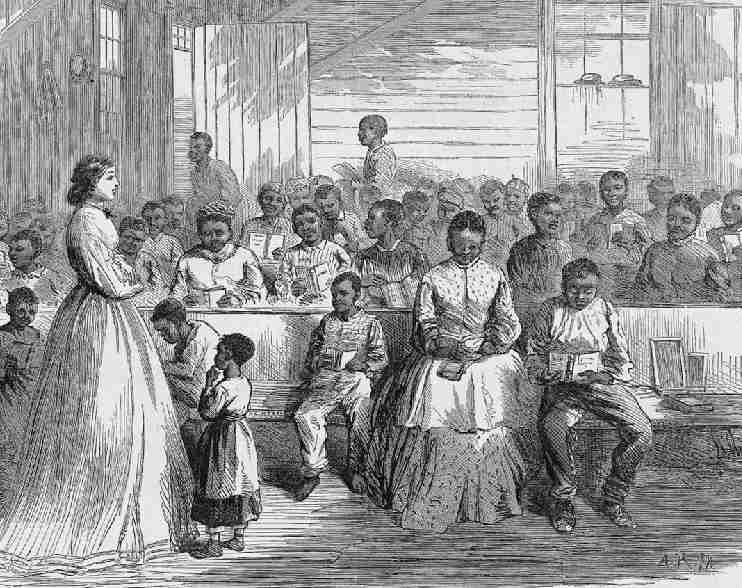
Congress established the Freeman's Bureau to assist the emancipated slaves after the Civil War (March 3, 1865). The Bureau sought to protect the interests of former slaves. The Bureau persued a range of programs in an effort to obtain jobs and provide education as well as basic health services. The Bureau in the next 12 months dispersed $17 million to set up 4,000 schools and 100 hospitals and to provide hosing and food. This was a social welfare program unlike any ever attempted by the Federal Government. It also involved activities like education that were areas that had been the preserve of state government. The Radical Republicans attempted to expand the work of the Bureau, but the law Vongress passed was vetoed by President Andrew Johnson (February 1866). The struggle with the president would eventually result in his impeachment.
The former Conderate states, except Texas, by the end of 1865 had complied with the requirements established by President Johnson for restoring civil government. The requirements did not address the civil rights of the emancipated slaves.
Blacks had great hopes for the future. Southeners generally assumed that a victorious Federal Government would resdestribute land to the freed slaves. Congress did in fact past Confiscation Acts (1861 and 1862). Sherman's orders redistributing land to former slaves (1865) gave rise to the phrase "Forty acres and a mule" abd further expectations among the former slaves.
White southerners attepted to intoduce a legal system which kept the freed slaves in a state of servitude. Their primary instrument was the Black Codes. The black codes were laws passed by state cauthoirities to define the legal status of emancipated slaves. The Black Codes resstricted the rights of Blacks and limited economic and educatioinal opportunities. Whites in particular refused to enfranchise blacks. The Emancipation Proclamation had freed the slaves in the states that has seceeded, but it did not enfranchise them. Other provisions of the black codes prohibited blackis from sitting on juries, limited their ability to testify against white men, banned them from carrying guns and other weapons in public. The Republican Congress in an effiort to strike down the black codes passed a Civil Riughts Bill, but President Johnson vetoed it (April 1866).
Southern Whittes not only used legal means such as Black Codes to control emancipated blacks, but they turned to extras-legal terrorism as well. Much of this was accomplished through covert vigelantee action through secret soicieties, especisally the Ku Klux Klan. The impetus here was provided by famed Confederate Calvalry commander, Nathan Bedford Forest. The Klan was founded in Tennesee but rapidly expanded throughout the South. White southerners formed a secret paramilitary white supremacist organization, the Ku Klux Klan (KKK). The KKK terrorized blacks with beatings, whippings, burning of homes and lynching. The Klan was active. The Klan operated throughout the South during the Renconstruction era, but then with the pasage of Federal terrorism laws and the success of white southerens in regaining control of state governments, the Klan largely disappeared. It was later revived and this time spread beyond the borders of the former Confederate states.
The principal issue in the 1866 Congressional by-election was how the defeated South should be treated. The Republicans advocating punishing the South while President Johnson wanted to treat the South leniently. This probably was received with sympathy by Northeners who lost loved ones in the War. the Republicans benefitted from their role in preserving the Union and continuing sympsthy for President Lincoln who had come to be seen as a martyr. President Johnson was a Democrat who had run with Republican President Lincoln on a Union ticket. He now stumped the country appealong for the lenient treatment of the South. He was accompaied by General Ulysses S. Grant, generally regarded as the great military hero of the War. Johnson mostly spoke for Democratic candidates. His speeches at the time were not particularly well received. The Republicans won in a landslide. The Republicans gained 37 seats, giving them 173 out of 224 seats (over 77 percent). Only three border states states voted Democratic (Delaware, Maryland and Kentucky). Tennessee sent a Republican delegation to Congress. There was no vote held in the other 10 ex-Confederate states did not vote. They substantially increased their majority in both houses to the point that they could now overide the President's vetoes. The results estanlished the basis for Radical Reconstruction and the President was not powerless to block Congressional action. The former Confederate states (except President Johnson's Tennessee) were not allowed to send Congressmen to Washington.
Radical Republicans in Congress were strengthened by the election of 1866. They dominated Congress because the states that secceeded were not allowed to resume their Congressional seats. Thus the democrats were a minority. The Reoublicans pursued a policy aimed at protecting southern blacks. Here there were both ethical and political convictions. The Radical Republicans had been the core support for abolition. There were also political concerns. Black sufferage in the South meant suppprt for the Republican Party from southern states. The Radical Republicans were led by Congressman Thaddeus Stevens and Senator Charles Sumner. They were determined to make black civil rights a cornerstone of Reconstruction.
Radical Reoublicans strengthened by the 1866 election passed the Reconstruction Act (1867). TYhe Act suuplanted previous acts. It divided the states that had secceeded (except Tennessee) into five milkitary districts. Goverernmental authority was placed in the hands of military commanders.
The differences between Congress and President Johnson intensified (1864-69). The Republicans victory in the 1866 Congressional by-election enabled the Republicans to impeach the President over the issue of the Tenure of Office Act (1867). Congress passed the Act over Johnson's veto. The Act prohibited the President from removing presidential appointees which had obtained their offices with the Senate's advise and consent--without Senate approval. The purpose of the Act was to protect Secretary of War Edwin M. Stanton who was quarelling with Johnson. Disregarding the Act, Johnson fired Stanton and replaced him with Civil War hero General Ulysses S. Grant. Grant subsequently relinquished the post to Stanton. Even so, the Republicans in Congress now had an issue they believed could be used to remove President Johnson. The House approved articles of impeachemet. The President survived the sunsequent impeachment trial in the Senate by only one vote (1867). By this time, however, the Republicans began to look at the upcoming 1868 elections.
The central step taken during Reconstruction, in effect the crown jewels, was the passage of the 13th-15th amendments. These amaendments abolished slavery and guaranted the civil rights, including the freed slaves right to vote, and ensured access to equal protection of the law. The Emancipation Proclamation (1863) was an exective order and open to legal chalenge. It was inevitable that once the former Condereate states were readmitted to the Union that slave owners would sue in the Federal courts for the return of their 'property'. Only incorporating emancipation in the Constitution through an amendment would make emancipation permanent and unasailable. The Republicans decided to go beyond simple emancipation and take the further step of granting citizenship to the freed slaves. The final amendment resulted from Southern efforts to prevent the freed slaves now citizens from voting. White opposition in the South largely undermined the achievement of tee goals invisioned. But enshrined n the Coinstitution, these amendments would evetually a century later make it possible to achieve the goals envisioned.
President Grant was more supportive. Grant of course as Union commander was the primary beneficiary of the black troops mutered after the Emamcipation Proclamation.
Republicans in the South on the basis of black sufferage were able to gain control of state governments in the South. The Freedmen's Bureau and the Union League Clubs helped to get out the black boat. White southerners complasined bitterly of Carpetbaggers and Scalwags. Gradually whites regained control of state government. Here the KKK and white terrorism was a major factor. Only three states (Florida, Louisana, and South Carolina) remained under Reconstruction rule by 1876.
Juries are selected from voter roles. Thus while during the period of Reconstruction the newly freed slves could vote, there wre mixed race juries and the results were mot preordained. Ome of the most sensational trials was that of the kidnappers of 17-month old Mollie Digby (June 1870). Little Mollie was the daughter of working-class Irish immigrants. She was kidnapped by two African-American women. The case not only was a criminal trial, but had much wider political connotatioins. It was also covered sensationally by the New Orleans press which charged Mollie was taken to be used in a grusome Voodoo ritual. The national press picked it up. For many whites the message was clear. The freed slaves were a dangerous rabble. It fit into the narative of those trying to restore white rule. And the Democrats were intent on defeating the Republicans controlling the Reconstruction state government. Governor Henry Clay Warmoth had created an integrated New Orleans police force. An Afro-Creole detective, Jean Baptiste Jourdain, was the lead investigator. Two months after she was taken, Mollie was returned. Her father did not recognize her, but her mother accepted her. The accused were two stunnigly beautiful Afro-Creole women. They were tried by an integrated jury before standing-room only crowds. A decade later, the outcome would have been preordained. But this was not only a racially integrated jury, but Afro-Creoles had a socual standing for mulattos unusual in the South. [Ross]
A strange process occurred after the Civil War during Reconstruction which is difficult to fully understand. There was a rapid reversal of the heros and villans. I know of no comparable reversal in American history. Before the War the heros were the abused slaves (but not freed blacks) and the villans were the slave masters and overseers. The classic expression of this was of course Hariet Beecher Stowe's Uncle Tom's Cabin (1852). After the War, the freed slaves somehow gradually became the villans. The Confederacy may have lost the War, but the Lost Cause proponents won the ildeolgical debate. [Lemann] A milstone event was held on the Gettysburg battlefield--the 50th anniversary of the monentous battle (1913). Both the GAR and UCV veterans participated. Newspapers pictured them shaking hands and exchanging stories. I'm not sure about the experience of black veterans. They were all hailed as heros. Left out of the event was any real consideration of slavery and emancipation. Newly elected President Woodrow Wilson spoke at the event without mentioning emamcipation. A popular expression of the Lost Cause was D.W. Griffith's classis film "Birth of a Nation" which President Wilson commented was "terribly true". The heros in American popular thinking became the KKK and similar groups which rode to protect emperiled white women from licentious, criminally inclined blacks. [Foner] It is not altogether clear how just a total reversal could have so rapidly occurred. Certainly the Lost Cause historians played a major role, but they could not been as effective if there were not underlying reasons. Lincoln had suceeded in turning the Civil War into a moral crusade against slavery. The Northern population accepted this, but emancipation did not automatically include granting the feeed blacks full civil rights. This had not yet been done in many northern states. America both North nd South was still a very racist society. Even many abolitionists did not believe that blacks were capable of exercising full civil rights. In addition, the New York Draft Riots (1863) had shown the depth of Northern racism, especially among emigrant groups like the Irish competing for jobs with freed blacks.
There began in the South during Reconstruction a process of separation between blacks and whites. Before the War, blacks and whites had been in close contact. The institution of slavery demanded close contact. There were also extensive contascts between freed blacks and whites in the ante-bellum South. Freed blcks attended the sane churches as whites. This changed after the war. Blacks began to attend separate churches. [Ely] One of the reasoin for thie separation was black enpowerment. Whites felt threatened by blacks to an extent they had not felt when blacks were ciontrolled by slavery.
Sharecropping is an agricultural system which developed in the Southern states during the Civil War. It was a farm tenancy system in which families worked a farm or section of land in return for a share of the crop rather than wages. Sharecropping replaced the plantation system destroyed by the Civil War. The victorious Federal authorities which occupied the South did not seize plantations, but empancipation meant that the owners no longer had a captive laor force. The former planters, even those activly engged in rebellion, for the most part still had their land, but no slaves or money to pay wages. The former slaves on the other hand did not have jobs or land and because they had been denied education, had few options. Sharecropping developed because the former slaves and planters needed each other. The principal crop continued to be cotton. And the planters under the sharecropping system contnued to a large degree to control the lives of the blacks working their land. While the system at first developed to obtain black labor, eventually poor whites also entered the sharecropping system. The system varied, but in many cases all the cropper brouht to the arrangement was his labor. The planter provided the land, but also commonly animals, equipment, seeds and other items. The land owners also commonly advanced credits for the family's living expences until the crop was harvested. The system was open to considerable abuse because the cropers were uneducated, commonly iliterate. Akmost all slaves in the Deep South following the Civil War would have been illiterate. It was illegal to teach slaves to read. The system continued into the Depression of the 1930s. After World War II, migrtion to the North, farm mechinization, education, other employment options, and the Civil Rights movement brught the system to an end.
From an early stage in the Civil War, slaves began fleeing plantations in an effort to reach the advancing Federal lines. These people were as first called contrabands. They were used as workers to support the Federal Army. The Federal armies in the west achieved more success than in Virginia and by the first year of the War had penetrated deep into the Confederacy and soon had thousands of run-away blacks to care for. President Lincoln chnged their status with the Empancupation Proclamation (1963). As the fortunes of the Confederacy declined, more and more former slaves fleed the plantations. Maj. Gen. William T. Sherman in part to deal with the huge numbers of freed slaves following his army, issued Special Field Orders, No. 15 which awarded a land grant of a quarter of a quarter section (160 acres) to heads of households (January 16, 1865). This essentially transferred plantation land to freed slaves. It was applied to the areas under the control of Sherman's army (coasts of South Carolina, Georgia and Florida). Sherman's orders specified "the islands from Charleston, south, the abandoned rice fields along the rivers for thirty miles back from the sea, and the country bordering the St. Johns river, Florida." The term term "40 acres and a mule" was not used in Sherman's order. It is likely, however, that mules were also distrubted. Sherman's orders were the origin of the Reconstruction phrase "40 acreas and a mule".
Federal and state homestead grants at the time commonly ranged from auarter to a full section.
An estimated 10,000 freed slaves were settled on about 0.4 million acres in Georgia and South Carolina. There were also a great deal of land that had been abandones or confiscated from Confederates. The Confiscation Acts passed by Congress (1861 and 1862) meant that large amounts of land were available for distribution to former slaves. .
Most of this land was, however, returned to the former owners as a result of President Lincoln and Johnson's lenient amnenesty proclamations. President Johnson, in particular, ensured that a wholesale land redistribution to the freed slaves did not occur. President Johnson after President Lincoln was assasinated also revoked Sherman's Orders. The Freeman's Act which fllowed contained no land grants. The land was, as a result, returned to its former owners. Despite the failure of Sherman's plan, many blacks did buy land in the South. The defeat of the Confederacy and the collapse of the economy resulted in aharp drop in land prices. This enabled many former slaves to buy land. We do not have details yet on just how much land that former slaves managed to purchase, but believe it was substantial. A major factor here was a decesion by the Federal Government to make oublic lands available on a non-discrimnatory basis. Thus sales of public lands occurred in Alabama, Arkansas, Florida, Louisiana, and Mississipp. One historian reports that former slaves owned substantial areas of land: Folorida (161,000 acres) and Georgia (350,000 acres). [Franklin, p. 312.] If one sivudes these amounts by 40 acres per family farm and an average family of about 5-6 people. one can get a general idea of land ownership as a result of Reconstruction. Clearly only a minority of blacks acquired land, but it was not an inconaequential minority.
We would be interested in any references readers can provide addressing this issue. We have archived some images on HBC of black landowners. We note an Arkansas family about 1940.
The Lost Cause historians who for many years dominated the histography of the Civil War painted a dark picture of Reconstruction. Their accounts were filled weith tales of Carpetbaggers and Schalwags. Black elected officials were depicted as ignorant and uncivilized. The Reconstruction state giovernmrnts were described as corrupt and persuing ruinous economic policies. Some even excused the terroirism and other acts of violence as necessary to opposed the policies of the Reconstuction governments.
For years as a result of the work of Lost Cause historians, Reconstruction has been seen as not only a failed effort, but a dark page of American history. Modern historians now draw a more nuanced view of Reconstruction. There were in fact real achievements. The slaves were freed, Reconstruction brought great hope for change in the South. There were some considerable gains made. Schools were established and Blacks elected to public office. The Freedman's Bureau was established. Public schools systems were founded in southern states. The real failure was the inability to guarantee civil rights for the freed slaves. Yet the 14th and 15th Amendment were approved. Racist southerners could seize control of state governments and largely disenfranchise the freed slaves, bit to accomplish this they had to use extra-lehal violence. The new state governments imposed Jim Crow--a system of racial segregation which for decades would limit the aspirations of black Americans. Yet the 14th and 15th Amendments were inshirined in the Constitution. And it would be these two key stones of Reconstruction that the Civil Rights Movement would use to end the segrationist system.
Lost Cause historians painted a dark picture of the Reconstruction era.
Reconstruction was depicted as a time when Carpetbaggers and Scalliways exploited the prostrate South. Black controlled Southern legislatures susposedly enacted ruinous taxes and graft was rife. Roving black gangs susposedly robbed and raped. [Lemann] The historical record presents a far different story. Blacks never controlled southern legislatures, although they had cinsiderable influence. Takes were raised, but the higher taxes were primarily to create public school systems. Rioutos gangs of blacks did not teroize the South and few women were actually raped. Lynchings began to occur, but accusations of rape often were made after the lyncjings. [Foner]
The acceptance of these images can be seen in popular movels like Gone with the Wind. Thdy were also prevalent in high school text books well into the 1970s.
he Republicans nominated Ohio Govenor Rutherford B, Hayes in 1876. Hayes' liberalism, party loyalty, and a good war record made him an appealing candidate. The Democrats nominated Samuel Tilden. The Democrats surged and the election prived to be the first contest since the Civil War that the Democrats had a real chance of winning. Northerners were tiring of Reconstruction and the economy cost the Republicans votes. The results proved extremely close and led to a disputed outcome. The presidential election of 1876 was strongly disputed, primarily because of southern election results--the states still under Reconstruction governments. The election proved to be the most disputed in American history. It was finally decided by a special bipartisan commission (March 1877). While the subject of bitter partisan attacks, Hayes brought to the Executive Mansion dignity, honesty, and moderate reform. Hayes insisted that his appointments must be made on merit, not political considerations. Hayes pledged protection of the rights of Negroes in the South, but at the same time advocated the restoration of 'wise, honest, and peaceful local self-government'. This meant the withdrawal of Federal troops. President Hayes was a moderate reformer. He promoted both civil service and prison reform. The withdrawl of Federal troops, howver, meant the beginning of Jim Crow and the loss of civil rights by the newly emancipated slaves throughout the South.
After President Hayes (1877-81) withdrew Federal troops from the South, the white majority began to take away the civil rights that the freed slaves had briefly experienced.
The process of restablishing white supremecy began well before Federal Troops were withdrawn from the South. Both legal and extra-legal methods were used to restablish white supremecy. It is a sad chapter in American history and until recently not accurately told. Poorly prepared freed slaves sought to establish themselves. All to often they were cheated out of their wages. Those that dared to object were attacked by Klan terroists who beat them and all to frequently lynched blacks who were too successful or vocal. Gradually the Klan violince was institutionalized by Jim Crow and seggregation laws to formally instal white supremecy. [Foner] Essentially what emerged in the South was an acceptabce of the 13 Amendment (abolishing slavery), but an evasion of the 14th and 15 th Amendments conferring civil rights and the vote on blacks. Blacks were able to develop a civil society in the South, but were unable gto achieve real citizenship. They weee subject to the control of whites. Many worked as sharecropers on the former plantations, a status little removed from serfdom. Blacks had no real access to the courts in any disputes with whites. Not only were there few if any legal options, but there was also extra legal actions against blacks. [Lemann] Both blacks and whites understood that if a white man killed a blackman there would be unlikely to be even a procecution, let alone a conviction. This did not change until even after the Civil Rights movement in the 1960s.
We have archived portraits of some Afrro-American children taken durung the Reconstruction period. Unfortunately we often have no information about the children pictured. A good example is an unidentified Afro-American boy taken about 1870.
Lincoln and the Federal victory in the Civil War suceeded in preserving the Union and ending slavery. Lincoln began the process of ending slavery with the Emancipation Proclamation and getting the 13th Amendment through Congress. All of these were major, important achievements. Lincon was killed before Reconstruction could begin. But he had set in motion the 14th and 15th Amendments which went beyond emancipatian and made the Freedmen full itizens with all-important voting rights. Lincoln's death meant that he ws not in offuce to guide the Reconstructiin effort. It is not clear that Lincoln ould have suceeded. It is clear that Reconstrucion would have had a better chance with Lincoln in the white House. The failure of Reconstruction delayed the black achievement of full citizenship for a century. It is also, and this is less commonly noted, insolated the South from the American mainstream for a century. [Langguth] This mean that not only did blacks suffer, but that southern whites also did not enjoy the full realization of the american drem. Vlack incomes were not only supressed, but white incomes and wages were well blow the national average. Poverty levels were abnormally high in the South, and this was not only anong blacks, but large numbers as white as well. This is now changing, but another adverse impact is that the Reconstruction and Jim Crow experience poisoned the attitudes of many blacks toward America and their place in the americn experience. Now that institutional racism hs been ebded in america and black Americans are able to participate in the opportunity that the country offers, many are convim=ncd hat there is no nse in even trying and that rhere is no real opportunity open to them. This has ben a factor in the decline in personl responsibility among Afro-Amricans, reflected in levels of unwed pregnacoes, criminality, drug use, and educational filure.
Ely, Melvin Patrick. Israel on the Appomattox.
Foner, Eric. Forever Free: The Story of Emancipation and Reconstruction (Knopf: 2006), 268p.
Franklin, John Hope. From Slavery to Freedom (New York: Vintage Books, 1967), 686p. The copy we used was Franlin's third edition. The book was originally published in 1947 and was a ground-breaking work on slavery. It was written before much of the modern research on slavery and race was begun in the United States.
Langguth, A.J. After Lincoln: How the North Won the Civil War and Lost the Peace (2014), 464p.
Lemann, Nicholas. Redemtion: The Last Battle of the Civil War, (2006).
Levine, Bruce. The Fall of the House of Dixie: The Civil war and the Social Revolution that Trahsformed the South (2012).
Ross, Michael A. The Great New Orleans Kidnapping Case: Race, Law, and Justice in the Reconstruction Era (2014), 336p.

Navigate the CIH Civil War Section:
[Return to the Main Civil War Page]
[Biographies]
[Campaign]
[Causes]
[Emancipation]
[Families and youth]
[Fiscal policy]
[Formations and units]
[Law]
[Railroads]
[]
[Slavery]
[Soldiers]
[Uniforms]
[Weaponry]
[Lost Cause]
[Civil Rights movement]
[Race]
[Return to CIH Home page]