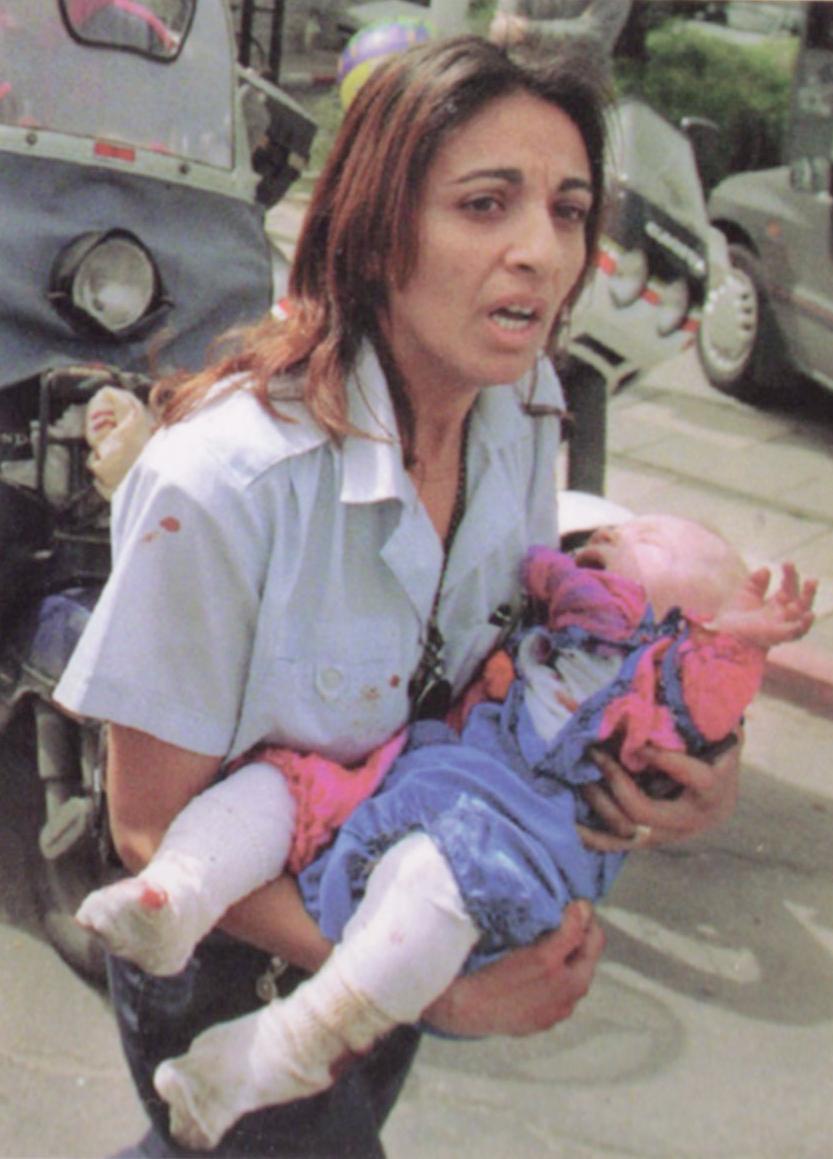
Figure 1.--The Plistinins launched the Interfada for two purposes Sime wanted to improve their negotinting position. Others wanted to simply block the peace process. Palestinians used the traffic between the West Bank and Israel to infiltrate terrorists. Especially useful were the Palistinians working in Israel. The Interfda included terror atacks on Israelis. The Israeli resonse was the West Bank Security Barrier to improve their people from terror attacks. The Palistinians for propganda purposes call the Wall 'jidar al-fasl al-'unsuri' (racial segregation/Apartheid Wall), but the Israelis were willing to offer jobs to Palistinians, it was Palistinian terror attacks that forced the Israelis to separate themselves from the Palistinians. Here we see the result of a Palistinian terror attack (March 1999) that led to the Wall. It is the Palestinians that are driving separation (Apartheid), not the Israelis. The Palistinians hate the Wall, but it is their actiins that have led to it.
Tragically the Isreali-Psalestinian conflict has continued into the 21st. President Clinton made a major effort to reslove the conflict (2000). His effort has been much-criticized, but it was aserious effort. Primeminister Barak grugingly made major concessions. Chair Arafat refused to do so, probably accurately gudeging Palestinian public opinion. Since the Camp David talks hosted by President Clinton, the situation has deteriorated. The Palestinians launched a new Interfada. This has undermined the fragile Palestinian economy. Israel concluding that there was no real partner for peace has attempted to withdraw, bith from Lebanon (200?) and Gaza (200?), but the Hesbolah militia in Lebanon armed by the Iranians and the Palestinians in Gaza have still launched attacks across the border. Palestinian suiside attacks have led to the Isreali contruction of a wall in the West Bank. Fatah's commitment to the peace process. Hamas rejects the peace process, although when speaking to the Western media is often ambigious. The rise of Islamic militancy has resulted in Hamas challenging Fatah for control of the Palestinian Authority. Hebolah attacks accross the border caused a costly war (2006). The rivalry between Fatah and Hamas has led to armed clashes beginning to take the chracter of a civil war, causing further suffering among the Palestinian people.
Isrraeli Policy
Israel has continued to pursue the policy of land for peace in the 21st century. Four Isreali prime-ministers hace pursued this policy.
Prime-Minister Egud Barrack agreed to the Clinton Plan to establish a Palestinian state in the West Bank and Gaza. Pakestinina Authority Presidebt Yasser Arafat walked out and launched the Second Interfada (2000). Thevmajor impact was the Palestinina West Nank economy went into a free fall.
Prime-Minister Sharon disengaging from Gaza, even removing 8,500 settkers in some cases by force (2005). Sharon, a former military commander, assured Israelis that the withdrawl would 'grant Israeli citizens the maximum level of security'. Optimists pronostigated that it would turn Gaza into the Hong Kong of the Middle East. Two years later, the Palistinians in Gaza elected Hamas in a free election, which would be the last election there. In the enthusuastic resoibse to Usrael's deoarture, Hewish synagiuges and businesses that the Palestnians could have operated were destroyed. Soon terror attacks into Israel began and eventually rockets were flying into Israel. The stable economy under Israeli control began to decline. Hamas blamed Israel and continues to do so, ignoring that terror attacks and rockers may hace simething to do with it. Ehud Olmert offered the PA a detailed map pf the West Bank and Gas=za Strip firv Palestinian state (2008). PA Presidentb Mahmoud Abbas refused to regotiate.
Benjamin Netanyahu agreed to the Trump Peace Plam (2020).
The Palistinian Authority on the West back was less willing to launch overt attacks than Hamas , but attacks continued. The Israeli resoonse to the Secon Ibterfada (2000) was the Securirt Barrier which limited the ability of Palestinians tomlaunch terror attacks. Some coninued and the PA pays bpinties to terrorists who coninue to kill Isrealis. This has wrecked efforts to oursue the peace pricess. Israeli settlements are not helful, but the Palistinians have showed so little willingness to negotiate and the resonse to the withdraw from Gaza leads one to question any willingnes on the part of the Palistinians to pursue peace.
Palestinian Policy
The Plestinians have shown ni real desire to oyrsue peace. Their policy has continued to be ro demand thec Right of Return which would destroy Isreal by creating a Palestinian majotity. Never mentioned is the gfact that iy was the Palestinians and their Arab allies that rejected thevUnitescNations Partition of Palestine amd aunched the Arab Israeli War (1948). There are consequences to war. Andcfisplacement of civilans is one of them. Abd there were inumeravke Palestinian attacks on Jews before the 1948 war as well as a series of wars the Arabs launched after the 1948 war. The Palestinians have pursued every policy except peace beginning with the British nanndate after World War I. The British offered the Palestinians majority Home Rule (1920s). ThevPlestinians rejecteedd the offer because itv inckuded legal protections fot minorities and turned to terror attacks on Hews, includes a Kristalmacht-like pogrom before World War II. Since then they allied first withb the NAIZs and then the Soviets before turning to pure terrorism. Now they inlike many other Arabs have moved closer to the Iranian Nullahs. The result as they cut themself off ffrom the Israelis have bee a huge decline in the econoinynand living standards in cintast to the Israelis which have enginnered a booming economy.
The Wider Arab World
Major changes have occurred in the Middle East in the 21st century. They are affecting a range of matters, increasing the Israeli-Arab relationship.
First, increasing numbers of educated Arabs have begun to question their society--namely the economic failure of Arab countries. There is mot one economically sucessful Aran nation, exceot those benefitting from oil. Wevthink not a majority, but increasing numbers.
Second, the emergence of Iran as a regional hegemon. This has changed the mindset of many Arabs, meaning the majority Sunni wgich see the Shi'oa Iranians as an existential threat, far greater than the any imangined tghreat from the Israelis. This has reduced Arab support for the Plestinians and their rejection of the peace process.
Third, the States has become basicall self sufficent in not only denergy, but oil. This hasmeantb a massive dall in oil prices. This has substantially reduced the inflow of cash into the Arab world reducing the vfinamcing to terror groups.
Fourtg, President Trump has reduced the policy of appeasing Iran. We do nit know yet of he will be elected, but if he is, American policybwill mconyinue to be to make Iran pay a price for promotung terrir and its camapaign against Isreal.
Fifth, there is a campaign against fossil fuels in the West. Now the Green Mocement over estimates the ability of economies to rapidly replace fissil fuels. Even so, the act tht the West is moving away from fossil fuels cannoyt be gppd news to Arabeconomies based in fossil fuels. There is no imprtant economic activity in the Arab world exceot fir oil.
President Clinto brought PLO Chairman Yasser Arafat and Isreali Primier Ehud Barak together at Camp David to reach a final resollution of the issues set in motion by the Oslo Peace Process. The negotiations were protracted and contentious. President Clinton did a comendable job of keeping the negotiations going and wringing concessions from both sides. Considerable controversy exists over what the final Isreali offer was to the Palestinians. The offer is, however, a matter of clear historical record. [Ross] One can argue the value of the accord hammered out and wether is was a fair and just resolution, but the details are a matter of public record. The Palestinians can argue that the Isreali offer was not adequate. They can not, however not argue that the Isrealis did not make substantial concessions and meet many of their legitimate demands. Israel offered Arafat 94-96 percent of the West Bank and all of Gaza. Israel would ceed 1-3 percent of its territory to the Palestinians. [Clinton, p. 936.] Thus the Palestinians were essentially offered 97 percent of the West Bank. This is a matter of historical record. Individuals who deny that Israel offered the Palestinians 97 percent of the West Bank are either in error or dishonest. The areas retained by the Isrealis contained 80 percent of the Jewish population in the East Bank. The Arab neigborhoods of Jeruselum would be incorprated into the new Palestinian state, this included parts of the Old City. This both states could claim Jersuselum as their capital. The Palestinians were given soverignity over the Temple Mount/Haram and the Isrealis soverignity over the Western Wall. There was to be no excavations without mutual consent. There were a variety of arrangements governing Isreali withdrawl from the West Bank and provisions to satisfy Isreali security concerns. The right of return was to be limited to the new Palestinian state, although it was understood that Israel would except small numbers of Palestinians, especially from the refugees in Lerbanon. [Clinton, p. 937.] There was to be a major international effort to help resettle the refugees. A international aid package ofg about $30 billion was discussed. [Ross] Yasser Arafat's rejection of the Israeli peace offer led to a new Interfada, disastrous for both the Israeli and Palestinian people. Arafat has widely been blamed for the failure of the talks and the violence that followed. His moytives are not known. Some believe that he calculated that a brief resumption of violence would improve his baragaining position. He may have also believed that he could had got a better deal with Bush. What ever his reasons, the violence quickly spiraled beyond his control. This may be the case. It also may be the case that he believed that signing the agreement would be like signing his death warrant. Other Arab leaders attempting to makes peace with Israel were assasinated (Jordanian King Abdullah and Egyptian President Sadat). It may also be the case that the Palestinian people are simply not ready for peace.
The right of return is one of the most difficult issues in the Isreali-Palestinian conflict. One of the principle reasons that Arafat decided not to sign the Camp David accord was that it rfused to permit the right of retrurn of Palestinians refugees (now mostly the descendents of refugeees) to Israel. Here a lot of misleading retoric is often used. Palestinian spokesmen speaking in English often say they accept a two state sollution and recognize Israel's right to exist. One especially effectiive Palestinian spokespetrson is Dr. Hanan Ashrawi. Like many Palestinian spokespersons she criticses the 2000 Camp David accord. One of her principle objections is the failure to accomodate the right of return. Of course as a Palestinian spokespersons she has every right to advance the interests of her people. And her position accurately reflects the sentiment among most Palestinians. What is not legitimate, however, is to claim to recognize Israel's right to exist and then insist on the right of return. The two are mutually inconsistent and Dr. Ashrawi. The position makes for effective propaganda. It dies not, however, offer any hope of resolving the conflict. It also leads one to seriously question if Palestinian leaders have any interest in a peaceful resolution of the conflict. Another issue concerning the right of return is that the discussion usually focuses only on Palestinian refugees and Jewish refugees arre also ignored as if they did not exist.
Taba Summit (2001)
American Commitment
President Truman decided to vote for he recognition of israel in 1948, but American support was for years limited. Isreel's support came from America's Jews. This was a relatively small part of the population and declining as a proprtion of the population. The rise of the religious right in America, profoundly changed America's relationship with Israel. Some how Fundamentalists which had once been influenced by ant-Semitism became string supporters od Israel. As a result, President Bush has made the stringest statements in support of Isreal of any american preident.
The Second Interfada (2000)
An unusual aspect of the current Isreali-Palestinian conflict is that children (Arab and Jewish) are not only the victims of the conflict, but they are also participating in the violence. We have all seen the images of rock-throwing Palestinian boys, some as little as 6 years old. Palestinian youth have carried out suicide bombing attacks killing Isrealis of all ages. We wonder about who these suiside bombers are what motivates them to kill civilians including childre. One of the best recent journalist accounts has insights on this difficult topic. [Hammer] Americans watchinging a steady stream of Palestinian suiside attacks and Isareli reprisals, despair of a sollution. Not all obrvers are as pessamistic. One observer believes that demographic trends strongly push Isreal to withdrw from the Wwest Bank, otherwise Jew would find themselves a minority in their own country. [Wasserstein] The Jewish settlers on the West Bank are often portrayed as religious zealots seeking anexation of the West Bank and a substantial threat to the peace process. They may well be less of a threat than believed. One observer believes that the attractiin of cheap rents may be more important than religious zealotry. [Wasserstein] Other observers after the bloodleating of the Iterfada is deeply pessimistic. He believes that it clearly shows that the Palestinians have not accepted either Israel or the peace process. He fears it is just a matter of time before the Palestinians make the transition from suiside bombings to weapons of mass destruction. [Hertzberg] One positive aspect of the struggle is that it has been a largely secular conflict of copeting nationalism. If religious zealtory enters the picture, than the conflict could be come even worse. [Hertzberg]
There are Palestinian communities in both the Gaza Strip and the West Bank. These areas wereoccupied by Israel during the 6 Days War. These communities as a result of the Oslo Peace Process are self governing under the Palestinian Authority. There was great hope for the Palestinians as a result of the Oslo Agreements. There was general hope that this would lead to a two-state sollution and an indepndent and properous Psalestine. Little political process was made. Analysts dispute who was responsible for this. Living conditions have declined disatrously, especially since the Interfada. This means essentially that living conditions were substatially higher during Isreali occupation. Many issues concerning the Isreali-Palestinian issue are in dispute. The decline in living standards is an undisputable fact. There are also Palestinian communities spread throughout the Arab world. These are largely the descents of the refugees from the 1948 War. The size of these communities vary from country to country as well as ntional law and policies which affect the refugee population.
Isareli society is quite complex, consisting of many national and relogious communities. There are many different Jeish groups, often assoiciated with religious and immigrant factors. Some of the most important are: Ashkenazim, Mizahim, immigrants (especially Russian and Ethiopian), Haredim, religious-Zionsts, and secular Jews. There are are also wide religious differences. There is also a substantial Arab population, including Muslims, Druze, and Christians. Perhaps the greast danger to the Israeli Airforce today is that Israel is a bottle neck in the bird mifrations between Europe and asia and africa. One key institution in the socilization process is the Army. [Rosenthal] Israel is virtually the only democratic state in the Middle East. Ironiclly it is one of the few states in which Palestinians or for that matter Muslims can vote in open democtatic elections. Readers have complained to us that Israel is an Aparthaid state in which Palestinians are oppressed and have no legal rights. Thus we have decided to look a modern Israel, the various ethnic and religious communities, the political, legal, and social system. Of course this is a major undertaking and will take some time. Here we encourage reders to add what ever insights they may have.
The IDF actions at Jenin and Nablus during 2002 must be viewed in the larger context of the Interfada. Palestinians charge that IDF actions in Jenna and Nabblus surin 2002 were examples of Isreali genocide aimed at the Palestinian people. The Isrealis maintain that the action was necesitated by Paestinian suiside attacks against Isreali citizens.
Road Map for Peace / Geneva Accord (2003)
Road Map for Peace was promulgated by the Quartet.
The West Bank Security Barrier (2002-04)
The Interfada and suiside attacks on Iserealis resulted in nearly 2,000 casualties. A grass roots organization called "Fence for Life - The Public Movement for The Security Fence" began to lobby for the construction of a continuous security fence (June 2001). The turning point for many Israels was the Dolphinarium discotheque suicide bombing. The only way of protecting Isrealis was to separate them from the Palestinians on the West Bank. The path of the barrier can be debated. What can not be denied is that Israel has a right to protect its citizens. Israel since its establishments has been willing to allow Palestinian Arabs to work in Israel. Palestinian terrorists began to use access to Israel as a way of to attack Israeli civilians. A campaign they conducted with chilling success. The Barrier is a fence with vehicle-barrier trenches surrounded by a 60 meter (average) wide exclusion area (90 percent of tghe extebt) and an 8 meter tall concrete wall (10 percent of its extent. Most of the Barrier is in the West Bank and in part follows the 1949 Armistice line (Green Line) between Israel and Palestinian West Bank. American diplomat Dennis Ross summed up the WesT Bank Barrier succintly. He wrote "Truth be told, those responsible for the fence are Hamas, Islamic Jihad, and the al Aqsa Martyrs' Brigades. Their terror produced the impulse for the fence. If violence were not a threat, the fence would not be necessary." [Ross, 'When ....] Palestiniasn spokesmen are vehemently crituical of the barrier. The issues can be debated. But what can not be denined is that the Barrier has prevented almost all of the suiside attacks on Isreali civilians.
The Holocaust in recent years has become an issue in the Israel-Palestine conflict. There are several aspects to this. The two most important are holocausr denial and holocaust inversion. It is difficult to understand how any one can seriously deny the NAZI Holocaust of the Jews given the overwealming body of evidence, but some Muslims do, especially the Arabs and the Iranians. The Iranians even held an international conference on the Holocaust to which prominent Holocaust deniers were invited. What appears to be at play here is the Arabs onject to anything that might create sympathy for the Jews. Ironically while many Arabs deny the Holocaust, at the samr=e time they have begun to claim that the Isrealis are carrying out a Holocaust of the Palestinians. This is called Holocaust inversion. There are two other Holocaust threads. One is that the Palestinians should not have to pay for the Holocaust conducted by Germans and other Eropeans. And that the Europeamn Jews fleeing European anti-Semitism is an esentially colonial intervention into the Middle East.
Israeli Withdrawl from Gaza (2005)
Prime-Minister Sharon disengaging from Gaza, even removing 8,500 settkers in some cases by force (2005). Sharon, a former military commander, assured Israelis that the withdrawl would 'grant Israeli citizens the maximum level of security'. Optimists pronostigated that it would turn Gaza into the Hong Kong of the Middle East. Two years later, the Palistinians in Gaza elected Hamas in a free election, which would be the last election there. In the enthusuastic resoibse to Usrael's deoarture, Hewish synagiuges and businesses that the Palestnians could have operated were destroyed. Soon terror attacks into Israel began and eventually rockets were flying into Israel. The stable economy under Israeli control began to decline. Hamas blamed Israel and continues to do so, ignoring that terror attacks and rockers may hace simething to do with it.
Lebanon (2006)
The Israeli Army pulled out from Lebanon in 2000. Isreal pulled back to a border recognized by U.N. Resolution 1559. The Shite Hezbollah militia used this as an opportunity to improve its fire power and fortify the border with Israel. For 6 years heavily financed by Iran, Hezbollah builtup a huge stockpile of rockets and even a smaller number of more accurate missles. During this period Israel focused on the severe security problems posed from Palestinian suicide bombings. Hezbollah to support the Hamas militia in Gaza carried out a cross-border raid, capturing two Israeli reservists and killing eight others. (The reservists were subsequently executed by Hezbollah.) Israel in resonse launched a fierce air, sea, and ground assault, attempting to target Hezbollah. This proved difficult because Hezbollah is a non-uniformed civilian militia which has military facilities in civilian areas, often placed near schools and mosques. Hezbollah responded with about 4,000 rockets and missles. In the 34-day war that followed, 120 Israeli soldiers and 39 civilians were killed. There were about 1,200 Lebanese killed. Press reports generally refer to them as civilians. There is no doubt that many were, but as Hezbollah is a non-uniformed group commonly deployed in civilian areas, there is no way of knowing how many of the casualties were truly "innocent" civilians. Israel also did great damage to the infrastructure of southern Lebanon. Critics generally claim thast Israel used disproportinate force, but fail to offer any alternative method of preventing Hezbollah from brining in rockets to fire on Isreali cities. The War was ended by U.N. Resolution 1701. This impossed a ban on weapons deliveries to Hezbollah and Hezbollah military operations along the Isreali border. More than 30 countries have positiones over 10,000 troops in souther Lebanon. (The number and national make up varies iver time.) The Isreali attacks did not fubamentally weaken Hezbollah and the U.N. force has not prevented Hezbollah from replenishing its rocket stockpiles. The damage done by the Isreali strikes, however, did surprise Hexbollsh leaders and undountedly has created a degree of caution. Israel in 2010 took an unusual step, a public relations campaign consisting of inteligence maps and aerial photographs signaling Hezbollah they know where their stockpiles are. They also hughlight how Hezbollah has placed its bases near schools, hospitals, and mosques. [Cohen]
Annapolis Process (2007)
Olmert Effort (2008)
Ehud Olmert offered the PA a detailed map pf the West Bank and Gas=za Strip firv Palestinian state (2008). The Palestinian refussal to engage led Israelis to wonder, whatbis the balue of ebgaging with a authority thatbhas no desire to negotiate.
The Isreali-Palestinian conflict is one of the most, if not the most contentious conflict of modern times. This is in part because both peoples can claim a stake in the land. Of course it is debateable as to the strength of each claim. Of course there are partisans on both sides, but the point is that it is debateable. The job of the historian is to collect, organize, and evaluate facts. As we know, a range of conclusions can be drawn from any given set of facts and authors vary as to the facts they collect and consider important. And of course some authors only collect those facts that butress their point of view. The problem with the Isreali-Palestinian conflict is even more difficult than that. The issue is so incendiary that some authors actually make up what they claim to be facts as well as quotations. Here the Muslim world is particularly likely to do this because of limitations on scholarship. Muslim scholars that dare to diverge from accepted views are quite litwraly putting their lives in danger. While no mater how outrageous the attacks on Jews, there are no adverse consequences. Poor scholaership is not, however, limited to Muslims. We note dishonest scholarship in the West as well, most commonly on this issue among left-wing writers. We mention this because readers who would want to seriously address this subject need to look carefully at the sources of articles they read to make sure they are based on sound scholarship. We will post some examples of poor scholarship as an example of the difficulties of resaerching this topic.
Israel and the Western Left
The political left is among the most vociferous critics of Israel. This seema at first difficult to understand, especially because the Palestinain movement is increasingly becoming dominated by Muslim extremists. And Muslim extremists are intolerant toward secular political movements, including Socialists and Communists. The initial Paestinian movement was religious in nature, launched by the Grand Mufti. But then the fight against Israel was taken over by Arab Socialists led by leaders like Nasser. Here leftist support of Palestinians was understandable because Nasser was backed by the Soviet Union was the struggle portrayed as part of the anti-colonial effort. Arab Socialism was a failure for a range of political, economic, and social reasons. The situation today in the arab world is quite different. Socialism has lost its cachet and many young Muslims are turning to religious fanatics. Ironically the only plave in the Middle East that left-wing authors could live and publish is Israel. Left wing authors tend to be very critical of religion, especially Christianity and Judiasm. There criticism of Islam is often much more muted. Not only do Islamic countries not permit left-wing authors who question Islam to publish, but they would be putting their lives in fanger to do so. Thus the question becomes, why is the left so soft on Islam in general and specifically why has it fallen so decisively on the Palestinian side of the Isreali-Palestinian issue.
Civilians have been a major issue in the Isreali-Palestinian conflict from the very beginning. Even before Isreal was created, civilians were targeted. Arab rioting and acts of violence fomented by the Grand Mufti targeted Jewish settlers. During the First Arab-Isreali War the two sides were realatively balanced. Many Palestinians fled the fighting. The Arabs now maintain that they were driven from their homes by Jewish violence. There were attacks on civilians, by both Arabs abnd Jews. Isrealis also point out that Arab radio broadcasts encouraged Palestinians to evacuate so that Isrealis could be more effectiveky targeted. Gradually the ballance of power shifted so that Isreali became a modern miliyary force confronting less effective Arab milutary forces and more recently Palestinian irregular forces operaring from civilian areas. The Geneva Conventions require military forces to avoid causing civilian casualties. This does not mean, however, that soldiers do not have a right to react to attacks by civilians. And military forces and irregular are prohibited by the Geneva Convention of using civilians as human shields. Considerable controversy exists concering Isreli policy as to limiting civilian casualties in its military operations. It is clear, however, that the Isrealis do place limits on its military. Observers can debate whether those limits are adequate, but there are undeniably limits. Arab irregulars on the other hand specifically target Isreali civilians, in part because civilians are soft targets and they do not have the capability to seriously attack the Israeali military.
HBC is particularly concerned with children's issues. The question we want to persue is how the Isreali-Palesinian conlict has affected the children. We have noted some horific images broadcast by the media. Some seem to defy understanding. Here we need to look at society, education, the economy, living standards, health care, and the conflict itself. This is aparticularly important topic for our HBC assessment. We are not entirely sure how to address this topic, but we have some basic ideas and hopefully readers will also have insights to add.
We do not know a great deal about schools in Isreali and Palestinian education, but we have begun to collect information. There are a variety of complications in looking a Isreali education. There are for example Palestinians and non Jews living in Israel. The subject of Palestinian education is also complicated. The religious issue is complicated by language differences. The Palestinians live in the occupied West Bank and unoccupied Gaza. There are also Palestinians living in various Arab states. We are unsure to what extent the Palestinian children have been integrated into the educational system of those countries. And the wider issue education in Arab states is also of interest. Here we are interested in both the quality of instruction, student achievement and political socialization. The content of text books and libraries is also interesting. This is a very broad topic and one which we do not have much information at this time. We have found some information and thus are creating this page as a place to archive information as we find it. One reason we are interested in this topic is we believe that what a regime teaches its children is an interesting view into the values of a society. Regimes can use propaganda to hide its values and objectives. But it often speaks with considerable clarity when it teaches school children. We invite readers to add here any insights they may have.
An important part of the peace puzzle is just what the two sides want. This is more complicated than it seems. There is no clear united voice for the Palestinians. There are two competing groups claiing to be the legitimate voice of the Palestiunians--Fatah and Hamas. This greatly complicates negotation as there is no authority wehich can speak definitively for the Palestinian people. If one side offers a compromisde, the other side can claim weakness or treason. And he issue is not dediced at the ballot box. Rather the two sides use violence to pursue their agenda. This makes Israel less willing to make compromises bercause one Palestinian side will not acceot compromoises made by the other. This is the tactic that Hamas has taken. Another problem is that Palestinian leaders are prone to speak differetly in the English and Arabic press. This is important because most Palestinians get their news from the Arabic-lsanguage press. The Isrealis have two major political parties as well, Likud and Labour, but their political differences are fought out more openly ad decided st the ballot box. And once decided, the Isreali Government is capable of making commitments.
An eight ship convoy describing itself as a �peace flotilla� was organized in Turkey to deliver supplies to Palestinians in Gaza. The organizers decided to defy Israeli regulations that requires shipments to Gaza to be first landed in Israeli ports for inspection. The Israeli Navy was ordered to stop the flotialla once the ships entered Israeli territorial waters and bring it into Israeli ports for inspection before the supplies were delivered to Gaza. The eight ships consisted of four freighters and four passenger ships. They left from ports in Greece and Turkey, most coming from Turkey. While describing themselves as a"peace flotilla", the organizers were not pacifist groups, but groups and individuals who openly favor a Palestinian victory in the Aran-Israeli conflict. Many openly advocate the demise of the Jewish state and at the same time promote Islamic states.
The principal group organizing the flotilla is the Humanitarian Relief Foundation (IHH). This is a Turkish humanitarian relief organization, associated with the Turkish government that is working to demolish the secular nature of the Turkish state and replace it with an Islamic Government. The IHH is an extension of the Muslim Brotherhood in Turkey. Aboard were 800 passengers from 30 countries, most of whom are on one large ship that left from Istanbul. Aboard were about 30 members of various European parliaments as well as an Israeli Arab member of the Israeli Knesset Parliament, Hanin Zuabi. Dror Feiler, one of the organizers of the flotilla, is a former Israeli and currently a Swedish citizen. He is best known staging the �Snow White and the Madness of Truth� exhibit in a Stockholm museum (2004). He depicted the figure of the suicide bomber from the Maxim restaurant (21 killed) in a blood-red pool as a hero. The flotiall organizers claimed to be brining humanitarian supplies, including 10 tons of medicine and medical equipment and food to the Gaza people. Most Western newspaper and broadcast media carried the term "humanitarian supplies" without decribing in detail what was loaded on the ships. Particularly notable was the role Erdogan Government which refused to work with the Israeli Government to overt bloofshead. The Obama Administration and European leaders made no attempt to defuse the situation.
Obama Washington Initiative (September 2010)
American Secretary of State Hilary Clinton announced that the United States has invited Prime Minister, Benjamin Netanyahu, and Palestinian President, Mahmoud Abbas, to begin direct peace talks in Washington (September2, 2010). U.S. Middle East envoy Mitchell, has been shuttling back and forth to the region since early 2009, succeeding in brokering the proximity talks between the two sides, a critical precursor to the direct Washington talks. The goal is to "re-launch direct negotiations aimed at finally resolving final status issues. Secretary Clinton stated, "we believe we can complete in one year." She indicated that she would host the first direct Israel-Palestinian negotiating session (September, 2) and that the United States has also invited President Hosni Mubarak of Egypt and King Abdullah of Jordan join that first session. This is another in a long list of failed American-backed efforts. The Obama Admisistration is hopeful that its much publicized ininiative to the Muslim World begun with his Cairo speech (June 4, 2009) has laid a foundation for breaking the deadlock. This was followed by a series of Administration criticisms of Israel and a reluctance to criticize any Muslim countries, including the Iranins when peaceful demonstators protesting the stealing of the presidential election were openly murdered on the street. The Administration appears to believe that a more 'even handed' American policy will encourage the Palestinians to make peace. There is also an undercurrent within the administration that the problem is fundamentally economic in nature. The Administrations efforts seem higly ideological in nature, a reflection of the Amnerican left's growing hostility toward Israel. President Clinton came very close to a peace agreement (2000). In the end, Chairman Arafat refused to sign, explaining that he would be signing his death warrant. Has the Obama Administration prepared the conditions that could achieve peace. Israel in 2010 is weaker than it was in 2000. It now faces Hezbollah armed with 45,000 Iranian supplied rockets. Iran also attemps to arm Hamas in Gaza. Neither the Bush Administration or the Obama Administration have seriously addressed these threats. Both Hezbollah and Hamas are pledged to Israel's destruction. This Israel is determined to maintain a military pressence in the West Bank least it turn into another Gaza with rockets being fired into Israel. Nor has the Administration done much to prepare the Palestinians to making peace. Hamas in Gaza is emboldened by Iranian aid, progress toward a nuclear weapon, and shifting Turkish policies. Palestinian Authority leader Mahmoud Abbas continues to insist on the 'right of return' and realizes as Arafat did in 2000 that he will be accuses of treason if he signs a peace agreement. President Obama is putting his prestige on the line. Although the main-stream media is reluctant to criticize the President, some have begin to ask just what the returns are on his policy of appologizing for Amnerica. And hard-headed analists less ideologically driven point out that in the Arab world, military strngth has had much more import than words.
Trump Peace Effort (2020)
President Trump proposed a sweeping Osrali--Palestinian peace plan (2020). The objective wad to creating a lasting peace agreement to end the Israeki-Palesrinina c0nflict. It proposed a Palestinian state consisting of a the West Bank and Gasa with a way of connecting the two disjointed Palestinian territories. The plan was crafted by the prsidebt's son-in-law and senior adviser, Jared Kushner. There are two parts, an economic portion and a political portion. The President bhad earlier released the economic portion-- 'Peace to Prosperity' (2019). The political portion was released later (2020). The plan is heavily premissed on securing Palestinian participation oon the nasis of ecomomic development. This seems very iptimistic given the fact that the Palesrinians have puesued a range od poicies sucg as the Unterfada which have devestated their economy. The situation on the froind is left largely unchanged And the palns rejects the Right of Return. Bothe these issues are major Palestinian demabds. Te Palestinians played no role in crradting the palan, maefely because they refused to particioate. The settlement issues was left unresolved. Given the what the Israekis went through to remove their srttlers from Gaza only to be rewarded with terror andcrocket attacks, dealing with the settlement issue is unlikely until they know the Palestinian s are really committed to oeace. Another main problem is that Abas and other PA officials know that if they sign a cimpromise peace they will become a target of Palestinian terror. Araft himseld exolained that to President Cliton amd Prime-minister Ehud Barak (2005). The Trump Plan appears to have little chance of success. The Palestinian reaction is absolute rejection, although the wider Arab raction is less absolute. The need for American backing has begub to change attitudes in the Sunni mworld. The Trump Administration's hope is that the economic incentives will wevebtually begin to change some minds. This is unlikely in the near future.
HBC deals with many controversial issues. Few are more controversial than the Isreali-Palestinian conflict. Our approach to this issue as with other issues covered by HBC is to prevent as much of the facts as possible and to try draw back from judgements based on emotions. We encourage readers to challenge information that they do not agree with or information they may think important. Our general experience here is that many people have formed an opinion on this conflict and are only interested in facts that justify their opinion. Our interest is in collecting as much information from as wide a range of sources as possible. Of course many facts are in question, but many facts are incontestable by fair-minded observers. Readers are welcomed to comment on the pages that we have worked up or issues of concern on this subject. We or other readers may comment.
Sources
Clinton, Bill. My Life (Knopf: New York, 2004), 957p.
Cohen, Stephen P. "Preventing the next Lebanon war," Wall Street Journal (July 20, 2010), p. A17.
Hammer, Joshua. A Season in Bethleham: Holy War in a Sacred Place (2003).
Helms, Eichards with William Hood. A Look over My Shoulder: A Life in the Central Intelligence Agency (Random House, 2003), 478p.
Hertzberg, Arthur. The Fate of Zionism: A Secular Future for Israel and Palestine (Harper: San Francisco, 2003).
Oren, Michael B. Power, Faith, and Fantasy (2007),
Rosenthal, Donna. The Israelis: Ordinary People in an Extrodinary Land (Free Press, 2003), 466p. This is rather a popular, but insightful description of Isralei society.
Ross, Dennis. The Missing Peace. Ambassador Ross was deeply involved in the Camp David discussions. Ross includes in his book a verbatim copy of the final offer Barak made and that Arafat refused to accept.
Ross, Dennis. "When is a Fence not a Fence?" Wall Street Journal (August 4, 2003).
Wasserstein, Bernard. Israelis and Palestinians: Why Do They Fight? Can They Stop? (Yale University Press, 2003).