|
"A period of 25 years -- that is the time Russia will need to restore what has been destroyed." This statement shows that even those involved in the destruction did not understand the full dimensions of Hutler's plzns for the East and the populaion there.
--Gen. Carl-Heinrich von Stülpnagel
"Now I have proof. The entire general staff is contaminated. Were it not for these traitors, we would have won long ago."
--Adolf Hitler after the bomb attack.
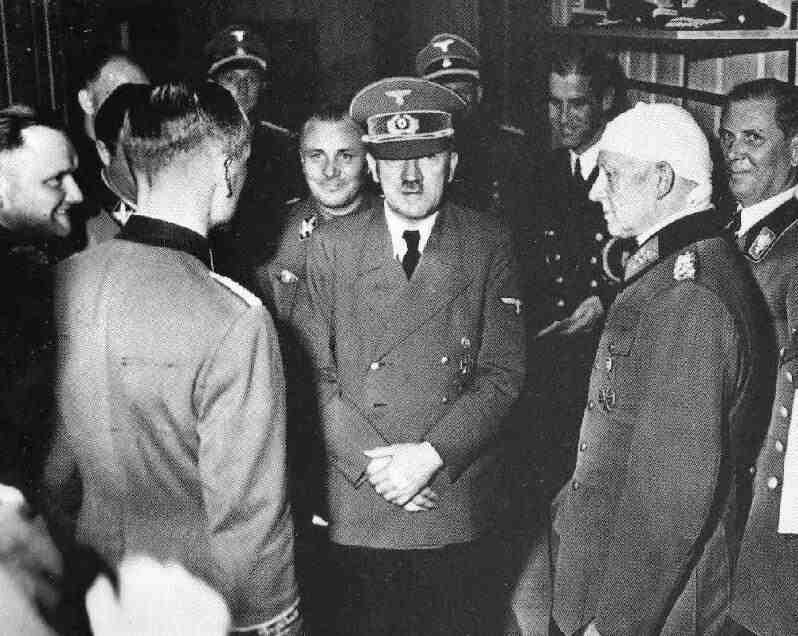
The best known assination attempt was the Wehrmacht Valkyrie conspiracy ending in the July Bomp Plot (1944). Hitler had correctly judged that after his appointment as Chancellor, that the Reichwehr was the only force in Germany that could prevent him from seizing absolute power. The Whermacht was also in 1944 the only force capable of taking control of Germany from the NAZIs. Wehrmacht officers had perpetrated terrible attrocities. Some were apauled with what the SS abd other security forces were doing. Others were bothered about the Wehrmacht's conduct. Only the impending defeat of Germany, however, brought about an attempted (July 1944). An idealistic young Catholic aristocrat, Colonel Claus von Staufenberg, placed a bomb in the Wolf's Lair. After Hitler was dead, the Hpme Army would seize control of Berlin and then Germany. The idea was to then negotiate a separate peace with the Western Allies. That by 1944 was unrealistic. Someone moved the bomb and Hitler was protected by the thick oak leg of the map table. The failure to kill Hitler and the extensive NAZi penetration of the Wehrmacht led to the coup's failure. The bulk of the Wehrmacht remained loyal to Hitler and the NAZIs. In the end, the Wehrmacht's sense of honor condemned the German people who they were resonsible for protecting To a cruel fate. The real loser was the German people. The great bulk of German civilian casualties took place after the failed coup. Nearly a million Germans would die in 1945. More were wounded or raped. And many who sonehow survived had their homes and work places destroyed. To form the Honor Court trying the conspirators, Hitler appointed Field Marshal Gerd Von Rundstedt--a Prussian aristocrat who despised Hitler personally.
Importance
Hitler correctly judged that after his appointment as Chancellor, that the Reichwehr was the only force in Germany that could prevent him from seizing absolute power. The Whermacht was also in 1944 the only force capable of taking control of Germany from the NAZIs. Some authors suggest that the fact that the plot to assasinate Hitler came from within the Wehrmacht shows the extent to which the barbarities of the NAZIs offended the Christian sensibilities of the Prussian officer corps. It certainly offended some like Col. Stauffenberg. One author writes, "The radicalization of the resiatance was most marked among army officersvwho witnessed such attrocities as the massacre of Jewish communities, and the slaughter of Slav 'sun-humans--both civilians and Soviet prisoners--and who gradually became aware of similar Nazi crimes within Germanybitself, including the euthanasia of the mentally and physically handicapped. Such flagrant trampling on the Christain ethics that had tradutionally underpinned Christian ethics that had tradutiinally underpinned German society profiundly shicked tge Prussian officer corps." [Jones] Just how many is another question. It must remembered that the Wehrmacht itself was deeply implicated in the cries committed in the occupied countries. And at any rate, from an early point, it was only the Wehrmacht that as Hitler correctly assessed, had the capability of seizing power from the NAZIs.
Attitudes within the Wehrmacht
Goebbels after the Soviet Winter Offensive before Moscow (December 1941) began writing about defeatists within the Wehrmacht. Interestingly he discussed this issue with Abwehr Commander Admiral Canaris. Goebbels did not complain about abti-NAZI setiment or objections to German attrocities, but criticism about the War and Germany's ability to win it. Wehrmacht officers had perpetrated terrible attrocities. Some were apauled with what the SS and other security forces were doing, especially the Einstatzgruppen in the Soviet Union. The Holocaust was primrily conducted by the SS, but the Wehrmacht played an essential supporting role and was involved in actual killing as well. Others were bothered about Hitler's mismanagement of the War effort and interference in the tactical decesiuons. Only the impending defeat of Germany, however, brought about an actual attempt (July 1944). This suggests that the major complaint was not the attrocities, but Hitler's conduct of the War and his continual interference in tactical decesions. This is important because the Wehrmacht was the only institution within Germany that had the force to remove Hitler. It there was toi be a coup, it could only come cfrom the Wehrmacht.
Previous Attempts
Valkyrie was not the first attempt on Hitler's life. There were in fact several and they came very close to killing him. Every year the NAZI Party faithful met at the Munich Bürgerbräukeller to hear Hitler speak on the anniversary of the failed Beer Hall Putsch. The Munich Bürgerbräukeller was demolished by carpeter Georg Elser's bomb (November 8, 1939). He was a humbel carpenter disturbed by the way the NAZIs treated working people and what as he saw as Hitler's march toward war. Eight people were killed and 60 injured. Hitler who left early, however, eascaped injury. A Wehrmacht plot also almost killed him. Hitler visited Army Group Center's headquaters at Smolensk (March 13, 1943). A bomb on his plane failed to detonate. [Jones] The aristocratic von Boeselager brothers serving under von Kluge, appauled by attrocities they witnessed, were involved in attemps to kill Hitler (1943 and 44).
Timing
The timing of the July plot has been questioned. Actually there had been earlier attempts that had not succeeded, but were unknow to the NAZis because the actual explosives had not been detonated. It is certianly the case that it was too late to save the vast number of Jews consumed in the Holocaust or Slavs killed in the Soviet Union. It was too lare the save the NAZI regime. The Allies had landed in Normandy and were in the process od of destroying the German forces in France. The Red Army was in the process if destroying the Wehrmachts largest remaining formation--Army Group Central. What had not yet taken place, however, was the destruction og German cities. The Allied bombers had damaged a number of cities, but it was not until Eisenhower released the 8th Air Firce and Bomber Command (September 1944) that the devestation of German cities went forward. And they would proceed to relentlessly pound the cities of the Reich. The ploters had various goals in mind. Some still thought that a Soviet occipation could be avoided. Many hoped to avoid the whole-scale destruction of Germany which was yet to occur.
Claus von Staufenberg (1907-44)
Claus von Stauffenberg was born in Jettingen (1907). He had twin older brothers (Berthold and Alexander). He was very intelligent, but only an average student. He decided on a military career and at age 19 became a cadet. The Germany Army, the Reichswehr was extremely limited because of the Versailles Peace Treaty. He went on to attended the War Academy in Berlin. He was appointed to the General Staff (1938). Germany invaded Poland, launnching World war II (September 1939). Stauffenberg was assigned to the staff of the the staff of 6th Panzer Division. Germany Generals and Hitler gave considerable effort to tanks (panzers), emphasizing speed and mobility. Poland was the world's introduction to what they could do. The turning point of the War, was Hitler's decesion to invade the Soviet Union--Operation Barbarossa (June 1941). During Barbarossa Stauffenberg was horrified by the atrocities committed by Germans, especially the Schutzstaffeinel (SS). He met other officers that shared his revulsion of SS attrocities. Especially important were Henning von Tresckow and Fabin Schlabrendorff). He was promoted to the rank of major. He was severly wounded when his staff car ran into a mine field and was strafed by aircraft. Stauffenberg's injuries were extensive. He lost his left eye, two fingers on the left hand and his right forearm. Even before he was injured Staufenberg was meeting with other officers that shared his revulsion of the SS and the attrocities German forces were committing. Especially important were Henning von Tresckow and Fabin Schlabrendorff). Stauffenberg decided s early as 1942 to kill Adolf Hitler and overthrow the Nazi government and began conspiring with like-minded officers. The result was the July Bomb Plot.
The Plan
An idealistic young Catholic aristocrat, Colonel Claus von Staufenberg was assigned the key role. The key conspirators were Admiral Wilhelm Canaris (head of the Abwehr), Carl Goerdeler, Julius Leber, Ulrich Hassell, Hans Oster (Admiral Canaris' deputy), Henning von Tresckow, Fabin Schlabrendorff, Peter von Wartenburg, Ludwig Beck, and Erwin von Witzleben. As a result of the need for secrecy, many individuals were not directly involved in the plot, but were willing to accept Hitler's removal as demonstrated by the fact that they did not report clearly treasonous conversations. Stauffenberg was promoted to Colonel and appointed Chief of Staff to Home Army Commander General Friedrich Fromm (June 1944). This was the posuition that gave him direct access to Hitler's briefing sessions. The overall plot was much more involved including a range of Wehrmacht officers including General Erwin Rommel. The attempt became known as the July Bomb Plot. The plan was to assasinate the key NAZI leaders (Adolf Hitler, Hermann Goering and Heinrich Himmler), then use loyal troops to seize control of Berlin and the major government buildings. This would include the important communication facilities in Berlin: telephone and signal centers and radio broadcasting stations. The key target of course was the Führer himself. Several attempts were made on Hitler's life. At least six attempts had to be aborted. Stauffenberg decided he could kill Hitler during a military conference at the Führer Wolf's Lair (field headquarters) in northern Poland (July 20, 1944). Stauffenberg was there as a representative of the Home Army. The idea was to kill Göring and Himmler with the same bomb. After Hitler was dead, the Home Army would seize control of Berlin and then Germany. Göring and Himmler were not at the conference. Despite orders to abort the bombing, Staufenberg decided to go ahead. Stauffenberg had never previously met Hitler. He carried the bomb in a briefcase and placed it on the floor next to where Hitler was standing. He then left to make a pre-arranged telephone call. The bomb exploded and Staufenberg thought he had suceeded. Hitler had, however, moved the brirf case to the other side of a oak beam supporting the briefing table. Four men were killed. Hitler was badly shaken and his right arm injured, but he was not killed. After Hitler's assasintion, Ludwig Beck, Erwin von Witzleben and Erich Fromm were to take command of the Wehrmacht. This effort was abandoned when it became clear that Hitler had survived.
Failure
The idea was to kill Hitler and for Wehrmacht units to take contol of the sate aparatus. They would then negotiate a separate peace with the Western Allies. That by 1944 was unrealistic. And the failure to kill Hitler doomed the plot. The effort began to unravel when the briefing was moved from a solidly built bunker to a wooden hut. Thios waas because of construction work and sweltering summer temperatures. Stauffenberg only had time to arm one of the two bombs in his briefcase. He placed it under the map table next to Hitler. After he left, however, another officer wanting a better view of the map moved it. The briefcase thus ended up behind a heavy table leg which when it exoloded, shielded Hitler from the blast. And the wooden hut failed to contain the explosion as anunker would have done. In the end, the failure to kill Hitler and the extensive NAZi penetration of the Wehrmact led to the coup's failure. The bulk of the Wehrmacht remained loyal to Hitler and the NAZIs. Fromm attempting to protect himself, ordered the immediate execution of Stauffenberg along with three other conspirators (Friedrich Olbricht and Werner von Haeften). They were executed by firing squad in the courtyard of the War Ministry. Stauffenberg is reported to have shouted "Long live free Germany" as he was shot.
Reprisals
Himmler's Gestapo encouraged by an enraged Hitler proceeded to round up most, but all of the principal conspirators. They also arrested large numbers of individals who had only the most remote connections to the plot. They also discovered details about earlier failed plots, especially conspiracies in 1938, 1939 and 1943. The Gestapo found incriminating letters and diaries and viciously interogated those arrested. This led to more and more arrests. Himmler's new Sippenhaft (blood guilt) laws led in addition to the arrest of relatives of the principal plotters--this included wives, children and the elderly. We are not sure that family members were tortured unless they ws evidence of complicity. Here we need more information. Eventually about 5,000 people were arrested and approximately 200 executed. They were not all connected with the July 20 Bomb Plot. The Gestapo used the opportunity to move against several individuals eho they had suspected of disloyalty. Relatively few of the plotters attempted to escape or to deny guilt after the Gestapo arrested them.
Trials
We note questions about what the Germans planned for Allied leaders if they had won the war. We have a very good idea what any NAZI trial would have been like. All we have to do is look at Stalin's Show Trials or the NAZI trial of the July Bomb Plot conspirators. The NAZI trials were totally different than the Vichy Riom trials. Those who managed to survive the brutal Gestapo interrogations were given perfunctory trials before Volksgerichtshof (People's Court) and its dedicated NAZI judge, Roland Freisler. The first trials were held within a few weeks (August 7-8). One historian writes, "Just one day later, having beeb roundly abused, intimidated, humiliated and accused by Freisler of high treason and betraying Germany, all seven of these well-known and (in four cases) very senior officers were found guilty. Their executions were carried out with calculated savagery at Berlin-Plötzensee later that same day .... During the days and months that followed, a further 89 alleged conspirators followed those first seven army officers into the same execution shed, the majority of them serving or retired army officers." [Stone] Hitler appointed Field Marshal Gerd Von Rundstedt, a Prussian aristocrat who despised Hitler personally, to oversee the purging of the Wehrmacht. He oversaw the Honor Court trying the conspirators. If any one dared speak out he knew that his family would suffer. When they appeared in court without attorneys and the ability to present evidence. The accused were were unshaven and hollow shells. They were denied belts so they had to hold up their trousers while being harangued by Freisler. Hitler ordered that those found guilty be "hung like cattle".
Executions
There were several executions that took place in the immediate aftermath of the Bomb Plot. The NAZI judge presiding over the trials, Freisler, was killed in an American air raid on Berlin (February 3, 1945). This ended the formal trials, but not the execultions. The Gestapo as a result of the investigation has come to suspect Admiral Canaris, head of the Abwehr. They had trouble finding solid evidence. Finally they found his diary. Canaris and other plotters were transported from various prisons and camps and executed at the Flossenb�rg Concentration Camp (April 9, 1945). The execution of those with a Rote Kapelle (key role) was a grisely affair. They were stripped naked and slowly stranggled by rope attached to slaughterhouse meathooks. For the actual July 20 plotters piano wire was used. Both the trials and executions were filmed. The first show trials wwre shown in German newreals. The execution films were for Hitler's personal viewing. Goebbels used the films to create a short 30-minute film. The film was reportedly shown to cadets at the Lichterfelde Military Academy. The cadets reportedly were apauled and walked out. [Dulles, p. 83.]
Survivors
Philipp von Boeselager provided the plastic explosives used in the bomb. As Staffenberg was executed, he managed to escape detection. You know that the Gestapo must have tried to find out wherethe expolsives came from. Somehow he survived the war. He proved to be the last surviving plotter. He died May 1, 2008 aged 90.
Hitler's Assessment
Many NAZIs had no religious belief, but somehow had vague connections connections with mysticism. This varied from indivdual to individual. Hitler seems to have taken his survival as a 'divine moment in history'. In the aftermath of the failed plot, he commissioned a special military decoration. It was called the Wound Badge of 20 July 1944. He awarded it to those who were in the conference room with him when the bomb exploded.
Real Losers
The plotters had varing motives. Some seemed to invisioned "saving Germany". Some hoped that peaced could be made with the Wesern Allies and the war in the East continued against the Soviet Union. Saving Germany was no longer possible by 1944. [Jones] The War was inrevocanly lost. And by July offensives in Allied offensives in Poland and France would smash the major Wehrmact formations. The NAZI positions in the occupied Easr nd France unraveled much more rapidly than Hitler and his intimates as well as leading Wehrmacht generals believed possible. Spme of the generals dismissed by Hitler bought land in East Prussia. The real losers in the failed polt proved to be the German people. The great bulk of German civilian casualties took place after the failed coup.
Assessment
Claus and Berthold von Staufenberg are today considered martyrs to Hitler's genocidal fanaticism. Although they initially supported Hitler, the support was for hitler's nationalism, not genocide. Their religion was probably a factor in turning them against the dictator. One question that has to be asked about the Wehrmacht officers who conspired against Hitler was what their motives were. Staufenberg and his brother Berthold seem to have been truly apauled by the attrocities they witnessed. Many Wehrmacht officers were more concerned with the fact that Hitler's war was lost and that continuing it was ruining not only Germany, but their beloved Wehrmacht. Stauffenberg and his brother and no doubt some others did act out of Christain ethics. One author provided a more charitable assessment to the genuine heros who "may have failed to kill Hitler, but in the mere fact of making the attempt these brave man snatched the soul of their tortured country from the pit--and saved it." [Jones]
Public Reaction
The Valkyrie plotters were not seen as heros even in post-War Germany. It took some time for Germans to reassess their initial critical opinion. The situation was complicated by the reluctance of Many Germans to discuss their war time experiences frankly, if at all. Participation in Valkyrie was hidden by many families. Thus for many German children who were very young during the War or born after the War, the issue of Hitlerand the NAZIs were discussed at school, but commonly not at home. One German journalist remembes not asking a lot of questions about her father--Hans Georg Klamroth. She was told that he was n admirer of Hitler and a volunter in the SS. On an assignment in Israel, she was shocked to see a photograph of her father among the Valkyrie plotters. He was one of the plotters executed. She then began digging into family letters and diaries. [Bruhns]
Source
Bruhns, Wibke. My Father's Country (2008).
Dulles, Allen. Germany's Underground.
Jones, Nigel. Countdown to Valkyrie: The July Plot to Assainate Hitler.
Stone, David. Shattered Genius: The Decline and Fall of the German General Staff in World war II (2012), 424p.
CIH -- WW II
Navigate the CIH World war II Section:
[Return to the Main Hitler assasination attempt page]
[Return to Main German Resistance page]
[Return to Main Wehrmacht page]
[Return to Main Hitler page]
[About Us]
[Biographies] [Campaigns] [Children] [Countries] [Deciding factors] [Diplomacy] [Geo-political crisis] [Economics] [Home front] [Intelligence]
[POWs] [Resistance] [Race] [Refugees] [Technology] [Totalitarian powers]
[Bibliographies] [Contributions] [FAQs] [Images] [Links] [Registration] [Tools]
[Return to Main World War II page]
[Return to Main war essay page]
[Return to CIH Home page]
Created: 5:30 AM 8/20/2008
Last updated: 4:00 AM 4/24/2023