|
The course of human history is of course frought with war and crisis. Such events are known at the dawn of human history. HBC has little information on these early periods and in many instances detailed information on the society and clothing is unavailable. It is worthwhile, however, noting some of these events for future reference.
This list of course is by no means exhaustive. HBC would be very interesting in any advise or insights that readers can offer on these eras. Some limited information is available in the chronolgical section of HBC.
History essentially begins with the great River Valley civiizations. The first was the Sumerian and the many subsequent civilizationds of Mesopotamia. This was closely followed by Egypt which was in contact with Mesopotamia. These civilizations are fairly well studdied and some is known about the conflicts in the Near East. There are three great Mesopotamian civilizations. they are related and introduced new weapons and tactics to Mesopotamian warfare. They primarily warred with others. The technology of the day, made long distant warfare difficult. Thus war between Mesopotamin civilizatiins and Egypt was kimited. Initially Mesopotamian city states warred over water and land rights. These were the vital elements for civilzations based on agriculture. Gradually larger states formed . The three major civilizations were Sumer, Akkadian, and Babalyon. The many city states of Sumer had no standing armies and only few professional soldiers. When the rling elite (king, high priest and council of elders) determined oin war, the free male citizens armed thenselves, they had to provude their own arms. This included bows, spears, slingshots, battle axes, maces and knives. Few had protective armore, although many had shields. The few professional soldiers had copper helmets. The earliest known war, was between the city states of Umma and Lagash (about 2525 BC).
Akkadians changed the political landscapoe of Mesopotamia. The first centralized state in Mesopotami was of Akkad. It was Sargo of Akkad wo conquered city states throughout Sumer and created the first known enpire. Sargon’s conquest began with Sumer, but eventually was nmot of Mesopotamia and extended from the mouth of the Igurus Eurphrates (Persian Gulf) west to modern Syria and the Taurus Mountains in southern Anatolia (Turkey). Sargon reined for
five decades and reptdely fought 34 wars. He apparently had a core military force of 5,400 men. This was the key to his success--the world's first true standing army. Once Sargon captured a city-state, he forced it to provide a contingent of men for his growing army. This was a common procedure employed by Mesopotamina and many other other conquerers. (This was the make up of the huge Persian Army that Alexander faced.) Sargon was tghe first to create a large army, but as subsequent armies grew in size the need for professional leadership and management increased. as did the issue of logistics because large bodies of men had to be moved and transported over increasing distances. Sargon was not only a highly talented miluitary commander, but proved a competent administrtor with the ability to select trusted individuals to which he could delegate authority and commands. Technology also gave Sargon armies a great advantage -- the composite bow.
Mesopotamian Warfare: Babylonians
Babylon was an imprtant Mesopotamian city state. Hammurabi (1792-50 BC) created the first Babylonian empire. He adopted both Sargon’s weapons and tactics. Hr was not only a highly effective military commander, bit a skilled diplomat whi made alliances, often temprary ones. He was j=know for turming on former allies to expand his empire. Hammurabi not only was a skilled military oomander bujt used engineering to conquer city states with such actiins like diverting river flows--a powerful tactic in a rod rehion like Mesoptamia dependent rivers fir access tonwater. He is best know for is legal code. His empire did nit survive his death. A melinnium later the Neo-Babylonian Empire (626-539 BC) rose again.
China was one of the great river valley civilizations. It was the last of the great river velley civiizations to develop and unlike thg other three appears to have developed in isolation. There are many destinctive features of China in contrast to the other civilizations. Agriculture was different as was the grain on which it was based. And the political development was also different. All the other civilizations eventually splintered into a range of small polities or in the case if Egypt did not expand permanently beyound the narrow confines of the Nile Valley.
Huge battles were fought in the Middle Kingdom during the 3rd nd 2nd centuries BC by the Warring States. We do not yet have details yet on individual batles, nor were they known in the West. Many inovations i military technology occurred. These battles are, however, hugely sinificant because they led to the formatiin of a unified China under the Han. A king from the western state of Qin united and subjugated the variousd Warring States of China (221 BC). He declared himself the first emperor of China and the precedent of a unified Chima became seen as the proper order ordained in the heavens for a vast area of eastern Asia. The Qin and Han emperors suceeded in welding together warring kingdoms into a uniioed China. Through the twists and turns of Chinese history, one basic principle was held by the Chinese--China was a single unified nation. This process began in Europe with the rise of Rome and Pax Romana, but was destroyed with the barbarian invasions shattered Europe into competitive and warring states which has only begun to piece itself together in the aftermath of World War II. While China developed in isolation. That does not mean that developments in China did not affect the West. In fact China became the engine of history for the vast Eurasian continent. When China was strong and united they drive the fierce Steppe barbarians west. This is what drive the Germans into the Roman Empire. When Chins was weak, the Steppe peoples attacked east into China leaving the Europeans long periods of relative security.
The Phoencians were a Semetic people who founded a great seafaring civilization. The first important Phoencian civilization was centered on Crete (2000-1200 BC). The Phoencians created the first alphabet. Under pressure from Mycenaean Greeks, the Phoencian civilization shifted to the eastern Mediteran coast, especially the area of modern Lebanon. Eventually the Phoencians were overwealmed by Babalonians, Persiansd and Greeks. One Phoencian colony, Carthage, rose to dominate the Wrestern Mediterrean. Carthage destroyed or subjacated many Greek colonies in the wrestetrn Mediterrean, except Syracuse. One of the epic struggles of the classical world were the Punic Wars (264-146 BC) between Carthage and Rome. Other wars fought by Carthage and Rome were for limited objectives. The Puunic Wars, however, were a war to the death between these two great Mediterrean powers.
The Greek tribes moved south into the Peloponesus Peninsula as a result of the decline of the Minoan civilization. The result was a kind of dark age until advanced civilization gradually developed. Ancient Greece was the location of almost constant warfare among city states, a kind of perpetual war. These battles between hoplites became almost ritualized. They fought with 30 lb bronze breast plates, 20 lb shields, and 8 ft spears. They fought in phalanxes 8 rows deep. These battles were bloody, but normally short in duration. [Kagan] The first united action came in face of a common danger. The occassion was the first great conflict between the Western world and the East was the effort by Persian to add the Greeks on the western fringe of their territory to their empire--the Persian Wars. It was at the time of the Persian Wars that the Athenians pefected their system of democracy. The defeat of the Persians and the Golden Age of Greece can be seen as the birth of Western Civilization. The conflict between Soaeta and Athens resulted in the Peloponesian War, one of the epic struggles of the ancient world. Greece in the 4th and 5th centuries B.C. spread its culture through the Western Mediterranean and Near East. The agent was of course Alexander the Great and his conquests.
The history of ancient Rome spanned a millenium and included three eras (kingdom. republic, and empire. One of the great struggles of the clasical world was the Puinc Wars ((264-146 BC), the epic struggles between Rome and Cathage led by the military genius Hanibal. Many military struggles followed as the chillingly efficent Roman legions carved out the entire Mediterranranen world as an empire. Rome fought the Servile Wars during the 2nd and 1st centuries BC. The Third Punic War was the Spartacus Revolt (73-71 BC) which posed a real danger to the Roman state. One of the best chronicled Roman campaign was Ceasar's campaign to conquer the Gauls. Crassus attempted to move the Roman empire east when he launched the Parthian Wars, but his army was destroyed in te desert at Carrhae. The Roman Republic was essentially finished when Ceasar crossed the Rubicon. The Western orientaion of Rome was settled at Actium when Ceasar's nephew Octavian, the future Emperor Augustus, defeated the forces of Mark Anthony and Cleopatra. The Roman disaster at the Teutoburg Forest in 9 AD helped to create the cultural and political divide between the civilized Roman west and the barbarous Germanic east that affected Europe into the 20th century.
A period of strong stable Chinese rulers deflected the Steppe Barbarians west. This put pressure in thE Germans in eastern Europe who moved west, some seeking the security of the Roman Empire. The Huns reach the West and battle with the weakened legions. With the decline of Rome, howver, the Legions no longer had the military capability of defending the Empire's borders and eventually even Rome itself. The Germans sack Rome and establish kingsoms throught Western Europe. The Germans become the ruling elite over the variously Romanized population. Germanic tribes also crossed the North Sea to invade Britain. but here they seemed to have displaced the partially romanized population and set up Anglo-Saxon kingsoms. The specific Germanic tribe and the subjected population varied across Europe. .
Byzantium was involved in wars as part of the Roman Empire. With the fall of Rome (5th century AD) we can begin to talk about Byzantun wrss. The Empire participated in over a thousand wars of varying inntensity during the millennium that it existed. In the 5th century the first major adversary from the beginning was Sassanid Persia. In the 6th century wars continued with Sassanid Persia. There was also the Vandalic and Mooris wars in North Africa. The Gothic War was fought in the Balkans. The Byzantines intervened in the Visigothic Civil War. Awar was fought over the Po Valley in Italy. Justnian was beginning to reconstitute the Roman Emppire when the plague struck. More fighting ocuured in the Balkans with the Avars abd Skavs. In the 7th century the final war was fought with the Persians. The Avars layed seige to Constantinople, but could not breach the walls. The Wars with he Islamicized Arabs began with stunning defeats on various fronts as the Bzantines were driven back into Anatoilia. Byzantium's efforts to centalize rule and supress divergent Christian churches played a role in the success of Arab armies. From that point as the Eastern Empire evolved into the Byzantine Empire, the Empire was fighting for its life and ceased to play a major role in medieval Europe, although it did have an important non-military role with the Rus in the Ukraine. Campaigns against the Skavs weee fouught in the Balkans. In the 8th century a war was lost to Bulgaria. There was almost constant war with the Arabs. Notably the Umayyad Caliphate failed in the Second Arab Seige of Constnainople (717-18). This is one of the most imprtant battles of history. It permanenbtly altered the Caliphates strategic outlook. The Caliphate continued to attack Byzantium's borders, but never again struck directly at Constaniople. This would shield Western Christendom for seven centuries. In the 9th century there were more wars fought with the Aeabs and Bulgars. Sicily was lost, the largdest and most importannt Mediterranean island. In the 10th century the Rus raided Constantinoople. More conflict with the Arabs and Bulgars. Crete is recapturedd. In the 11th century wars continued with the Bulgars and Arabs. The Bzantines were confronted by Arab piracy. There was another Rus attack. The first conflict with the Seljuk Turks. The Great Schism split the main faction of Christianity into two divisions, Roman Catholic and Eastern Orthodox, permanently altering Christianity and the European political landscape (1054). Today, they remain the two largest denominations of Christianity. Another Rus attack occured The Normans enter Italy and several conflicts occur. The First Crusade passes through Byzantium. There are gains in western Anatolia with Crusader aid. In the 12th century, there are contihued war with the Skejuk Turks. War was fought with Venice which raided the Greek coast. War were fought with Hungary and Romania. A Serbian revolt was supressed. The Italian expedition is defeated. The Bulgarian Empire is reestablished. In the 13th century the Fourth crusade results in the becasuse of the split in Christianity, Constninople is occpupied and sackede. Wars are fought wuth the Crusaders. Another war with the Bukgars. A war was fought in Albania. Another war is fought wuth Venice, mostly in the Aegean Sea. In the 14th century the wars with the Turkn continue, now with the Ottomans. And more wars with the Bulgars. Bzyzantuiumn experienced a civil war, an all too common occurance in Byzantium. The Ottomans made major advances in Anatolia. The last major war with the Bulgars was fought. The Serbs advance in the Balkans. A war is fought wuith Genoa and more civil wars occur. In the 15th century there is an unsuceesful Ottoman seige of Constantinople. The Great Walls were finally breached by Mehmed II and his cannons (1453). Notably the cannons were the work of an Hungarian canon master. The Ottoman Army was impressive, more important, however, was the developing techhnology in the West that helped make Mehmed's cannons.
The Arabs swept through the Holy Land and Mesopotamia, driving back the Byzatines and defeating the Persians in 637 AD. At the time most in the pople in th region wre Christians and Zoroastrians. The Arabs set about spreading the Islamic faith, but allowed much more religious diversity than was the case of Christian Europe. Islam when the Arab conquet began developed approches for dealing with the "conquered peoples". The conquered peoples were "protected persons" only if they submitted to Islamic domination by a "Contract" (Dhimma), paid poll tax - jizya - and land tax - haraj - to their masters. Any failure to do so was the breach of contract, enabling the Muslims to kill or enslave them and confiscate their property. The cross could not be displayed in public and the people of the book had to wear special clothing or a belt. Their men were not allowed to marry Muslim women, their slaves had to be sold to a Muslim if they converted and they were not allowed to carry weapons. They had to take in Muslim travelers, especially soldiers on a campaign. This took place after a decade when Muhammad was dead and when his second successor and son-in-law Umar announced these terms to conquered Christians. The resulting inequality of rights in all domains between Muslims and dhimmis was geared to a steady erosion of the latter communities by attrition and conversion. While these provisions seem draconian, they were less rigorous at the time than the approaches taken when Christians conquered Islamic principalities.
The Arab armies fired by Islam reached Western Europe in the 8th century, sweeping over the Iberian Peninsula, but turned back by the Franks at Tours. One small Christian kingdom remained unconquered--Asturias. Here the Visigothic claimant held out. What followed was the reconquest of the Iberian Penninsula by a long series of Christian kings. It is a complicated story. It is not entirely clear why the Moors tolerated a Visigothic Christizn kingdom south of the Pyrenees. But within only a few years, Asturias established itself and expanded to an extent that the Moors were unable to dislodge it, What followed was not a war between Christians and Moors. Several Chiistian kingdomes emerged (Asturias, Castile, Catalonia, Navarre, Leon, and Portugal). King Sancho of Navarre united most of the Christian kingdoms, but they did no stay united. The Iberian Peninsula at the time was very different than the intolerant regime dominated by the Inquisition. Iberia was the most tolerant and progressive area of Europe where the people of the Book lived in close contact and harmony with one another. Spanish universities were rare centers of learning in the European medieval Dark Age. The Reconquista was not a simple straightfoeward matter. Not only were their wars between Moors and Christaians, but wars among Moors and Christians. Also both Moors and Christains sought allies from their co-religionists as well as princes and nobels of the other faith. Finally with the growing power of Castile, Christians moved south and one Muslim principality after another fell. The last Muslim kingdom to fall was Granada (1492).
The first Viking or Norsemen, appear in the 8th century and raids gradually increase in severity. The first raids were on islands and coastal towns. The Vikings are often referred to in English history as the Danes, but not all came from Denmark. The Vikings began full scale invasions (865). The Danes almost overran all of Britain , but were fimnally stopped by King Alfred of Wessex. Britain was split between the Anglo-Saxon kingdoms and the Danelaw. Within the Danelaw, the land was divided among the Danish warriors. Alfred's successors eventually conquered the Danelaw and form the first united English kingdom. The Danes left an enduring imprint on England in place names and in English law, such as trial by jury. Danish invaders overcame King �thelred (965?-1016) in the 10th century. A Dane, Canute became king (1016). When the Danish line expired (1042), Edward the Confessor of the Wessex dynasty regained the throne, although the Dane Godwin held the true power. After Edward's death Harold was establishing his control when William, duke of Normandy invaded and defeated Harold at Hastings (1066).
William's claim on England is a matter of historical debate. He claimed that both Edward the Confessor and Harold accepted his claim. This may have been the case. But on Edward's dearh, Harold seized the throne abd refused to acceot William's claim. But Harold faced two invasions. The first was from a Danish force in the north by his half-brither Torig. He rush his forces north and defeated the Danish force at Stabford Bridge near York. It is at this time he learned that Willian had landed in the south. Harold rushed south anf the fate of England was settled at Hastings. William the Conqueror's victory introduced the final element to the groups that xreated modern England--the Normans. The Normans were actually Vikings that conquered what is now called Normandy and suronding areas. By the time of the conquest, however, they had been largely Francified. Thus William not only brought Norman-style political and military feudalism to England, but the French language and culture. He was the most efficent administrator since the departure of the Romans. William used the feudal system to collect detailed information on his new realm and collect taxes. He made use of the church bureaucracy to strengthen the new central government. He also created a more efficent royal justice system. William did not, however, sweep away all Saxon and Norman institutions. Some he found useful.
The Crusades are the series of religious wars launched by the Medieval kingdoms of Euroope during the 11th-13th centuries to retake the Hollyland from Islamic rulers. Christian pilgrims after the Arab conquests of the 7th and 8th centuries had to travel through Islamic lands to venerate the great
shrines in Jeruselum and other Biblical sites in the Holy Land. In addition the Ottoman Turks were increasingly encroaching on the Eastern or Byzantine Empire. The Turks apparently preyed upon Christian pilgrims. Byzantine Emperor Alexius Comnenus, perhaps concerned about the plight of the pilgrims, more likely seeking allies against the Turks, wrote to a friend Robert, the Count of Flanders, in 1093. He recounted the alegeded atrocities
inflicted on the pilgrims by the Turks. Count Robert forwarded Comnenus' letter to Pope Urban II. Pope Urban like Emperor Comnenus perhaps concerned about Christian pilgrims, more likely seeing a political opportunity, decided to promote a military crusade to seize the Holy Land from the infidel Turks. European Christians at the time were locked in intractable dynastic wars in England, France, Italy, and other domains, destabilizing large
areas of Europe. The Pope sought to redirect the fighting to an infidel adversary. Pope Urban's crusade, the First Crusade, was launched in 1095.
Modern history is generallyEuro-centruc. This is not only becuse people are most interested in their on history and until the 2st century. yje educated public studying history were modstly European. This has begun to change as countries in Asi and LatinAmerixa adopt free market refoirms and economic affluence is becoming more widesporead. Hopefully the same historical standards used to understand European countries will be af=dopted to study maju of these poorly studied civilizations. Many ancient civilizations are well studied, especially those of Mesopotamia and Egypt. Les well known or the medieval empires of Asia and Africa. There were also Meso-American empires during the European. These cultures hada wide range of notable accomplishments and culturl achievements. There were wars, invasions, and conquests, some of epic proportions. Many are not very well known except to a small group of specialized historians. Many of these civiklizations disappeared before the European maritime outreach. Some were assaulkted by the Europeans beginning with the Potuguese who opened the maitime routes to the East,
The Steppe people of central Asia have played a huge role in world history. How hese nomads developed sophisticated tactics to rival and often ioverwealm the settled people in the Euro-Asiatic landmass is one of the great stoiries of history. They extorted vast wealth from Chinese empires through arange od expedients, including pillage, tribute, trade, and conuest. Often they primarily impacted China. The Mongols are but one of these peope, but by far the best known. This is because they not only invaded and conquered China, but struck west and entered Rurope. This occured just as Europe was emerging from the medieval era and as a result of the Renaisance enterijg the modern age. The Nongols came very close to ending that process. Hardened by the great central Asian steppe, the Mongols developed as superb horsemen and warriors. Temudjin united the Mongol tribes and was proclaimed Khan (1205). Genghis from his Mongolian homeland conducted a series of military cmpaigns with built the largest land empire in human history. Genghis led what was described at the time as the Mongol hordes. In fact the Mongol army commonly was smaller than the armies that they defeated. Although a relatively small population, the Mongols established the most extensive empire in history, streaching from Korea to Eastern Europe. Only the Japanese suceessfully defied the Mongols. The Mongols also conquered and influenced many of the major world powers, China, Russia, Persia, amd India. The Mongol Empire eventually extend from the Pacific to Eastern Europe.
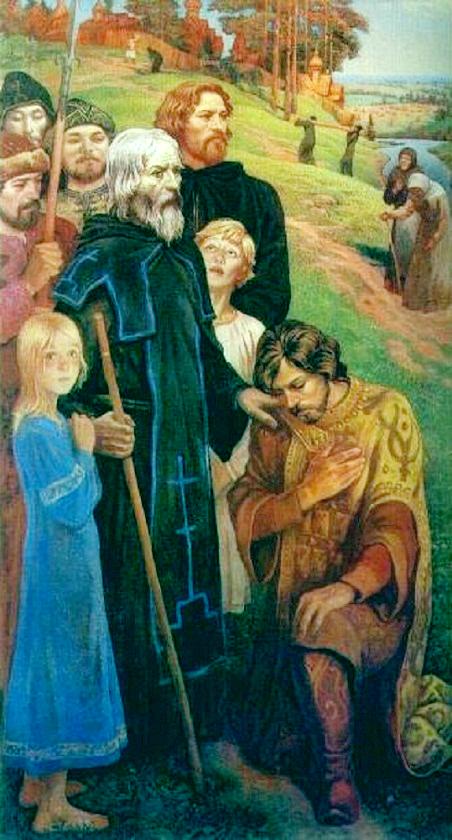
The Mongols imposed their control over Russia (1240). The Golden Horde imposed tribute on Russian principslities. The Battle of Kulikovo is seen by historians as the single most important event in medieval Russian history. It was the central event which set the stage for the emergence of Muscovy as the the core of the evolving Russian state. The Russians saw a series of dynastic quarrels after the death of khan Jani Beg (1357) weakening the Goldren Horde. Muscovy's refusal to pay tribute to the Golden Horde caused their leading general, Mamai, to organize a military campaign to bring the Russians in line. To resist the Golden Horde, the Russians needed to unite and combine their forces. Muscovy at the time was a principality, an important one, but only one of many Russian principalities. The resulting battle at Kulikovo was the beginning of the liberation of North-West Russia from Mongol rule. The Battle of Kulikovo was fought September 8, 1380. The Russians led by Dmitry Ivanovich, prince of Moscow and grand prince of Vladimir defeated the Golden Horde. It showed the developing military power of the Russians. After Kulikovo. Muscovy as a result of its military leadership rapidly emnerged as the leading Russian principality.
Perhaps the most important military campaign in Japanese history is the defeat of the Wmperor Kubla Khan's invasion fleet. The Mongol Emperor of China was Kublan Kahn introduced to the West by Marco Polo. China at the time was the most poweful country in the world Mongul armies had conquered China and then swept all opponents and pushed into the Middle East and Eastern Europe. Kubla Khan controlled an empire streaching from Poland to Korea. He dispattched an invasion fleet to add Japan to his empire. Japan at the time was a primitive country made up of waring fiefdoms. The Hojo family usurped the authority of the Japan's emperor, establishing the Shoganate. When the Shogun refused to pay homage to the Mongol Emperor, Kubla Khan set his eyes on Japan. He launced a massice invassion in 1281. The invasion fleet was made up of 4,200 ships and 142,000 men--larger than the D-Day invasion at Normandy. The Japanese would have been no match for the hugh Mongol army and sophiticated battlefield tactics. Mongil sophisticate battle formations rather than individual Samuri The fleet was destroyed by a storm known as the Divine Wind (Kamikaze). This became the inspiration for the Japanese suiside pilots (Kamikaze) of World War II.
The Hojo Shogun was held responsible for the weakening of Japan, inviting the Mongul attack (13th century). A revolution sought to restore the emperor. The almost holy Kamikazi myth was butrssed in the next century by a Samari General Kusunoke Masashige, who launched the hopeless battle of Minigaw at the order of the Emperor. Kusunoki Masashige has become known as the finest example of loyalty to the Emperor. He swore by his brother's dying words, to give his life seven times to the country! As a result, his obedience and sacrifice came to be lionized in Japan and a holy natianal myth was built around him. His statue now stands in a Tokyo park near Imperial Palace. His spirit influenced generations of Samuri warriors, nbut it was with the Meiji restoration that he became one of the country's greatest nationsal heros. With the Emperor now in cintrol, loyalty to the emperor took on an aura of patriotism and duty. It was his life that became the basis durung World war II for the Kamikaze campaign to defend the Home Islans. The letters, diaries, and poems of the Kamikaze pilots who flew to their deaths were filled with references to Masashige.
Edward III initiated the Hundred Years War with France (1337). Edward with his many French possessions refused to do homage to King Philip VI of France. Edward had aclaim to the French crown through his mother. Hostilities erupted and cintinued over 100 years. The French suffered some serious defeats in the early years of the war, Cr�cy (1346) and Poitiers (1356). At Poitiers French King John the Good was captured by the English Black Prince Under Charles V the struggle became a war of attrition. He relied on Bertrand du Guesclin to engage the marauding Free Companies, marauding mercenaries. Charles V by his death had
stabilized the struggle (1380). England's Richard II seeme willing to settle the differences. Charles VI's mental instability and feuding princes undermined the French position. John the Fearless, duke of Burgundy, had the king's brother, Louis of Orleans murdered (1487). This left France deeply slipt between Armagnacs and Burgundians. Henry V seized the opportunity. The result was the most disastrous French military defeat until Napoleons defeat in Russia. Henry destroyed the cream of French nobility at Agincourt (1415). Henry forced Charles VI to acknowledge him as the legitimate heir to the French throne. France was split between the powerful John Duke of Burgundy and the Dauphin, Charles, son of Charles VI and Isabella of Bavaria. Gradually the Dauphin aided by the young peasant girl Joan of Arc built his power. He was crowned Charles VII at Reims, recaptured Paris, and recovered Normandy (1450). Charles then took Guienne (1453). With the the victory of Castillon, France had effectively defeated the English and united the country.
Constantine Palaeologus, the last Byzantine emperor as Constantinre XI was born (1404). Constantinople had declined by the 15th century to a shadow of its former imperial glory. The city was a tempting target, but the city's massive walls held the Turks at bay. Emperor John VIII dies and the sucessioin is disputed betweem his brothers Demetrius and Constantine (1448). The arrival of gunpowder from China, as in Western Europe,changed the military calculations of beseiging Medieval fortifications. Cannons devestated the walls that had protected the city for 1000 years. Mahammed II became Sultan on the death of his father (1441). Mehmed II conducts a 2 year siege. Finnaly Turkish cannons achieve a break in the wall and Turkish soldiers pour through. Byzantium was finally overwealmed by the Ottoman Sultan Mehmet???? II (1453). The few remaining cities, such as Trebizond and Mistra, also fell to the Turks before the end of the century. The fall of Constantinople was a shock to Western Christendom. It was a great victory to the Ottomons who benefitted in many ways from possession of the great city. The city's fall also fueled the already increasing interest in Greek and classical studies, especially in Italy. This was a major factor in the appearance of the European Renaissance.
The War of the Roses in England erupted just after the end of the Hundred Years War. It developed as a drawn out dynastic conflict which evolved into a medieval civil war. There was not constant fighting, but rather a series of wars. It pitting the House of Lancaster against the House of York in a quest for the English crown. The heraldic shield for the Lancastrians was the red rose and the Yorkists employed the white rose which is why the war came to be called the War of the Roses. The two families were related, both could claim descendents from King Edward III. Beside the competing dynastic claims, there were a variety of contributing factors. The ruling Lancastrian king, Henry VI, brought loyal, but unpopular nobles to his court. The development of civil unrest among the population as a result of losses in the Hundred Years War as well as coruption at court. The existence of powerful feudal nobels with loyal private armies made England a virtual powder keg. And the situation was further stoked by episodes of mental illness on the part of Henry VI. The Lancasterians gained the crown by deposing Richard II (1399). Henry VI (1422-61) proved to be a weaking and wa dominated by his wife Margaret of Anjou and powerful nobels at court. Henry was opposed by Richard Duke of York who as a result of Henry's insanity was made prote. The War began with First Battle of St. Albans (1455). The Yorkists won at St Albans (1455) and more importantly Northampton (1460) in which King Henry was captured. It was agreed that Richard would become king when Henry died. Queen Margaret object as this disinheruted her son. She raised an army an Richard was killed. Even so Richard's son was crowened as Edward IV (1461-70 and 1471-83). Edward's son was one of the little princes murdered in the tower by his Uncle Richard Duke of Gloucester who ruled briefly as Richard III (1483-85). In part because of Tudor propaganda, Richard has become themost hated of the English kings. It finally ended with the Battles of Bosworth (1485) and Stoke (1487). Richard was killed at Bosworth. The War finally ended with the victory of Henry VII (1485-1509) who founded the Tudor dynasty, uniting the two competing houses. The Tudor symbol became a red and white rose.
The history of central Asian invasions is complicated. The Moguls were the last and most successful of these invaders. Mongol people began expanding out of the northern part of Central Asia. There primary target for centuries was China and its vast wrealth. This was why the Great Wall was built. Indiua was partially shielded by the Himalayas. The domestication of the horse gave the people of the Sreppe great power. Steppe people like the Persians began moving south into the Middle East creating a vast empire which was destoyed by Alexander (4t cenury BC). Than as the Roman Empire declined we see Steppe people moving west. This was onde reason the Germanic people were moving west into the Roman Empire. They were bein pressured by fierce Steppe people. This was partially due to the power of China t the time which was successfully dealing eith Mongol attacks. The Huns were fhe first Steppe people to reech Europe (5th century AD). They were followed by the Avars, the Ghaznavids, and the Seljuks. The focus was on Europe and the Middle East. The Turkish Ghaznavids in what is now Afghanistan began raiding northern India attracted by the fabulous wealth found there (about 1000 AD). The Ghaznavid raiders yield vasr plunder, much gold plunder – gold and pearls. They also carried awany many captive Indians as slaves. The Seljuk Turks seized control of Afghanistan (essentially the gateway to India) from the Ghaznavids. The Seljuks for what ever reason weere not interested in raiding India. Another group of Turkic invades, the Mamlkuks, renewed the attacks into northern India. They did not just raid, but established the Delhi Sultanate (1192). From Delhi they ruled much of northern India. The Mamlkuks were Muslim and many of the conquered Indians began concerting to Islam. Genghis Khan,
and his Mongol Army rose in the eastern Steppe. He breched the Great Wall and established a vast Asian empire. They
conquered the Uighurs, the Kyrgyz, and the Khitan. The Mongol Empire streached from rom Mongolia to Russia. Finally Turkic/Mongol expansion reached India (1221). Genghis ordered his Mongol armny from from Iran and Afghanistan into India. Genghis' son Ogedei suceeded him followed by his grandson Mongke. The Mongol rule was still limited the the northwest (moderrn Pakistan and Kashmir). India at the time was divided into many often warring states including the Rajaputs. As part of these many wars, Indian states would ask for Mongol support. Tthe Mongols became the power broaker throughout northern India. They did not at this time conquer the Delhi Sultanate. The Mongol Empire was vast and they had other priorities. The Mongols weakened and the Delhi Sultanate under the new Khalji Dynasty revived and became stronger (early-14th century). The energized Delhi Sultanate defeated the Mongols in several battles, driving the Mongols out of India. The Mongols renewed their invasion of India. A Mongol khan, Timur (Tamberlain), acting on his own raided as far as Delhi, sacking the city (1398). That was the catrostophic end of the Delhi Sultanate. This essentially ended central rule in northern India. Timur died (1405). Tthe Mongols lost control of northern India. Local Muslim leaders formed small states in northern India. Babur, a great-great-great-grandson of Timur, seized Kabul (1504). After failing to seize Samarkand, he turned his attention on India (1522). His army had advanced gunpowder weapons and captured Delhi (1526). Babur founded the Mughal Empire-- Mughal is actually just an Indian spelling of Mongol, but by this time the old Mongol Empire founded by Genhis had declined and was divided into khanates.
Kagan, Donald. The Peloponesian War (Viking, 2003), 511p.

Navigate the Children in History Web Site:
[Return to Main war chronology page]
[Return to Main war essay page]
[Return to Main military style page]
[Introduction]
[Biographies]
[Chronology]
[Climatology]
[Clothing]
[Disease and Health]
[Economics]
[Geography]
[History]
[Human Nature]
[Law]
[Nationalism]
[Presidents]
[Religion]
[Royalty]
[Science]
[Social Class]
[Bibliographies]
[Contributions]
[FAQs]
[Glossaries]
[Images]
[Links]
[Registration]
[Tools]
[Children in History Home]