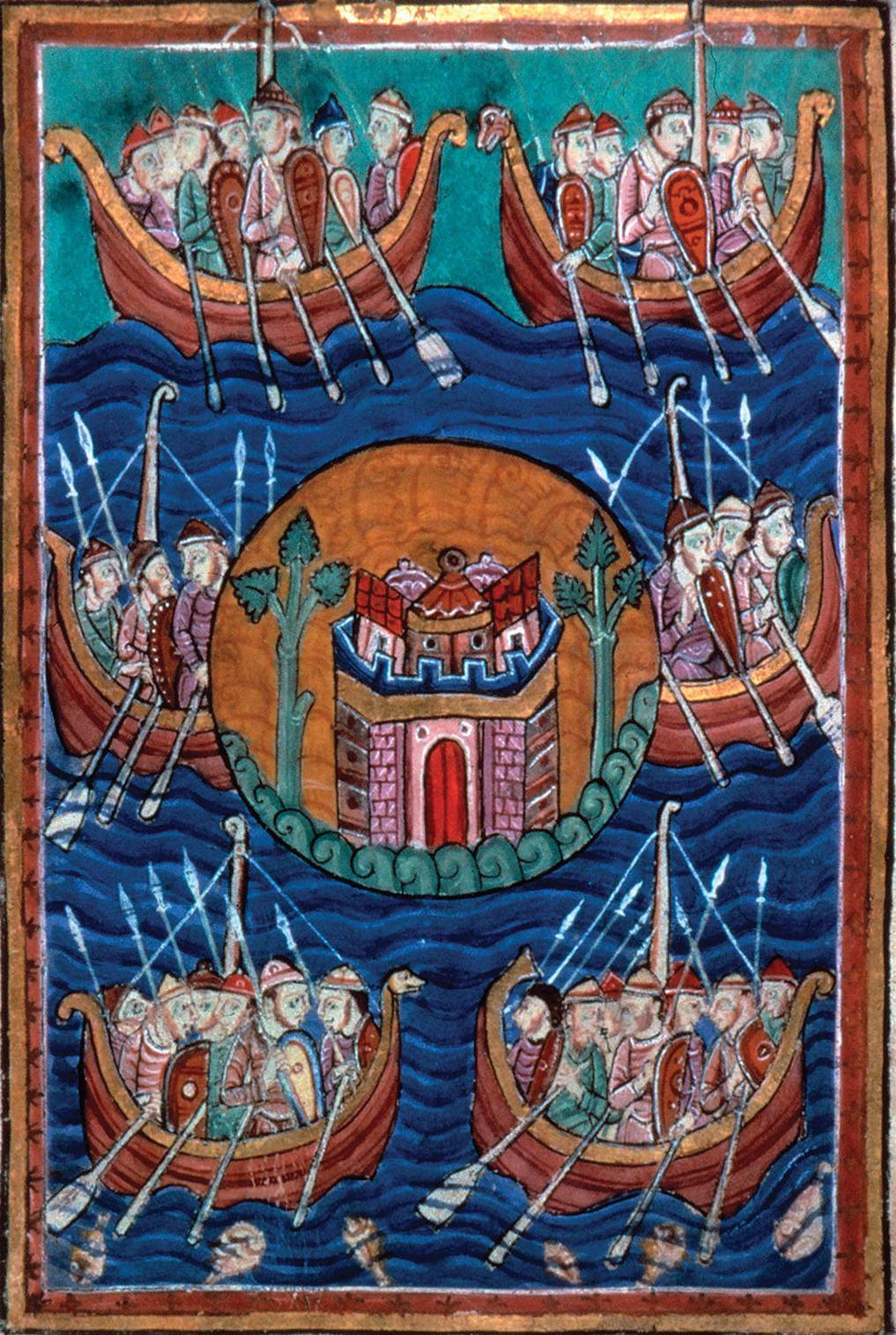
Figure 1.--The Vikings begn raiding England with an attck on Lindusfarne (793). The illustration here comes from an illuminated English manuscript written by Abbo of Fleury (c945-1004). The illumination is much later (c 1130). It shows the Vilkings attacking the monastary on the island of Lkndisfare off northeastern England. The Vikings would go on to play a central role English history and interestingly in the developmnt of democrcy. They destoyed all but one of the Anglo-Saxon kingdoms and coming close to conquering all of England. That was prevented by Alfred the Great. The Vikings continued to threaten England, including King Harold who was preparing to fight Duke William and his Norman invasion force along the Channel. The last Viking to play an important role in English history was Norwegian Viking Harald III (Harald Hardrada) who had an amazing life. Hardrada was aided by Tostig (King Harold's brother). The Vikings landed an impressive army in Yorkshire and seized York (1066). Upon hearing this, King Harold marched his army north. He desisively defeated the Viking army at Stamford Bridge near York and thus rushed south to engage William.
At the time Saint Augustine arrived, the Anglo Saxons controlled most of southern England and were expanding north and west (late 6th century). The Anglo Saxon invaders had no central organization as Roman Britain had or as the Normans would institute after Hastings. They gradually colonised England northwards and westwards, pushing the native Britons to the western fringes of island. Thus Roman Britain was replaced by Anglo Saxon Britain, The Anglo-Saxon invaders formed several new kingdoms. The Anglii settlements evolved into the kingdoms of East Anglia, Mercia, and Northumbria. The Saxons settlements appeared to have founded the kingdoms of Sussex, Wessex, and Essex. The Jutes apprear to have predominated in Kent and the Isle of Wight.
Wars between these kingdoms gradually resulted in the consolidation of three impotant kingdoms into Mercia, Northumbria and Wessex. War cointinued between these kingdoms as well as raids from the west and north, but they were stronger than the Romanized Britons and able to deal with these raiders. This was the England that the Vikings found when they began to raid. When the Viking insursions began, there was not coordinated Anglo-Saxon response. The Viking incursions culminated with a "Great Army" landing in East Anglia (865). It made wide territorial gains, and the kingdoms of Mercia and Northumbria had succumbed (by 875). Only Wessex survived the Viking onslaught. The Vikings while devestating large areas also played a role in the spread of commerce and the evolution of democracy in England.
At the time Saint Augustine arrived, the Anglo Saxons controlled most of southern England and were expanding north and west (late 6th century). The Anglo Saxon invaders had no central organization as Roman Britain had or as the Normans would institute after Hastings. They gradually colonised England northwards and westwards, pushing the native Britons to the western fringes of island. Thus Roman Britain was replaced by Anglo Saxon Britain, The Anglo-Saxon invaders formed several new kingdoms. The Anglii settlements evolved into the kingdoms of East Anglia, Mercia, and Northumbria. The Saxons settlements appeared to have founded the kingdoms of Sussex, Wessex, and Essex. The Jutes apprear to have predominated in Kent and the Isle of Wight.
Wars between these kingdoms gradually resulted in the consolidation of three impotant kingdoms into Mercia, Northumbria and Wessex. War cointinued between these kingdoms as well as raids from the west and north, but they were stronger than the Romanized Britons and able to deal with these raiders. This was the England that the Vikings found when they began to raid. The Anglo-Saxon invaders were not-yet Christianized. While they defeated the Christinized Britons, they eventually became Chritinized. The Church became the richest institution in the country and the only centralized institution. The Church also acquired prestige and political influence. Their wealth was in land and gold and silver jewellery, relics, and chalses hkld by the churches and manastaries. The Christianized Anglo-Saxon sttes fought among each other, but generally respected church property.
Scandinavia
Scandinavia is the region of northwestern Europe that comprises the modern states of Norway, Sweden, and Denmark. They are groped together not only by geography, but by historical and cultural affinities. The Viking expansion resulted in the creation of new states, Iceland and the Faroe Islands which may be included in Scandanavia. Finland is also sometimes included because it adjoins Scandanavia geographically. The Finns are, however, ethnically and linguistically different. Norway and Sweden make up the Scandinavian Peninsula, surrounded by the Gulf of Bothnia, the Baltic Sea, the , the North Sea, the Atlantic Ocean, and the Arctic Ocean. The Danish Peninsula is kinked to Sweden by islands with the
Kattegatt and Skagerrak straits cut through. Scandanavia was populated primsarily by the northern German tribes and speak a
Germanic language which has evolved into Danish, Norwegian, and Swedish. The Lapps and Finns are people descended from
people who inhabbited Scandanavia before the arrival of the Germanic tribes.
Reasons for Viking Outburst
It is not entirely clear why the Vikings began raiding Western Europe (9th century). The Vikings were a pre-literate people. As a result, we do not have a historical record to understand events in Scandanavia at the time in any detail. Several factors appear to have been involved. First, some historians believe it may be related to the expanding population in Scandinavia. Second, some authors believe that individual Vikings were responding to the political onsolidation of society into more centrally controlled kingdoms. The raiders seem to have been individuals or small groups, at least at first. They may have been individuals opposed to the rising leadership in Norway, Denmark, and Sweden. Third, climatic factors also seem to be a factor. Historians have begun to write about the Little Ice Age. This caused declining agricultural yields at the same time the population was expanding. THis is a matter of considerable historical debate. The term Little Ice Age itself is widely debated, especially the chronology. The widest chronological expanse is about 600-1850 AD. Many historians date it more narrowly. It does appear, however that within this period a climatic cooling did occur with very significant impacts on agriculture, especially of socities located at extreme lattitudes. And it sdhould be noted that until the 19th century, economies were based primasrily on agricultural production. The collapse of Viking society on Greenland may have been largely due to a climatic cooling. Four, even with all of these events, the Viking outburst would not hasve been posdible without the Longboat. Thus technological change was a factor. Such change does not take place in a vacume. Over crowdiung and edcling yields mnay have helped drive technical change. These and other factors were stirring the Norse in the 9th century. And of course, often in history there was no singular cause to major events. In all probability it was a combination of these and other factors which caused the Viking outburst.
Initial Viking Encursions
The Norsemen were a pagan (un-Chritianized) Germamic people that began raiding Christian Europe in the 8th century seeking plunder and booty.
One account describes three Vijing ships appearing at Portland near Weymouth (789). They first struck Lindesfarne (793). There may have been earlier attacks, but this was the first recorded one. Lindisfarne was a revered monastary on an island off northern England. The Vikings wre attracted by the wealth accumulated in Chistian monastaries and churches and the fact that they were not protected by defenses and armed guards. The wealth they found was unimaginable to peole eeking out a hard scrable life in Scandinavia. The Vikings were not Christians and had no scruoles about attacking holy places. The attack on a holy place in particular struck fear struck terror in Anglo Saxon England. The plunder found there brought further attacks on England, Scotland, and Ireland. A raid on the Jarrow Monastary followed (794). When the Viking incursions began, there was no coordinated response by the Anglo-Saxon kingdoms.
Mass Migration (750-1050 AD)
The attack on Lindisfarne was the opening event of what was to become the mass migration of the Scandinavian people throughou Europe. What began as plunder raids evolved into a mass migration seeking to settle better agricultural lands and trade centers. Norwegian and Danish Vikings settled the northern island off Scotland and then Iceland and Greenland, even reaching Labrador. Soon the Viking raids in England shifted from plunder raids to conquest and settlement. They conquered coastal France, even moving up the Seine to Paris. Normandy became a Viking provence, named after the north mem. Vikings eventually reached the Mediterranean. Swedish Vikings headed east carving about a kingdom in Russia and eventually reached the Black Sea.
Danegeld/Danelaw
The Danelaw or Danelagh is the name the Anglo Saxons gave to the area of Britain dominated by the Vikings who the Anglo-Saxons referred to as Danes. Here Sanish law prevailed. At its peak this was most of modern England, northern and eastern England. This began with the Viking migrations and conquests (9th century).
The actual term in refernce to a geographic area appeared much later (11th century).
A part of the Danelaw were the legal terms created in the treaties between the English king, Alfred the Great, and the Danish warlord, Guthrum the Old, These wwre set down following Alfred's victory at the Battle of Edington (878). The treaty was formalized sevral years laterv(886). The treaty set up boundaries with provisions for peaceful relations between the two formerly warring nations. The Danish laws held sway in the Kingdom of Northumbria and Kingdom of East Anglia which had been conquered by the Vikings. The Danelaw also was established for the historic Five Boroughs (Leicester, Nottingham, Derby, Stamford and Lincoln). The prosperity Viking communities within the Danelaw such as J�rv�k (York) attracted the attention of less prosperous Vikings stillmin Sandinavia. Thus we find Vikings raiding the settlements within the Danelaw.
Population
The number of Vikings which migrated to England and settled in the Danelaw is unknown. The Vikings did not keep any such records and were a pre-literate people. Some authors have thus concluded that it is impossible to know how many Scandinavians settled in The Danelaw. We are not sure this is the case. Given the conquest of the Anglo-Saxon kingdoms and the impact on the culture within the Danelaw, surely it must have been many thousands. And modern DNA methods should be able to assess the presence of Scandinavian haplotypes in the modern English population. We are not familiar with such studies, but you would think that British researchers have worked on it.
While the number of Vikings settled in the Danelaw is not know with any precession, they had a very substantial impact on developing English culture. This can be readily seen in both language and place names. Many other cultural topics are important tonassess, including agriculture, art, clothing, government and law, maritime technology, religion, and other matters. The language impact is particular striking and may be an indicator of just how much the Vikings affected developing culture. Both Viking Old Nore and Anglo-Saxon Old English had germanic roots, but had developed into two destincr languages. Thus basic communication was possible as so many words were similar. The grammar, however, was different. Over time the two languages merged. The destinctive dialects of the regions most heavily settled by the Vikings (East Anglia, Yorkshire, Lancashire, The Lake District and Lincolnshire) are the result of this merger. Linguists can assess which language predominated and this is a possible indicator of the actual cultural dominance in each area. Over time the Vikings who settled turned increasingly to agriculture as the English farm land was more productive than the rocky Scandinavian soil. Thus the Vikings gradually moved away from Scandinavian Viking culture to the more agricultural-based Anglo-Saxon soiciety. This promoted the merging of the two groups. Anglo-Saxon and Viking art, craft and ornamentation also appear to have merged. Here religion plsayed a role. The Vikings gradually accepted Christianity. Throughout Europe, artistc expression common was expressed in religious terms. We see destinctive Anglo-Norse decoration on many stone crosses and 'hog-back' shaped gravestones throughout the Danelaw. We see a mixture of Christian and Norse mythological sculpture, but over time the Christian works tends to dominate.
Anglo-Saxon Resistance
Gradually the Viking raids increased in scale and the Vikings instead of raiding began settling areas along the eastern coast. Serious invasions began (about 835). A steadily growing Viking fleet brought more and more Vikings to England and they began to pose a real threat to the Anglo-Saxon kingdoms. The Anglo-Saxons not only fought the Vikings, but attempted pay then off--the Danegeld. payment).
The Great Army (865)
The Viking incursions culminated with a "Great Army" landing in East Anglia (865). The Great Army was led by Ivar the Boneless and his brother, Halfdan. Both were sons of Ragnar Lodbrok who was killed during the fighting in Northumbria. Ivar took part of the Great Army to Ireland. Halfdan continued the conquest of English. Halfdan and many of his followers settled down in the area they conquered.
The Great Army made wide territorial gains, and the kingdoms of Mercia and Northumbria had succumbed (by 875).
Wessex
A commander in the Great Army was not prepsred to settledown. Guthorm coveted Wessex, the last surviving Anglo-Saxon kingdom. Guthorm began a series of attacks on Wessex. and its king, a young man named Alfred. Wessex was the only Abhlo-Saxon jingdom to survive the Freat Army. The Wessex king was killed in the fighting. His younger brother Alfred inherited the crown, rather than his brother's sons. The Vikings then moved on Wessex in force. The area of Dnish control in northern and eastern England was known as the the Danelaw. Wessex survived in part by paying the Danegeld. The Vijings up the any when they refused to leave after arriving for the annual Danegeld patment (876). They in fact remained in Essex for 2 years. Fighting broke out. The Wessex Army was virtually destroyed (878). King Alfred fled into the remote Somerset marshes--the wesern-most reaches of England. He found refuge on the island of Athelney. This was the turning pointin English history. Had Wessex fallen, England would have become Norse. Here he eluded the Vikings and regrouped to counter attack. He recruited a new army from the men of southern England. Alfred in the same year surprised the Vikings at Ethandune (878). Although relatively little known, it was one of the most important battles in English history. Alfred's victory was commemorated by carving a night on a white horse on the hillside. Alfred signed a treaty wih the Vikings, the Treaty of Wedmore. This essentially split England, but Wessex was saved. The Vikings controlled the north and the Anglo-Saxon English the south. The country was split vby the Dane Line, essentially Watling Street, the Old Roman Road that bisected England from London to Chester. Alfred is the only English monarch honored by the appelage "Great". This is not only because of his military victory, important as it was, but because he began the reconquest of England. This was not done militarily. The primary weapon that Alfred used was the English language.
United England
Alfred the Great's grandson Eadred reigned over a united England (955). The military power of the Viking leaders within the Danelaw gradually declined. The continuing wars with both Mercia and Wessex had weakened the Viking communities within the Danelaw. Ironiclly it was the continuong raids from Scandinavia that finally enduced the Viking Danelaw rulers to pay submission to the English King Eadred (Edward the Elder) in return for his protection. Thus the Danelaw became a part of England rather than Denmark. This was the first time England had been united since the Roman era. Eadred reigned over an increasingly centralized state.
King Aethelred the Unready
Saxon King Aethelred moved against what he preceived as the eroding Viking (Danelaw) presence in England. King Aethelred plundered the Viking occupied Isle of Man and parts of The Danelaw (1000). Aethelred married Emma, sister of Duke Richard of Normandy (1002). (And the great Aunt of the future Duke William.) Few details are available, but this presumably was a politically arranged marriage. Aethelred probably saw this as strengthening his position against the Vikings by a marriage alliance with the Normons, descended from a Norwegian viking dynasty. He proceeded to order the bloody massacre of Danish men in England. This included people related to Danish and Norwegiab Vikings. Among those slain were Danish King Svein Forkbeard's sister and his brother-in-law, Pallig. Svein raided along the southern and eastern coast (1003 and 1004). He returned to Denmark because of a famine in England (1005). Sevin subsequently continued to raid England for plundr and and collected large payments in silver as Danegeld.
Canute the Great
King Svein returned to England with with his son Canute (1013). Canute is known as Knud in Denmark and Knut in Norway. Canute's grandfather was Harald Bluetooth and his great-grandfather was King Gorm. Svein this time he was not just interested in raiding. He was determined to conquer England. He landed in southern England, but moved north, making the Danelaw his first military objective. He reasoned that many people there were of Viking ancestry
and would not only accept, but support Canute. Svein and Canute secured the Danelaw and soon threatened most of te rest of England. The Anglo-Saxon Chronicle reported, "...all the nation regarded him as full king". King Aethelred was forced to fled to Normandy. When King Svein died, Aethelred returned to England and defeated the Viking Army. Canute fled to Denmark. He returned to England with a new army (1016). Canute prevailed at the Battle of Ashingdon (Ashingdown), defeating Edmund 'Ironside', Aethelred's eldest son and successor. Canute and Edmund agreed to a truce under the Treaty of Olney. Canute receiced the Danelaw and the English Midlands. Edmund kept control of southern England, but died shortly after. Canute found then himself the the most powerful force in the country, but not the legitimate king of England, essentially a Viking warlord. In an attempt to merge the English and Viking dynastic lines, Canute married Aethelred's widow, Emma (1017). Emma was, however, not Anglo Saxon, but Norman. Her sons by King Aethelred remained safely in Normandy. Emma had two more children by Canute, Harthacnut and Gunhild. Canute was a Viking Christian and serious about his religion. In addition to Emma, Canute took a mistress--Aelfgifu. They had two additional sons, Harald and Svein. Another wave of Viking raider targetted England. King Ethelred the Unready was hard pressed to resist the new attacks. By the time of Ethelred's death (1016), the Viking warlord Cnute was in effective control of England. Canute's brother, Harald, King of Denmark, died (1018). Canute sailed to Denmark to secure his claim to his brother's realm. Canute then laid claim to Norway (1020). He suceeded in capturing Norway and placed his son Svein and his mistress Aelfgifu on the throne. Even Scotland submitted to Canute. Canute was able to legitimately claim to be 'king of all England, and of Denmark, of the Norwegians, and part of the Swedes'. Canute wanted to consolidate political control of England. He razed some of the burghs which had been established to defend southern from the Danelaw Vikings,. Defensive walls and ditches at Cricklade, Lydford, South Cadbury and Wareham were destroyed. Canute (1035). He was only about 40 years old. He was buried in Winchester from whih he often ruled. It had been the capital of the Saxon kingdom of Wessex. His sons proved unable to hild together the vast Anglo-Scandanavian empire he constructed.
Edward the Confessor
Edward was the son of Ethelred II the Unready and Emma, the daughter of Richard I of Normandy. The family had to go into exile in Normandy after the Danish King Sevin with his son Cunute invaded (1013). They soon reyurned
and managed to negotiate Ethelred's reinstatement (1014). After Ethelred's death (1016), the the Danes again took control of England. Edward lived in exile for an extended period. He returned to the London court of his half brother, Hardecanute (1041). Edward who became known as the Confessor thus became king (1042). Canute's death had left England divided. Edward the Confessor was the legitimate king. He had grown up in Normandy because his father Aethelred the Unready was driven into exile. His relationship with Duke William is a matter of historical debate.
Much of Edward's reign was peaceful and prosperous, a rare interlude in tumultous times. Thre were mior kirmishes with the Scots and Welsh. The domestic administration was steady. The financial and judicial systems were well executed and trading propered. Edward introduced some Norman friends to court, which was not well received. The houses of Mercia and Wessex in particular resentedthe Normans and both were powerful houses. Edward's main support was Godwine who Canute had made Earl of Wessex. Edward married Godwine's daughter Edith (1045). The two men fell out (1049). King Edward with the support of Leofric of Mercia, outlawed Godwine and his family (1047). Edward's Norman connections cntinued to undermine his rule. He could not prevent Godwine and his sons returned (1052). Edward had little power and the nobels supporting him were not prepared to fight a civil war. The King had to make terms. Godwine's lands were returned to him and Edward was forced to exile many of his Norman favorites. Edward was unable to exert his authority over his competing earls. Edward was more concerned with religion than governing England. England became ncreasingly divided again into competing earldoms. And Edward leaned increasingly on Earl Godwine's son -- Harold Godwinson.
Harold Godwinson
The strongest earl in England after the death of Canut proved to be Harold Godwinson, Earl of Wessex. Harold had power, but no hereditary connection to any previous English king. His sister Edith, however, was wife of Edward the Confessor. His father, Earl Godwin, was the most powerful noble in England. While known to history as the English Saxon king, Harold's mother was a Viking. He proved more competent than Canute's sons. Thanks to his father and Harold's successful battles and astute marriage arrangements, the Gdwine family came to control not nly Wessex, but Hrefordshire, Nrthumbria, East Anglia, and Kent. Harold was the most powerful man in England. He was more powerful than King Edward who came to rely on him. Whem nobels in Northumbria ousted his brother Tostig, Harold refused to support him, fearing civil war. This strengthened his acceptability to the English nobility as Edward's successor, but fatally split his own family. Tostig would eventully convnce King Harald Hardrada of Norway to invade England. King Edward died without a male heir (1066). He appears to have died without making any provision as to the secession. Harold claimed the throne as Harold II and was confirmed by the Witenagemot which was aware of the threat from Duke William.
Last Viking Invasion: Harald Hardrada (1015-66)
Norwegian Viking Harald Hardrada when Edward the Confessor died decided to seize the English throne. Hardrada is seen as the last of the great Viking warrior kings. He was born Harald Sigurdsson in Norway (1015). He fought as a teen at the Battle of Stiklestad (1030) in the forces of his half-brother Olaf Haraldsson, the exiled king of Norway. Olaf was attempting to regain the throne. Olaf failed and was killed. Hardrada had to flee Scandanavia heading east. He fought as as a mercenary for Jaroslav the Wise, grand prince of Kiev. Continuing south, he reached Constantinople. He became a member of the Byzantine emperor�s famed Varangian Guard. He ultimately retirned to Sandanavia as a wealthy, skilled warrior and military commander (mid-1040s). His sins appeared to have been forgotton. Hardrada allied himself with Svein Estrithson. Sevin was nother climant, this time to the Danish throne. They challenged King Magnus the Good, who ruled Norway and Denmark. Harald ended his alliance with Svein (1046). Magnus astutely decided to offer him what he had wanted originally--Norway. Hardrada became co-ruler of Norway. Magnus conviently died the next year (1047), leaving Hardrada the sole ruler in Norway--Harald III. Svein became king of Denmark. Hardrada and Sevin fought each for years. Hardrada got the best of these battles, but never completely defeated him. And then for not fully understood reasons, he decided to make peace with Sevin and reounce his claim to Denmark (1064). He apparently began to see a much more promising possibility--England. Hardrada formed an alliance with Tostig Godwinson (King Harold's brother). Tostig was the deposed Earl of Northumbria. Harold had not atually deposed him, but saw that nobels were set agaist him and recommend that King Edward who had little force at his dusposal afirm the action of the nobility. Tostig blamed his brother and plotted reenge. It is belieed that it is he who cnvinced Hardrata to invade England. Together Hardrada and Tostig landed an impressive army in Yorkshire and seized York (1066). They gained a victory at the Battle of Fulford Gate. King Harold in southern England was bracing for a cross-channel invasion by William Duke of Normandy who also claimed the English crown. Upon hearing of Hardrada's and Tostig's Viking invasion, King Harold marched his army north. He encountered Tostig's army unrepared and searated from Hardrata's army. He desisively defeated the Vikings at Stamford Bridge near York. Hardrada and Tostig was killed and their army destoyed. Harold had, however little time to celebrate his victory. King Harold was informed Duke William had landed an army in the south. Harold marched his army south in 13 days, an impressive achievement. This was a distance of some 240 miles. King Harold after the victory at Stanfrd Bridge might have been known to history as a great English warrior king. Unfortunately for him, less than a month after his great victory in the north he prepated to meet Duke William's Norman army at Hastings.
Duke William
William was born in Falaise, Normandy in France (1028). His father was Robert II the Devil, Duke of Normandy (1008- ). His mother was Herleva (Arlette), Officer of the Household (about 1012- ). William became Duke of Normandy (1035). Normandy at the time was a French state established by the Norse (Vikings) and had a powerful army. One thing is known with certainty about Edward's time in Normandy, Duke William expected Edward to name him as his heir and he had a distant claim because Queen Emma (now the Queen Mother Emma) was William's great aunt. Harold Godwinson, Earl of Wessex, also spent time in Normandy after being ship wrecked. Again the historical record is unclear, but William claims that Harold pledged his alegiance. Duke William was thus enraged when after Edward's death that Harold seized the crown. He was the stringest force in the country and his claim was confirmed by the Witan, the Anglo-Saxona council of wise men. He married Matilda of Flanders (1053). They had 10 children: Robert II Curthose, Duke of Normandy (1054- ), Richard, Duke of Bernay (about 1055- ), Cecilia of Holy Trinity, Abbess of Caen (1056- ), Adeliza, Nun, (1055- ), William II Rufus, King of England (1056/60- ), Constance (1066- ), Adela, Countess of Blois (about 1067- ), Agatha (about 1064- ), Matilda, and Henry I Beauclerc, King of England (about 1068- ). William died at Hermentrube, Near Rouen, France (1087). Harold's claim to the English crown was disputed by William, Duke of Normandy, whose claim was even more tenuous than Harold's. The last major role the Vikings played in England was helping William seize the throne.
Battle of Hastings (1066)
Hastings was one of the most important battles in British history. After centuries of political division and wars between the Romanized Celts, Anglo-Saxon invaders, Vikings, and others, Harold had managed to created a unified English state. After defeating a Viking invasioin on the north, Harold learned that Duke William was finally crossing the Channel, Harold rushed back south. The two armies met as Hastings. southeast of London (October 14, 1066). It was a fierce all day battle. Harold's army was tired, but larger and had the better field position. William's army was smaller, but better armed and desciplined. The Norman archers and calvalry proved the decisive force. Harold was killed in the fighting, an arrow piercing his eye. William became known as William the Conqueror. With the death of Harold and the defeat of his army, William was able to establish his authority throughout Saxon England. He was crowned William I in London on Christmas Day (1066)
Norman England
William after his victory at Hastings, moved to seize control of England. He was crowned king of England in Westminster Abbey on Christmas Day (1066). William completely subdued Saxon England in the following years (1072). He imposed continental Norman military Fedualism on Saxon England. William granted land to his followers in return for Feudal pledges of service and loyalty. He began the Domesday Book (1085) to understand just waht the resources of England were.
Impact
The Vikings had a huge impact on England. They affected many aspects of Anglo-Saxon life and the fusion of the two in many ways was the creation of the English nation. Perhaps the two mosdt importantimpacts were in the development oif the English language and English law. The Vikings while devestating large areas also played a role in the spread of commerce and the evolution of democracy in England. Important English institutions like the jury system are Viking in origin. The Vikings also made an important contribution to the English language. The Vikings almost completely overran Angl-Saxon Britain. The only Anglo-Saxon kingdom to survive was Wessex and Wessex too was almost defeated. Only King Alfred's victory at Ethandun fought near Westbury, Wiltshire finalled stemmed the Viking onslaught (878). Alfred pursued the Danes to their stronghold at Chippenham and there starved them into submission. King Alfred negotiated a truce with Guthrum, the Viking king (878). The truce agreement required Guthrum to accept Christiasnity and be baptised. England was into the Anglo-Saxon south and the Danelaw. The Danelaw included those counties north of a line that ran from from London to Bedford and then on to Chester. Thus during the 10th century the Danelaw coexisted with Anglo-Saxon England, each influencing the other.
English Language
One of the many important Viking impacts on England was in the development of the English language. Given the military success of the Vikings, one might have thought that the spoken language would have become Old Norse. Anglo-Saxon Old English certainly was affected by the Vikings Old Norse, but the language of England remained Old English and by the time of the Norman invasion, old Norse had largely disappeared from England. This is not to say that Norse did not enrich the English language. The Vikings were not alkways at war with the Anglo-Saxons even before Guthrum's conversion. Interaction between the Viking settlers and their Anglo-Saxon neighbours resulted in a good deal of linguistic exchange, in effect the melting pot of the two languages. Viking settlement varied substantially from area to area. And numbers were an important factor as to which language would dominate. The impact of Old Norse on the Old English dialects spoken was substantial and a factor in the various English dialects that survived into the 20th century. Trading, farming, intermarriage, and eventually assimilation fused the two languages. It was their combination in the north and east Midlands dialects that gradually developed into modern English. Note that the east Midlands dialect developed in an area where Anglo-Saxon England bordered on the Danelaw and was the dialect spoken in all important London.
English law
The Vikings were depicted by the Anglo-Saxons as lawless plunders. The 'Anglo-Saxon Chronicle' vidly depicts the lawless, uncivilized Vikings (793). The Chronicle reads, "Terrible portents appeared over Northumbria and miserably frightened the inhabitants: these were exceptional flashes of lightning, and fiery dragons were seen flying in the air. A great famine followed these signs; and a little after that, in the same year on 8 June, the harrying of the heathen miserably destroyed God's church in Lindisfarne by rapine and slaughter." And indeed there were no limits on attacking the Angl-Saxons. Just as there had been no Anglo-Saxon limits during their invasion of Britain on attacking the Romanized Celts earlier. Raids outside the Danelaw were not illegal. Among themselves within the Damelaw, the Vikings had laws and their laws made important contributions to the development of English law. The English word for a local law, meaning municipal regulations, is 'by-law'. The word "by" is the Norse word for "town". Many English towns such as Derby, Whitby and many others incorporates the Norse word in their name. We also refer to local elections as a 'by-election'. The Norse word for their governing assembly was 'ting' was the Viking word for a combined governing assembly and law court. Criminal were brought before it to be tried to stand trial. The facts of a case were established by a panel (kvidr) which would state a finding of truth. The English jury system was of Viking origins. A jury of 12 or multiples of 12, for especially important cases, decided the question of guilt. Lawyer is another term of Norse origins. A 'law-sayer' would inform the jury what the law said about the crime. The jury would then decide on the accused guilt or innosence. Those conviced would then either be fined or declared an out-law. Outlaws were essentially expelled from community. He had to live outside of Viking or in England the Danish communities. No Viking/Dane was allowed to help the outlaw or hasve dealings with him. Rather they were expected to hunt them down and kill him. 'Ull's ring', the sacred ring of the Norse god Ull had a symbolic role at Viking/Norse trials. A duel (Holmgang) was an accepted way of resolving disputes. The strengthen of Anglo-Saxon and Viking law and legal institutions meant that the victorious Normans could not fully implant the feudal system in England. And it was in England with the Magna Carta that English law began to resist the unrestrained power of feudal authority.