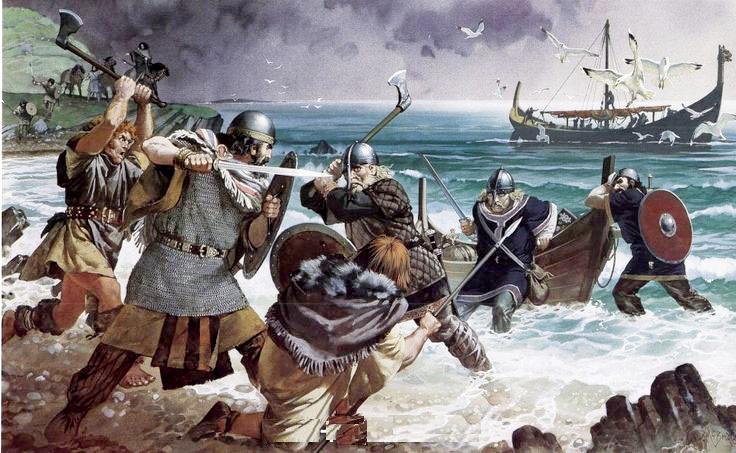
Figure 1.-This dramatic sccene depicrs an Irish Gael attack on a a Viking riding party landing. It is a modern painting by Angus McBride. We are not sure, however, how many Viking raiding parties were met at the water's edge. A great advantage the Vikings had was mobility. The Scotts, English, and Irish did not have standing armies. And moving overland was slow. Thus often the Vikings landed, attacked , pillaged, and departed before any kind of force could be organized to opposed them. Ireland was particularly vulnerable because the there was no strong national state.
The Northern Germanic tribes or Norsemen were unknown to the Romans, but burst out upon Medieval Europeans in the 9th century as the Vikings. They played a major role in the history of Western Europe, especially in British and French history. The Norsemen were an un-Chritianized Germamic people. Athough farmers, they developed a great technical inovation--the draggon headed longboat. This ship far outclassed the contemporary English or Frankish vessels in weight and efficiency. Longboats carried Viking raiders across the ocean an up rivers. Soon Viking raiders and traiders in the West were appearing from Scotland south to North Africa. They began raiding Christian Europe in the 8th century, first striking Lindesfarne (793). This was a revered monastary on an island off northern England. The plunder found there brought further attacks on England, Scotland, and Ireland. Voyages further into the Atlantic followed, to Iceland, Greenland, and North America. A permanent settlement was established in Iceland. The most important Viking explorers were Erick the Red and his son Leiv Eriksson. Norwegian-born Eirik Thorvaldsson, known as Eirik the Red, sailing from Iceland explored and colonized southwestern Greenland (986). He named this largely ice-covered island Greenland to attract settlers, His son, Leiv Eiriksson, became probably the first European to reach North America. Little accurate data from the extensive Viking voyages, however, ever appeared on European maps. The Norsemen or Vikings became a major threat to Christian Europe after the death of Charlrmagne and the splintering of his domain. The Vikings established Normandy, a dukedom that rivaled the power of the French monarchy and Duke William of Normandy would conquer England (1066). The Vikings while devestating large areas also played a role in the spread of commerce and the evolution of democracy in England.
Early Raids
The Northern Germanic tribes or Norsemen were unknown to the Romans, but burst out upon Medieval Europeans century as the Vikings (9th century). They were an un-Chritianized Germamic people that began raiding Christian Europe in the 8th century, first striking at the great Lindesfarne monastary (793). This was a revered monastary on an island off northern England. The plunder found there brought further attacks on England, Scotland, and Ireland. The Vilings did not strike blindly. They developed sturdy ships needed for the North Atkantic. It is likely that merchants and traders brought back to Scandanavia reports of riches to be had.
North Atlantic
The Vikings settled small islands close to the Norwegian coast like Lefoton in the north which was imprtant in the cod fishery. This was a factor in developing the technology for building sturdy ships and navigatinal technology. Voyages further into the Atlantic followed. The Norsemen became aware that something was out there in the North Atlantic. They noticed birds as well as detritus coming from the West. They were trading people with sturdy ships. The North Atlantic islands were within range of their ships. Irish monks seem to have preceeded the Vikings in the North Atlantic. The early history of the Shelands and Faroes is not known with any certainty. It appears to have been colonized by Norwegian Vikings (about 800).
Much more is known about Iceland. It is a substantial voyage from Norway ao Iceland, but the voyages to the Shetlands and Faroes make it a more manageabke voyage. A kind of island hopping undertaking. The Vikings established a permanent settlement on Iceland (875). The occupation of Iceland was rapid and the island like Norway itself quickly felt the pressures of overpopulation. The agricultural and animal husbundry basis of these northern islands was limited which in turn, as in Norway, limited the population. Iceland experienced a famine (975). An interest in finding new lands further west for expansion built.
At the time Saint Augustine arrived, the Anglo Saxons controlled most of southern England and were expanding north and west (late 6th century). The Anglo Saxon invaders had no central organization as Roman Britain had or as the Normans would institute after Hastings. They gradually colonised England northwards and westwards, pushing the native Britons to the western fringes of island. Thus Roman Britain was replaced by Anglo Saxon Britain, The Anglo-Saxon invaders formed several new kingdoms. The Anglii settlements evolved into the kingdoms of East Anglia, Mercia, and Northumbria. The Saxons settlements appeared to have founded the kingdoms of Sussex, Wessex, and Essex. The Jutes apprear to have predominated in Kent and the Isle of Wight. Wars between these kingdoms gradually resulted in the consolidation of three impotant kingdoms into Mercia, Northumbria and Wessex. War cointinued between these kingdoms as well as raids from the west and north, but they were stronger than the Romanized Britons and able to deal with these raiders. This was the England that the Vikings found when they began to raid. When the Viking insursions began, there was not coordinated Anglo-Saxon response. The Viking incursions culminated with a "Great Army" landing in East Anglia (865). It made wide territorial gains, and the kingdoms of Mercia and Northumbria had succumbed (by 875). Only Wessex survived the Viking onslaught. The Vikings while devestating large areas also played a role in the spread of commerce and the evolution of democracy in England.
Scotland
Some Romanized Britons were pushed north by the Anglo-Saxon invaders an area inhabited by the Picts. They would then be invaded by the Scotti from Ireland. They brought with them the Gaelic or Celtic language and Scotland was the fusion of these diverse groups. This was the Scotland that the Viking invaders incountered. The eastern coast of Scotland and England was most exposed to the Vikings. An early Viking raid hit the Jarrow monastery just south of Scotland, the resistance of the monks and a storm people resulted in a rare Viking defeat (794).
Viking raiders probled the British Isles for weakness. There were an extended period of low-level raids. The level of raids increased dramatically (830s). Finally the Vikings invaded Scotlasnd in force, moving into the central and northern areas of the country (839). The Vikings moved in large numbers into the Tay Valley, Earn Valley, and Galloway. They also invaded the Shetlands, Western Isles, Orkney, Sutherland, and Caitness. They also settled on the Isle of Man.
The Viking warriors killed the king of the Picts and his brother who was another king in Scotland. This was the end of the Pictish leadership an they also killedd many members of the Pictish aristocracy.
The Vikings also made an importsant contribution to Scottish literature. The Orkeyinga Saga, King Harald's Saga and the Laxdaela Saga appeared in the 13th century, based on earlier oral traditions.
Ireland
The Vikings found Ireland relatively easy pickings. Ireland was not densely populated, The population totaled about 0.3 million. And there was no central authority. The situattion was even more unsetteled than in England. The Iriush chiefs had less devloped states and were constantly raiding or warring with each other.
Viking raiders first struck at Lindisfarne off the eastern coast of England (793). While Vikings raidswere the most extensive on the closer coast of northeastern England, at the time divided into Anglo-Saxon kingdoms, it was not long before the Vikings reached Ireland as well. The raiders were Norwegian Vikings. The first known Viking raid on Irekland was an attack on Rathlin Island off Antrim (795). They burned the church. Other attacks were carried out on the west coast the monasteries on Inismurray and Inisbofin which were plundered. The Scottish island of Iona was also attacked (795). Viking raids in Ireland soon develooed a familar pattern. They were hit and run attacks by small bands, presumably freebootwers. They attacked monastaries on the coast or a few miles inland. The mobility of the Vikings afording the element of surprise made defense difficult. There were occassional Irish victories. Irish victories were recorded by the Ulaid (811). The men of Umall and the king of Eóganacht Locha Léin (Uí Caipre Luachra) slaughtered a raiding party (812). But these were unusual events. And the Vikings had hit targets all around the coast (early 820s). They attacked the sland monastery of Sceilg, off the Kerry (824). During this early period of Viking raids, the numbers were rather limited. Often there was only one major raid in all of the country. Occassionlly none at all. This could not have seriously damaged a counry the size of Ireland. Ireland at the time was a dangerous place. There were more raids by the Irish themselves. Attacks on Irish monasteries by Irish raiders were reportedly common well before the arrival of the Vikings. There were even wars and battles between monasteries themselves.
Irish monastaries by the 8th cenbtury moanastries had become very wealthy. They were tempting targets because they were oprotected only by unarmed or lightly armed monks. (This was less true in England which had only recently been Chritianized and the Irish Christisan monastic tradiotion was less important.) The Irish monasteries often had sizeable populastions, plentifulm provisions, and valuable artifacts. The Vikings attacked the monastic city of Armagh three times (832). This was the beginning of a major change in the pattern of Viking raids. The raids began to intenssify (830s). Much larger fleets of raiders appeared off Ireland. More Irish targets were hit and hit more often. And then the Vikings actually began wintering in Ireland and setting up permanent colonies (840s).
France
Viking attacks on France began even during the reign of Charlemagne. The raids were limited and Charlemagne military had difficulty dealing with low-level hit-and-run raids. The Norsemen began to focus more on France after the death of Charlemagne and the decline of his empire. The Vikings became a major threat to Christian Europe after the death of Charlrmagne and the splintering of his domain. The Vikings began raiding the coastal region of France, especially around the mouth of the river Seine. The Vikings could penetrate deep into France by rowing their longboats up the relatively slow flowing rivers. Moving up they Seine they reached Paris. And after Charlemagne the military capacity of the successor states declined significantly. The Vikings laid siege to Paris several times and constantly expanded the area around Paris that they pillaged. The French kings dealt with the Vikings by buying them off. They allowed the Vikings to move unmolested to attack the Burgundiuans. This was the beginning of a century-long feud between the French crown and the dukes of Burgundy. There was also a gradual shift in the Vikings. As in Britain, there was an increasing tendency to settle down. Viking settlements began to appear along the coast. The Vikings were wearying of the raids, perhaps because the French defenses and defending armies were becoming more effective. Viking losses in plundering raids were increasing. The French Crown reached an agreement with the Vikings (912). The Crown recognize the Vikings possession of the lands they possed and some additional land. The Crown made the Viking leader Rollo a French noble--the Duke of Normandy. Rollo for his part agreed to convert to Christianity, acknowledge the French king as his leige lord, and protect France against future raids by still unChristianized Vikings. The Normans very quickly become French. The Vikings were never more than a small minority in the new dutchy. Most of the Vikings that same to Normandy were young males. They married local women who raised the children. Thus the Norse language and customs very rapidly faded. Their war-like habits, however, persisted. And the dukes of Normandy began to challenge the power of the French crown. William, Duke of Normandy managed to obtain a clain to the English throne (1060s). At the same time, another Viking the Norwegian king also cast covetous eyes on England. And yet a third nobel of Viking descet, Harold seized the English crown after Edward the Confessor died. Wjen the Norwegian king with Harold's brother invaded, King Harold rushed north and decisively defeated the Norwegian landing force at Stamford Bridge . It is at precisely this time that Duke William invaded accross the Channel. Harold upon hearing of William's landing rushed south, but was defated at Hastings (1066).
Italy
The Vikings from Scandinavia were never a major threat in the Mediterranean. The Viking inplants in Normandy were another matter. Normans began conquests in Sicily and southern Italy. They batteled with Byzantines, Lombards, and Muslims (Arabs) which they encountered there. They established the kingdom of Naples and Sicily which would endure under different names into the 19th century. In this enterprise they managed to obtain the support of the papacy. Tne Norman operations against Lombards, Byzantines, and Muslims served the interests of the papacy as the Normans recognized the authority of the pope. And the Normans as the vikings had done in England ad France, quickly became Italicized. In Italy the Normans ere an even smaller proportion of the population than had been the case in England and Normady.
North Africa
The Vikings had trading links to Africa. Viking raiders also struck North Africa, although not in great force.
Information on Viking contacts in Africa are limited. And there is a complication in translations of medieval records. The reason for describing "a black man" was sometimes black hair, not black skin. Norse sagas commonly describe Africans as "Blaumenn" (blue men). There are accounts of Blaumenn in Dublin and of someone called Kenneth of Niger in Scotland in the 10th century. There was no Viking settlements founded in Muslim North Africa.
North America
Southern Europe where Iberia is the most westerly point is separated from North America by a huge ocean gap. Even if beginning from the Azores or Canaries, there is a vast ocean gap between the American and Europen continents. The situation is very different in the North Atlantic. Faroes, Scottish Isles, Faroes, and Greenland offer much shorter stages conecting Europe with the North American Continent. And of course the Vikings had the Long Boat capable of oceanic voyages, well before Christian Europe had vessels capable of such a voyage. Iceland was known to the Romans and rediscovered by the Norwegian Viking Nadod. It was colonized by Ingolf (875). A colony on Greenland off North America followed (about 983). Bjorne Herjulfson sailed from Greenland to the south-west (about 986). He may have reached Nantucket, Nova Scotia, and Newfoundland. It is unclear if he attempted to land. The most famous Viking explorers were Erick the Red and his son Leif Eriksson. Norwegian-born Eirik Thorvaldsson, known as Erik the Red, was apparently exiled from Iceland for unknown transgressions. He sailed from Iceland explored and colonized southwestern Greenland (986). Of course it was not green, but the name Greenland was more likely to attract settlers. Several settlemebts were founded whuch were active for some five centuries. There was contact and trade with the Inuits. His son, Leif Eiriksson, became probably the first European to reach North America (about 1000). He sailed along the American coast as far as 41.5° north lattitude. He discovered what he described as the Vinland (Winekand), which received its name from the wild grapes which Tyrker, a German who accompanied the expedition, found growing there in abundance. The fertility and mild climate of North America, compared to that of Labrador and Greenland, induced Leif and his party to settle and they appear to have founded the first European colony on the American continent. The precise location of the colony is a subject of intense debate. The history of the colony and any subsequent effort to found colonies is largely unknown. The problem is that North America, unlike Iceland and Greenland, was realtiveky densly populated. And ve the further south they went, the more densly populated the land was. The Vikings called the Native Americans Skrelingers (dwarfs). The Native American people, however, must have been a formidable challenge for a small group of Vikings. And unlike the Spanish and Portuguese five centuries later, the Vikings did not have gunpowder and steel weapons. There is little evidence of trade. The last account of North America in the old Scandinavian records is a reference to a ship (1347). It seems to have sailed from Greenland to Markland (Nova Scotia) to gather wood, a scarce commodity on barren Greenland. It was driven by a storm to Stamfjord on Iceland. Little accurate data from the extensive Viking voyages, however, ever appeared on European maps. European fishermen did, however learn about the Grand Banks, almost certainly as a result of these Viking voyages. One interesting observation is that European diseases do not seem to have been transferred to Native American peoples. We do nnot know why, but the level of contact was probably the factor. [Fowler] We are unsure about climate.
Sources
Folger, Tim. "Darkness at the edge of the world," Smithsonian (March 2017), pp. 28-39, 82.
Fowler, William Jr. Northeastern University. E-mail-excahange (June 21, 2021). We duscussed Dr. Fowler's lecture on the European voyages of discovery.