
The Opium Wars
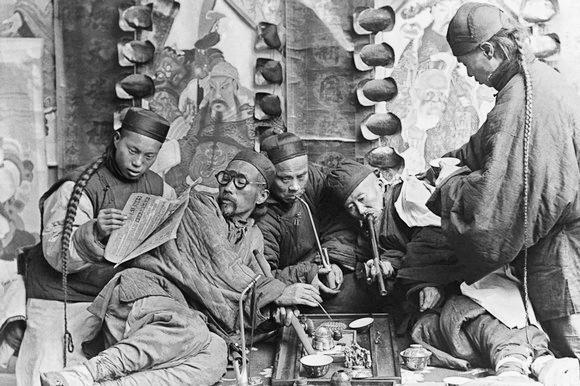
Figure 1.-- Europeans encountered a major problem in trding with China. There was a great demand for Chinese products (porcelin, silks, and other items) in the West. The Europeans had, however, difficulty delivering products of interest to the Chinese. Preindustrial China found few items made in Europe that were marketable. The British sollution was to sell opium produced in India. When the Imperial Chinese Goverment resisted, the Brtish launched the Opium War to force them to accept it.
|
|
The Opium War was a war between the United Kingdom and Imperial China. The British objected to China's attempt to limit British shipments of Indian opium to China. The Chinese were reacting to increasing levels of addition among the Chinese people. It is notable that as late as 1840 that British traders were having difficulty supplying goods that were of interest to the Chinese in exchange for the many Chinese products (especially porcelin and silks) that were in demand in the West. One of the few British products that was in great demand was Indian opium. The War was the British effort to force the Imperial Government to cease its efforts to prevent opium importation. The War ended in 1842 with the Treaty of Nanking which opened specified Chinese ports to foreign trade and the cession by China of the island of Hong Kong to the British there by opening southern China to trade nd commerce. The Opium War was a critical turning point in Chinese history. In the West it is a conflict virtually unknown except to historians. In China every schoolboy knows about it.
Opium
Opium is a milky substances that can be drained from unripe poppy capsules. It is a mixture of alkaloids, especially codeine, morphine, and narcotine and various organic acids, especially meconic acid. These substances have a variety of medicinal uses, primarily for the sedetive effect. It also is smoked as an intoxicant. Smokers can experience agreeable dreams, deep sleep, and in large doeses death.
Discovery in China
Medical science until modern times was much more advanced in China than the West. One Chinese discovery was opium. The Chinese began manufacturing opium for medicinal purposes in the late 15th century. Chinese doctors used it to treat dysentery, cholera, and a variety of other diseases.
Drug Addiction in China
Smoking opium for the hiluciongenic effects is not noted in China until the 18th century, but probably began sometime eralier. The Chinese Imperial Government in the early 18th century became increasingly concernred with the spreading addiction to opium and its debilitating effect. The Imperial Government prohibited the sale of opium mixed with tobacco and banned
opium-smoking houses (1729). The Imperil Government classed selling opium for smoking "with robbery and instigation to murder, and punished with banishment or death." [Rowntree] The Governmebnt found, however, very difficult to stop the trade, especially as the British steadily increased shiopments to China. The opium trade produced a country with huge numbers of drug addicts. Opium parlors despite being illegal sprang up all over the country because of the craving of adicts for the drug. What had been a serious problem in the 18th century reached crisis levels by the early 19th century as British shipments of opium from India continud to increase. One historain writes, "The effects on Chinese society were devestating. In fact, there are few periods in Chinese history that approach the early nineteenth century in terms of pure human misery and tragedy." [Hooker]
British Trade
Europeans encountered a major problem in trding with China. There was a great demand for Chinese products (porcelin, silks, and othr items) in the West. The Europeans had, however, difficulty delivering products of interest to the Chinese. Preindustrial China found few items made in Europe that were marketable. This problem gotten even worse when Europeans in the 18th century developed a taste for tea. The result was an unfavorable ballance of trade which could only be settled with bullion, gold and silver. This only began to change when the British used their Indian colony to alter the basis of trade, developing a triangular trade. The British shiped merchandize to India and Southeast asia which with the Industrial Revolution included large quantiie of finished cotton goods. Thereraw materials and semiprocessed goods were shipped to Canton and Guangzhou. British shipments to China by the early-19th century were largely Indian cotton and opium. This was the case even though Chinese authorities had outlawed opium shipments.
Britain and the Opium Trade
The increasing dominance of the Royal Navy combined with British victories over the French in India, especially during the Seven Years War put Britain in control of the international opium trade. Previously other European countrues, especially Portugal and Holland, had played an important role. Although discoivered in China, much of the world's opium in the 18th and 19th centuries was grown and produced in India. Patna was an especially important production center and both British and Dutch factories opperated there.
English East India Company
The English East India Company obtained monopolies on several products, including tea, salt, betel and other commodities. One of those was opium. This the company sought to increase its sales to China, especially because many of its other products were of little interest to the Chinese. This was of great concern because Chinese products were in great demand in Britain and graet profits could be made in the trade in Chinese goods. British opium sales to China grew from 2,330 chests in 1788 to 4,968 chests in 1810. This had expanded to 17,257 chests by 1835 as was a leading British export to China. As a result, the British increased opium production. Britain's governor-general of India wrote in 1830, "We are taking measures for extending the cultivation of the poppy, with a view to a large increase in the supply of opium."
English-Chinese Relations
Opium was not the only issue on which the Chinese and British disagreed. In fact, had it been, it probably could have been resolved peacefully. Although it was Chinese Imperial Government actions on opium that brought on the War, it was the larger trade issues that was the real cause of the War. There was at the time no formal trade treaty between Britain and China. The British refused to "submit" to the emperor which the Chinese demanded as a element of any such traety. This mdeant that many aspects of trade were unresolved. The British also objected to the fact that many Chinese ports were closed to foreign commerce, greatly impeding theor ability to enter the Chinese market. One especially touchy issue was that of extrateritaoriality, in particular the British objectioin to applying Chinese law to its subjects. The Britsh viewed the the Chinese legal system as corrupt and backward if not vivious. The Imperial Government insisted that foreigners accused of committing crimes in China be dealt with solely by Chinese justice.
Imperial Action
China since the early 18th century had strong laws agianst opium, but in 1836 took a number of added steps. At first this had little impact as both Chinese and British merchants payed generous bribes to corupt Imperial officials.
Lin Tse-hsü (1785- 1850)
It was Lin Tse-hsü who brouht the issues between the British and Chinese to a head. Lin Tse-hsü was a dedicated and absolutely incoruptable imperial official--a kind of Chinese Elliot Ness. He was scanadlized by the opium menace to China and the impact on people. He was appointed Imperial Commissioner at Canton, a key Chinese port open to foreigners. He set out end the opium trade by arresting corrupt officials and cracking down on British merchants involved in the drug trade. Lin took office (March 1839) and within 2 months had virtually ended the drug trade in Canton. Lin not only seized the stocks of opium owned by Chinese dealers, but detained the entire foreign community and proceeded to confiscate and destroyed about 20,000 chests of British opium--all completely illegal undr Chinese law. Lin wrote a letter to Queen Victoria requesting that her Government end the opium trade, pointing out that the opium trade and
consumption was illegal in Britain because of its harmful effects. When the English refused to end the trade, Lin threatened to terminate all trade with England. This would have had a devestating effect on British merchants. [Hooker]
The War (1839-42)
The Opium War began when the Chinese Imperial Government demanded that foreign merchant ships surrender their illegal opium cargo. When they refused Chinese Imperial vessels (junks) attempted to prevent English merchant vessels from entering Canton (November 1839). Littkle actual fighting occurred at this time. The British priceeded to gather a large fleet of modern naval vessels (June 1840). Chinese officials, including imperial military commanders, had no concept of the power of modern weaponery. The Chinese with relatively fragile ships a primative naval guns were unable to resist the British fleet. The fleet attacked fortifications and cities all along thde Chinese coast. The Chinese army was also unpreapred for modern warfare and was defeated in several land engagements.
Attrocities
Not all of the engagements in the War were military engagements. The British undertook punative expeditions aginst coastal cities. One such expedition was conducted against Chusan. One newspaper described a British attack on the city of Cusan, "A more complete pillage could not be conceived than took place. Every house was broken open, every drawer and box ransacked, the streets strewn with fragments of furniture, pictures, tables, chairs, grain of all sorts -- the whole set off by the dead or the living bodies of those who had been unable to leave the city from the wounds received from our merciless guns. ... The plunder ceased only when there was nothing to take or destroy." [ India Gazette, 1840]
Negotiations
The negotiations ending the War wouls set the precendent for what the Chinese would come to se as the "uequal treaties" or "national humiliations." The Treaty of Nanjing was followed by aseries of other trade treaties forced upon the Chinese. Ther was also a war with Japan in hich Taiwan was lost. Chinese military weakness made it impossible for theImperial Gocernment to resist foreign demands.
Treaty of the Bogue
Initial negotiations to end the fighting resulted in the Treaty of the Bogue. The negotiations failed, however, when Imperial officials failed to reimburse the British for their opium that had been seized and destroyed. In retaliation, the British seized Amoy, Tinghai, Chunhai, and Ningpo.
Treaty of Nanjing (1842)
The Chinese finally saw no alternative but to accept the terms demanded by the British. The Treaty of Nanjing (August 29, 1842). The treaty was signed on a British naval vesel by two Manchu imperial commissioners and the British plenipotentiary. It was the first of a series of trade agreements that the Chinese were forced to sign with European countries involved in the China trade. Eventually Japan also forced concessions from the Chinese, but the Japanese not only demanded concessions, thet seized Chinee territory--the island of Taiwam (Formosa) (1895). The hinese now call these treaties "unequal treaties." The Treaty provided for te cessation of the island of Hong Kong to the British. The established licensed monopoly trade system was abolished. The British no longer had to pay tribute to the emperor. The Chinese agreed to open five ports (Canton, Shanghai, Foochow, Ningpo, and Amoy) to British residence and trade. Chinese import duties were limited to 5 percent ad valorem. The Chinese were required to grant British subjects extraterritoriality. The Chinese also had to pay an indemnity of $15 million. The British demanded most-favored-nation status.
What is now Hong Kong was of little importance until the 19century. The Chinese even for a period ordered coastal residence to move inland. The first know European visitor was Jorge Álvares, a Portuguese explorer who arrived on a few years after the Portuguese rounded yhe ape of Good Hope (1513). This lead to the establishment of Macau (1557). This opened up southern China to trade. Portuguese merchants began trading in southern China. Subsequent military conflict led to the expulsion of all Portuguese merchants from the rest of China. The Chinese issued the Haijin order (closed-door, isolation policy) which forbade all maritime activities (mid-16th century). This was designed prevent maritime contact with foreigners (motly Europeans). The area of what would become Hong Kong was affected by the Kangxi Emperor who issued the Great Clearance. This required coastal residents to evacuate coastal areas of Guangdong (1661-69). The British did not arrive in the area until the Opium Wars, about 300 years after the Portuguese. The refusal of Qing imperial authorities to support opium imports caused the outbreak of the First Opium War between the British and the Qing Empire. The British during the War landed on Hong Kong Island (January 20, 1841). China first ceded under the Convention of Chuenpee, a ceasefire agreement between Captain Charles Elliot and Governor Qishan. The Treary was, however, not ratified. After further negotiations, the Treaty of Nanking formaly ceded Hong Kong Island in perpetuity to the British (August 29, 1842). The British officially established a Crown colony and founded the City of Victoria in the following year (1843). There was virtually nothing there except a few fishermen and charcoal burners, whose settlements scattered along several coastal hamlets. In the 1850s, a large number of Chinese immigrants in scattered villages. Hong Kong opened up southern China to the British. This caused a rapid incrase in population. Hing Kong also provide a place of sfety. Chines flocked there to escpe the bloody Taiping Rebellion (1850-64). Natural dsasters and famine also drove Chinese to Hong Kong which at first had no border controls. Continued conflict over opium led to the Second Opium War, this time with French participation. The British managed to expand the Crown Colony to include the Kowloon Peninsula and Stonecutter's Island. Both were ceded to the British in perpetuity under the Convention of Beijing (1860). Britain obtained a 99-year lease from the Qing under the Convention for the Extension of Hong Kong Territory (1898). The British also secured Lantau Island and over 200 other small outlying islets.
Consequences
There were other consequences beyond the formal provisions of the Treaty of Nanjing. No restrictions were acceptedon British trade. As a result, opium imports doubled in the three decades following the signing of the treaty. China was forced in 1844 to sign similar treaties with France and the United States. More to follow werewith Italy, Japan, Germany, Russia, and other countries. Lin Tse-hsü, the Imperial commissioner who oversaw the anti-opium campaign in 1839 was disgraced and reassigned to a post in remote Turkestan. Lin ws one of the few Imperial official to appreciate the shift in the ballance of power. He submitted assessments to his superiors stressinbg the need to adopt Western technology, especially military technology. His recommendations, however, were largely ignored.
Second Opium War (1856-60)
The Chinese Imperial Government took no sustantive measures to resdress the growing military inballance with the West. The British were generally unhappy with the results of the Treaty of Nanjing. This was because even with five treaty ports, their trade with China was below what they had expected. They also objected to what they saw as treaty violations. The Chinese. Further illwill arose against foreigners in general by the mistreatment of Chinese nationals in America and the Caribbean where they had emmigrated. Mot faced racial discrimination and restrictive laws. Some worked under conditions that were little more than slave labor. Other were asaulted even killed. These simmering issues resulted in 1856 in a series of incidents that did not end until 1860. Britain forced a second set of treaties on the Imperial Government which again humiliated officials and further discredited the Imperial Government. The British High Commissioner was Lord Elgin who wrote to his wife that he was ahamed of what the British Government instructed him to do. The British forced the Imperial Government to completely legalize opium and to allow European missionaries to freely promote Christianity without restiction throughout China.
The history of Christian missionaies is extensive and an important chapter of European and Chinese history. It is at first largely an account of the Catholic Church. This did not change until the 19th century when Victorians, especially the English, began to evangelize the Gospel. British missionaries set out to bring the Gospel to the new Empire. The interior of China was opened by the treaties following the Opium Wars. Protestant missionaries were different from the Catholic missionaries in that they brought their families with them. British colonial officials by the 19th century were also bringing their families, but were more likely to live in cloistered foreign communities. The missionary families were more likely to live with the local population since their mission was to convert them. American Protestants also took up this mission, especially after the Civil War (1861-65). American missionzaries went to many foreign locations, but no country fired the American missionary zeal more than China. The missionaries themselves were concerned with salvation. There effort was, however, much more significant. With them they brought modernity and opening to a wider world. Opinions vary. Some see the missionaries as a modernising force. Others see them as a disruptive force, resonsible for Chinese xenephobia. The missionaries set up the first modern schools and hospitals. In their wake came businessmen. They brought with them European products, stimulating a demand for these goods. Europeans seized control of treaty ports in China. The United States did not do this, instead opting for an Open Door Policy. There were military consequences. The Japanese invasion of China (1937) was accompanied with horendous attrocities against Chinese civilians. Reports from missionaries in China had a profound impact on American public opinion. Thus when President Roosevelt began a series of diplomatic efforts including embargoes to force Japan out of China, he received considerable support in a still largely isolationist America.
Assessment
A British historian described that the British were "in a great hurry to make money out of the East, and the gunboats were found to clear the way quickly. All vestiges of compassion for mankind had been swept away by the silver stream of rupees which poured into the Calcutta Exchequer." [Rowntree] Another historian writes, "The Opium War, also called the Anglo-Chinese War, was the most humiliating defeat China ever suffered. In European history, it is perhaps the most sordid, base, and vicious event in European history, possibly, just possibly, overshadowed by the excesses of the Third Reich in the twentieth century." [Hooker] This seems rather an excessivde statement given the scale of the NAZI and Japanese militarist killings and their goals. There are ceratinly other base enterprises in European history, such as the crudsades, although with loftier goals.
The moral overtones aside, the Opium Wars were a turning point in China's rekationship with the West. The Industrial Revolution had transformed the ballance of power. European powers with their growing military power began carving up China. The Industrial Revolution also began supplying many other goods besides opium that were in demand in China. The war was a humiliating defeat for the Imperial Government and descredited it in the eyes of the Chinese people, especially the rising generation.
International Convention
Federal officials in America were concerned as to how they could ban cocain and other drugs. Officials work for 15 years, but strict constuctionists objected to Fderal action. American missioinaries promote an international convention to ban the opium trade. The convention required participting countries to adopt domestic laws banning drugs. After the Senate ratified he treaty there was a justification for Federal action without th need of a Constitutional Amendment. It was decided to use the Federal authoirity to regulate interstate commerce to deal with drugs. The Harrison Tax Act of 1914 was the first Federal drug legislation.
Sources
Hooker, Richard, "Ch'ing China: The Opium Wars" (1996).
1996, Richard Hooker
Rowntree, Joshua. The Imperial Drug Trade (London: 1905).
CIH

Navigate the Boys' Historical Clothing Web Site:
[Return to the Main 19th century war page]
[Return to the Main specific war page]
[Return to the Main Chinese Manchu page]
[Return to Main European Imperialism page]
[About Us]
[Introduction]
[Biographies]
[Chronology]
[Climatology]
[Clothing]
[Disease and Health]
[Economics]
[Freedom]
[Geography]
[History]
[Human Nature]
[Law]
[Nationalism]
[Presidents]
[Religion]
[Royalty]
[Science]
[Social Class]
[Bibliographies]
[Contributions]
[FAQs]
[Glossaries]
[Images]
[Links]
[Registration]
[Tools]
[Children in History Home]
Created: September 6, 2003
Last updated: 8:33 AM 1/10/2016