|
When the United States entered the War, President Wilson appointed Herbert Hoover to the post of United States
Food Administrator (1917). Food had become a weapon in World War I and no country produced more food than America.
Hoover succeeded in cutting consumption of foods needed overseas and avoided rationing at home, yet kept the Allies
fed. America had to produce the food needed by the new large army America was building as well as for Allied armies
and civilians. Hoover designed a voluntary program. He called it food conservation, but many Americans took to
calling it "Hooverizing." Various promotions were devised, such as wheatless Wednesdays and meatless Mondays.
Hoover was convinced that Americans would cooperate voluntarily to support the boys overseas. He did not want a
mandatory program and Government regulated rationing. The idea was that American civilians would have to modify
their eating habits voluntarily so that more food was available for shipment overseas. The American housewife was
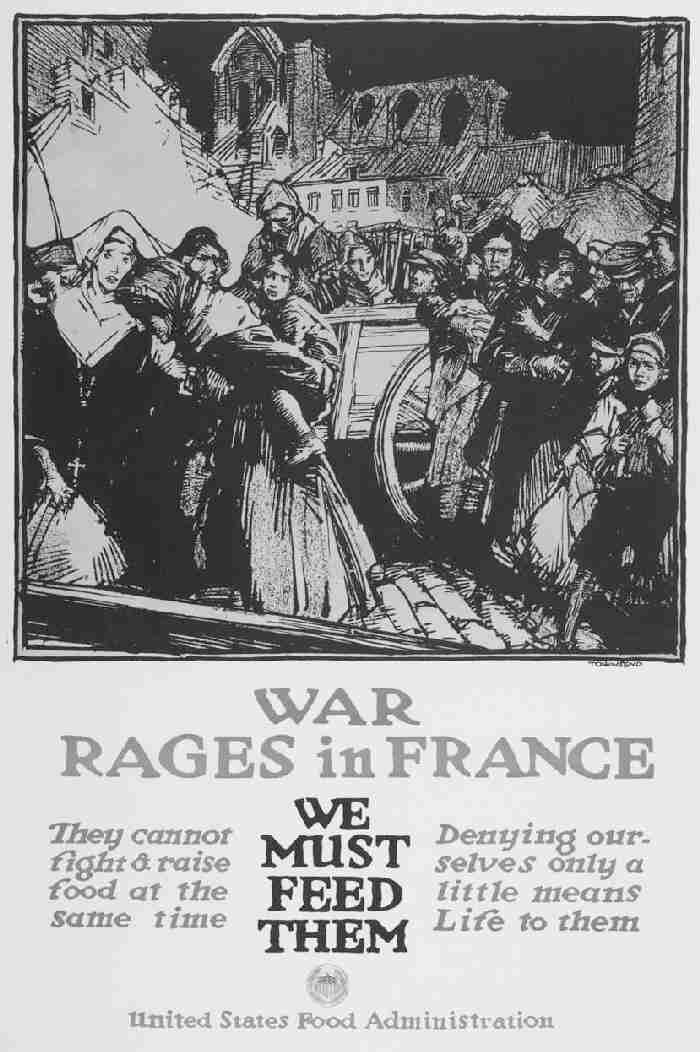
urged to conserve food and eliminate waste. Signs and posters appeared in workplaces and public areas with the
slogan "Food Will Win the War". Hoover managed to voluntarily reduce domestic food consumption 15 percent without
rationing. Hoover guaranteed the farmer a "fair price" and there was an overseas market for all that could be
produced. American food exports tripled. Not only did America help feed the Allies, but the shipments created
surplus stores of food that helped prevent a post-war famine in Europe. America after the War not only helped her
Allies, but the former Central Powers countries as well as Soviet Russia.
Some states began to act even before the Federal Government took action. Wisconsin, an important farm state, in
particular led the way. Wisconsin was the first state to organize both state and county-level Councils of Defense
tasked with educating the public about the War and the sacrifices that would be required. Wisconsin's State Council
of Defense took on the task of addressing the food problem that was developing in 1917. The Wisconsin Council was
led by Magnus Swenson. He came out with a number of innovative ideas. He promoted promoting food conservation
through the cultivation of home gardens and institution of meatless and wheatless days. After President Wilson
appointed Herbert Hoover to lead the new United States Food Administration, Hoover was impressed with Swenson's
pioneering efforts. He adopted many of Swenson's policies and appointed Swenson Wisconsin state Food Administrator.
The Allies which as a result of the British Royal Navy had control of the seas were able to import food.
Foreign purchases had depleted American food stocks and driven up prices. Wheat reached
a record $3 a bushel. There was legislation designed to control the problem (the Johnson Act, Cash and Carry
legislation, and export controls), but they were proving inadequate. America was particularly important to the
Allies. Food could be imported from countries like Australia and Argentina, but the distance required more
shipping. The shorter North Atlantic lifeline required fewer ships to deliver the same volume of cargo.
[Mullendore] In addition, until the Germans resumed unrestricted submarine warfare (February 1917), American ships
could deliver food stuffs unimpeded to Britain.
A few weeks after America entered World War I, a volunteer organization was established (May 4, 1917). It soon
became apparent that the War required a much greater Federal effort to address the issues concerned with food
production. Food shortages began to appear as prices were rising in 1917. President Wilson established the United
States Food Administration (USFA) as an independent agency by President Wilson with Executive Order EO 2679-A
(August 10, 1917). The President acted under the authority of the Food and Fuel Control Act (40 Stat. 276), August
10, 1917. The task assigned to the USFA was to regulate the supply, distribution, and conservation of foods. The
USFA bought and sold grain and sugar and their products through two subsidiaries: the Food Administration Grain
Corporation (U.S. Grain Corporation) and the U.S. Sugar Equalization Board, Inc.
When the United States entered the War, President Wilson appointed Herbert Hoover to the post of United States
Food Administrator (1917). Herbert Hoover at the time World War I broke out was unknown to the American people. He
by happenstance was in London and got involved in helping Americans get home from Europe. Slowly he got more and
more involved in relief efforts. This is why President Wilson chose him for the post of Federal Food Administrator.
Hoover as Food Administrator actually had very limited powers. He did not have the authority to ration food.
Nor could he set farm prices or retail prices for consumers. He did have three powers at his disposal. First, to
negotiate voluntary agreements with producers and traders on prices. Second, the power to license traders. Third,
the power to buy and sell food. This was a very different administrative authority than that granted to the British
Ministry of Food which was essentially a vast trading enterprise. The USFA with two exceptions did not get involve
with trading commodities on any scale. The exceptions were wheat and sugar. [Mullendore]
Food had become a weapon in World War I. This was not a new development in warfare. Countries since ancient
times had besieged enemy cities and fortresses with the idea of starving them out. Caesar had used this tactic
against the Gaul leader Vercingetorix (1st century BC). The industrial revolution had significantly changed the
food situation in Europe. Populations had increased exponentially. And large numbers of people had moved from
rural areas seeking jobs in the city. Major countries like Britain and Germany were no longer self sufficent in
food. They had to import food to feed their population. One of the primary purposes of the Allied naval blockade
on Germany was to prevent Germany from importing food. One of the principal purposes of the German U-boat campaign
was to prevent Britain from importing food.
No country produced more food than America. America at the time of World War I was a major food producer. It
not only was self sufficent in most agricultural commodities, but also exported large quantities of grains and other
food products. The few products that America had to import were products that were best grown in tropical regions,
particularly sugar and coffee. The United States also imported vegetable oils. [Mullendore]
Wheat used for bread and other food stuffs was the most critical agricultural commodity. Thus it was the
commodity given the greatest attention by the USFA. One way of freeing up more wheat to feed the Army and to assist
America's allies was to reduce domestic wheat consumption. Here the USFA came up with a range of ideas to use corn
and other grains for a range of wheat products.
Hoover's immediate problem after his appointment was the fact that foreign purchases had depleted American food
stocks and driven up prices. There was legislation designed to control the problem (the Johnson Act and Cash and
Carry legislation), but they proved inadequate.
For most countries developments on farms had little impact on other countries, even neighboring countries. Not so America. America is an exceptional country which the Europeans already knew. Thus is why millions of Europeans came to America. What the Europeans did not know at the beginning of the decade waa that American farmers would save millions of lives throughout the continent. American farmers saved millions of people in Europe during the decade, both during and after World war I. No other people in world history had ever attempted such a humanitarian effort on basically altruistic motives and on such a massibe scle. And it was all possible because of the American farmer. No country produced more food than America. America at the time of World War I was a major food producer. It not only was self sufficent in most agricultural commodities, but also exported large quantities of grains and other food products. The few products that America had to import were products that were best grown in tropical regions, particularly sugar and coffee. The United States also imported vegetable oils. [Mullendore] Major developments occured in rural America during the 1910s. Farm credit was a major issue. About a third of the more than 90 million Americans lived in rural areas (1910). Russia in the early-20th century was the European breadbasket, exporting large quantities of grain. The industrialized countries of Western Europe (espcially Britain, Germany and the Lowlands) had to important food to feed their workers. France with its especially abundant land was in a little better shape. World War I created an enormous demand for agricultural products. Farmers and farm workers were conscripted throughout Europe for military service. Fertilizer factories were converted for munitions production. This and the the destruction of War substantially reduced agricultural production. The Central Powers could not import from Russia, the European breadbasket or from overseas because of the Allied naval embargo. Farm production in Europe fell along with the devestation and shifting of priorities to war production. Shortages in Russia, Germny, and Austria-Hungary undermined the imperial regimes. The Allies, especially Britain did import and in large quantity. American farmers thus played an important role even before America declared war on Germany. And the increased demand affects American farming. The markets created and the resulting price increases meant boom years for American farmers and a rush to expand plantings. Great Planes farmers expand dryland farming. Farm workers appear from Mexico, both as a result ofthe Mexican Revolution andthe need for workers as production increased. New Government prigrams are untriduced such as the Stock Raising Homestead Act (1916). Imprioved mechanized equipment appears such as large opengeared gas tractors (1910), closed gear tractors (1915), and small prarie combines (1918). The Northern Plains states (North Dakota, Kansas, and Minnesota) become the principal wheat producing states. As a result of experiments with different wheat strains, durum wheats becomes an important commercial crop. The effort to increase production meant that grain farmers were moving into the most arid area of the Great Plains. Marquis wheat was introduced (1912) Kansas red wheat was introduced (1917). Henry Fors's Model-T and country road building significantly increased the mobility of farmers and the access to small farm equipment like tractors. The Rural Post Roads Act begins regular Federal subsidies to road building (1916). The American railroad network peaked at 254,000 miles (1916) providing the farmer unparalleded market access. The Government once America entered the War (1917), encouraged American farmers to increase production and they responded with major increases in planting and land utilization. Thus during the War, the Allies did not face the same problems with food that Austria-Hungary and Germany faced. After the War, the United States fed a prostrate Europe, averting widespread starvartion.
The principal job of the USFA was increase food production and to promote conservation efforts to free up even more food to supply the Amerivan Expeitionary Force, Americcan allies and the needy and dispossed throughout Europe. throughout Europe. The United States not only helped the Allies win the War, but played an unprecedented humaniraian role. Food was badly needed in Europe, both for refugees and those who remined in their homes but were threatened by food shortages. The USFA set up and organized operations thoughout the United States. It did not, however, have the staff needed in Europe to distribute the food. The Red Cross which was an international organization provided the network needed for foreign operations. The American Red Cross began building a European-wide net work needed to destribute food. And because America was neutral for nearly 3-yeats of the War, the American Red Cross could work in both Allied and CentralmPowers controlled areas. The American Red Cross was the principal organization which oversaw relief distribution. The first major effort was Belgian Relief. Millions survived the War because of American food. Belgian Relief involved a carefully negotiated arrangement. The British and French did not want to allow food into the Netherlands (where Belgianns had fled) and occupied Belgium. An arrangement was reached in which the Duth and Spanisg Governent would oversee the food distribution to ensure that the German Army would not interfere or appropriate some of the food meant for hungary civilians. [FoodvProgram, p. 578.] An estimted 42.5 million bushels of wheat were sent to support Belgin Relief. Some 10 million Belgians and French people benefitted. As the War progressed, the American Red Cross became increasingly imprtnt in the relief effort.
Hoover succeeded in cutting consumption of foods needed overseas and avoided rationing at home, yet kept the
Allies fed. America had to produce the food needed by the new large army America was building as well as for Allied
armies and civilians. Hoover designed a voluntary program.
Hoover called it food conservation, but many Americans took to calling it "Hooverizing." Various promotions
were devised, such as wheatless Wednesdays and meatless Mondays. Hoover was convinced that Americans would
cooperate voluntarily to support the boys overseas. He did not want a mandatory program and Government regulated
rationing. The idea was that American civilians would have to modify their eating habits voluntarily so that more
food was available for shipment overseas. The American housewife was urged to conserve food and eliminate waste.
Signs and posters appeared in workplaces and public areas with the slogan "Food Will Win the War". Hoover managed
to voluntarily reduce domestic food consumption 15 percent without rationing.
Hoover guaranteed the farmer a "fair price" and there was an overseas market for all that could be produced.
American food exports tripled.
The USFS ended the wartime controls immediately after the Armistice (November 11, 1918). The USFA conservation
regulations lapsed (November-December 1918). The licensing requirements were terminated (January-February 1919).
The commodity controls, except on wheat, were ended (June 1919). The Government transferred the administration of
wheat program to United States Wheat Director, who concurrently served as Chief of the USFA Cereal Division and
President of the U.S. Grain Corporation (June 23 and 24, 1919). The residual functions of Food Administrator were
transferred to Chief of the Cereal Division, USFA (wheat and wheat products), and to Attorney General (all other
food products) (November 21, 1919). The USFA was finally a abolished: By EO 3320 (August 21, 1920). This executive
order also terminated the USFA Cereal Division.
With the end of the war, the United states wound down the United states Food Administration (USFA). Europe was, however, in crisis. The war had damged and dirupted the continents economy. This included the agricultural sector. Europe was not producing enough food to feed its people. Europeans were going hungary and facing famine on a collosal scale. This was not only the industrial countries that imported food before the War, but the agicultural countries that had a food surplus before the War and exported food. Here Polnd and Russia were in particularly desperate states. As a result, the United States created a successor agency to the USFA with the sole purpose of saving starving Europeans. The sucessor organization to deal with post-War relief was the the American Relief Administration (ARA) (February 1919). USFA Director Herbert Hoover was put in charge of the new effort. The ARA inherited the USFA staff with extenive relief experience. The ARA was funded by both the U.S. Congress and private donations. The ARA set about opened missions in Europe. The ARA opend missions in both Allied countries as well as the former Central Powers, the enemy countries during the war. The ARA even tried to open an office in Bolshevik Russia. Bolshevik Russia was a state which from the beginning was dedicated to destroying the capitalist United States. Even so the ARA odffered to aid the Russian people as a humanitarian effot (1919-20). The Bolsheviks despite the desperate need of the Russian people at first refused, demanding total control over any food relief efforts. They could not believe that the United States, the great capitalist power would be so insane as to aid a country devoted on destroying America and capitalism. The plight of the srarbing Russian masses was simply dismissed. Wjile the ARA was unabke to help the Rusian people, it did launch a massive effort to aid the rest of Europe. The primary goal of the ARA was to provide food relief, but it actually did much more providing warm clothing, blankets, medical aid, relocation services, and much more. Hoover placed a special focus on saving the children. The ARA was invisioned as a short-term effort lasting a few months. Hoover who went to Europe in 1919, however, saw immediately that a longer term effort was desperately needed. Tragically for the Russian peoole, millions perished durung a horible winter famine (1920-21). Only after respected author Maxim Gorky personally petitioned Vladimir Lenin to allow America to establish a relief effirt did the situation change in Russia nd tge Bolsheviks relent. ARA European Director Walter Lyman Brown and Soviet assistant Commissar of Foreign Affairs Maxim Litvinov finally reached an agreement for an ARA Russian mission (Summer 1921). Only because of this did millions of Russins survive the winter. In all American relief efforts saved some 350 million during and after World War I.
The American relief efforts during World War is one of the most astonishing humanitarian actions in human history. Some 300 million lives may have been saved. The United States did nothing short of preventing an entire continent from starving. Nothing like this had ever before even been conceived of--let alone attempted. America not only attempted it, but suceeded. The effort began to feed German-occupied Belgium. This in itself would have been a huge accomplishment, but Belgian Relief set in motion America's effort to save an entire continent. A host of American chairitable organizations collected supplies and money. The U.S. Food Administration and the American Relief Administration added crucial government support. The U.S. Government turned to an unknown mining enginer, Herbert Hoover, who coordinated Belgian Relief to oversee America's efforts to save Europe. The American Red Cross played a major role in distributing the supplies. this effort. The Red Cross did not just conduct programs at home or for American soldiers overseas. It played a major role in American relief efforts overseas that prevented millions of Europeans from starving. This was because of its overseas organization, made it the organizational infrastructure to handle food and other relief programs. This was especially the case after America entered the War. Many charitable and volunteer groups organized drives to collect funds, food, medical suplies, blankets, clothing. For example the food here was collected and packaged by the Greek War Relief Association. Such groups, however, had no way of getting the food and other relief supplies to Europe and destributing it there. It was the Red Cross that proved to have the cability to deliver the relief supplies to desperate Europeans. It essentially acquired this role by default. American Relief started in Belgium with private donations. Eventually the U.S. Food Administration got involved, putting Government resources behind the relief effort. Just about every European country received American war relief and the Red Cross became the major American orgnization distributing food and other relief abroad: Armenians, Belgium, France, Greece, Italy, Montenegro, Poland, Romania, Russia, and Serbia. The food went to all kinds of distribution points, including food kitchens, schools, and orphanages. It was a major salvation for refugees, but also civilian populations that had not been displaced, but were experiencing severe food shortages because of the War. Here we have information on about 20 coyntries America assisted. This is only part of theceffort which reached 33 different countries.
Researchers interested in pursuing the history of the USFA in greater detail can access the records of the
agency which have been archived by the National Archive.
Mullendore, William C. History of the United States Food Administration, 1917-19 (1921).
"Food Program for Relief in Belgium," The American Food Journal Vol. 13, No. 10 (1918).

Navigate the CIH World War I Section:
[Return to Main U.S. World War I relief efforts ]
[Return to Main U.S. World War I home front page]
[Aftermath]
[Alliances]
[Animals]
[Armistace]
[Biographies]
[Causes]
[Campaigns]
[Casualties]
[Children]
[Countries]
[Declaration of war]
[Deciding factors]
-------[Diplomacy]
[Economics]
-------[Geo-political crisis]
[Home front]
[Intelligence]
[Military forces]
[Neutrality]
[Pacifism]
[People]
[Peace treaties]
[Propaganda]
[POWs]
[Russian Revolution]
[Terrorism]
[Trench warfare]
------[Technology]
[Weaponry]
[Bibliographies]
[Contributions]
[FAQs]
[Images]
[Links]
[Registration]
[Tools]
[Return to Main World War I page]
[Return to Main war essay page]
[Return to CIH Home page]