|
The most tragic aspect of war is the people caught up in war. The most obvious individuals are the graet war leaders, civilian and domestic. Some emerge as statesmen, usally those on the victorious side. Others emerge as villans or at least weak leaders, usually those on the losing side. HBC has developed a number of biographies of some of the important people involved in World War I. Our focus is of course their childhood and clothing, but we also provide some basic information on their adult lives. In many cases, their childhood played an important role in the War. Many others were caught up in the War. Millions were in fact killed, both soldiers and civilians. Many more had the course of their lives irrevocably altered by the War. We want to have a look at some of the ordinary families in the different combatant countries.
Europeans in 1914 launched into World War I with great popuklar enthusisam. It must be stressed that with the exception of Russia, the states involved were parliamentary democracies. While Germany and Austria-Hungary were more autocratic than Britain and France, all of the countries involved had parliamentary systems and to vary degrees wide sufferage (for men), a popular press, a generally independent legal system, and a politically aware population. Popular support for the War continued even after the populatioin became aware of the terrible casualties involved. In the end it was Russia that cracked first followed by Germany and Austria-Hungary. The ineffucent use of resources, especially food shortages, may have been a more powerful force undermining the war effort than casualties in the front.
HBC has developed a number of biographies of some of the important people involved in World War I. Our focus is of course their childhood and clothing, but we also provide some basic information on their adult lives. In many cases, their childhood played an important role in the War.
The 20th century was not kind to the great royal houses of Europe. The turn of the 20th century saw a Europe still largely dominated by monarchial government. The only important republic was the France. All other European states, with only minor exceptions, were ruled by hereditary monarchs. This vast monarchial system was virtually swept away in a few years by the malestorm of the First Word War. More than half of the monarchs were forced to abdicate. The Romanovs were shot. Most of the monarchs steped down peacefully in the face of poopular outrage over the war. At the time it was seen as a progressive democratic step, but the nationalistic passions unleased play a major role in the horrors of the World War II. Monarchies in Austria, Italy, Germany, and Russia were replaced or eclipsed by totalitarian regimes of the left and right that were to challenge the very principle of democratic ruke. And as seen still today in the Balkans, where World War I erupted, the ultra-nationalist excesses that were once constrained by European mnarchies have still not yet fully played out.
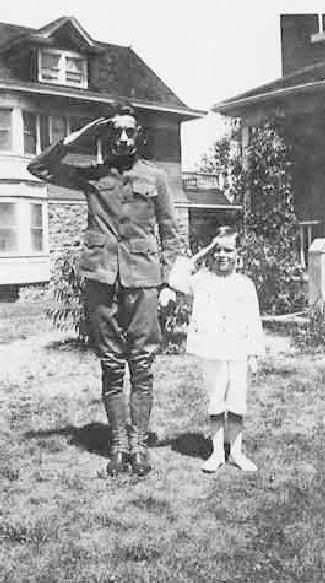
Many others were caught up in the War. Millions were in fact killed, both soldiers and civilians. Many more had the course of their lives irevocably altered by the War. We want to have a look at some of the ordinary families in the different combatant countries. Here we will just provide hot links to pages that have images of families right before or during the War to show just who was involved in the War. The casualty figures are mind numbing and in fact so immense that they are difficuklt to comprehend. Looking at images of real people probably provide a better idea as to who was caught up in the War. In most cases we know little or nothing about the actual family.
We are unsure at this time as to the age of the soldiers involved in World war I. We are not sure at what age boys could join the military or at what age boys were conscripted. We do not at the time have this information. One aspect we notice is that at the turn of the 20 century such as in the Bohr War (1899-1902), the Briish were still accepting quite young boys in the army to serve as musicians. This no longer appears to be the case by World War I. Many countries (Austria, Germany, France, and Russia) entered the War with conscription laws in place. Countries competing with these countries had to introduce conscription. Other countries (Australia, Britan, Canada, and the United States) had to intoduce conscription after entering the War.
Children vwere affected in many ways by World War I. There was enormous enthuisasm for the War at the onset. Manu hilren tried to enlist. Recruiters in most counties had an age limit of about 18 years, but often turnd a blind eye, especually if the boy looked alder than his real age. And we know from the photographic record that some boys were accepted even if they clearly looked below the recruitment age. We are not entirely sure how these under-age boys were used in the various armies are just how common they were. Using boys was less common than in 19th century armies, but
we still see quite a number of boys involved. The impact on children varied somewhat in East and West. On the Western Front, the fighting was laregly confined in a relative narrow strip thrpough Belgium and northern France scarred by formidable trenches. Thus the primary impact on children was the loss of fathers in the fighting. The children were noit exactly orphaned, but as the fathers for the most part were the bread winners, families and the children in them were devestated and commonly spun into poverty. Belgium was an exception. Here because of German occupation policies, the civilian population, especially the childern faced starvation. Only American relief supplies prevented mass starvation. In the East the fighting was different without one permanent clearly defined front. As a result, there was not only oprphaned to deal with, but many displaced children. And as the War was primarily fought on the territory of the Tsarist Empire with few resources, the institutional capability was very limited. No children probably suffered more than Serbian children when the entire country was occupied by the Central Powers which held Serbian reponsible for causing he War. And unlike Belgium, there American reflief supplies did not reach the country. Families and children were often on their own. Countries before and after the War adopted a range of policies to aid the child victims of the War. This varied from country to country depending on the policies of the differentbcountries and their capacity to deal ith the problem. Children in Russia were particularly affected because of the Revolution and Civil War destroyed any capability to aid children especially when famine resulted in mass starvation. Again american food relief saved millions, but was delayed 2 years by the Bolheviks.
World War I caused mass slaughter on a basis never before exoerienced in Europe. The number of father killed in every country is difficult to fathom. The loss of life in all the major combatent countries was astromical, although smaller in America which entered the War in 1917 and did not commit troops in large numbers until 1918. The number
of orphans was extremely high in Belgium and other areas where fighging took palace. ted. A friend tells me that early Life Magazine articles had some images of European children showing period clothes. I think in 1917-18 they ran a series of articles on French children who had lost their fathers in the War. The magazine I think was asking for donations to help these families. The series contained lots of pictures of these, sadly mostly young, fatherless children. If anyone has access to a good University library, these Life Magazine images should be available. There apparently was a variety of boys clothes pictured. Another problem was that while many children were not orphaned, rhere were millions without fathers. As the father in the 1910s was the principal, if not thde only, income eraner, this maent that millions of children were reduced to poverty or very close to it.
The birth rates of the different combatant countries varied. This to a large degree depended on the degree of industrialization. Agricultural countries tend to have highter birth ratres than industrial countries. This is because children are an advatage to farming families. They provide extra hands to the multitude of tasks that have to be done fon a farm and the food is availble to feed them. The situation is different in the cities with worker families. Here the children are more of a cpst and less useful and the food is less available. One advantage that Germany has was a fairly high birth rate because while areas of Germany vwere industrialized, large areas were still rural or urban families that has only recently moved to the city. Thus each year of the War thre was a faorrly large 18-year old chhort to conscript.
Fighting between Austria and Serboa began first (August 1914). This soon spiraled into a general European war when Germany invaded Belgium (August 1914). World War was the largest war fought in Europe up to that time. The major combatants soon found themselves with large numbers of prioners of war (POWS). The Germans took many French, Belgian, and Russian POWS. The British and French began taking Gernan prisoners as the BEF expanded into a major force. The Russians on the Eastern Front took fewer German prisoners, but quite a number of Austria-Hungargary prisoners. Turkey (1914), Bulgaria (1915), Italy (1915), and Romania (1916)subsequently entered the War. The Central Powers overan Serbia and Romania taking many POWS and releasing the POWS held by both countries. Russia quit the War and returned large numbers of POWS. America entered the War late and thus few Americans were captured, but took a number of Germans POWs. Generally these prisoners were treated correctly by the major combatants. The widespread attrocities commited in World War II did not occur in World War I. The behavior of Germany, Japan, and Russia, in sharp contrast to World War II, was generally correct. There were, however, some exceptions. The Austrians were very harsh with the Serbians, although we have few details. The Ottomans seem to have been the worst offenders. The Aran irregulars usually did not tale prisoners. The International Committee of the Red Cross (ICRS) initiated a major effort to address the POW problem and opened an office in Geneva for thos purpose (October 1914). Conbatant countries reported almost 5 million POWs to the ICRC. The ICC visited many of the prisoners and set up a system for families to send letters and relief parcels.

Navigate the CIH World War I Section:
[Return to Main World War I page]
[Return to Main military style page]
[About Us]
[Aftermath]
[Alliances]
[Animals]
[Armistace]
[Causes]
[Campaigns]
[Casualties]
[Children]
[Countries]
[Declaration of war]
[Deciding factors]
-------[Diplomacy]
[Economics]
-------[Geo-political crisis]
[Home front]
[Intelligence]
[Military forces]
[Neutrality]
[Pacifism]
[People]
[Peace treaties]
[Propaganda]
[POWs]
[Russian Revolution]
[Signals and intelligence]
[Terrorism]
[Trench warfare]
------[Technology]
------[Weaponry]
[Bibliographies]
[Contributions]
[FAQs]
[Images]
[Links]
[Registration]
[Tools]
[Return to Main World War I page]
[Return to Main war essay page]
[Return to CIH Home page]