|
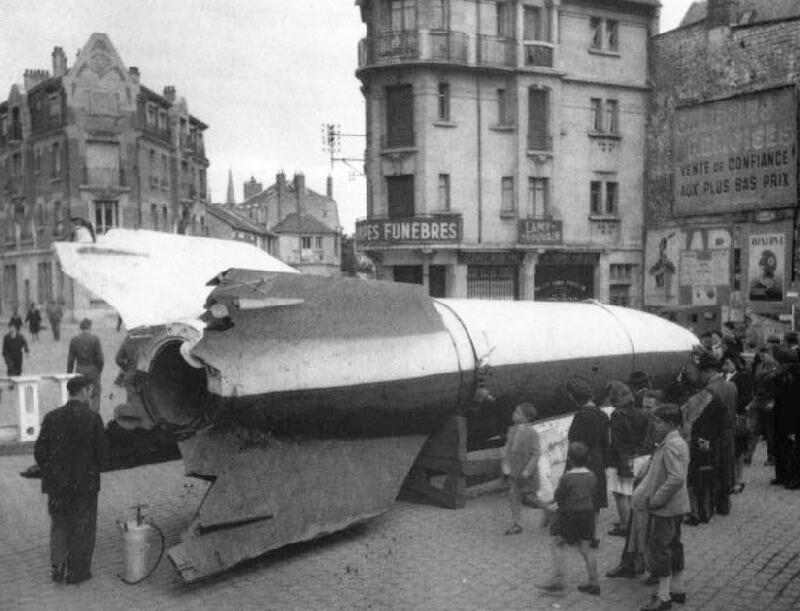
The NAZI V weapons are sometimes referred to as rockets. Rockets were effectively used in the World War II, but the German V-weapons were not rockets. The V-1 was a unmanned jet bomb or primitive cruise missle. The V-2 was a much more complex weapon system, a balistic missle. The NAZIs in 1944 launched these revolutionary weapons in an old fashioned terror campain against Britain. The V stood for Vergeltungswaffe--vegence. The vegence was retaliation for the Aliied strategic bombing campaign. The Germans were the firt to build and deploy these weapons. These wee extremely innovative weapons system and are today key components of modern militaries. The V-1 or buzz-bomb was a realitively simple weapon, a flying bomb using a ram jet engine. The V-2 balistic missle was very different. It was a technological achievement of the first order. Intelligence played a key role in the Allied response to these weapons. [Keegan] Both weapons are generally dismissed as of little importance and introduced too late to have any real impact on the War. This is not entirely accurate. This was true of the V-2. It was so costly and time-consuming to build that it was not an effective weapon with rhe conventinal war heads the Germans used. The V-1 was, however, a different matter. It was a simple system that could be easily mass-produced in large numbers. Amassive attack on the English Channel ports could have delayed or seriously hampered the D-Day landings.
The NAZIs launched World War II with devestating Luftwaffe attacks on Poland, including Polish cities (1939). Soon the same Luftwaffe bombers were atemptiung to pound London into submission (1940). Hitler and Göring authoirized these and other attacks with the naive belief that other countries wuld not be sanle to bomb Germany to any degree. Luftwaffe chief Göring pesonsally gusaranted it. The British steadily expnded their bomber force and after America entered the War (1941), the Allies began to build a vast air armada which by the beginning of 1944 had achieved air superority over Germany. One German city safter another was shatterd by Allied bombers. Hitler essentially disappeared from view, rarely even speaking by radio to the German people. Propaganda Minister Josef Goebbels did continue to speak publically. And he threatened vengence, never quite explaining why the NAZIs should not expect other countries to strike back. He assured the German people that Germany had secret weapons that would destroy the Allies. He spoke in general terms, never detailing just what Germsany had. And after D-Day, the Germans launched two of these revolutionary weapons in an old fashioned terror campain, rimarily against Britain. The V stood for Vergeltungswaffe--vegence. The vegence was retaliation for the Aliied strategic bombing campaign. These were not military weapons, but rather terror weapons that could primarily threaten civiliams. The Luftwaffe was powerless to stop the waves of Allied bombers striking German cities or retaliate by bombing British cities.
Peenemünde was a German island like sand spit in the Baltic. The Wehrmacht located the Heeresversuchsanstalt Peenemünde, HVP (Peenemünde Army Research Center) there (1937). It was one of five military proving grounds operated by the (Heereswaffenamt (German Army Weapons Office). Its location allowed the Germns to use the Baltic io test fire its weapons. The Wehrmacht purchased the entire northern peninsula of the Baltic island of Usedom. The Army facility had been separated from the Luftwaffe facility and was nearly complete, with personnel moved from Kummersdorf (1938). Peenemünde Ost (the Army Research Center) was divided between Werk Ost and Werk Süd, while Werk West (Peenemünde West) was Erprobungsstelle der Luftwaffe
(Luftwaffe Test Site). This was one of the four Luftwaffe test and research facilities, with its headquarters facility at Erprobungsstelle Rechlin.
The Germans were the firt to build and deploy these weapons. These wee extremely innovative weapons system and are today key components of modern militaries. The V-1 or buzz-bomb was a realitively simple weapon, a flying bomb using a ram jet engine. The V-2 balistic missle was very different. It was a technological achievement of the first order.
The NAZI V weapons are sometimes referred to as rockets. Rockets were effectively used in the World War II, but the German V-weapons were not rockets. The V-1 was a unmanned jet bomb or primitive cruise missle. The V-2 was a much more complex weapon system, a balistic missle. They were both innovative eapons developed after years of expensive experimentation and using critical materials. The V-2 in particular was a technological marvel. However impressive the research and enginering involved, with only a conventional war head they were not military weapons. This is because they could not be aimed with any precission. They did inspire public fear as intended, but inaccuracy made them militarily ineffective. Also, the ever-increasing Allied strength in Europe following the June 1944 D-Day invasion ance made the V-weapon mission practically hopeless from the beginning. Germany could not perfect the weapon fast enough or produce enough of them to avoid defeat. They could hit cities, but not any specific targets in cities. And even city trgeting was not very precise as the Germans had no way of knowing just where these weapons hit. Hitler had learned nothing from the Battle of Britain. Using valuable military assetts to destoy homes was not going to win the War.
Labor proved to be a huge problem when late in tyhe War Hitler decided to build the V-weaponns and made it a priority. Early in the War, after stunning military victories, Hitler turned down the dark path of genocide. He deluded himself with the idea that the war had been essentially won and that he could now do whatever he wanted. Here the Western Offensive and fall of France was a turning point. Many peoole have the cdeluded idea that bombing was the main killer in Workd war II. It was not. It was in fact a minor killer. The majir killer was Axis, especially German, actions targetting civilians. In percentage ternms, the major focus was on killing Jews. But in raw numbers, Slavic people were the major targets. Ober 27 million Soviet citizens perished. A small part of that was the over 1 million Jews killed by the NAZIs in the SivietUnioin alone. As the War turned against Germany, Hitler was forced to call up more and more highly skilled workers in arms factories. They were replaced by unskilled slave labor. The labor pool had been depleted by all the people the NAZIs had murdred like Jews and Soviet POWs. The Germbns worjers called up to serve in the eastern meat grinder were replace with unsklilled slave labor motivated only by raw terror. You read a lot about how these people sabatoged the arms they were forced to manufacture. There are reports of V-2s failing. We are not sure if this really was a factor. But horrifyiong working conditions and starvation must not have masde for the most productive labor force. The situation as worsened by the NAZI response to the Allied bombing--they wnt underground. This made for even more dreasdful working conditions. And the dark, putrid underground tunnels were soon festined with inmates hanged to motivate the workers. One author writes, "Large proportiions of highly prod=ficuient Gerrman personnel has been replaced by late 1944 with foreign manoower composed of, among others, large numbers of Jewish hiouse wicves and teenage school girls [younger girls had been murdered as part of the camp selection process] picked up in placs like Auschwitz. The massive use of slave labour beame in within months a central cgharactristic of this branch [meaning the Luftwaffe]. 【Uziel, p. 144.】
Intelligence played a key role in the Allied response to these weapons. [Keegan] The first report the British received was the Paul RosbaudOslo Report (Movember 1939). The Oslo Report information on what would be called the V-weapons was difficult to interpret and discounted by most of the British analysts.
The most fruitful British spy in NAZI Germany was Paul Rosbaud. He was throughout the War the best-placed British spy with access to both sciuentific and military information. Rosbaud, code name was �The Griffin�. His firstvreport was on the V-1 buzz bomb and V-2 rocket programs. He also provided early news of German consideration of an atomic weapon. And it was his reporting that evetually quited British fears of a NAZI atomic bomb. He reported that the German atomic program had made little real progress. [Kramish] Rosbaud is also notable for helping Jewish scientist Lise Mietner escape from the NAZIs when other colleagues had largely abandoned her. Rosbaud was considered so critical that the British did not share his reporting with the Americans until just before D-Day.
Most of the evacuees by late-1943 had returned home. There were only 350,000 people still officially billeted outside London and the big cities. The German V-1 campaign came as a shock to the British people. They had gone through the Blitz and thought that the Germans no longer had the capability to bomb Britain. Actually the Germans had planned a much more massive assault, but was substantially undercut by Allied bombing operations. All of this was done in secret, both the German plans and the Allied disruption efforts. There was no effort made to prepare the British people. The V-1 campaign It occurred amidst the euphoria of the successful D-Day landings. The Germans began launching the V-1 flying buzz bombs a week after D-Day (June 13). They had no choice because they could only reach Britain if fired from the French Channel coast and now the Allies were in the process of liberating France. The V-1 was a relatively simple weapon and could be produced inexpensively in large numbers, but it could not be aimed at sprcifuc targets other than large cities. The effort had been delayed and reduced by the Allied counter measures, but finally began. London was the main, but not the only target. Hitler had a fixation on the British capital. Not only had the stubbon resistance of Londoners derailed his war plans, but the British RF was now helping the British to smash German cities to rubble. He hd tried to destroy it once and now hd another opportunity. The result was the third and final British World war II evacuations. The V-1 attacks resulted in a third and final exodus from London. Some 1.5 million people had left (by September). Only 20 percent of these, however, were 'official' evacuees. Most of the evacuees sought to live with family and friends in the countryside and small towns. Tthe evacuation process was officially halted (September) when the Allies were in full command of yhe Channel Coast. The evacuation was reversed for almost all areas except for London and the vulnerable East coast. The Germans were, however, not done with London. This was just when the V-2 attacks began. The V-2s had much greater range than the V-1s. They could devestate an ebtire city block, but were much more complicated to produce and this were not available in the numbers that had been planned for the V-1s. Unlike the V-1s they could not be shot down. The British Government did not officially approve people returnong to London until a month after the German surrender (June 1945). The billeting progrm was finally ended (March 1946).
Despite Hitler's expections, the V weapons proved useless as military weapons. A military weapon has to have the capability to be precisely aimed at a target of ome importance. And as marvelous a technical achievement the V-wepons were, they simply could not be precisly aimed. They coulkd hit a specific city if it w large enough, but not a target in thst city or a battlefield target of importance. The result was that more people (slave laborers) lost their lives in making the V weapons than Allied victims, almost all of which were civilians. The one battlefield impact of the German V-weapons was that they pushed Eisenhowe to approve Market Garden, in part because it would deny the Germans the last ares that the V-weapons copuld be used to hit Britain. .
Both weapons are generally dismissed as of little importance and introduced too late to have any real impact on the War. This is not entirely accurate. This was true of the V-2. It was so costly and time-consuming to build that it was not an effective weapon with rhe conventinal war heads the Germans used. The V-1 was, however, a different matter. It was a simple system that could be easily mass-produced in large numbers. Amassive attack on the English Channel ports could have delayed or seriously hampered the D-Day landings. As mentioned above, the V-2 wa a major reson Eisenhower approved Market Garden. This may have not been the best Allied strategy and Montgomery may have not been the best of the commanders. Military historans still debate this. The Allied options, however, were limited. There were not supplies available for a broad front advance. A more definitive impact is the huge resources that were lavished on the V-weapns. This diverted resources from other projects. Virtually any other ise of ghose resources, such as building more jet aircraft would have returned greater mikitary dividends.
Werner von Braun and other German rocket scientists after the War were brought to the United States through Operation Paper Clip. Both the Western Allies and the Soviet Union scoured Germany after the War for German scientists. The rocket scientists were some of the most sought after. They played a promonent role in the American space program and the Cold War Space Race. The German scientists were put to work in Huntsville, Alabama and other places for the development of the national space program in order to beat the Soviets during the Cold War. Without them the United State missle program would have lagged behind the Soviet program with very serious potential reperussions in the Cold war. Also the United States would not have been able to have put a man on the moon as early as it did. The Russians tried to do that also, but did not succeed. It always has been an embarrassing subject to have used the knowledge and expertise of German sientists. The connection of these scientists with the NAZIs is a matter of conjecture among historians. Some charge that they were committed NAZIs. Others that they were primarily focused on rocketry and space and only the German military offered the funding needed to persue their work. The V-2s in particular were built by slave laborers working in horrific conditions in underground facilities. A reader writes, "I think it shameful that the inventors (rocket scientists von Braun and his team) immediately after the war in 1945 were brought to the United States to be enployed in further development and research of the American space program."
Keegan, John. Intelligence in War: Knowledge of the Enemy from Napoleon to al-Qaeda (Knopf, 2004), 387p.
Kramish, Arnold. The Griffin: Paul Rosbaud and the Nazi Atomic Bomb That Never Was (Houghton Mifflin Company: Boston, Massachusettes, 1986).
Uzuel, Daniel. Armig the Luftwaffe: The German Aviation Industry in World War II

Navigate the CIH World War II Section:
[Return to Main German secret weapon page]
[Return to Gweman weapons industry page]
[Return to Main World War II European air campaign page]
[Biographies]
[Campaigns]
[Children]
[Countries]
[Deciding factors]
[Diplomacy]
[Geo-political crisis]
[Economics]
[Home front]
[Intelligence]
[POWs]
[Resistance]
[Race]
[Refugees]
[Technology]
[Bibliographies]
[Contributions]
[FAQs]
[Images]
[Links]
[Registration]
[Tools]
[Return to Main World War II page]
[Return to Main war essay page]