|
When large formations of Allied four-engine bombers finally flew over Europe, it marked the beginning of the end for the Third Reich. Their relentless hammering of Germany - totaling more than 1.4 million missions - took out oil refineries, industries, and transportation infrastructures vital to the Reich's war effort.
-- Robert S. Elhers. Targetingb the Reich, 2009
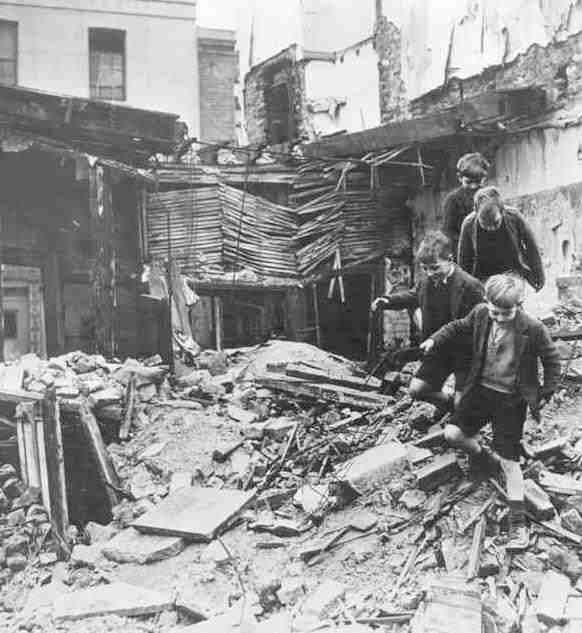
It was the Germans who began bombing civilian populations rather than military targets as a terror tactic calculated to destroy civilian morale. Visionary German military planners in the 1930s built the world's most advanced air force at the time--the Luftwaffe. Germany was the first World War II combatant to use bombers to terrorize urban populations. This began even before World War II during the Spanish Civil War. The British Government even before war was declared on Germany in September 1939 sought to safeguard the civilain population, especially children, from aerial bombardment. The German initiated their long awaited western campaign in May 1940. Paris fell June 14 and France capitulated June 22. The Luftwaffe quickly established bases in France and by July 10 launched preliminary strikes in what has come to be called the Battle of Britain. The Luftwaffe while better trained and outnumbering the RAF was ill prepared for the campaign and the result was the first significant German defeat of the war. The initial British bombing raids in 1939 dropped leaflets. The British were reluctant to actually bomb German cities, in part fearing reprisal raids from the Luftwaffe. The German air assualt on Britain changed this. The whole thrust of the War was changed with Operation Barbarossa--the NAZI assault on the Soviet Union. the Luftwaffe was a key aspect of the invasion, but it had been weakened in the Battle of Britain. Adolf Hitler on December 11, 1941, declared war on the United States. This conviently solved FDR's dilema of how to enter the war against the NAZIs when America had been attacked by the Japanese. The entry of America into the War changed all calculations of strategic ballance. The output of American industry made possible the construction of amassive air armada to assault Hitler's Germany. Once America joined the War in December 1941, a massive bombing campaign against Germany from England became feasible. America's indistrial potential gave the Allies to mount a strategic bombing campaign orders of magnitude above the Luftwaffe's capability. Much less known than the British World War II evacuation of children from urban areas is the German evacuation program evacuating children. The Allied air campaign against Germany in the months leading up to the Normandy invasion has to be cut back. Targets in France associated with the landings were given the highest priority. Contrary to popular conceptions, the German economy was not effectively harnessed for war. Only when Albert Speer was appointed Armaments Minister in 1942 did German industry begin to take needed steps to maximize production and reach some of its potential. [Speer] The Germans, as a result, despite the bombing were able to expand war production. Hitler by late 1944 no longer spoke to the German people in sharp contrast to earlier years when he ws a constant presence on German radio. Goebbels raged about vengenance and secrt weapons. There were indeed secret weapons. The most criticised Allied air raid occurred at Dresden near the end if the War. The Allies conducted incendiary raids on Dreden February 13-14, creating a firestorm killing thousands of civilian. After Dresden, Prime Minister Churchill ordered Air Marsahll Harris to end to area bombing. Churchill explained: "It seems to me that the moment has come when the question of bombing of German cities simply for the sake of increasing the terror, should be reviewed. Otherwise we shall come into control of an utterly ruined land." Any assessment of the Allied bombing campaign has to ask the question of how much more the Germans could have expanded production had it not been for the bombing. The bombing significantly clearly disrupted the economy and the ability of the NAZIs to persue their development of new weapons.
H.G. wells was one of the first authors to begin writing about war in the air. He described how air forces would "tower with pitilessly watchful eyes over his adversary". British civilians were the first to feel the impact of aerial bombardment with the World War I German Zephlin raids. Advances in aviation after the War left the public and officials concerned about future bombing of cities. The axion was "the bomber wil always get through". Hitler played on this fear as he built the new German Luftwaffe in the 1930s.
Hitler first used his Luftwaffe to aid Franco in the Spanish Civil War. The Luftwaffe and the huge advantage it held over Britain and France was the reason that Hitler could cow the Allies. After Munich, American leaders pledged that they would never allow another Munich to occur. Ambassador Bullitt distilled the lesson of Munich to President
Roosevelt, "If you have enought airplanes you don't have to go to Berchtgaden." [Freidel Rendezuous, p. 303.] President Roosevelt was determined that America would never be in that position. The European air campaign despite the early prominance of the Luftwaffe would be dominated by the U.S. Army Air Corps. This was possible because of the steps toward rearmament sponsored by the Roosevelt Administration as well as orders from the Allies following Munich. This was to be the beginning of a massive expansion of the American aircraft industry which woyld evenbtually devestate Germany.
The Germans during World War I created an air arm during World War I (1914-18). The airplane was first used in any significant way in World War I. It played a useful, but marginal ole. The Allies were able to outproduce the Germans, but both side made important technological strides. The German air ace the Red Baron (von Rictoff) was the most famous pilot of the War. When he was killed, Herman Goering took over command of the the Flying Circus. The German air forces were dissolved after the War, as required by the Treaty of Versailles. Even so the German military continued to develop technology through secret arrangements with the foreign countries. German companies built planes in other countries, especially the Netherlands. Glider clubs throughout Germany provided training for future pilots. The operations were expanded when the NAZIs seized control (1933). Soviets and Japanese. Adolt Hiter ordered Göring to formally establish thevLuftwaffe (February 26, 1935). The Versailles Treatu was still in force.
The Luftwaffe played an important role in all of the early German campaigns. The German concept of war was Blitzkrieg. This involved concentrating conat power at critical points of the battlefield. The Luftwaffe was a key element in Blitzkrieg because it provided powerful support to fast moving ground forces in a way that artillery could not. It was also used to disrupt enemy movement toward the critical points. This permitted the rapid breaching of enemy linrs and breakout out to cut off and destroy enemy strong points. At the onset of the inasion of Poland, the Luftwaffe conducted massive air raids on Polish cities (September 1939). Wieluń became the first city destroyed by bombing in World War II. The initial directives issued to the Luftwaffe pilots were to destroy the Polish air force to prevent it from supporting Polish ground forces or attacking targets in the Reich. [Speidel, p. 18.] The Poles had only a mall air force, but had dispersed much of it. The Luftwaffe was highly sucessful in dusrupting Polish mobilization and troop movements. The Luftwaffe also played an important role in the campaigns against Denmark and Norway, the Luftwaffwe role in Norway was decisive. Again the Luftwaffe played key roles in the Western offensive against the Netherlands, Belgium, and France. The offensive as in all German campaigns was led off by raids intended to criple the oposing air force. Here they were largely sucessful, giving the Germans command of the air during the critical fighting which led to Dunkirk and the fall of France. The Dutch airforce was largely destoyed on the first day and the Nelgian airforce crippled. The French and British were unprepared for the force of the attack. The French unliked the Germans had not massed their air force to counter the German attack. A factor here may have been to make a knockout blow impossible, but it meant that a substantial portion of the French air force was out of the battle as the issue was being decided. The British held back much of the RAF to protect Britain itself. The primary use of Luftwaffe in these campaigns was tatical and within the rules of War, but from the very beginning in Poland, the Luftwaffe engaged in bombing cities, including terror attacks which were clear violations of the established standards of warfare.
It was the Germans who began bombing civilian populations rather than military targets as a terror tactic calculated to destroy civilian morale. Visionary German military planners in the 1930s built the world's most advanced air force at the time--the Luftwaffe. [Corum] Germany was the first World War II combatant to use bombers to terrorize urban populations. This began even before World War II during the Spanish Civil War. The Luftwaffe experimented with the bombing of Guernica in 1937 and other Spanish cities. The tactic was used extensively used by the Germans when the War was launched beginning with the invasion of Poland. One historian writes, "The bombing of Warsaw early in the war made it clear to the Allies how Hitler intended to fight his war. It was to be Schrecklichkeit ('frightfulness') with no regard for the civilian population." [Snyder]
The British Government even before war was declared on Germany in September 1939 sought to safeguard the civilain population, especially children, from aerial bombardment. The Government on August 31, 1939 ordered the evacuations to begin. Within a few weeks, 3 million Britains, mostly children had been evacuated from the cities. It was the most extensive movement of people in British history. Caos insued as the children were tagged liked parcels and shipped out of the cities. The abrupt separtaion of many very young children from their parents was a traumatic experience. The British concern was especially deep because of the Luftwaffe atracks on civilian populations. Even before the Blitz, the British watched in horror as the Luftwaffe in September launched terror attacks on Warsaw and other Polish citids. The vast majority of the children evacuated were sent to the English countryside, usually to live with individual families who volunteered to care for them.
The German initiated their long awaited western campaign in May 1940. Paris fell June 14
and France capitulated June 22. The Luftwaffe quickly established bases in France and by
July 10 launched preliminary strikes in what has come to be called the Battle of Britain. The Luftwaffe while better trained and outnumbering the RAF was ill prepared for the campaign. They did not appreciate the critical importance of the British home chain radar network. They also had no straegic bomber fleet. The air offensive was to be conducted with two engine bombers that proved highly effective in short range tactical operations, but were not well suited for kinger-range strategic bombing. The Battle of Brirain began in ernest on August 13 with Luftwaffe raids on British airfields and aircraft factories. Hitler had assumed that the Luftwaffe could force the British to capitualte. This isresumably why he stopped the panzers before Dunkirk. Unlike his strategy against the Poles, Dutch, and Belgians, there were no German terror bombing of London and other British cities. The Luftwaffe im its August campaign seriously weakened the RAF and Fighter Command was having increasing difficulty maintaining its forward air bases in Kent. Then off-course German bombers accidentally bomb London on August 23-24. RAF Bomber Command on August 25-26 mounted a small reprisal raid against Berlin. Hitler is furious and orders an immediate change in Luftwaffe tactics. Rather than completing its offensive against the RAF infrastructure, Hitler ordered a "blitz" on British cities which began in earnest on September 7. The Luftwaffe wreaked havoc on civilians in London and major English cities. An estimated 42,000 civilians were killed. Thousands of civilians were killed. Edward R. Murrow broadcasting from London ("London calling ...") described Britain's valiant resistance to rapt American radio audiences, greatly affecting American attitides toward the Hitler and the NAZIs. White British cities burned, the RAF was given a respite, allowing its forward air bases to recover from the damage done in August. As a result the RAF was able to mount increasingly costly attacks on the German bomber fleets. The Lutwaffe eventually is forced to shift to nightime raids. Night bombing made it impossible to hit actually military and industrail targets, only cities could be targetted. The Luftwaffe eventually ended the major offensive against the British as the German military in 1941 began preparing for Opperation Barbarosa, Hitler's long awaited dream of invading the Soviet Union which at the time was a virtual German ally.
The initial British bombing raids in 1939 dropped leaflets. The British were reluctant to actually bomb German cities, in part fearing reprisal raids from the Luftwaffe. I have little information on the French at this time. There was not significant bombing campign, except for Luftwaffe operations in Poland (September-October 1940), until the Battle of Britain. After the fall of France (June 1940), German cities were no longer as vulnerable to FAF attacks. Bomber Command had only small numbers of heavy bombers and they were slow, poorly defended, and had a limited load capacity. Throughout the Battle of Britain, small numbers of British bombers hit German targets in night time raids. The rids were wholly ineffectual in a military sence. Hitting a military target at night with 1940s technology, especially 1940 technology was very difficult. Sometimes the raiders did not even hit the intended city. Some of the raids were also very costly in air crews and planes. The raids did have an in important psychological impact. British raids on Berlin so enraged Hitler that he ordered a change in Luftwaffe tactics in the Battle of Britain, which may have well resulted in a favorable turn in the battle in favor of the British
The Battle of the Beams began with the Battle of Britain. German bombers at first flying during datlight hours could navigate by sight. London was easpecially easy to find because of the Thames. When RAF fighter opposition proved too costly, the Germans began bombing at night. And for night operations, electronic systems were neeed for guidance. Fortunately for the Luftwffe, Lufthansa had been working on directional systems before the War began. The Luftwaffe used a number of increasingly accurate systems of radio navigation for night bombing. The two sides proved relatively evenly matched. British scientists mobilized by the Air Ministry developed developed electronic counter measures, including jamming and distortion of the German radio beacons Meacon was an early sucess. One author writes, "The British Meacon [masking beacon] not only prevented Luftwaffe air crews from getting good bearings on their beacons back in france but actually presented an eroneous bearing in its place .... Time and again the Meacon stations were able to seduce German bombers away from heir intended flight paths leaving them hopelessly disoriented." [Sauders] The first phase of the Battle of the Beams ended when the Luftwaffe began shifting East in preparation for Barbarossa. The last major Luftwaffe raid was staged to coincide with Congresssional passage of the Lend Lease Act (May 1941). The Battle of the Beams did not end here. The British and then the Americans had the same problem in reverse as they set out to bomb the Germans.
Malta was the cornerstone of the British campaign in the Western Desert. British possession of Malta and the invaluable naval and air bases there played a major role in interdicting Italian and Germany supply convoys to Libya. And it was supply shortages that played a key role in defeating Rommel and the Afrika Korps. Malta became the most bombed place on earth. German and Italian air forced relentlessly pounded the island. The island somehow managed to with tand the fiercest air assault of the War. The Italians began bombing Malta in 1940. The Luftwaffe joined in the campaign (January 1941) even before Rommel arrived in North Africa. Malta by March 1942 was enduring an average of 10 air raid alerts daily and there had been 117 straight days of bombing. The bombing was devestating. It also prevented supplies, food, and fuel from reaching the island. At one point Malta was near to capitulation, left virtual no fuel, food, or fighters. It was a convoy with an American carrier that finally succeeded in getting needed supplies through. Civilians suffered teribly. They had to move underground. Newsreels in Britain and America showed school children moving rapidly into undergrond bunkers when the air raids sireens sounded. The population was near starvation at one point. The Axis did not, however, launch a parachute assault on the island. They had the capability as shown in Crete. Senior Axis commanders advised just sych an action. After the German terrible losses suffed by the German parachute units on Crete, however, Hitler demured, After the War, historians have taken to summrizing the assul on Cretr as "the wrong island".
No one was more surprised with the fall of France than Stalin. He had hoped that his Non-Agression Pact (August 1939) with Hitler would safegard him from German attack while Hitler fought it out with the British and French. Instead the fall of France left him facing Hitler alone. Stalin ignored warnings that the Germans were preoaring an invasion. Hitler thus launched Operation Barbarosa June 22, 1941 surprising unprepared Sovier forces. The invasion had been delayed by a hasity executed invasion of Yugosalvia. The Wehrmacht performed brilliantly in the opening phase of the campaign. Probably only Hitler's medling prevented them from taking Moscow. The Luftwaffe's performance was, however, below expectations. They destroyed large numbers of obsolete Soviet planes and supported tie Wehremacht's advance, but the vast distances involved made the Liftwaffe less effective than it had been in the West. Particularly troubelsome was the lack of long range strategic bombers that could strike at Soviet industry beyond the Urals with large bomb loads. The Japanese attacked Pearl Harbor December 7, 1941. Hitler had tried to convince them to attack the Soviet Union. (The Axis never succedded in coordinating strategy as the Allies did.) The Japanese attack in many ways ended any hope of Germany victory on the Eastern Front, if not the War as a whole. Informed by inteligence operatives that Japan had decided to strike America (rather than move north against Siberia), Stalin rushed crack Siberian reserves to Moscow enabling Marshall Zukov to launch a winter counter offensive against the Germans Decembr 6. Now Germany, which had only a few short months earlier had appeared invinceable, faced the combined forces of undefeated Britain and the Soviet Union as well as a now resolute United States with its huge industrial capacity.
Adolf Hitler on December 11, 1941, declared war on the United States. This conviently solved FDR's dilema of how to enter the war against the NAZIs when America had been attacked by the Japanese. Curiously, America was the only country on which Hitler ever declared war. The entry of America into the War changed all calculations of strategic ballance. The Soviets alone in 1941 were already out producuing the Germans in many areas such as tanks. The entry of America was to mean that German war production would be only a fraction of Allied production and that difference was already being felt on the battlefield. The story of American industry in the War is phenomenal. FDR in 1941 was already supplying Britain and the Soviets through Lend Lease. The declaration of war enabled FDR to harnass the vast American economy to war production. This was something that the Germans had still not done as late as 1942. Within the first year alone, America built 24,000 tanks and 48,000 planes. An impressive start, but just the beginning. American industry in 1942 equaled the armaments production of all three AXIS countries combined. And this was occurring at a time when the Societs alone, not to mention the British, were already out producuing the Germans. America in 1944 doubled its arms production again. [Fest, p. 656.] These were numbers the Germans could not hope to match. In no theater did these overwealming numbers show up more than the air campaign. At a time that the Luftwaffe could not fulfill its required role along the vast Eastern Front, a tidal wave of long range American bombers (B-19 Flying Fortresses and B-24 Liberators) flowed into England, each had the range to hit every German city including Berlin. The American planes began arriving in England early in 1942. England became, in effect, a huge unsinkable air craft carrier in the North Sea. Combined with the RAF's new Avro-Lancasters, the Allies were building a massive air armada aimed at German industry.
Most historical accounts of the air war available in the West seal with the Luftwaffe campaigns in the West and the subsequent Allied strtegic bombing campaign. The air war on the Eastern Front is much less studied. This is somewhat surprising as Germany and the Soviet Union when the War began had the two mist powerful air forces. The Luftwaffe essentially destroyed the Red Air Force during the first few days of Barbarossa. As a result the Red Air Force was not a factor during Barbarossa. The Red Army during the Barbarossa had to fight with virtually no air cover. This graduaally changed and by 1943 the Red Air Force was again an important factor in the War. Several factors were involved here. The Soviets did have a substantial aeronautics industry and the Soviet war plants that had been moved east by 1943 had reached full production. America through Lend Lease was delivering planes to the Soviets. The Allied strategic bombing campaign forced not only forced the Luftwaffe to withdraw assetts from the Eastern Front to defend German cities. In addition the bombing disrupted German production as well as casused substantial lossess in German fighters. Many accounts of the air war do not give sufficent attention to the impact on the Luftwaffe of engaging the Allied bombers even before long-range fighter cover became available.
With the NAZIs in command of the Continent, the only way that Britain could stike at Germany was by air. Germamn air defenses meant that the RAF could only bomb at night and restricted British strategy to areavbombing. This significantly inhibited the effectiveness of British operations. The entry of America into the War meant that the air offensive could be significantly expanded. Both Curchill and Roosevely were committed to strategic bombing. The hope was that strategic bombing would force the NAIs to capitulate. The Allies at Casablanca demanded unconditional suurendetr (January 1943). The American buildup of air forces in Bitain continued throughout 1942 and by the beginning of 1943 the 8th Air Force was ready to join the British in an around-the-clock bombing campaign against Germany. American and British planners agreed on four priority targets: 1) U-boat building facilities, 2) aircraft production plants, 3) ballbearing plants, and 4) oil refineries. Although not at the time, the Allied strategic boming campaign has become the most controversial aspect of World war II.
Much less known than the British World War II evacuation of children from urban areas is the German evacuation program evacuating children. The program was called the Kinder Land Verschickung (KLV) which operated during World War II (1939-45). The children had to go to rural areas on "holiday" but really they should be out of the cities and towns that had difficulties feeding them and were being bombed by the Allies. Both schools and the Hitler Jugend (HJ) were involved in organizing thd KLV. The HJ was especially important in the KLV organiation beginning in 1940. About 2.5 million children were send to 9,000 camps until end of World War II. In many cases the children were accomapnied by their teachers.
The British had been bloodied by the Germans. Their initial British reluctance to use their bombers had dissappeared in the Blitz. Churchill made it clear, "We ask no favours of the enemy. No, we will meet out to the Germans the measure and more of the measure that they are meeting out to us. We remember Warsaw in the first few days of the War. .... You do your worst and we will do our best." The man given the job of organising the strategic
bombing campaign by RAF Bomber Commasnd became known as 'Bomber Harris' After the War,
Bomber Harris was never given recognition for the job he was given and while other commanders recieved Knighthoods Harris never did. It is only recently that a statue to him was erected in Parliament Square. It is the target, as is Winstan Churchill's statue, of leftwing grafitee writers when there is a protest rally.
Both the Axis and Allied powers believed that terror bombing campaigns would undermine civilian moral and destroy their will to fight. During the War, terror bombing had mixed results. I proved effective in Poland (Warsaw), the Netherlands (Rotterdam), and Yugoslavia (Belgrade). In other countries such as England (London and Coventry) and Germany (Hamburg), it was not effective in undermiing morale. In Britain ' London Can Take It' unified the civilian population and made them more determined than ever. This would seem to be the situation in Germany where the Allies not only returned tit for tat but bombed German cities to rubble. The differenc appears to be whether the civilian populationpreceives that it is possible to resist. In the instances where tetrror bombing did force the country to surrender, it was accompanied with a land invasion which convinced civilians that resistance was futile.
The Luftwaffe in the opening weeks of the Battle of Britain pursued a precision bombing campaign targetting the RAF. The Luftwaffe was a tactical force, suite for such an operation. It might well have worked had Hitler not ordered a terror bombing campaign targetting London and other British cities--a strategic task for which the Luftwaffe was not well suited. This tactic was rejected by RAF bombing command because of the strength of German air denses. Bomber Command thus from the earliest phase of the war began night operations. Americam air commanders despite the failure of the Luftwaffe and the Britiish expereincewere weded to the principle of strategic bombing using precission methods. This became ingrained in the American preparations. The Army Air Corps claimed that they could drop a bomb in a pickle barrel with their new Nordon Bombsite. Considerable accuracy was possible in the clear and uncontested skies of the Arizona dessert. Conditions proved very different once the Ameriucans arrived in Britain. Over northern Europe with the German defenses and the often cloudy weather, results were very different. The Eight Air Force decided on daylight operations so the bombers could hit specific targets with preission, something not possible at night. The American commanders were sure that the heavily armed bombers could fight their way through without escorts. The British were skeptical, but hoped that around the clock bombing could achieve constant stress on the Luftwaffe. Such efforts began breaking down in face of German air defenes. [Budiansky]
The influx of American soldiers, sailors, and airmen flooding into Britain has been well reported. Britain enteed the wt with a peace-time airforce and a peace-time pilot training program. Less well known is the RAF sent large numbers of trainee pilots to America and Canada for training so that British air fields could be fully devoted to the air campaign against Germany. The pilots could be trained in the more secure and open air space available in North America. And in America and Canada, the fuel needed for training was readily available. Training was one of the weaknesses of the RAF in the opening phase of the War. The RAF was never short of planes in the Battle of Britain, but it was critically short of experienced pilots. As a result, young men were sent up with only the most minimal trainingagainsr experiened Luftwaffe pilots. This was finally being rectified.
Once America was thrust into the War (December 1941), history's first massive strategic bombing campaign became feasible. America's indistrial potential gave the Allies the resources to mount a strategic bombing campaign on orders of magnitude the Luftwaffe and Hitler could only have dreamed about. The air campaign became a major aspect of Allied strategy. While American began building in facilities (1942), the British debated how to begin the strategic bombing campaign. Some wanted to target key German industrial sites, especially German synthetic fuel plants. Had they done so at this time might have changed the course of the War. Hiting precission targets, however, over heavily defended, often cloud-covered German cities was no easy matter with 1942 bombing technology. [Speer, p. 287.] In addition the British had been bloodied by the Blitz and the much easier to execute strategy of area bombing was appealing. The strategy of area or terror bombing of civilians won out. RAF planner Charles Portal was the leading abvocate of area bombing. Air Marshall Arthur "Bomber" Harris, the head of RAF Bomber Command, introduced area bombing as the RAF's principal strategy in the bombing campaign. Harris phrased it susinctly, "The Germans sewed the wind, now they will reap the whirllwind." The RAF began its area bombing strategy on March 28, 1942 with a massive night time raid on Lübeck, virtually destroying the historic city. Hitler transferred two bomber groups of about 100 planes each from Sicily which conducted Baedaker targeting historic treasures of British cities. The ballance of forces, however, had turned decidedly against the Germans. The RAF responded on May 30 with its first 1,000 bomber raid on Cologne. The results were devestating. One of the wirst hit cities was Hamburg. Thre were firestorms which destetated the central cities. The firestorms sucked tres, vehichles, sections of buildings, and people into the conflagerations. Those not killed by the bombs and flames were suffocated by the smoke and lack of oxygen. The American 8th Air Force with even larger number of bombers than the British began initial opearions against the Germans in 1943. The Americans opened their full-scale daylight bombing campaign on January 27, 1943 with an attack on Wilhelmshaven. Througout 1943, German cities were exposed to "round the clock bombing" inflict serious civilian casulties. The Americans bombing by day, attempting to hit specific targets using their Nordon bomb sites. The British bombed by night and at best could hit specific cities. Large numbers of German civilians were killed, injured, or rendered homeless. The RAF on May 16-17 began targeting German industry in the Ruhr. The American and British air crews suffered very heavy casulties against German fighters and increasingly effective anti-aircraft guns. At times it was unclear if the bombing campaign could be sustained. Long range fighters were not available in 1942-43 to escort the bombers to their targets in Germany. The actual impact of the campaign was disappointing. German civilian morale did not crack under the British area bombing and the Americans found it much more difficult to hit specifuic industrial targetys than anticipated. Even so, the air campaign forced the Luftwaffe to deploy major assetts defending German cities rather than on the critically important Eastern Front. Especially important large numbers of Luftwaffe fighters and even more important trained pilots were being shot down by the bombers. In addition large numbers of artillery pieces, which could have been used against Russian tanks, had to be diverted to anti-aircraft defenses. These defenses were manned largely by the Hitler Youth.
The Germans shifted the Luftwaff east during early-1941 in pepration for Barbarossa. This was the end of the Blitz. At the same time, RAF Bomber Command equipped with inadequate aircraft and suffering serious losses, also reduced bombing raids. This changed in 1942. Air Marshl Arthur Harris was appointed to head bomber command (February 1942). This was the same time that Lancasters began reaching Bomber Command. There was an immediate expansion of bombing Germany. Harris understood that Grmany's costal cities were vulnerable targets ansas they were in the ciast, much easier to find than iland targets. Lubeck was destroyed (March 1942). Rostock followed (April 1942). Until these raids, RAF bombing had been both ineffective to the Germans ans costly to Brirish air crews. Now whole cities were being dstroyed by the British. Hitler was inncensed. Harris was absolitely correct when he stated, "The Nazis entered this war under the rather childish delusion that they were going to bomb everybody else, and nobody was going to bomb them. At Rotterdam, London, Warsaw, and half a hundred other places, they put that rather naive theory into operation. They sowed the wind, and now, they are going to reap the whirlwind." The Luftwaffe was strached to the limit with operation in the Soviet Union and North Africa. Hitler ordered, however, that the Luftwaffe must strike baxk against the Germans. The result was the Baedeker Raids, a series of Luftwaff air attacks on Briitish cities. The targets of the raids were chosen for their cultural or historical significance, rather than for any industrial value. The name Baedeker came from the title of popular travel guide books. The same term appeared in both Britain Germany and Britain. This was because German diplomat Baron Gustav Braun von Stumm, a spokesman for the German Foreign Ministry after learing about Rostock, made astatement, "We shall go out and bomb every building in Britain marked with three stars in the Baedeker Guide" (April 24, 1942). This was not, however, what Goebbels in th Propaganda Ministry wanted to hear. With Germany losing its capability of terror bombing, he had been pursuing the line that Germany sttod for Europen culture and that the British were fighting a dirty war, killing woomen and children and destruying cultural trsures. Stumm's remarks indicated that Hermany was doing just that,The Baedeker Raids involved a relatively small bomber force began (April 1942). The Germans hit Bath, Canterbury, Exeter, Norwhich, and York (April-May 1942). Smaller raids followed , continued into 1943. The cities were hit, but given the limited forces abAilable to the Luftwaffe, had not appreciable impact on the War. Hitler, Göring, and Goebbes could not appreciate at the time how feeble the effort was in comparison to what the Allies were narsaalling against Germany. Not only were the British building aassive force of Lancasters, but American 8th Air Force was beginning to build up its forces in Britain. Shortly after the main Baeddeker raids, Bomber Command staged the first Thouand Bomber command of the War -- devestataging Cologne.
The surrender of Italy and Allied occupation of southern Italy raised new possibilities for Allied air commanders. Targets in the southern part of the Reich were in range of Italian air felds. NAZI Balkan allies were also in range. Here the priority target was the Ploesti oil fields. Both American and Air commanders thought it appropriate to bring home to the NAZI allies the cost of their alliance. The British had bombed Sofia eatlier (1941) and panicking civilians fled the city. Raids begam on Sofia (November 14). A firce of 91 B-25s targeted railroad marshaling yards and airfields, but nearby civilan areas were also hit. Civilians poured out of the city. After some smaller raids, a major attackj was launched (Jnuary 10). The Americans sent143 B-17s ad the British 44 Welingtons. The British droppd incendearies (March 16). An British attack on Vranya burned the royal palace March 24). American B-17s hit Vrattsa. The Americans and British attacked Sofia with hundreds of heavy bombers igniting a fire storm (March 29-30). A major American attack targetted Sofia marshaling yardsand other rail centers, but bombs fell all over the city (April 4). Targets in Hungary and Romania were also hit, but required longr raids. Here Plesti was the mjor target, but both Budapest and Bucharesy were also hit. Air commanders debated the affect of the raids on Balkans cities. The Joint Staff Planners of the American Joint Chiefs of Staff concluded that additional raids on Bulgaria would not force the country to capitulate. This could only be done by the Red Army advance (March 1944). The Joint Chiefs adopted the proposal to direct Balkan air raids on military and indstrial targets (July 1944). There were, however, further raids on Balkans targets. The 15th Air Force struck Budapest just as the Red army approached (November 27). [Shaeffer, pp. 54-59.]
Hitler launched War with acountry that had serious weaknesses, both limited access to raw material and a limited industrial plant. Even so he was determined to launch and win a new world war. to reverse the disgrace of World War I in which he fought. His strategic concept was to defeat his enemies in detail, before hey could form an unbeatable allianace and prepare for war. He nearly suceeded, but the Englih Channel stopped the Panzers anf the Channel and the British RAF prevented the Luftwaffe from forcing the British out of the War. Thus from an early point of the War, technology began to ail the Germans. Frustrated in the West, Hitler turned east. Again he nearly succeeded, but the campaign he mastermined proved a disaster. The Red Army counter-offensive before Moscow (1941), Stalingrad (1942), and Kursk (1943) began to bleed the Whermacht dry. With America in theWr, the Whermact was badly out numbered on all fronts. Hitler's only hope was technology and German scientists and technicians had been hard at work on a wide range of new wepons. Some like the V-2 were technological marvels, but of no real military use. One weapon was of potentially great military potential--jet aircraft. Hitler had delayed the jet proram, but no jets and the other wonder weapons were his only real hope. A few months after Kursk, his failed hope of regaining the ininitiative in the East, Hitler was shown many of the most promisng new weapons (November 26, 1943). By then he was enthusiastic about jet aircraft. And indeed, jets held the potential to regain air superiority. But wht Hitler wnted was vengence. He wanted planes that could drop bombs as he Allies were doing. As a result while being shown the wonder weapns, he engaged Willy Messeschmitt in conversation. [Door] Any one with even the most minimal understanding of the air war understood that jet power could be used to build fighters that could bring down the bomber fleet pounding the Reich as well as esorts. And the ME-262 was almost ready to go into full production. Hitler discussed how the new plane could be used with Messeschmitt. And Messerschmtt like all successful men in NAZI Germany knew, the way to influence and reward was to give Hitler what he wanted. And Hitler wanted a bomber. Messerschmidt asuured Hitler that the ME-262 could be modified to carry a bomb. Hitler created the system that caused Messerschmidt to humor him and thus paradoxially end any hope of prolonging the War. For the rest of the War, Hitler continued to demand that this potent figher which could have dramtically be used to change the course of the Air War was used orimarily as a bomber thus negating a major technical advance. And within weeks, the American P-51 Mustangs began appearing in the skies over Germany to protect the bomber strems.
The Luftwaffe cdominated the skies over Europe during the early years of the war. The superority of German planes and the Luftwaffe's tactical doctrine was a key factor in the stunning German victories. This changed in 1943 and by 1944 German civilians as well as the Wehrmacy were paying a terrible price. Supperficial assessments of the Allied strategic bombing campaigns often point to the fact that German production of armaments increased in 1943 and in many areas even in 1944. Of course this is not a valid assessment as the historian has to assess what the Germans could have produced without the bombing. Contrary to popular opinion, the German war economy was not efficently run in the early years of the War and Speerv in fact achieved substantial results when he was put in charge of war production. Another critical impact of the strategic bombing campaign was the impact on the Luftwaffe. Although the Allies paid a heavy loss in air crews, large nimbers of Luftwaffe planes and the irreplaceable pilots were destroyed in the skies over Germany. In addition the Luftwaffe had to pull back to defend German cities. The arrival of high performance Allied fighters in large numbers was one factor in achieving air suoperority over the battlefields, but another key factor was that the Luftwaffe had to be withdrawn back to Germany. This meant that much of the German air strength was not available to support the Wehrmacht on the Eastern Front. It also meant that the Allied air forces had a free hand to attack the vaunted Atlantic Wall. When the invasion finally came, the Luftwaffe could offer only token resistance. The Allies achieved the air superiority in 1944 that the Luftwaffe attempted to achieve and failed over Britain in 1940. And it was this air superority that made the D-Day Normandy landings possible.
After the fall of France (June 1940), Britain found itself on the frontline of the air war. The Battle of Britain turned into the Blitz as the RAF made it too costly for the Luftwaffe to bomb at night. The Germans pinded British cities at night for several months. The Germans then turned east as Hitler launched Barbarossa (June 1941). While there were occassional subsequent raids such as the Baedecker Raids (1942), for the most part the British had respited as the air war shifted to the skies over the Reich. With the arrival of the Americans (1942) the balance pf power in the air shifted strongly to the Allies. Not only did the skies over Brrtain become dominated by Allied air power, but gradually France as well. As a result, when the Allies began planning the cross-channel invasion, they had detailed photo reconnaissance data on the Germans, but the Germns had very little information on the Allies. Allied air dominance was so overealming that even high speed fighter reconnaissance became difficult. The Germans never disovered that the First Army Group (FUSAG) was a huge deception--perhaps the greatest deception in the history of warfare. The Luftwaffe largely discontinued bombing, but there were a few small raids (1942-43). Not only were British air defenses formidable, but the Allies targeted Luftwaffe bases in France making it immpossible to assemble bomber groups beyond the Kamhubber Line. Small raids were possible, but no sustantial bombing. Essentially the British peopol had a 2-year respite from the bombing. The British publlic assumed that after D-Day, there would be no more German bomving, Bombing Britain was still high on Hitler's priorties. The Germans had, however, to turned to unmanned weapons to strike Britain. Thanks to the Allied strategic Bombing Campaign, the V-1 and V-2 campaigns were delayed until after D-Day.
Contrary to popular conceptions, the German economy was not effectively harnessed for war. Civilian consumption was not as drastically curtailed as was the case in Britain, although this changed, especially when the War began to go badly for Germany. Women were not mobilized for factory work. This was because of NAZI ideology asell as the fact that large numbers of German women were already employed in agriculture. They were, however, ineffecetively used because of the country's essentially peasant agricultural system. As more and more German male woekers were drafted for the front, the Germans bought in more foreign workers. Industrial prodiction was not totally directed at the War effort. Only when Albert Speer was appointed Armaments Minister in 1942 did German industry begin to take needed steps to maximize production and reach some of its potential. [Speer] The Germans, as a result, despite the bombing were able to expand war production. Some have used this to charge that the Allied bombing campaign was ineffective and a misallocation of resources.
The Allied air campaign against Germany in the months leading up to the Normandy invasion has to be cut back. Targets in France associated with the landings were given the highest priority. The strategic bombing camapign had, however, forced the Luftwaffe to esentially pull back to Germany. As a result, there was virtually no Luftwaffe operations to oppose the Allied landings on June 6. After D-Day and the subsequent operations to support the beach head (June 1944) and breakout (July 1944), the strategic bombing campaign could be resumed in full force against Germany with an ever expanding air armada. The bombers when operations were resumed had fighter escorts, long range P-51 Mustangs which significantly reduced the losses of planes and air crews.
The Luftwaffe began the War in Poland as a highly effective, short range tactical air force. They had worked out the all imprtant matter of air ground communications. The British at the time did not even have an advanced all-metal fighter, let alone a tactical doctrine. The RAF saw sreategic bombing as the most effective use of air power. The same was true of the French and they played a terrible price with a humiliating defeat (May-June 1940). The U.S. Army Air Corps (USAC), despite being a part of the Army was even more committed to strategic bombing. The USAC was dominate bt the Bomber Boys (Armold, Eaker, and Spaatz). The result was that the United States entered the war with what would become the world's largest air force and several advanced fighters, but no tactical (ground support) doctrine or intention of developing one. In fact, the USAC commanders not only were committed to winning the War through strategic bombing, but were opposed to disapating the bombing campaign by devoting resources to tactical operations. The Bomber Boys fervently believed that the best support the USAC could provide to American ground forces was to destroy German war industries producing military equipment. Fortunately for U.S. ground forces, the United States had the industrial capacity to produce both bombers and fighters. Thus when the United States arrived in North Africa as part of Operation Torch (November 1942), it had the aircraft needed for tactical operations, but incredably no tactical doctrine or pilots trained in tactical operations. The USAC was using the fighters for roles like escort and patrol duties. It did nor escape he Torch Commander, Gen. Eisenhower, and other American ground commanders that the Americans mauled at Kaserine (February 1943), had no air cover despite an overwealming American superiority in air assetts. Slowly commanders like Gen. Joe Cannon in Italy began to develop a tactical doctrine (1943). But Italy was a backwater and the war would be won or lost in France during 1944. It would be in France and Belgium that American tactical docrtine would be first deployed and come of age to play a decisive role in the War. USAC Gen. Ira Eaker based on Gen. Pete Quesada's work with fighters in North Africa, Sicily and Italy, brought him to England to command the new 9th Air Forces's Fighter Command (IX TAC). Gen. Eisenhower demanded tactical support for the Normandy landings. The 9th Air Force's Fighter Command would be responsible for tactical operations over the American Normandy beaches. This was done over the protests of the British and American Bomber Boys who wanted to continue strateguc operations seep into the Reich. Thus Quesada in only 4 months had to not only find and build facilities, train the air groups that had begun to arrive from America in strength, but also to develop an American tactical air doctrine from the ground up. [Hughes] We know of no American commander in any service except perhaps for Adm. Nimitz who accomplished more in four short months than Quesada. The Bombers Boys had two decades to develop strategic air doctrine, but Quesada and the talented staff he cobbeled together had only 4 months to create tactical air doctrine and train skeptical, inexperienced pilots. It would be IX TAC that after D-Day would would be at the center of the most dazzling display of air power in history. The American GIs tht stormed through NAZI-occupied Europe has mostly inferior wepons than the Germans, but had airborn tactical support that more than compensated.
After D-Day (June 1944), the Allied strategic bombing campaign was significantly intensified. This time the campaign was much different. The bombers now had fighters now had P-38 fighters accompany them from French bases which moved closer to the German border as the Allies took Paris (August 1944). Even longer range P-51 Mustangs, arguably the best propeller fighter of the War were deployed in increasing numbers. The result was a renwed and even more intense Allied air campaign with dramatic decline in Allied air crew losses. And as the fighters engaged Luftwaffe fighters rgere was a dramatic and unsustanable loss of German pilots. The Allies established air surperiority over Germany and bombed German cities at will. Rge Allied bombing killed an estimated 0.6 million German civilians and destroyed or seriously damaged some 6 million homes. Göering is reported to have said that he realized that te War was lost when he first saw the American P-51s over Berlin. Berlin and other major cities by 1945 were wastelands. This time German war production was affected, not only because of the damage to industrial cities, but because the Allies targeted Germany's production of fuel. The Romanian Ploesti oil field were targetted as well as synthetic fuel plants in Germany. About one-third of Germany industry depended on these plants. Most of the Luftwaffe's fuel came from them. [Hillgruber, p. 420ff.] By the end of the War many German units were reduced to using horse drawn carts. The Luftwaffe which still had planes could often not mauntain an effective training program because of fuel shortages and in many cases could even muster the fuel to fly the rapidly dwindling number of remaining planes.
Operation Bodenplatte (Ground Plate) was the last desperate operation of the Luftwaffe (January 1, 1945). It was not carried out by famed Luftwaffe commander Generalleutnant Adolf Galland. Hitler and Reichmarschall Göring removed him. He was replaced by a bomber commander, Dietrich Peltz, who was not outspoken like Galland. This was part of a wider undertaking at the time to replace competent, but outspoken Luftwaffe commanders with die-hard NAZIs. Preparations were even made to arrest Galland. Peltz planned a major air strike on 16 Allied front-line airfields in the Netherlnds, Belgium, and northern France. The objective was to cripple Allied tactical air strength. Peltz planned an operation used by the Germans in the early phase of the War. Strike at dawn and destroyed an unprepared eneny on the ground. He chose the morning of January 1 to maximize the surprise, knowing that the Allies would have been celebrating the night before. The Allies were surprised. Commanders did not believe that the Luftwaffe was any longer capable of a massive assault. In fact, Peltz ammassed 34 Gruppen and 900 fighters (FW-190s and Me-109s) under II. Jagdkorps (Fighter Corps). While the attacking Germans did surprise the Allies, that was the only achievement of Bodenplatte. The operation went bad from the very beginning. Peltz was not commanding the superbly trained Luftwaffe of 1939-40. The operation was carried out principlally by young, poorly trained pilots. As they did not have night-flying skills, Pelyz had to wait until dawn to launch the strike. And the German flak batteries opened up on them. At this stage of the War the only large formations were Allied planes. Large numbers of the attackers were shot down by friendly fire. 10 Gruppen failed to find their targets. 9 Gruppen failed to reach their targets in strength. 2 Gruppen found their targets to find they were no longer operational. 11 Gruppen did attack their assigned targets in frce, but found the bases were already operational with anti-aircraft defenses partially manned and more importantly Allied fightrs already airborn. The Germand lost 300 of their 900 plane force. Some downed pilots managed to make it back to German lines, but 214 were lost, including many irreplaceable formation commnders. The Allies were embarassed and thus losses were not well documented. The Germans appear to have destroyed about 300 planes, but very few pilots. The Allies could replace the losses. The air bases attacked were back up to full strength in a week. [Caldwell and Muller, pp. 262-263.] The Germans could not make up the losses. Peltz was not disciplined for his failure. Reichmarschall Göring was more concerned with growing insubordination than less than competent loyal NAZIs.
RAF Bomber Comman's leader Aur Marshall Harris had a fixation on Berlin. Bomber Command had begun hitting Berlin in force (1944). Losses were high and the resultsc inconclusive. With the scucces of D-Day and the breakout in France, the Allied air commanders began to rethink the resumption of the Strategic Bombing Campaign. Bomber Command drew plans for a massive joint American and British campaign air campaign to destroy the center of Berlin--Thunderclap (August 1944). The plan followed the RAF approach of area bombing to destroy civilian morale. American air commanders Spaatz and Doolittle both objected. The Americans still held to the presmise that only facilities of military importance should be targeted and not whole cities. Given World War II technology, this was more of a theory than an chievable military tactic. Without American participation, the British tabled Thunderclap. [Taylor, p. 207.] The 8th Air Force developed plans to go after two priority targets: 1) synthetic fuel plants and 2) the German trannsportation network. The Germans did not have petroleum resources. Their primsry source was the Romanian ploesti oil fields. Allied bombing and then the advance of the Red Army into Romania cut off Romanian oil. Thus the sunthetic oil plants were targeteed. They wre mostly located in sparsely populated aeeas. Attacking the transportation system was a different matter. The German transportation system was based on the rail system. Tracking down individual trains was a difficult undertaking. The best strategy was to hit the railroal marshelling yards, but they were located near cities, often in the city centrs. This meant that given the inaccuracy of bombing, that the Americans like the British would be attacking Germnan cities. There had been hopes of ending the War before Christmas. The failure of Market Garden ended any hope of an early end to the War (October 1944). Then came the German Bulge offensive and massive American casualties (December 1944). The Soviet Red Army also was stalled in Poland. Allied Air commanders began to consider how to use their massive air forces to end the War. Operation Thunderclap was brought out for reconsideration. By this time, the casualties from the Bulge and the disappointment that the war was not ended by the end of 1944, weakened American resistance to area bombing. Spaatz is finally convinced to use British-style area bombing. Eisenhower is uncompotrable with this. Doolittle opposes it, but Spaatz orders a sacaled-down plan. The Allies will bomb Berlin and eastern transportation hubs (Chemnitz, Dresden, and Leipzig) to support a Red Army offensive in the East. The goal to choke off units resisting the Red Armny drive west. Stalin had requested this at Yalta. The raids which ensued were large ones, but not as massive as initually envisioned. Doolittle gives the raiders targets in Berlin. The American bombers hit Berlin (February 3). The center of the city was devestated. About 3,000 people are killed and 120,000 left homeless. The most criticised Allied air raid occurred at Dresden near the end if the War. The Allies conducted incendiary raids on Dreden (February 13-14). The raid created a firestorm killing thousands of civilians. After Dresden, Prime Minister Churchill ordered Air Marsahll Harris to end to area bombing. Churchill explained: "It seems to me that the moment has come when the question of bombing of German cities simply for the sake of increasing the terror, should be reviewed. Otherwise we shall come into control of an utterly ruined land."
he Allied Air War was primarily conducted by Britain and the United States. About half of the industrial production of bothSWestrern Allies was devoted to the air war, primarily to the Strategic Bombing Campaign (SBC). It involved a relatively small commitment of manpower, but an enormous commitment of industrial resources. The Soviet Union began with the War with the largest air force in the world. The Luftwaffe destroyed during the first week of Barbarossa (June 1941). It was gradually built up again and was fully operational again (1943). It was from the beginning like the Luftwaffe a tactical grand support air force. The Soviet contribution to the SBC was minimal. One interesting topic is the extent of liaison with Soviets. We know that as the War in the West intensified that and Allied bombers came in range of the Ostkrieg that the Soviets began making requests of the Allies ton hit priority targets. In fact the genesis of the Dresden Raid was a request from the Soviets to block the movement of German units reinforcing the Eastern Front. The request came at the highest level at the Yalta Conference. According to a British historian, the Deputy of the Chief of Staff of the Soviet forces, General Antonov, requested British and American bombing support to "prevent the enemy from transferring his troops to the East from the Western front, Norway and Italy." He wanted air raids to disrupt German transport and communications. This request for Anglo-American air support was presented at their session (February 4). Antonov informed Big Three (Churchill, Roosevelt, and Stalin) that the Germans were transferring to the Eastern Front 8 divisions from the interior of Germany, 8 from Italy, 3 from Norway and a further 12 from the Western Front and that 6 were already moved. 【Gilbert】 Of course, Antonov would not have made that startling request without clearing it with Stalin first. And it was as much a indictment of the western Allies as request as he was essentially saying that the Western Allies were not pressing the Germans hard enough so that the Germans could move forces from the West to throw at the Red Army in the East. This was a huge exaggeration, but some divisions were being moved, but Stalin then asked what Churchill and Roosevelt’s wishes were 'in regard to the Red Army'. Churchill and Roosevelt immediately set in motion to hammer the remaining Germans transportation hubs. And the largest unbombed such hub was Dresden -- leading to one of the many tragedies of the War (February 13). And his request did not stop Stalin and Soviet propaganda from attacking the raid and its tragic consequences after the War as a war crime. We do not know at this time the extent of such requests and just how they were communicated to the Allies. We know about reciprocal agreements between the Western Allied nations (America, Brit sin, and France) and the Soviet Union agreed to shortly after the end of the World War II (1946). These missions were active from 1946-90. But we do not yet have infimation during the War which leads us to speculate that such requests were made through a cumbersome diplomatic process.
Hitler by late-1944 no longer spoke to the German people in sharp contrast to earlier years when he ws a constant presence on German radio. His deteriorating physical condition, relentlessly depressing reports from the fronts, and the destructon of German cities by Allied bombing were all factors. Hitler's mouth piece Josef Goebbels became his spokesman. Goebbels raged about vengenance and secret weapons. There were indeed secret weapons. The world's first combat jet, the ME-262, was introduced in 1944. It was an inovative extremely effective fighter and if properly used could have severely impaired the Allied air campaign. Hitler's interference, however, prevented it from being effectively used. The V-1 begining June 13 were used to target London and other British cities after the D-Day landings (June 1944). The V-1 could be shot down, but there was no defense against the V-2 balistic missles which soon followed. There were many other projects under development or on the drawing boards. Some like the ME-163B Komet were futuristic concepts. Especially significant, however, was a new generation of jet fighters which would have been ready in 1946. Only the Allied bombing camapign prevented some from actually being built.
NAZI Propagana Minister Goebbels was not bluffing when he threatened the use of devestating secret weapons. The NAZIs in fact had devestating secret wepons. But Hitler decided not to use them. One of the unanswered questions about World War II is why poison gas was not used. Gas had been widely used on the Western Front in World War I. It had first been developed by a German Jewish scientist working for the Whermacht. The Germans forst used it at Ypres with devestating effect (1915). The British and French followed suit. I don't thaink the Americans and Russians used it, but I think the Austrians did. After the War, the Italians under Musolini used it in their African campaigns in Libyia and Ethiopia. Military planners in England assumed that the NAZIs would use it when war broke out. Every British citzen, incliding children were issued gas masks. There wee even masks for babies. They were aklso issued in France, Italy, and Germany. Major combattant countries (Britain, France, Germany, Italy, and the Soviet Union) had large stocks of poison gas in their arsenals. (I don't think America did, but am not sure about this.) The question arrises as to why it was not employed in the War, especially in the air war. Other questions exist concerning biological and nuclear weapons. Germany also had enriched uranium which could have been used for a dirty bomb.
There is no doubt that air power played a major role in World War II. It was, however, a role short of what some proponents of air power predicted. Air power alone did not win the War or forced NAZI Germany to surrender. Necertheless, air power was critiocal to the outcome of the War. The Luftwaffe played key roles in the Luftwaffe's success in Poland (1939) and then in the German Western Offensive (1940). The Luftwaffe scored decisive victories with Operation Barbarossa (1941). The flat planes of the Russian Steppe would seem to have offered the ideal environment for the application of air power. Despite achieving virtually total air superiority, the Luftwaffe did not have an adequate force to be a critical factor on the Eastern Front given the scope of the conflict. The Allies gradually brought both powerful tactical and strategic air components to bear against Germany in the west. The industrial power of the United States combined with Britain's substantial aviation ikndustry was able to create a force capable of making Allied air power a decisive facytor in the West.
The final chapter in the European air war was the race by the victorious Allies to acquire the advanced aviation technology of the Luftwaffe as well as the rocket tevhnology of the SS program. One of the high priority targets was the ME-262 which had Hitler not intergfered might hsave enabled the Luftwaffe tob regain air superiority. There were many other targets such as guided missles the Luftwaffe had been developed. There was considerable competition among the Americans, British, and Soviets to acquire the planes as well as research documentation and scientists. The items collected played a major role in the Cold war arsenrels of both thevUnited States and the Soviet Union.
【Sammuel】
There is a vast body of literature on World War II, both fiction and non fiction. The Battle of Britain, the Blitz, the British evacuation of children, the V weapon attacks, and the Allied air campaign over northern Europe have been covered in thousands of books. There have also been large numbers of movies and television programs, again both documentaries and fiction accounts. These accounts address both the bravery of the aeviators and the suffering and endurance of the British people. Some of the accounts about children and books by adults looking back at their childhood are touching. HBC has drawn from much of this extensive literature and media presentations. Surprisingly given the fact that the Germans suffered more than any people in the War from the aerial campaign there has been an almost defening silence from German writers. We note very few writers or film makers who have addressed the subject.
Budiansky, Stephen. The Men, Machines, and Ideas that Revolutionized War, from Kitty Hawk to Gulf War II (Viking: 2004), 518p.
Caldwell, Donald and Richard Muller. The Luftwaffe over Germany: Defense of theReich (Greehill Books: London, 2007), 336p.
Corum, James S. Luftwaffe: Creating the Operational Air War, 1918-1940" (University Press of Kansas, 2000).
Door, Robert F. Fighting Hitler's Jets: The Extrodinary Storyof the Americn AirmenWo Beat the Luftwaffe and Defeated Nazi Grmany (2014), 304p.
Elhers, Robert S. Targeting the Reich (2009),432p..
Fest, Joachim C. Hitler (Vintage Books: New York, 1974), 844p.
Freidel, Frank. Franklin D. Roosevelt: Rendezuous with Destiny (Little Brown: Boston, 1990), 710p.
Gilbert, Martin. "Request to bomb Dresden February 1945, Yalta," (February 1, 2023).
Hillgruber, Andreas. Strategie-Hitlers Strategie: Politik und Kriegführung 1940 bis 1941 (Frankfurk am Main, 1965).
Hughes, Thomas Alexander. Over Lord: General Pete Quesada and the Triumph of Tactical Air Power in World war II(The Free Press: New York, 1995), 380p.
Lindkvist, Syen. A History of Bombing (1999). HBC has not yet been able to consult this important work.
Sammuel, Wolfgang W.E. American Raiders: The race to Capture the Luftwaffe's Secretds (University Press of Mississippi, 2004).
Sauders, Andy. Arrival of Eagles: Luftwaffe Landings un England, 1939-45 (2014).
Schaffer, Ronals. Wings of Judgement: American Bombing in World War II (New York: Oxford University Press, 1985), 272p.
Sebald, W.G. Trans by Anthea Bell. On the Natural History of Destruction (Random House), 202p.
Snyder, Louis L. Historical Guide to World War II (1982).
Speidel, Wilhelm (1956). The Luftwaffe in the Polish Campaign of 1939 (Montgomery, Alabama: Air Force Historical Research Agency, 1956).
Speer, Albert. Inside the Third Reich (New York, 1970).
Taylor, Frederick. Dresden: Tuesday 13 February 1945 (Bloomsbury: London, 2005).

Navigate the CIH World War II Section:
[Return to Main World War II air campaign geographic orientation page]
[Return to Main World War II air campaign war essay page]
[Biographies]
[Campaigns]
[Children]
[Countries]
[Deciding factors]
[Diplomacy]
[Geo-political crisis]
[Economics]
[Home front]
[Intelligence]
[POWs]
[Resistance]
[Race]
[Refugees]
[Technology]
[Bibliographies]
[Contributions]
[FAQs]
[Images]
[Links]
[Registration]
[Tools]
[Return to Main World War II page]
[Return to Main war essay page]