|
The Germans during World War I created a highly effective air arm (1914-18). The airplane was first used in any significant way in World War I. It played a useful, but marginal role. The Allies were able to outproduce the Germans, but both side made important technological strides. The German air ace the Red Baron (von Rictoff) was the most famous pilot of the War. When he was killed, Herman Göring took over command of the the Flying Circus. The German air forces were dissolved after the War, as required by the Treaty of Versailles. Even so the German military continued to develop technology through secret arrangements with foreign countries. German companies built planes in other countries, especially the Netherlands. Glider clubs throughout Germany provided training for future pilots. The operations were expanded when the NAZIs seized control (1933). Soviets and Japanese. Adolt Hiter ordered Göring to formally establish the Luftwaffe (February 26, 1935). The Versailles Treatu was still in force. Great priority was given to building advanced all-metal planes. By the time the Allies attempted to face up to Hitler at Munich (October 1938), Germany had the largest, most modern air force in the world. It was a major reason why the Allies decided to appease Hitler. When World War II finally broke out in Poland (September 1939), the Luftwaffe played a major in the early German victories. , on the eve of the outbreak of World War II, the Luftwaffe had become the most advanced, powerful air force in the world. As such it played a major role in Germany's early successes in the war, and formed a key part of the Blitzkrieg concept, much thanks to the use of the innovative Junkers Ju 87 dive bomber (Sturzkampfflugzeug - "Stuka"). A contingent from the Luftwaffe (The Legion Condor) was sent to support Franco's forces in the Spanish Civil War with planes (notably the Ju 87) and personnel which not provided critical support for Franco, but provided important battle experience for the Luftwaffe that the French Air Force and British Royal Air Force did not have. The Luftwaffe would prove an essential component to Blitkrieg. German artillery, in many cases move by horses, could not keep up with the Panzers. The Luftwaffe could. By the end of the War, the Luftwaffe was decimated. The fundamental weakness was the inability of German industry to create a force large enough to support the many campaigns to which Hitler committed German armed forces.
The Germans during World War I created a highly effective air arm (1914-18). The airplane was first used in any significant way as ailitary weapon in World War I. It played a useful, but marginal role. Its primary funxtion was reconisance, but close air support and strategic bombing was developing. The Germans were able to secure air superiority for some time--The Focker Curse. The British flew reconisance flights any way so important were the photgraphs. The death toll was enormous. In the end, however, the Germans could not match theAllies' industrial capacity. The Allies were able to out produce the Germans, but both side made important technological strides. The German air ace the Red Baron (Manfred von Richthofen) was the most famous pilot of the War. When he was killed, Herman Göring took over command of the the Flying Circus.
The German air forces were dissolved after the War, as required by the Treaty of Versailles.
The Versailles Peace Treaty ending World War I was signed on June 28, 1919, about 7 months after the Armistace stopping the fighting on November 11, 1918. It had a huge impact on the international status of Germany, impacting the country territorially, militarily, and econimically. Germany was made a pariah country and largely blamed for the start of the War. Of major significance, the Germany being punished was the Germany of the Weimar Republic and not Imperial Germany as the Kaiser had abdigated. As a result, the domestic German oposition to the changes, including the territorial changes, came to be directed at the Weimar Republic and not the Imperial Government and German military that had conducted the War. The NAZIs and other right-wing groups were to saddle demoncratic politicans with the "shame of Versailles". Germany under the terms of the Treaty suffered many consequences. The navy and merchant marine was lost. The battleships had to be turned over the the Allies. The battleships ships in fact steamped into the British naval base at Scappa Flow. The German captains, however, rather than turning
them over to the British, scuttled them. Germany lost her African and Pacific colonies. Along with territorial losses in Europe were important natural resources. The German Army was reduced to virtual impotence. And the country was sattled with immense retributions. A critical elemement in the treaty was the principle of national self determination promoted by President Wilson. This resulted in the creatiion of a large number of small, weak states in Eastern Europe. It must be said that the the Versailles Treaty was not as onerous as the Treaty of Breast-Litovsk (1918) imposed on the Russians. Still it was undenuably harsh. Many historians see it at the first step toward World War II.
The Versailles Treaty prohibited Germany from both army and naval military aviation. There was no ban, however, on civil aviation. The German Government promoted the growth of a civil aviation industry through a vaiety of credits and loan guarantes. This was a policy persued in other countries. Junkers, Heinkel, Dornier, and the Bayerische Motorenwerke (BMW) all were involved in the production of both engines and air frames. Smaller companies also manufactured air frames.
German companies also began exporting military planes (1930). Germany exported planes to Nationalist China which was at the time fighting war lords and facing an increasingly beligerant Japan. Germany in 1925 began developing large planes. They were presented as civilian aircraft, but in fact were designed as prototype bombers. This included both JU-52 and the Junkers G-38, the first flying wing type aircraft. Germany by 1930 had an estimated 1,000 planes anout half of which could be converted for military use. [Gumble] German companies also manufactured military aircraft. This was done through foreign subsidaries. The Swedish branch of Junkers, A. B. Flygindustri, built and tested a pioneer two-seater fighter (1931). [Gumble] The military also organized civilian and youth flying clubs to create a reservoir of men with flying skills who could easily be trained for military aviation crews.
Germany had both lighhter and heavier than air aircraft manufactuters. The most important of course are the companies building heavier than air aircraft. The lighter than air manufactuter was Luftschiffbau Zeppelin GmbH. 'Luftschiffbau' means building of airships. The company was founded by Count Ferduinand Zepplin (1908). It was of some importance during World War I when the Zepplin began bombing Allied cities, especially London and other British cities. This gave the Zepplins a sinister reputation. A problem for the Germans was America's unwillingness to sell inert helium forcing the Germans to rely on highhly flamable hydrogen. Eventually the British began sucessfully shooting them down and they proved of no real military value to Germany. The Germans began disassembling them to make the mateials available to heavier than air aircraft manufcturers. After World War I the company attempted to revive operationd focusing on commercial aviation. They had some success, but the rise of the NAZIs (1933) and Hindenberg disaster ruined their efforts (1936). German companies during World War I were able to compete quite sucessfully in aviation technology with the Allies, at times leapin ahead of the Allies--such as the Forker Curse. Eventually they failed to compete, howevr, in manufacturing scale and access to needed raw materials. Several heavier than air manufacturers after World War I, mostly during the NAZI era, developed sizeable operations: Arado, Dornier, Focke-Wulf, Forker, Junkers, Heinkel, and Messerschmitt. Germany's emphasis on commercial air transport helped these companies develop during the Weimar era. This well established aviation industry is one reason the NAZIs were able to build military air forces so quickly after the NAZIs seized power. (The same reason America was able to do the same after Pearl Harbor.) German production was limited, but German companies were up on all the new technologies and were able to ramp up production. Notably, almost all of the cutting-edge German aircraft were developed before the War. Only two important aircraft were developed during the War: the FW-190 and the Me-262. While German technology was competitive with the Allies, even leading the Allies in some areas, manufacturing techniques lagged behind the Allies and even the Soviets. The Germans made some prigress, but never never mastered mass production. This failure was largely because mass-production went against the deeply ingrainded German tradition of craftmanship. Midway in the War, the Germans to counter the Allied stratehic bombing campaign the Germans sispersed production and ent undrground and away from mass-production and assembly lines.
The operations were expanded when the NAZIs seized control (1933). The British and French the following year approched Hitler concerning the possibility of extending the Locarno Pact to air armaments (1934). At the time the Versailles Treaty prohibited Germant from havin an airforce. This approch meant that the Allies were clearly not going to enforce that provision. At first Hitler demanded a force half of Britain's air force in an effort to divide the British and French. The NAZI inspired assassination of Dolffuss in Austria resulted in a breakdown in the talks. When they resumed, Hitler began speaking about parity (1935). Then shifted the discussions to a naval pact which the British were willing to negotiatev (1935). [Fest, p. 488.]
Herman Göring Göering was the son of a senior army officer. He himself joined the army (1913). When war broke out the next year, Göring was serving in the infantry. After a few months active duty, he was hospitalized, diagnosed with rheumatoid arthritis of the knees. When released from the hospital he joined the German Army Air Service. His first dury was as an air observer, but he became a fighter pilot, shooting down his first Allied airplane November 16, 1915). When Manfred von Richthofen, the legendary Red Baron, was shot down Göring was appointed to lead the JG 1 squadron--the famed Flying Circus. Göring By the end of the war chalked up 22 victories and was awarded both the Iron Cross and the Pour le Merite (the highly coveted Blue Max) for bravery. Service as fighter pilots was the most dangerous assignment of the war. Most pilots were killed within a few weeks. To fly for 3 years meant that Göring was both very good and very lucky. He received considerable publicity and thus was well known in Germany after the War. He worked for a while in Holand as a pilot for the Fokker company. While in Holand he became acquainted with and married his wife--Baroness Karen von Fock-Kantzow. Göring returned to Germany (1923) and after attending a NAZI Party rally, became very impressed with Adolf Hitler. He soon became one og Hilter's cloesest supporters. He was instrumental in Hitler's seizure of power (1933) and in the Night of the Long Knives (1934) which eliminated any threat to Hitler's ;eadership within the NAZI Party. Because of their close assciation and Göring's background as a World War I pilot, Hitler gave him the task of building the new German air force (1935). He was spectacularly successful and the new Lufwaffe played a prominent role in early NAZI successes, most prominetly at Munich (1938). Göring basked in the glory. Hitler made him his deputy and legal heir. Göring became rich through various activities, including investments in aircraft companies. The Luftwaffe when war broke out (1939) played key roles in the initial NAZI victories: Poland (1939), Norway (1940), and France (1940). His pledge to destroy the British at Dunkirk was his first major failure. This was followed by the Luftwaffee's defeat in the Nattle of Britain (1940). This seriously affected his relationship with Hitler. The Luftwaffe performed brilisntly in the opening phase of Barbarossa (1941), but the Eastern Front was too large to exert the decisive impact that it played in the West. Attempting to regain his lost influence, Göring pledged to supply the Stalingrad pocket without any consulation with his staff (1942). Hitler used this to refuse pleas from Wehrmacht generals to order a breakout. The Luftwaffe airlift proved a disaster and ednded any creditibility and influence Göring had with Hitler. The expanding Allied stategic bombing campaign even widenened the breach.
The new Chancellor, Adolf Hitler, soon after taking office appointed one of his cloest associates, Herman Göring, as National Commissar for Aviation and former Lufthansa employee, Erhard Milch, to be his deputy. This enabeled Göring and Milch not only to coordinate the programs alread secretly in place by the German military, but to use the vast new sums approved by Hitler for aew German airforce. Soon afterwards, Hitler created the Reichsluftfahrtministerium (RLM - Reich Air Ministry) (March 1933). The RLM was created to developm and produce new aircraft. Its cover was that it was working on civilian aviation. A test site was opened at Rechlin. Hitler looked on Göring with his World War I experience for expertise in aviation. As a result, Göring had absolute control over all aspects of aviation in the Reich. The NAZIs next seized control of the Deutschen Luftsportverband (DVLA--German Air Sport Association) March 23, 1933). It proceeded to absorb all private and national organizations, while retaining its 'sports' title. The RLM scretly took control of all military aviation organizations (May 15, 1933). While not announced at the time, this was n fact the creatioin of the Luftwaffe. At this time members of the Nationalsozialistisches Fliegerkorps (NSFK--National Socialist Flyers Corps) transferred to the Luftwaffe. As these men were NAZI Party members, this gave the Luftwaff from its very creation, a NAZI core. While the there was considerable support for the NAZIs in the Heer, the other services did not have a NAZI core. Luftwaffe a strong Nazi ideological base in contrast to the other branches of the German military. Göring despite his leadership post, left the development of the new service to Milch and other suborfinates with actual expertise. Führer Adolf Hiter ordered Reichmarshal Herman Göring to formally establish the Luftwaffe (February 26, 1935). The Versailles Treaty was still theoretically in force. Göring announced the existence of the until then secret Luftwaffe (March 10). This must have been carefully coergraphed with Hitler in advance. It is unclear why it was Göring who made the announcement. Of course he was the head of the new Luftwaffe, but an announcement of such significane you would think would be made by Hitler. As a violation of the Versailles Treaty, it could have meant Allied intervention. Presumably because Göring made the announcement, Hitler had some room for maneuver if the Allies threatened to intervene, but they did not. This left Hitler free to make an event more important announcement. Shortly after Göring's announcenent and following the celevbation marking the return of the Saarland to Germany, Hitler announced his the new Luftwaffe to the German public. Sureptitious steps taken by the German military before and after the NAZI takeover made this a less daunting proposition than it might seem. The personnel was lrgely drawn from the Heer. This had the consequence of creating a tctical support mentality in the new Lutwaffe which bwould have significant consequences for World War II. (The American and British sairforces had a more strastehic vission.) Hitler also announced a new military conscription program. Both were flagrant violations of the Versailles Treaty. This would have justified the Allied reoocupation of Germany. Britain and France took no action beyond purfunctoary diplomatic protests. Allied kleaders as erll as the general public had no stomache for it. In fact Britain, bent on appeasing Hitler, proceeded to reward him with a naval treaty.
At the time, Europe was surprised by the creatioin of a new air firce when Göring made the announcement and the rapid expansion. Actually, it was not so rapid because the Weimar Republic government, despite the Veesailles Treaty, had been preparing the foundation from a very early point. There were various reasons that the NAZIs were able to accomplish this feat and surpass the air forces of Britain and France. First was the German civil aviation industry which the governmentbpromoted. Second was the pre-NAZI Flying Club movement which was further promoted by the Hitler Youth Movemnt. Third was the avition industry which the Allies permitted. The aviation was supported by perhaps the finest technological base in the world. Fourth was the secret aor cadres built up by the Defense Munistry during the Weimar era. Fifth was the emense appropriations Hitler directed at militry aviation upon seizing power (1933). Sixth, the NAZIs benefitted from revolutionary advances being made in aviation technology, making aircrft built before 1935 largely obsolete. Thus fast monoplenes with all metal bodies and retractable undercarriages that the NAZIs began building, easily outclassed all existing air fleets. All this occurred at the same time the French Armée de l'Air and the British Royal Air Firce were slicing aviation appropriations to the bone because of growing pacfist sentiment and the Great Depression (1930s).
Hitler once he set upon rearming Germany had to be cautious. Rearmament was a violation of the Versailles Treaty whichmeant the Allies could have reacted militarily. Before the rearmament had progressed, Germany was vulnerable. Hitler calculated correctly that they would not challenge Germany's rearmament in any meaningful way. Hitler at this stage seems to have been concerned with the potential of Allied bombing before the Luftwaffe had developed an adequate force. He proposed protected areas (1936). [Rumpf, p.36.] As far as we know, no one knows definitively why Hitler made this proposal. Hitler often made decessions without explaining them to subordinates. Of course it made perfect sence to be seen making what might seem like disarmament proposals why secretly building the military. We do not know if the idea was motivated out of any fear of the potential for devestation of aerial bombardment. Given his role in laubching the War, this seems unlikely. A German writer notes that once the War began, he sought to avoild a strategic bombardment campaign and tofight the war using air forces in a tactical role. [Rumpf, p. 36.] It might be said he persued this approach because Germany had no tactical air force. We would question the German author's main contention. It is true that with Britain, Hitler did make some effort to avoid a strategic bombing campaign. From the very beginning, however,Hitler threatened oponents with the bombing of cities. This began with Czechoslovakia (1938). Hitler thretened the bombing of Prague as a foreign policy tool. [Rumpf, p. 37.] And German operations in Poland included the bombing of cities, especially Warsaw (1939). The bombing of Rotterdam ocuured within day of launcing the German Western offensive (1940). So the idea that Hitler sought to avoid the bombing of cities is a very weak argument. Hitler would haved preferred rapid campaigns which achieved victory without bombing cities, but clearly he was ready to bomb cities if he encountered resistance. Some authors point out that it was the British that first turned to strategic bombing. While this is nor true, it was the German'in Poland that began bombing cities without any pretense of targeting military targets. It is true that the Germans at first avoided similar attacks against Britain. Hitler nevere explained this, but almost surely it was because he wanted the British to accept a Vichy-like arragement. It seems likely, however, that even if the British had not persued a strategic bombing campaign, once Russia was disposed of, the Germans would have built a stratehic bombing force to deal with Britain.
Although it was not known at the time, Göring's Luftwaffe had only 4 years pf fortmal existence to prepare for war. The Luftwaffe was created at a time when aviation technology was undergoing rapid change. The Luftwaffe gave great priority to building advanced all-metal planes. It has been suggested that the Luftwaffe's creation at this time gave it an advantage as its planes were all modern types. One German source, however, that the very short period of preparation was a critical flaw. He writes, "... the disadvantage of a long period of disarmament , during which it was forbidden to build military planes at all, proved greater than the advantages of being able to begin again from scratch. The situation would have been diiferent if it had been possible to build up the Luftwaffe steadily and not under constant pressure, but Giering and his staff were too impatient to wait until the findamental technical and organizational questions had first been satisfactorily answered." [Rumpf, p. 35.]
Hitler was intensely interested in military matters, but at the time the Luftwaffe was founded was still willing to accept the advise of military professionals on weaponery and tactics. He knew nothing about planes and thus did not interfere with Luftwaffe planners until well after the War began. The most influential individuals in the Luftwaffe were Görong, Udet, and Jeschonnek. All three had been courageous fighter pilots in World War I. None of these had stayed with aviation after the War, unlike the American and British commanders who would wage the air war. The Luftwaffe decession makers were thus men who were largely out of touch with both technical matters and theoretical discussions of air power. Udet was no just
The Air Ministry had seven departments, four were staffed with individuals with no background in aviation. And because the Luftwaffe was not created until the NAZIs seized power, it had to look to the Armny to staff the officer corps. Tt is thus not surprising that it developed as a tactical force. There was interest in strategic bombing, but Germany did not vhave the industrial base to build both a tactical and strategic force.
Hitler made the Luftwaffe a ministerial level organization. He appointed Herman Göring Reichsminister der Luftfahrt (RLM). The Luftwaffe high command was the Oberkommando der Luftwaffe (OKL). The RLM and OKL were were responsible for the direction of research, production and overall maintenance of aircraft. Hitler ordered that the Luftwaffe be established soon after seizing power (1933), although bthis was not made public until 2 years later (1935). The initial organization of the Luftwaffe was similar to the other servicesWithin a few years, however, as the pace of rearmament quickened, Luftwaffe comanders decided on a geographic organization. OKL oversaw the operational units of the RLM. The operational units were Luftflotten (air fleets).
Each Luftflotten was assigned responsible for a specific geographic region. Each was a self-contained operational units equipped with the types of aircraft required for the military operations required in its assigned geographic area. Each Luftflotten had administrative sections including supply elements, maintenance staff, administration and legal departments. Germany began the War with four Luftflotten which was responsible for about a quarter of the Reich. Luftdlotten 1-4 covered northeast, nortwest, southeast, and southwest Germany. As military success expanded the area of German control, new Luftflotten were established. Luftflotte 5 was created conduct operations in the north (Norway and Denmark). Luftflotte 6 carried out the campaign in the East. Luftflotte 7 based vin Berlin assumed resoponsibikity for home defense. Each Luftflotte in turn was divided into varying numbers of air districts (Luftgaue) and air corps (Fliegerkorps). The purpose of a Luftgaue was to provide administrative and logistical support to each airfield, whereas the Fliegerkorps controlled all operational matters. The Luftgau headquarters command consisted of one Generalmajor and a staff of 50 to 100 officers. Each Fliegerkorps would have a number of units under its command. These were usually several wings (German: Geschwader), but sometimes also specialized squadrons (Staffeln) and battle groups (Kampfgruppen). The composition of each Luftflotte varied as to fighter, ground support, bomber, recomisance, and other aitcraft. There were also Luftwaffe infantry divisions, including parachutte and glider units. Anti-aircraft (Flak) units were a major part of the Luftwaffe force component. As the War progressed the Luftwaffe began to using a range of other individuals (Hitler Youth members, oldermen, POWs, and others to man the FLAK gins. Parachute units were formed (1938). After the battle of Crete (1941), they were never again used for actual parachutte operations, but were highly disciplined infantry units. The Luftwaffe also began forming infantry units in the East (1942). These units did not have any sunstantive infantry trainings and were norrmally used in defensive roles.
One of the reasons that the Luftwaffe performed so well in the early years of the War was a very effective pilot training program. This began early, even before the Luftwaffe was created. A Hitler Youth unit air unit was formed--the Flieger HJ. Boys began learning about how to build gliders and fly them. As a result when the Luftwaffe was created, there was already a sizeable body of young people that had basic familiarity with flying. When the Luftwaffe was created, older Hitler Youth (HJ) boys were funneled into the military. As part of the Hilter Youth program a boy could select specific services and one of the options was the Flieger HJ which prepared boys for Luftwaffe service. The early German victories were not solely due to better aircraft types and a larger force. The Luftwaffe also had an enormous advantage of well-trained pilots with a well-defined tactical doctrine. There was, however, only one pilot training school. The Luftwaffe like the Wehrmacht was built around a strategic doctrine of campaigns against individual countries which could be quickly overwealmed. No one imagined that the F�hrer would taken on not only the British and French, but without completing the war in the West, the Soviet Union and the United States as well. One pilot training school might have suficed with the British and French, but not when the Soviet Union and the United States were added to Germnany's foes. Successes in the first 2 years of the War did not lead Luftwaffe planners to question this assessment. Hitler by December 1941, however, had involved Germany with an emensely powerful coalition including, America, Britain, and the Soviet Union with enormous indistrial and scientific resources. The German advantage disapated as the War continued. The Americans and British turned out ever larger numbers of competent air crews. The Luftwaffe unlike the Americans kept their aces in combat until they were killed or wounded. This meant in practice that hard won battle skills were constantly drained from the Luftwaffe. American practice was to bring back the most effective pilots after a tour of duty to train new pilots. Incredibly, the Luftwaffe did not open new pilot schools untill 1944. At first they modified the pilot training program to push more pilots through more quickly. Besides the limited capacity, the Luftwaffe training program failed to make use of the expertise of fighter aces.
Both Hitler and Göring as the War developed showed a preference for bombers. It is thus a mystery as to why the Luftwaffe entered the War without a strategic bombing force and did not build one during the War. A German historian admits that he does not know with any surity why the Luftwaffe never built a stratehic bombing force. [Rumpf, p. 34.] Apparently the internal working papers of the Luftwaffe were not preserved to permit historians to determine why this happened. There are some obvious factors. First was the limited time Germany had to build the Luftwaffe. Second was Germany's limited industrial capacity. Germany did not have the time and capability to build both a tactical and strategic force. Third, the Wehrmacht officers who staffed the Wehmacht were able to direct available resources into the building of a tactical, ground support force. We do know that Udet played a major role in determiing the Luftwaffe force structure an he was an opponent of heavy bombers. He wrote, "We do not need the expensive heavy bombers; it demands an excessive amount of material by comparison with the two-engined dive bomber." Another important Wehrmacht planner, Walter Webe, was a proponent of heavy bombers. His death in a airplane crash during 1935, removed the most important advocate for heavy bombers at an important stage in the Luftwaffe's development. Udet and Milch succeeded in directing the Luftwaffe toward planes lkike the JU-87 Stuka designed to support ground forces. We have noted that some authors have repoted that a important factor was the importance of numbers of bombers and much larger numbers of two-engine than four-engine bombers could be built. Authors have variously indicated that the numbers were important to variously impress Hitler and for use in propaganda and diplomacy.
The Luftwaffe, for whatever reason, began the War without a strategic bombing force and was unable to build one during the War. Air Marshal Harris writes, "They had, in fact, no strategic bombers at all, since their whole force of over a thousand bombers for army co-operation work, and was only used for attack on cities when not required to support the German Army. Even in daytime it was fitted only to carry out the work of a tactical air force, not strategic attack." [Harris, p. 86.] For a country untent upon a massive campaign of aggression, including other advanced industrial nations, this proved to be a disastrous miscalculation. Luftwaffe Commanders did not dismiss the long-rage heavy bombers out of hand. Rather the decession was to postpone the construction of a strategic bombing force. The strategic vission was that the German ground victories would succeed in extending the area of the Reich and occupied territories to such an extent that German cities would no longer be within the range of Allied bombers. [Rumpf, p. 38.]
The Germans beginning in 1936 were also active in Spain helping Franco establish a Fascist regime. Fighting began in Spain in July 1936. Spanish Generals Francisco Franco and Quiepo de Llano revolted against a new left-wing Republican Government elected in Madrid. Franco appealed for help. Hitler immeduately ordered Luftwaffe transport plans to transport Franco's loyalist troops in Morroco to participate in the fighting. He saw a left-wing government in Madrid as harmful to the Reich, aiding the French policy of encirclement. [Davidson, pp. 57-58.] Both Italy and Germany were soon sending arms and men to the loyalists and provided
important air elements. Whole units were deployed to Spain. It was in Spain that the aerial bombardment of cities began. The defenseless Basque village of Guernica was the first European city to be destroyed by the Luftwaffe. The democracies and League of Nations respnded with an arms embargo. Only the Soviets aided the Republic.
By the time the Allies attempted to face up to Hitler at Munich (October 1938), Germany had the largest, most modern air force in the world. [McNab] It was a major reason why the Allies decided to appease Hitler. The Czechs may have fought it out with the Germans even without Britain and France. The Czechs had strong border defenses and unlike the Poles were not surounded by the Germas and Soviets. They had high-qulaity weapons, includng tanks. They did not, however, have a substantial modern airforce. The fear of aerial bombardment was one of the main reasons that the Czechs capitulated.
The Luftwaffe desite the Versailles restrictions begn the War as the world's most modern air force. They had advanced, all metal aircraft with high performance and superb armament. they were the most adbanced air force in the world. [McNab] Incredibly the British oyal air Force almost began the war wuth biplanes. Isolationist Charles Lindberg was not wrong to be impressed with what he saw. The Luftwaffe began the War with experienced, well-trained air crews and a war-winnng tactical doctrine. While the Luftwaffe was only made public in 1935, the Germans had laid the foundation for it in the 1920s and then rushed into creation by the NZIs. As a reult, it outclassed not only mall countres like Czechoslovakia and Poland as well as Britain and France. The Luftwaffe had fine aircraft, but there early victories in Polnd and the West was more do its Blizkrieg tactical doctrine than any other factor. Hitler believed that Germany cespite its limited popultin and industry could defeat its adversaries by a combnation of technology and ighting spirit. The Luftwaffe's defeat over Britain should had led him to question his judgement. It did not. And the sheer size of the Soviet Union meant that the Luftwaffe would be less effective in the East. Then Hitler added America to Gdermany's enemies. Britain was already outproducing the Germans an when American aircraft was committed to battle, the Germans could not begin to contend with Allied air offenses in the West. At the samr time, Sovit aircraft production camne bck on line. The result was that Allied bombers began to pulverize German cities and the once poweful Lutwaffe could not opose the llied D-Day landings. Late in the Wr the Luftwaffe introduced the ME-262 Swallow, the most advanced figter of the War. It could have been introcuced earlier if Hitler had not nterfered with the jet prigram. By the end of the War, the Allies had swept the Luftwaffe from the skies over Germany. Amazingly even decimated, the Luftwaffe was the most modern air force in the War. They not only produced jet fighters and bombers, but were about to introduce a second generatin of jets which cirrected some of the limitatins of the frst generation.
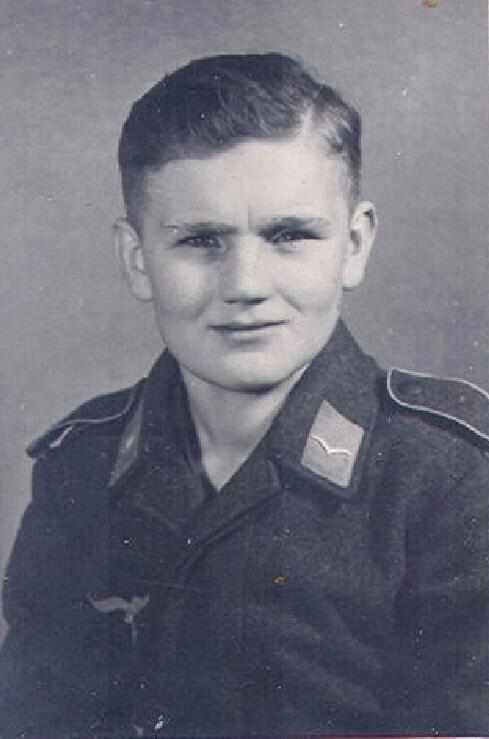
Many of the photographs archived on HBC help to illustrate or explain the pages on which they are posted. We have found some interesting images that do not seem to relate to an issue discused on our site. Or in some cases we do not understand what is shown in the image. Perhaps our readers will better understand the image. Here are some of the Luftwaffe images that we have found. Our attitude is that these images provide insights into the Luftwaffe and Luftwaffe operations even if we do not fully understand it at this time.
Corum
Davidson, Eugene. The Unmaking of Adolf Hitler (Univesity of Missouri: Columbia, 1996), 519p.
Fest, Joachim. Hitler (Vintage:New York, 1974), 844p.
Harris, Arthur T. Bomber Offensive (New York: Macmillan, 1947).
Heaton, Colin D. and Anne-Marie Lewis. The Germn ces Speak II: WW II Throughthe Eyes of Four More of the Luftwaffe's Most Important Commanders (2014), 304p.
McNab, Chris. Hitler's Eagles: The Luftwaff, 1933-45 (2014), 400p.
Rumpf, Hans. Trans. Edwrd Fitzgerald. The Bombing of Germany (Holt, Rinehart and Wilson: New York, 1962), 256p
Snyder, Louis L. Historical Guide to World War II (1982).

Navigate the CIH World War II Pages:
[Return to Main World War II European air campaign page]
[Return to Main German World War II Forces page]
[Biographies]
[Campaigns]
[Children]
[Countries]
[Deciding factors]
[Diplomacy]
[Geo-political crisis]
[Economics]
[Home front]
[Intelligence]
[POWs]
[Resistance]
[Race]
[Refugees]
[Technology]
[Bibliographies]
[Contributions]
[FAQs]
[Images]
[Links]
[Registration]
[Tools]
[Return to Main World War II page]
[Return to Main war essay page]