|
Although it was not known at the time, Göring's Luftwaffe had only 4 ½ years to prepare for war. The Luftwaffe was created at a time when aviation technology was undergoing rapid change. THe Luftwaffe gave great priority to building advanced all-metal planes. It has been suggested that the Luftwaffe's creation at this time gave it an advantage as its planes were all modern types. One German source, however, that the very short period of preparation was a critical flaw. He writes, "... the disadvantage of a long period of disarmament , during which it was forbidden to build military planes at all, proved greater than the advantages of being able to begin again from scratch. The situation would have been diiferent if it had been possible to build up the Luftwaffe steadily and not under constant pressure, but Giering and his staff were too impatient to wait until the findamental technical and organizational questions had first been satisfactorily answered."
The air plane emerged as a important weapon of war during World War I. A first it was air reconisance, but then fighters were needed to protect the reconisance planes. And greadually as more capable planes came on line, planes began to be use to attack ground targewts. Germany had a substantial and very effective air force during the War. The Germans built some great planes and for a while dominatied the air space over the Western Front. Baron Van Roctofer was thev most famous aviator of the War. His Flying Circus was the most effective unit of the War. Herman Göring flew in the Flying Citcus and was one of their air aces. The Germans did not, however, have the industrial capacity to match the Allies in air plane construction. Huge advances in aviation were made during the War. The War was primarily fought with fighters, but bith sides began to build bombers. The Germans bombed London and other Brutish cities. The Allies were preparing a strategic bombing campaign against Germany when the War ended.
The Weimar Republic replaced the Imperial Germany (1919). The Versailles Peace Treaty specifically prohibited Germany from having a air force. The German Army, the Reichwehr, never fully supported the Republic or was controlled by it. The Germans from an early sage began evading provisions of the Versailles Treaty and this include the air force provisions. [McNab] The Germans secretly built a small force by establishing a planning staff within the army where it attracted little attention. Germany also built a civil air industry. Lufthansa was a leading world airline. But air travel in the 1920s and even the 30s was a novelty and the relatively small. The size of the aviation industry was too small for any significant military program. It did provide, however, some basic infrastructure. It also provided some overses influence, including countries in South America, especially Brazil and Colombia.
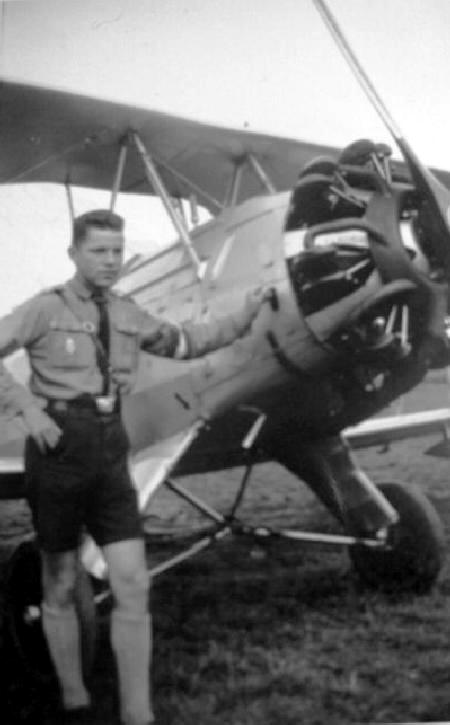
Soon after Hitler's appointment as chancellor, the Hitler Youth organization (HJ) seized control of the German youth movement. An air division, the Flieger program, was establlshed within the HJ. And older HJ bopys began working with gliders. Thus when the Luftwaffe was formally announced a program was in place that was producing recruits for the Luftwaffe with aeronautical experience. The program was very popular with HJ boys. World War II accounts of the air war generally focus on the planes involved. Less well covered is the preparation of the pilots. The German Luftwaffe began the War with the bestvtrained as most effective pplots and air crews of the War. (The one exception was the small elite pilots of the Japanese First Air Fleet.) Part of thecreason for this was the experience of the Luftwaffe in Spain. But a major reason was the large Flieger HJ program which meant that the Luftwaffe had access to large numbers of young men with basic aviation experience.
The Germans began opening glider fields after the NAZIs seized power. This was not Versailles Treaty and this not as provactive of fornally creating an airforce. Hirler's intensions were, however, clear to all but the most dimwitted. These fields were used by both the Hiler Youth and military personnel. Younger Hitler Youth boys built glider models and flew them in national competitions. Older boys were given the opportunity to actually fly gliders. Gliders werte not military aircraft, lacking the performance needed. Thiousands of young men were able, however, to learn basic piloting skills and an understanding od aeronautics that would enable them relatively quickly to become competent combat pilots. [McNab] The importance can be seen in the Battle of Britain. The British by this time were already outproducing the Germans in aircraft, what they desperately lacked in the Battle of Britain was a large reserve of trained pilots. And unlike aircraft, it would take time totain them--time the British did not have.
Adolf Hiter ordered Göring to formally establish the Luftwaffe (February 26, 1935). The Versailles Treaty was still theoretically in force. Shortly afterwards following a celevration marking the return of the Saarland to Germany, Hitler announced to the public the new Luftwaffe and a new military conscription program. Both were flagrant violations of the Versailles Treaty. Britain anf France took no action beyond purfunctoary diplomativ protests. In fact Britain, bent on appeasing Hitler, proceeded to reward him with a naval treaty (1935).
Although it was not known at the time, Göring's Luftwaffe had only 4½ years to prepare for war. The Luftwaffe was created at a time when aviation technology was undergoing rapid change. THe Luftwaffe gave great priority to building advanced all-metal planes.
It has been suggested that the Luftwaffe's creation at this time gave it an advantage as its planes were all modern types. One German source, however, that the very short period of preparation was a critical flaw. He writes, "... the disadvantage of a long period of disarmament , during which it was forbidden to build military planes at all, proved greater than the advantages of being able to begin again from scratch. The situation would have been diiferent if it had been possible to build up the Luftwaffe steadily and not under constant pressure, but Giering and his staff were too impatient to wait until the findamental technical and organizational questions had first been satisfactorily answered." [Rumpf, p. 35.]
Germany was one of the most industrialized countries in Europe. Its industrial base was, however, smaller than that of the Allies (Britain and France). The comparison was especially adverse before Munich when the Czech Skoda complex was not in NAZI hands. And German industry was a small fracrion of the Soviet Union and the Allies combined. Added to the limitations of the industrial base was the shortages of raw material, The resources need to build planes like aluminum needed to be imported and the NAZI Germany before the War faced a severe shortage of the foreign exchange needed to import the necessary materials. In addition it was the Wehrmacht that had the priority claim on resources. [Murray, p. 3.] Thus there were substantial limits on the force that Luftwaffe planners could build.
The Germans began building military aircraft in secret before Hitler and Göring announced the creation of the Luftwaffe (1935). By that time the Germans had about 1,000 planes. That was impressive at the time, especially because the Luftwaffe planes were modern types like single wing, all metal fighters like the ME-109. And the following year the rapidly growing Luftwaffe put its planes to use in the Spanish Cicil War. The results such as the destruction of the small Basque town of Guertnica terrified Europe. It was the primary reason the Czechs gave into the NAZIs after Munich (1938). The strength if the Luftwaffe was at the time of the Battle of Britain about 3,200 planes (July-September 1940). This was the peak of the Luftwaffe's power. They had defeated the French and the RAF would be brought to the brink of the breaking point. And the United States had only begun to build a powerful airforce. Even at the time of the Battle of Britain, the British had begun to build more planes than the Germans. But by that time the U.S. Air Force was beginng to approach the 80,000 aitcraft level it operated during the War. That number would have been inovceivable to the Luftwaffe chiefs that launched the war in Poland. Even the most ardent NAZI in the Luftwaffe would considered it national suiside to take on a country with an 80,000 plane air force. And the Luftwaffe also faced not only the British, but the Soviet Red Air Force. The Luftwaffe largely destroyed the Red Air Force at the onset of Barbarossa (June 1941), but by 1943, a rebuilt Red Air Force began to make itself felt in the East. The number of Luftwaffe planes peaked at 4,900 (May 1944). [Price] But by that time the experienced air crews had been seriously depleted and the Luftwaffe was reduced to sending up youths with the barest of training with predictable results.
McNab, Chris. Hitler's Egles: The Luftwaffe 1933-45 (2012), 400p.
Murray, Williamson. Strategy for Defeat: The Luftwaffe, 1933-1945 (Diane Publishing Company, 1983) Air University (US). Airpower Research Institute.
Price, Alfred. Luftwaffe Data Book (1997).
Rumpf, Hans. Trans. Edwrd Fitzgerald. The Bombing of Germany (Holt, Rinehart and Wilson: New York, 1962), 256p.
Völker, Karl-Heinz. Die deutsche Luftwaffe, 1933-1939.

Navigate the Boys' Historical Clothing Web Site:
[Return to Main Luftwaffe page]
[Return to Main NAZI rearmament page]
[Return to Main World War II European air campaign page]
[Biographies]
[Campaigns]
[Children]
[Countries]
[Deciding factors]
[Diplomacy]
[Geo-political crisis]
[Economics]
[Home front]
[Intelligence]
[POWs]
[Resistance]
[Race]
[Refugees]
[Technology]
[Bibliographies]
[Contributions]
[FAQs]
[Images]
[Links]
[Registration]
[Tools]
[Return to Main World War II page]
[Return to Main war essay page]