
World War II European Air Campaign--Luftwaffe Strategic Bombers
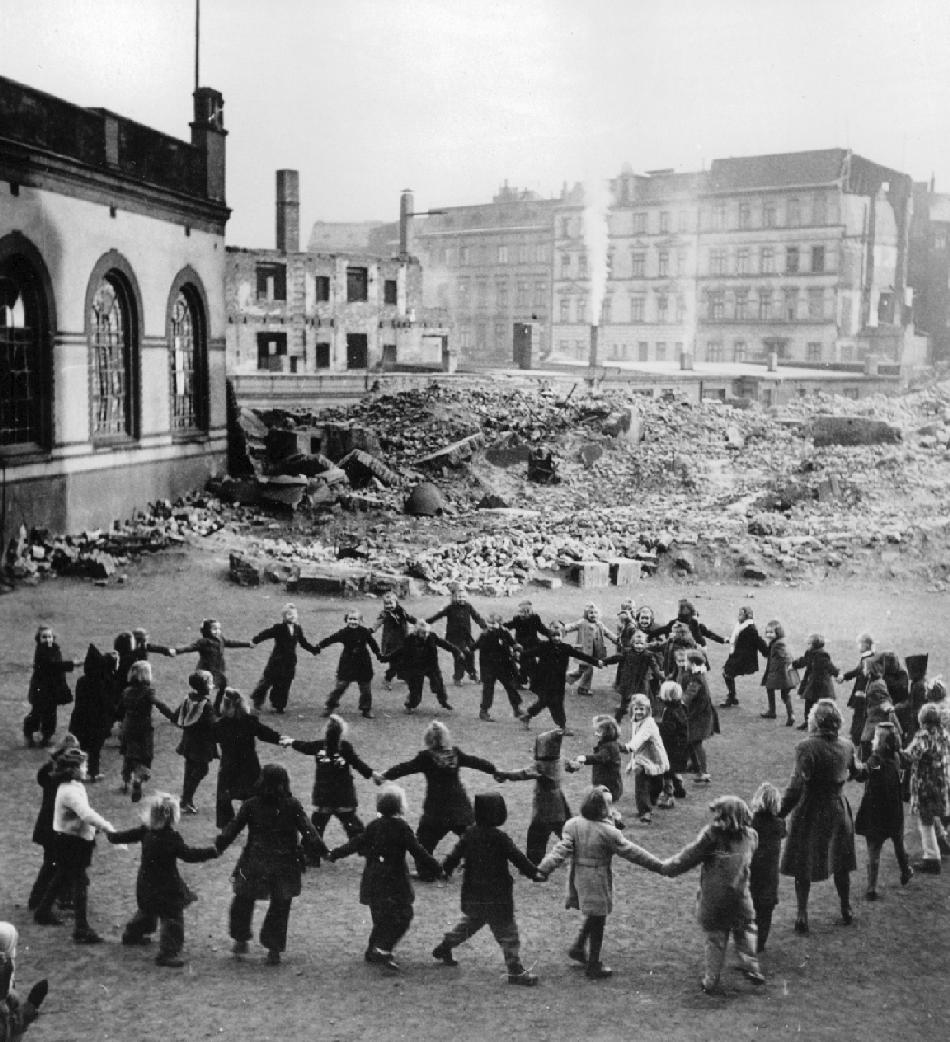
Figure 1.--The German concept of short, Blitzkrieg campaigns required small and medium tactical bombers, not large, lumbering long-range strategic bombers. Luftwaffe comanders reasoned that if needed, that their medium bombers had the range to attack the industry of its European adversaries. As the war developed after the fall of France, however, the quick victories ceased and Germany found itself locked in a long drawn out war of attition. And it needed to destroy the industry of the industrial giants that it had chosen to wage war with. The Luftwaffe bombers proved unable to even knock out British industry even from bses just cross the Channel. And the Luftwaffe could not even begin to reach Soviet industry beyond the Urals and American industry beyond the Atlantic. In the end it would be German cities that would be destroyed, like Hamburg here in a scene after the War.
|
|
The Luftwaffe began the War without a strategic bombing force and was unable to build one during the War. Air Marshal Harris writes, "They had, in fact, no strategic bombers at all, since their whole force of over a thousand bombers for army co-operation work, and was only used for attack on cities when not required to support the German Army. Even in daytime it was fitted only to carry out the work of a tactical air force, not strategic attack." [Harris, p. 86.] For a country intent upon a massive campaign of aggression, including other advanced industrial nations, this proved to be a disastrous miscalculation. It was not, however, a decission of ommission. Luftwaffe Commanders did not dismiss the long-rage heavy bombers out of hand. Rather the decession was to postpone the construction of a strategic bombing force. The strategic vission was that the German ground victories would succeed in extending the area of the Reich and occupied territories to such an extent that German cities would no longer be within the range of Allied bombers. [Rumpf, p. 38.] They had to decide on either a tactical or strategic force because Germany did niot have industrial capacity to build both when Hitler launched the War.
Force Structure Decisions
The responsibiliy for the Luftwaffe's force structure has bee commented on by quite a number of authors. We think it is primarily the result of two factors. First, the Luftwaffe was officered by Army officers. The Luftwaffe did not evenb exist formally until 1935. Thus when Hitler began to secretly build the Luftwaffe, he had to draw on the Heer officer core This from the beginning, the Luftwaffe had an organizational mentality of military ground support. The U.S. Army Air Corps (despite its organizational connection) and the British Royal Air Force had two decaded to develop an independent military vision and ethos. Second, Germny did not have the industrial capcity to build both a tactical and strategic airforce along with all the other military projects needed to prepare for a second world war. Thus it is understandable that the Heer officers that staffed the Luftwaffe would choose a tactical, not a bomber force. In addition the medium bombers used in tacical opertions had the range to reach targets in the enemies that ringed Germany (Czechoslovakia, Poland, France, and Britain). And Soviet industry at the time was mostly in the western part of the country. The three men most responsible for developing the Luftwaffe were Ernst Udet, and Erhard Milch, and Hans Jeschonnek. Udet was a dcorated World War I pilot. He joined the NAZI Party after Hitler seized power azi Party and became involved in the development of the new Luftwaffe. He was appointed director of research and development. He played a major role in the adoption of tactical aviation such as dive bombing. He was, however, not suited for administration. And he saw as early as the Battle of Britain that he had made serious mistakes. He turned to alcoholism and committed suiside (1941). Erhard Milch was a German field marshal who oversaw the development of the Luftwaffe.
He also bought into the tactical mission. Milch visited RAF Mildenhall (October 1937). The obsolete bi-wing fighters he saw left him with the impression that the Luftwaffe bombers would not require fighter protection. He was given charge of aircraft production during the War. He proved unequal to the task. He supported efforts to mass produce aircraft using American methods, but had to choose a few types. The aircraft chosen were largely obsolete by the time the new factories were operational. [Tootze] Hans Jeschonnek was chief of the General Staff of the Luftwaffe (OKL). He was a fervent propoment of tactical air, especially dive bombing.
In the end, Reich Marshal Herman Göring as Luftwaffe commander was responsible. He was also a decorated World War I pilot, but like Hitler not well educated or a professional military man. As best we can tell, he accepted the policy recomendations of men like Udet and Milch. Göring's one preminent focus was on how to maintain his influence with Hitler. He is known to have told intimtes, "The Führer will not ask how big our bombers are, but how many we have." We have seen authors blame Hitler for the laxk of a strategic bomber. Göring personally ordered the development of heavy bombers to ceased because they were too expensive and required huge quantities of material (April 29, 1937). Some authors argue tht Hitler himself was responsible for the decision not to build dtrategic bombers. One author claims that Hirler believed thst two small nombers are more vluble than one large bombers. We can not verify that he actually said that or when. Nor can we say the question was ever put to him. Goven his penchnt for size and destruction, one would think that he would hve chosen a strategic bombing force. We notice that the end if the war he was determined to ue he superb Me-262 jet fighter as a bomber.
Lack of Strategic Bomber Force
The Luftwaffe, for whatever reason, began the War without a strategic bombing force and was unable to build one during the War. Air Marshal Harris writes, "They had, in fact, no strategic bombers at all, since their whole force of over a thousand bombers for army co-operation work, and was only used for attack on cities when not required to support the German Army. Even in daytime it was fitted only to carry out the work of a tactical air force, not strategic attack." [Harris, p. 86.]
NAZI Calculation
For a country intent upon a massive campaign of aggression, including other advanced industrial nations, this proved to be a disastrous miscalculation. The strategic vission was that the German ground victories would succeed in extending the area of the Reich and occupied territories to such an extent that German cities would no longer be within the range of Allied bombers. [Rumpf, p. 38.] The quandry for the NAZIs was, that Germany did not have the industrial capacity at the onset of the War to build both a tactical and strategic bomber force. As one author explains, building strategic was not a viable option for the Luftwaffe. "... such a diversion would have been at the expense of the brilliantly effective co-operation between the German Army and Air Force; and on the other, it woud had led to no compensating advantage, as the campaign in Poland , France, the Netherlands, and Norway were far too quickly won for strategic to be necessary or useful." [Blackett, pp. 27-28.]
Germany even after World War I had the largest industrial establishment in Europe. It was that industry that was the backbone of the Central Ppwers war effort. The War had not been fought on German territory and except for the Saarland and Rhineland, Germany was not occupied by the Allies. Germany did loose some territory as a result of the Versailles Peace Treaty, but the country's industrial complex was left largely intact. The country's scientific establishment supporting that industry was also intact. The strength of that establishment can be seen by the number of Noble Prizes German scientists were awarded, One loss to German's industrial capacity was the disolution of the Austro-Hungarian Empire. This meant that the Skoda arms complex was now in Czechosolvakia, a new independent democratic country, orieted toward Britain and France. While Germany remained the most important industrial country in Europe, one area that Germany did not persue intensively was the automobile industry. Germany of course had some notable automobile manufacturers (Mercedes and Porch), they did not mass produce cars like American automobile companies (Chrysler, Ford, General Motors, Stutabaker, and others). The average german worker could not afford cars, especially the expensive cars made by German manufactuers. There were also weaknesses in the German industrial economy, the need to import raw materials. The most notable being petroleum. Nor did Germany have anywhere near the capability to build aircraft that its poptential opponents have. Imperial Germany in World War I did not have the same indistrial capability of the Allies--even before America entered the War. The industrial ballance of power was even less favorable for NAZI Germany as Hitler comtemplated another war. The Germany that the NAZIs seized control of was by any objective assessment not a country capable of wageing another world war. Only a leader patholically commotted to war would have contemplted such a decission. Germany would go to war with essentially the same industrial and scientific complex of Imperial Germany (the NAZIs did little to expand either). Yet the countries they would wage war against had greatly expanded their industrial and scientific complexes. The relative industrial ballance between Germany and the Allies (Britain and France) did not change appreciably in the inter-War era. What did change was the industrial capacity of the two European outriders--the Soviet Union and the United States. Tsarist Russia in World War I did not have the industrial capacity to properly equip its spldiers. The Soviet Union did. American had greatly expanded its industrial capacity. And one area that grew out of all prortion to Germany was the automoble industry--particularly important in a modern mechanized war.
Germany did not have Europe's dominant aviation industry before the NAZI takeover (1933). The three major European powers (France, Germany, and Britain) all had small and roughly comparable aircraft industries in the early 1930s. Germany was restricted by the Versailles Treaty from having military aircraft. At first the aviation industry in general was resticted. The Allies eased those constraints (1921-22). As a result, ab aircract industry building light-aircraft industry grew. The remaining restrictions on civilian aircraft were eliminated (1926). The restrictions on military aircraft remained. Several companies developed sizeable operations: Arado, Dornier, Focke-Wulf, Junkers, and Heinkel. Germany's emphasis on commercial air transpott helped these companies develop. The German military evaded the Vesaailles restrictions partially through contracts in other countrues, esprecially the Netherlands. With the NAZI take over, huge expenditures began for military aircraft. This was first done in secret. After Adolf Hitler abd the NAZIs seized power (1933), sizable funds began to be channeled into the development of military aircraft at the existing civilian aircradt companies. German aircraft companies obtained 84 million Reichsmarks for civilian projects (1927-31). The NAZIs pumped 980 million marks in aircraft projects, mostly military projects (1936 alone). Göring and Hitler made the new Luftwaffe public (1935). The lavish German spending soon made the German aircraft industry the most advanced in the world by the time that the Munich crisis occurred (1938). Luftwaffe planners had to make a major decesion at an early stage. Germany's limited industrial capacity meant that they could not build a sizeable tactical and strategic air force. The Luftwaffe planners, mostly officers frawn from the Wehrmacht, decided to build a tactical force to support ground operations. The massive expenditures enabled NAZI Germany to get a major lead on France and Britain by the time World War II broke out (1939). Many of most important Luftwaffe aircraft types were developed prior to the War (Messerschmitt Bf 109 fighter, the Junkers Ju 87 dive bomber, and the Heinkel He 111 medium bomber, Messerschmitt Bf 110 twin-engined heavy fighter and the Junkers Ju 88. Dornier also built bombers. Messerschmitt and Focke-Wulf focused on fighters. The German aircraft industry proved much less successful in introducing improved types. Two exceptions were the FW-190 fighter and the innovative Me-262 jet fighter. The German aircraft industry's failure was in part due to its limited capacity, but also due to the Luftwaffe's mismanagement. They sponsored so many projects that they squandered scarce resources and delayed the introduction of new aircraft types. Hitler personally delayed the production of jet aircraft so that the Me-262 arrived to late to affect the outcome of the air war.
The problem for the Luftwaffe and inevitably the German people was that the NAZIs were intent on a war that would ieveitably involve other modern industrial countries with the capability of building modern military airceraft. Two of those countries (Britain and America) had the capability to develop much larger air forces, including both tactical and strategic forces. As a result of the swift GErman victories at the onset of the War, strategic bombing was one of the few ways that the Western Allies could come to grip with the NAZIs. Both countries also saw strategic bombing as a way to limit battlefield losses.
Lutfwaffe Strategic Bombers
Luftwaffe Commanders did not dismiss the long-rage heavy bombers out of hand. Rather the decession was to postpone the construction of a strategic bombing force. Infact the Luftwffe built or attempted to build several different planes. And interest increased as American boms begain raining down on the Reich (1943).
The JU-390 Urals Bomber project had been cancelled in 1938.
The Focke-Wulff 200 Condor was one such plane, but realtively few were built and it was used primarily used for reconisance in the Battle of the Atlantic and in the Soviet campasign, although we know less about its use in the East. The Blitz Bomber which Hitler promoted was to light and camr to late. The Heinkel 177 Greif was built durng the War (1942-44). One reports suggests 1,146 were built, before it was scrapped because of design faults. [Rumpf, pp. 44-45.] If these reports are true, it was an enormous scaundroning of scarce resources for the dwindling capability of the Reich. Ernst Heinkel in his autobiography describes the frustrtions he encontered in building the He-177. {Heinkel] Luftwaffe planners conceived of the innovative Me-264 Amnerika bomber pushed by Göring late in the War. The Allied strategic bombing campaign, however, made construction impossible.
Sources
Blackett, P.M. The Military & Political Consequences of Atomic Energy (London: Turnstile Press, 1948).
Harris, Arthur T. Bomber Offensive (New York: Macmillan, 1947).
Heinkel, Ernst .
Rumpf, Hans. Trans. Edwrd Fitzgerald. The Bombing of Germany (Holt, Rinehart and Wilson: New York, 1962), 256p
Tooze, Adam. The Wages of Destruction: The Making and Breking of the Nazi Ecnomy (Penguin: New York, 2006), 800p.
CIH

Navigate the CIH World War II Section:
[Return to Main World War II European air campaign page]
[Return to Main Luftwaffe page]
[About Us]
[Aftermath]
[Biographies]
[Campaigns]
[Children]
[Countries]
[Deciding factors]
[Diplomacy]
[Geo-political crisis]
[Economics]
[Home front]
[Intelligence]
[Military forces]
[POWs]
[Resistance]
[Race]
[Refugees]
[Technology]
[Totalitarian powers]
[Bibliographies]
[Contributions]
[FAQs]
[Images]
[Links]
[Registration]
[Tools]
[Return to Main World War II page]
[Return to Main war essay page]
[Return to CIH Home page]
Created: 3:09 AM 8/25/2005
Last updated: 6:40 AM 5/7/2017