**
war and social upheaval: World War I Versilles Peace Treaty
World War I: Versailles Peace Treaty (1919)
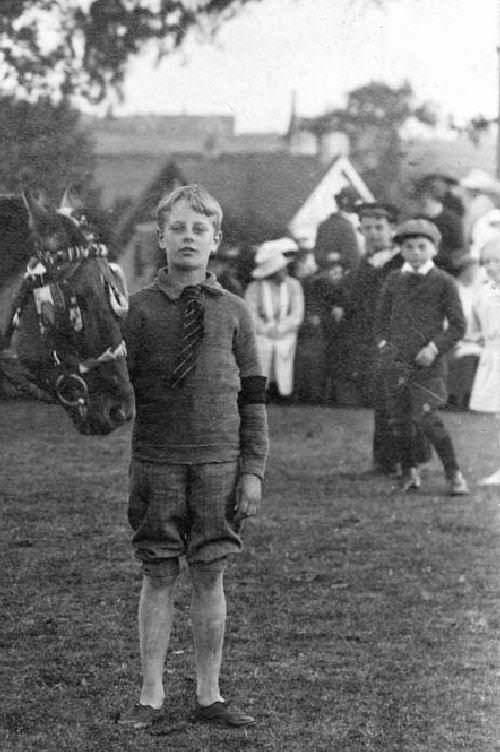
Figure 1.--Of course it was on Armistace Day that the real celebrations were held. But there were also celebrations througout 1919, especially after the signing of the Peace Treaty. We know that this was some of fete in association with the World War I peace because the back of the photograph reads "Peace Treat - Sept 1919". The boy holding the horse is wearing a black armband. It is likely that his father was killed in the War. Click on the image to see some of the others at the celebration. Image courtesy of the MD collection.
The Versailles Peace Treaty ending World War I was signed on June 28, 1919, about 7 months after the Armistice stopping the fighting on November 11, 1918. It was one of the mos important treaties of the 20th century. It had a huge impact on the international status of Germany, impacting the country territorially, militarily, and economically. Germany was made a pariah country and largely blamed for the start of the War. Of major significance, the Germany being published was the Germany of the Weimar Republic and not Imperial Germany as the Kaiser had abdicated. As a result, the domestic German opposition to the changes, including the territorial changes, came to be directed at the Weimar Republic and not the Imperial Government that had conducted the War. The NAZIs and other right-wing groups were to saddle democratic politicians with the "shame of Versailles". Germany under the terms of the Treaty suffered many consequences. The navy and merchant marine was lost. The battleships had to be turned over the the Allies. The battleships ships in fact steamed into the British naval base at Scappa Flow. The German captains, however, rather than turning them over to the British, scuttled them. Germany lost her African and Pacific colonies. Along with territorial losses in Europe were important natural resources. The German Army was reduced to virtual impotence. And the country was saddled with immense retributions. A critical element in the treaty was the principle of national self determination promoted by President Wilson. This resulted in the creation of a large number of small, weak states in Eastern Europe. It must be said that the the Versailles Treaty was not as onerous as the Treaty of Breast-Litovsk (1918)
imposed on the Russians. Still it was undeniably harsh. Many historians see it at the first step toward World War II.
American President Woodrow Wilson ran for reelection in 1916 on a campaign "He kept us out of war." The President became increasingly uneasy about a possible German victory. Efforts by Wilson to negotiate an end to the War were dismissed by the Kaiser as naive. Many Americans favored the Allies at the inset of war and German offers of the southwest to Mexico (Zimmerman Telegram) and British war propaganda gradually moved most Americans increasingly to the Allied side. When the Kaiser ordered the resumption of unrestricted
submarine warfare, Wilson asked the Congress to declare war. (April 1917) President Woodrow Wilson unveiled a new Peace Program to Congress (January 1918). The program had been prepared by a group of U.S. foreign policy experts and consisted of 14 major principles. The first five points dealt with major principles. Point 1 renounced secret treaties which many had come to see as a cause of the War. Point 2 dealt with freedom
of the seas, the issue that brought America into the War. Point 3 called for the removal of worldwide trade barriers. This was a major issue both in American domestic politics as well as international diplomacy. Point 4 advocated arms reductions. Point 5 suggested the international arbitration of all colonial disputes. Points 6 to 13 were concerned with specific territorial problems, including claims made by Russia, France and Italy--some of the major Allied belligerents. Here Wilson addressed difficult issues such as the control of the Dardanelles and the claims for independence by the people living in areas controlled by the Central Powers. The principle to be followed was to be national self-determination. This is such an accepted principle today that it is difficult to understand the emense impact and repercussions on a Europe that had been dominated by four huge empires
(Austro-Hungarian, German, Ottoman, and Russian). This was of interest to many ethnic Americans especially Polish Americans. These ethnic groups were not coincidentally important sources of strength for Wilson's Democratic Party. Many of these issues were highly controversial. All the belligerent countries objected to some aspects of Wilson's Peace Program. They proved, however, very popular among the Allied public. Wilson himself both because of the American intervention in the War and his Peace Program was lionized, much more so than in America. British and French officials were much less enthusiastic. French Premier Clemanceau mocked, "Moses was satisfied with 10 commandments but, Wilson requires 14." When peace negotiations actually began in October, 1918, Wilson was adamant that his 14 Points should serve as a basis for the signing of the Armistice.
The 14 Points did not include any mention of reparations and on this issue the British and French would not compromise.
As the German position on the Western Front began to seriously deteriorate, the German Government headed by Max von Baden asked President Woodrow Wilson for a ceasefire October, 4, 1918. After talks had taken place, Baden accepted Wilson's 14 Points Peace Program. Wilson in fact had much more difficulty persuading the British and French to accept his 14 Points, especially the lack of reparations. Only after Wilson agreed to reparations would the British and French consent. The Allies refused to deal with the Imperial German
Government. Only after Kaiser Wilhelm II abdicated an a Republic proclaimed were the Allies willing to treat with the Germans. The Armistice was signed in a railway car at Compiegne in France on November 11, 1918. The provisions of the Armistice included:
1. Effective six hours after signing.
2. Immediate clearing of Belgium, France, Alsace-Lorraine, to be concluded within 14 days. Any troops
remaining in these areas to be interned or taken as prisoners
of war.
3. Surrender 5000 cannon (chiefly heavy), 30,000 machine guns, 3,000 trench mortars, 2,000 planes.
4. Evacuation of the left bank of the Rhine, Mayence, Coblence, Cologne, occupied by the enemy to a radius of
30 kilometers deep.
5. On the right bank of the Rhine a neutral zone from 30 to 40 kilometers deep, evacuation within 11 days.
6. Nothing to be removed from the territory on the left bank of the Rhine, all factories, railroads, etc. to be left
intact.
7. Surrender of 5,000 locomotives, 150,000 railway coaches, 10,000 trucks.
8. Maintenance of enemy occupation troops through Germany.
9. In the East all troops to withdraw behind the boundaries of August 1, 1914, fixed time not given.
10. Renunciation of the Treaties of Brest-Litovsk and Bucharest.
11. Unconditional surrender of East Africa.
12. Return of the property of the Belgian Bank, Russian and Rumanian gold.
13. Return of prisoners of war without reciprocity.
14. Surrender of 160 U-boats, 8 light cruisers, 6 Dreadnoughts; the rest of the fleet to be disarmed and
controlled by the Allies in neutral or Allied harbors.
15. Assurance of free trade through the Cattegat Sound; clearance of mine fields and occupation of all forts and
batteries, through which transit could be hindered.
16. The blockade remains in effect. All German ships to be captured.
17. All limitations by Germany on neutral shipping to be removed.
18. Armistice lasts 30 days. [German press release]
Versailles Palace
The Versailles Palace was one of the most historic locations in Europe long before the treaty ending World War I was signed. Versailles is located about 15 kilometers southwest of Paris. It is of course known for the elaborate palace and formal gardens built by Louis XIV in the 17th century. It was here that Louis brought the aristocracy of France and established absolutist rule for the first time
in France. Louis XV made changes to the interior of the palace. Louis XVI used the palace as one of his residences until he was detained by Republican forces. It was at Versailles that the Estates General was convened in 1789 leading to the Revolution. Louis-Philippe after the Revolution transformed the palace into a museum displaying trophies of the victory of France. The Prussians in
the Franco Prussian War captured Versailles and it was here that the German Empire was proclaimed and King Wilhelm made Germany's first kaiser. The Army was headquarted there during the suppression of the Paris Commune. After the peace treaty ending the Franco-Prussian War, the French National Assembly and Government was located at Versailles
until 1879.
There was great hopes for the Peace Conference. Some saw it as a conference on the very future of makind. The Versailles opened on January 18, 1919. The Big Four were represented by David Lloyd George (Britain), Vittorio Orlando (Italy), and Georges Clemenceau (France), and Woodrow Wilson (United States). These men had widely dissimilar backgrounds, but they had one common trait--they were all successful politicans who had lead their countries during the War. None had great experience in diplomacy or were knowledgeable about international relations. [Wells, pp. 923-924.] Russia the other major Allied power and the country that had suffered more than any other in the War was not invited. The Bolsheviks had seized power killed the Tzar and his family and signed a separate peace with the Germans. At
the time of the Conference a vicious civil war was waging in Russia and the Allied had intervened. President Wilson submitted a Draft Covenant for a League of Nations on February 14, 1919. This Covenant became the first of the 26 Articles of the Treaty. The Germans came to the Peace Conference believing that Wilson's 14 Points would form the basis for the peace treaty. The original Allies (Britain, France, and Italy), however, all had
interests that they were determined to pursue that had nothing in common with Wilson's 14 Points. They were the predominate influence at Versailles. The Conference which so many had attached such hopes gradually declined into what some saw as more of an old-fashioned diplomatic conspiracy. [Wells, p. 924.] In the end the Germans felt that Wilson and the other Allies leaders had deceived them. The Peace Conference was largely a debate between Britain, France, and Italy as to how to achieve their war aims. America had played a major role in the War, but after the American Army had been largely sent home, Wilson had much less influence at the Conference. France was by far the most belligerent member of the Big Four. Lloyd George and Wilson managed to dissuade Clemanceau from actual territorial gains on the east bank of the Rhine. Germany had virtually no influence and simply had to accept what was decided.
Signing (June 28, 1919)
The Versailles Peace Treaty ending World War I was signed in Hall of Mirrors on June 28, 1919, about 7 months after the Armistice stopping the fighting on November 11, 1918. There was no negotiation with the German Government. The Germans could not discuss the text or object to any provision. The Germans were given two options. They could accept the treay and sign or the Allies would occupy the country.
The most striking aspect of the Treaty was the war guilt clause. Article 231 placed the plame for the War fully on Germany. This justified Article 228 which caused for punishing Germany "for acts gainst the laws and customs of war". And this included extensive war reparations. The other significant provisions of the Treaty was territorial concessions by Germany. There were, however, many other provisions of the Treaty which affected Germany. Especially galling for German pride was the limitatioins on the German military. The complete text of the treaty is available on-line.
Ratification
The Treaty after signing was rapidly ratified by most of the major belligerent countries Ratifcations included: Germany (July 7), France (October 13), England (October 15), Italy (October 15), and Japan (October 30). Except for Russia, the one major exception was the United States. There President Wilson faced a highly sceptical Senate.
European Empires
All three of the great European Empires were destoyed in the aftermath of the War.
Germany
It had a huge impact on the international status of Germany, impacting the country territorially, militarily, and econimically. Germany was made a pariah country and largely blamed for the start of the War. Of major significance, the Germany being published was the Germany of the Weimar Republic and not Imperial Germany as the Kaiser had abdicated. As a result, the domestic German opposition to the changes, including the territorial
changes, came to be directed at the Weimar Republic and not the Imperial Government that had conducted the War. The NAZIs and other right-wing groups were to saddle democratic politicians with the "shame of Versailles". Germany under the terms of the Treaty suffered many consequences. The navy and merchant marine was lost. The battleships had to be turned over the the Allies. The battleships ships in fact steamed into the British naval base at Scappa Flow. The German captains, however, rather than turning them over to the British,
scuttled them. Germany lost her African and Pacific colonies. Along with territorial losses in Europe were important natural resources. The German Army was reduced to virtual impotence. And the country was saddled with immense retributions.
Austria-Hungary
The Austro-Hungarian Empire and the monarch disintegrated at the end of the War. Emperor Karl I was forced to abdicate. Separate countries were formed and recognized by the Treaty and the League of Nations. There was strong sentiment in Austria for union with Germany. France was adamantly opposed to this. French foreign policy for years played various German states against each other, primarily Austria and Prussia. A union was considered dangerous for French security.
The French insisted on a provision of the treaty prohibited it. This was a notable exception to the principle of "self-determinastion" suposedly championed by the Versailles Peace Treaty. [Wells, p. 935.] In the end, the Treaty delayed, but did not prevent union with Germany. The final outcome 18 years later was Anchluss under the NAZIs.
Russia
The staggering losses on the Eastern Front and the deprivations on the home front led to a fall of the Tzar. A democratic, reformist government was soon replaced by the Bolsheviks who instituted a Communist regime. The Bolsheviks killed Tsar Nicholas II and his family. The Germans forced the Bolsheviks to sign the humiliating Brest Litovsk Pace Treaty (1918). After the Armistice on the Western Front, the Allies intervened in Russia to support the Whites in the Civil War. The Russians were not invited to the Versailles Peace Treaty. While the Germans were forced to renounce the Brest-Litovsk Treaty, subsequent military action
as well as League of Nations actions resulted in considerable territorial losses, most notably large areas to Poland. The Russians also lost Finland and the three Baltic Republics.
The German people were shocked at terms of the Versailles Treaty. German diplomats at Versailles were not allowed to debate the terms of the Treaty, It was simply handed to them to accept. The Armistice had been signed agreed to on the basis that the peace would be based on President Wilson's 14 Points. The Versailles Treaty was not al all what they had anticipated. The War guilt clause (Article 231) in particular shocked many Germans. THey did not see their country as responsible for the War. And tis served as a basis for punishing the Germans (Article 228). Many aspects of the Treaty might be considered as a way of punishing Germany. The most significant here was substantial war reparations. And worse was to come as the Allies began to draw the new borders. Here a series of referendum were used to determine the to what country areas of mixed population would be assigned. In the end, Germany lost aover 10 percent of its pre-War territory. As news of the Treaty provisions were published in Germany, a wave of protest engulfed the country. Meetings and street protests took place. The countrybwent into a virtual state of mourning. Stahe theaters and movies shit down. Most Germans felt deceived.
National Self Determination
A critical element in the treaty was the principle of national self determination promoted by President Wilson. This resulted in the creation of a large number of small, weak states in Eastern Europe.
President Wilson saw at the center of a new international order, a League of Nations. As soon as he returned home from the Versailles Peace Conference, he launched upon a cross-country tour to promote the Treaty and U.S. membership in the League. He told Americans, "At the front of this great treaty is put the Covenant of the League of Nations. It will also be at the front of the Austrian, treaty and the Hungarian treaty and
the Bulgarian treaty and the treaty with Turkey. Every one of them will contain the Covenant of the League of Nations, because you cannot work any of them without the Covenant of the League of Nations. Unless you get the united, concerted purpose and power of the great Governments of the world behind this settlement, it will fall down like a house of cards. There is only one power to put behind the liberation of mankind, and that is the
power of mankind. It is the power of the united moral forces of the world, and in the Covenant of the League of Nations the moral forces of the world are mobilized." [Wilson]
The Versailles Peace Treaty ending World War I was signed on June 28, 1919, about 7 months after the Armistice stopping the fighting on November 11, 1918. It was one of the most important treaties of the 20th century. President Wilson after submitting a Draft Covenant for a League of Nations on February 14, 1919, left Paris on February 15, returning to the United States. He sought to promote the League which he saw as the central feature of the Versailles Peace Treaty and a "world made safe for democracy" without the scourge of
war. Upon arriving in Boston on February 15, he gives his first speech promoting the League. Wilson met with highly skeptical Congressional leaders over dinner on February 26. Key Republican leader, Republican Majority Leader and Foreign Relations Committee Chairman Henry Cabot Lodge, in a February 28 speech rejected the principle of mutual guarantee in the Wilson proposal, but not the League outright. With Wilson's refusal to compromise, the Senate overwhelming rejected the Treaty by wide margins in two votes on November 19. The Senate rejected the Treaty with the 14 Lodge reservations 39-55. Both Democratic candidates actively expoused President Wilson's global idealism and promoted the League. Americans were having none of it. The War losses, mild by European standards, were very real. The economy by 1920 had turned down in post-war recession. The Republican candidate, Warren G. Harding was another Ohio publisher serving in the Senate. Harding offered a "return to normalcy" and was on November 2, elected in a Republican landslide. This effectively end the debate in the United States over the League of Nations and active participation in European affairs.
Assessment
Modern discussion of the Versailles Treaty commonly focuses on the the treatment of Germany. The German provisions, however, were only one part of the Treaty. And an important point in evaluating the Treaty is the enormiity of the changes resulting from the War. Any criticism of Varsailles has to take in account how likely it is that any treaty could have solved the problems thay were created by the War. Think of it. The Austrian-Hungarian Empire was gone. The Ottomam Empire was gone. The Tsar and the Tsarist Empire was gone and replced with a totalitarian regime detrmined to destroy the democratic states of Wesern Europe and America. A whole generation was desroyed and the physical damage beyond belief. People were starving. And one if the worsr pabdemics in history had struck both the devestated people of Europe and America.
It lso has to be stressed that the Treaty was not intended as the end and final product to reorder Europe. Rather, it was only meant to be the beginning of a process. That process was to be worked out through arbitration and nehotiation facilitated by the League of Nations. Here the refusal of the United States to join the League and the rise of Bolshevism in Russia would make the felicitous outcome of this effort unlikely.
Now as to The Germans. Many historians see it at the first step toward World War II. Not only did it create immense ill-will in Germany, but it destroyed the creditability of the new Weimar Republic. Many Germans felt that their country had been humiliated and they came to blame the Weimar politicians that accepted the treaty. Had their been a more benevolent peace based on Wilson's 14 Points the Weimar Republic might have mustered the strength to successfully fight the post-War economic and social turmoil. This is, however, conjecture. One of the principal concerns of Germans were the territorial concessions and most of these were based upon the right to national self determination which was part of the 14 Points. It is not really the case, however, that Versailles was unblievanly harsh. It must be said that the the Versailles Treaty was not as onerous as the Treaty of Breast-Litovsk (1918) which the Germans imposed on the Russians. Or the Romanian Treay. Germany was not occupied ro any sificant extent, only a shortterm occpation of the Rhineland. It is true that it was not a a magnamanous treaty of reconcilition. The problem with Versailles was that it was a compromise. It was harsh enough that it alienated the Germans. It was, however, not harsh enough to convince the Germans that their desire to dominate Europe was going to invite disaster--basically if you do not want yout home burned downm, d't set the world on fire. Choosing the middle road at Versilles baically guaranteed a second chpter to the World War I tragedy.
Franklin Roosevelt
A young Franklin D. Roosevelt (FDR) was only the Assistant Secretary of the Navy during World War I, but he took the Wilsonian commitment to the League to heart. As the Democratic candidate for Vice President in the 1920 presidential election, Roosevelt campaigned tirelessly for the League. The massive Republican victory in 1920 convinced leading Democrats like New York's Al Smith,
who ran for president in 1928, that the League was a losing issue. Roosevelt never lost his belief in the League, but he was an astute enough politician to see that Smith was correct in his assessment. When FDR was elected president in 1932, isolationist sentiment made any
approach to the League impossible, especially because all of the energies of the New Deal were directed at the Depression--an economic crises of staggering proportions. Later in World War II, it was Roosevelt who believed that American refusal to join the League was a major factor in the outbreak of World War II, revived the issue of the League in the United Nations (U.N.). He even hoped to be the first Secretary General after the War was over. Sadly FDR's health did not permit this, but his wife Elenor played a major role in the founding of the U.N. after her husband's death. This time given FDR's stature and shifts in American sentiment, there was no serious opposition. Another major conclusion that FDR drew from World War I was that it had been a major mistake to stop the Allied Armies at the Rhine. After America entered World War II in 1941, he was determined to achieve unconditional surrender from both the Germans and Japanese. One of the consequences of that decisions is
today's democratic, peaceful and very prosperous Germany and Japan.
The German military had been the most powerful in Europe. The Prrussian officer class which had been the backbone of German military leadership was extremely resentful of the limitations imposed by the Treaty. As a result, the Germand from the breginning set out to evade the limitations. Some of these were authorized by the civilian Weimar Governmnt. Others were conducted by the military in secret, both from the Allies and from the Government. Some of these efforts were suptergfuges to like non-military names to desguise the purposes of groups and keeping military connections secret. Another ploy was to conduct activities and programs in foreign countries.
Causes of World War II
The terrible tragedy of World War I with the vast destruction and loss of life should have meant that a Second World War was unthinkable. And it was with most Europeans, including most Germans. But World War I veteran Adolf Hitler was detrmined to have another war and for Germany this time to win it. And he used the German hatred of the Versailles Treaty as part of his campaign to gain power and prepare for another war. The Versailles Treaty was the ine thing on which most Grmans afreed. nd Hitler skillfully capitalized on this to gain support from Germans who otherwie disagreed with him. Some historians agree with Hitler. Any survey of World ar discussions on the inernet turns of ersilles over and over again. One historian insists that the Allies chose vengence over opeace and assessed massive reparations on a defeated and humiliated Germany. [Stone] There is some truth in this, but the true picture is more complex. Certainly there were some in Britain and France who wanted vengence, but therewas alsio massive damage in northern Frnce and Belgium and Germany was virtually untouched by the War. In addition it was the Germans themselves that had begubn the ide of reparations by territory imposed on the Danes (1864), a huge indeminity imposed on France after the Franco- Prussian War (1870-71). And if you think the Versailles Treaty was harsh, look at the Treaty of Brest-Litovsk imposed on Russia by the Germans (1918). Even so, any assessment of post-War Europe shows that Versailles was only one of the post-World war I issues. World War II occurred because not only did World War I settle nothing, but it left Europe much more volatile and conflict prone than pre-War Europe. It created the Soviet Union which was determined to not only change borders , but to undermine the political and economic nature of Europe. And no longer had World War I ended, than conflicts sprang up all over Europe, the Russian Civil War, the Polish-Soviet War, fighting in the Baltics, engagements between Poles and Germans to settle the German-Polish boundary, fighting between Poles and Czechs, disagreements over the Rhineland, and the Greek-Turkish War. The implosion of the Tsarist and Austrian Empires created many new states, mot of which had territorial and ethnic differences with their neighbors. And Versailles itself was not novel, but very similar to peace treaties the Germans imposed on the Danes (1864), French (1871) and Russians (1918). The only thing that made Versailles different is that it was imposed on the Germans. Like bombing in World War II. The Germans had no real objection in principle, they just din;'t like it being done to them. Thus World War I occurred because it settled nothing and left a more unstable Europe with more national grievances than before the war. The nationalism that played an important role in igniting World War was not tampend down by the War, but actually inflamed in many countries, especially many of the newly created countries--a natural imapct of the beak up of the empires that dominated urope befre the War. As another historin writes, "Europe was not ready for peace." [MacMillan]
Reader Comments
A French reader writes, "It must be considered that France and Germany were the main elements of the World War I on the Western Front. The United States entered the international stage for the first time in a major role. Wilson was a perceptive person, not sufficiently regarded by either the American Congress or we French. We were affected by emotions, the more than 1.3 million killed and 3.6 million wounded. This had a major impact on French public opinion."
Sources
German Government press release, published in the Kreuz-Zeitung, November 11, 1918.
MacMillan, Margaret. The War that Ended Peace: The Road to 1914.
Stone, Norman. World War II: A Short History (2013).
Wells, H.G. The Outline of History: The Whole Story of Man (Doubleday & Co.: New York, 1971), 1103p.
Wilson, Woodrow. Speech at Pueblo, Colorado, September 25, 1919.