|
I am not entirely sure how school was handled. The schools were used to organize the actual evacuation process. The children were taught in the schools at the villages and towns where they wrere evacuated. In many cases children
from a school were evacuated to the same town and village where their teachers were added to the faculty of the local schools and helped look after the evaceuees.
Some villages were so small so only a few evacuee children, not a large segment of a city school. Hopefully our British readers can provide us more information on this. Many private schools were boardinf schools located in the country and thus relatively safe. There were also private schools located in the cities, although many of these were not boarding schools. Some of these schools were also evacuated because facilities were needed for the war effort. Isolated country estates had a vriety of uses. This was especially true of schools located along the southern, Channel coast where schools were evauated both for the childrren's saftey and because the facilities wer needed.
The schools were used to organize the actual evacuation process. The children were taught in the schools at the villages and towns where they wrere evacuated. In many cases children
from a school were evacuated to the same town and village where their teachers were added to the faculty of the local schools and helped look after the evaceuees.
Some villages were so small so only a few evacuee children, not a large segment of a city school. Hopefully our British readers can provide us more information on this. Many private schools were boardinf schools located in the country and thus relatively safe. There were also private schools located in the cities, although many of these were not boarding schools. Some of these schools were also evacuated because facilities were needed for the war effort. Isolated country estates had a vriety of uses. This was especially true of schools located along the southern, Channel coast where schools were evauated nboth for the childrren's saftey and because the facilities wer needed.
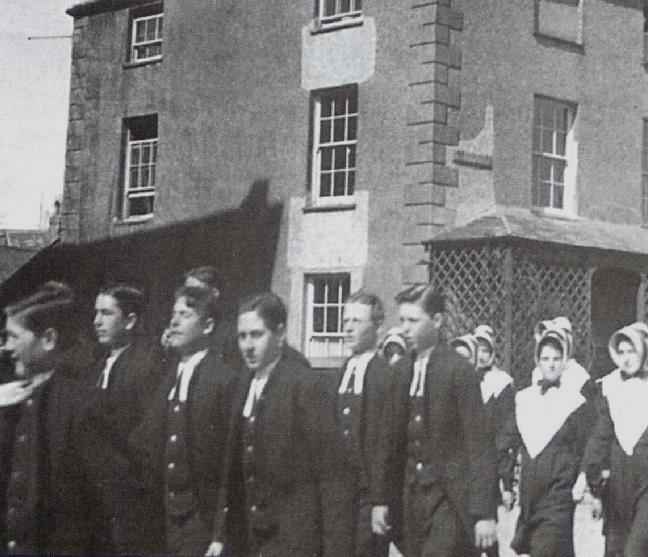
Many private schools were boardinf schools located in the country and thus relatively safe. There were also private schools located in the cities, although many of these were not boarding schools. Some of these schools were also evacuated because facilities were needed for the war effort. Isolated country estates had a variety of uses. This was especially true of schools located along the southern, Channel coast where schools were evauated nboth for the childrren's saftey and because the facilities wer needed. The Blue Coats School Liverpool was evacuated to a seaside town in Wales called Beaumaris. The Bluecoat boys from London, like many other Liverpool boys, were evacuatd to Wales. A British reader reports, "I find these pictures very moving. The Blue Coat Liverpool School was evacuated in September 1939 at the outbreak of the War before the actual bombing began. The boys arrived as evacuees dressed in the historic school uniform. They paraded down the High Street to the billiting centre with school band playing. They paraded in their traditional uniform because it was a Sunday when they went to Beaumaris, it is a small vilage on Angles, North Wales." Notice the girls in the background. Like the boys they are wearing a very traditional uniform. Apparntly the Liverpool Blue Coat School had girls as well a boys. This image provides a wonderful insight into the British character. The British love ceremony. The procession and ceremony here is a statement that they were not about to give in to Hitler and the Lufwaffe. A pupil at that time was John Houstan. He wrote: "At the time there were 300 pupils, boys and girls, with ages from 8 to 16. As well as our everyday
uniforms we alaso had, especially for Sundays, the old traditional uniform, in which we paraded through the streets, led by our band of brass and drums, to attend church each Sunday. The boys Sunday Uniform was long serge trousers, a long-tailed cut-away coat and a waistcoat with silver buttons down the front. Around our necks, in place of a tie, we wore an old fshioned white clerical neckband. .... The girls wore a long sleeved navy blue pleated dress, buttoned up to the neck and belted at the waist. On top of this was a big white starched collar arrangement, the points of which extended to thewaist. Long black stockings completed the outfit and on their heads they wore a straw poke bonnet which tied with a broad ribbon under the chin." [Wallis, p. 124.]
The schools were very important in the evacuations. The entire opperation relied on teachers to organise and escourt the children. This provided some continuity and the children did not feel quite so separated from home, Yje teachers ould join the staff of the local schools to help with the added childrn. This did not always work perfctly. The first evacuation (Swptember 1939) was conductd in some haste under the unrealistic assumptiin that Luftwaffe attacks were iminent. In the hat and with the need to fully use available space on the trains, some school grops were separated. Even so, With out the asistyance of the teachers, the entire operation would have collapsed. [Imperial War Museum publication.]
Imperia; War Museum. We are trying to find the title of the specific publication.
Wallis, Jill. A welcome in the Hillside (Avid). ISBN 1902964136

Navigate the CIH World War II Pages:
[Return to Main English World War II evacuation page]
[Return to Main World War II aerial campaign page]
[Biographies]
[Campaigns]
[Children]
[Countries]
[Deciding factors]
[Diplomacy]
[Geo-political crisis]
[Economics]
[Home front]
[Intelligence]
[POWs]
[Resistance]
[Race]
[Refugees]
[Technology]
[Totalitarian powers]
[Bibliographies]
[Contributions]
[FAQs]
[Images]
[Links]
[Registration]
[Tools]
[Return to Main World War II page]
[Return to Main war essay page]
[Return to CIH Home page]