|
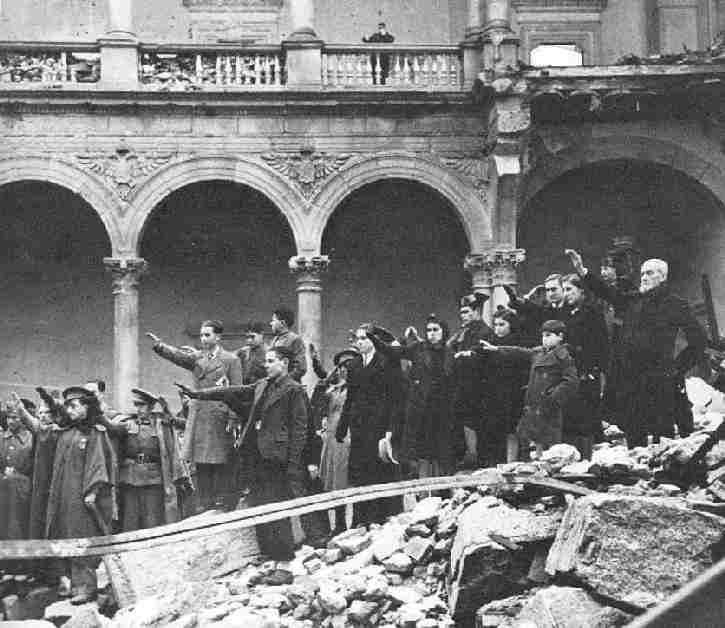
Following a period of escalating political instability in the early 20th century, the Spanish monarchy fell. It was replaced by a Republic which began instituting social reforms. Threatened conservative elements supported a military revolt led by Francisco Franco. This plunged Spain into a bloody civil war. NAZI Germany and Fascist Italy beginning in 1936 were also active in Spain helping Franco establish a Fascist-like regime. The Spanish Civil War is often seen as the unveiling of the new German Luftwaffe after Hitler had unilaterally abrogated the Versailles Peace Treaty prohibiting Germany from building an air force. Spanish Generals Francisco Franco and Quiepo de Llano revolted against the reform-minded Republican Government elected in Madrid (July 1936). Franco appealed for help. Hitler immeduately ordered Luftwaffe transport plans to transport Franco's loyalist troops in Morroco to participate in the fighting. He saw a left-wing government in Madrid as harful to the Reich, aiding the French policy of encirclement. [Davidson, pp. 57-58.] Both Italy and Germany were soon sending arms and men to the loyalists and provided important air elements. The defenseless Basque village of Guernica was the first European city to be destroyed by the Luftwaffe. The democracies and League of Nations respnded with an arms embargo. Only the Soviets aided the Republic. The Spanish Civil War is most commonly seen as the first major battle against fascism in Europe. Less know and more controversial is the social revolution launched by the Republic.
Spain in the early 20th century was a European backwater. Spain and Portugal were the two poorest most backward countries in Western Europe. This is an interesting phenomenon given the fact that these two countries lead the European outreach and age of discovery. This was in part because of the innovation and scholarship of leaders like Prince Henry the Navigator. Yet neither country significantly participated in the Renaissance, Enlightenment and scientific inovation that made modern Europe. They were once the richest countries of Europe. So historians must assess why the Spain and Portugal were such failed socities. And here the the decession of the Spanish monarchy to create a throughly Catholic country with a Church determined to control thought and behavior has to be considered a major factor. This was best symbolized with the expulsion of the Jews and Moors (1492). And of course was overseen by the Inquisition. The Inquisition was finnaly abolished in the 19th century (1834), but its impact over several centuries had a profound impact on Spanish intelctual life. This and a conservative clergy and military supported land owners and industrialists which combined to repress workers. The result was two of the poorest countries in Europe.
Alfonso XIII was one of Spain's longest ruling monarchs. He was King of Spain from 1886-1931. Alfonso mairred Victoria-Eugenie (one of Queen Victoria's forty grandchildren, who died in 1969. She was also a Battenberg, her mother was Princess Beatrice and her father Price Henry of Battenberg. King Alfonso XIII had six children. One Prince Juan Carlos would eventually regain the Spanish crown for his son that his father lost. Alfonso XIII supported the military dictatorship (1923-30) of Miguel Primo de Rivera, but social unrest and a republican election victory led to his deposition and exile (1931).
Miguel Primo de Rivera established a military dictatorship (1923). He cooperated with France to recover lost Moroccan territory. But the natinalist actions did not appeal workers demanding the rights to organoze and strike to gain better wages. The Stock Market Crash in America (1929) had ripples around the world. One of those countries was Spain. The growing world-wide Depression affected Spanish companies and workers were laid off in large numbers. Unemployment fuel worker resentment at Primo de Rivera and his regime. King Alfonso forced him to resign (1930) and offered real elections. Even so, many workers connected the King with the dictatorship.
Spain in 1931 held its first truly democratic elections. Resentment toward the King's involvement in his dictatorship, Spain's wirkers and other urban population voted strongly for republican parties in the municipal elections (April 1931). These were Spain's first truly democratic elections. Feightened by the strength shown by the republicans, King Alfonso fled the country, but did not abdicate. A united front of socialists and liberals seized power. The new government declared Spain a Republic--Spain's Second Republic. The Republic launched a program of social reform designed to bring a still almost feudal society into the 20th century. Women were given the right to vore. Substantial autonomy was granted to the Basque Country and Catalonia. This put the Republic in conflict with the aristocracy that held large tracts of land and the conservative Catholic church. The Republic began seizing the large haciendas and destributing the land to the peasantry. The Republic also recognized labor unions agitating for better working conditions. Much of the Left including anarchists, socialists and some communists pushed for even more radical reform. Many liberal and moderate forces were concerned that social reforms were destabiling the political situation. The Church, the aristocrcy, and the military controled by the extreme right wing were increasingly alienated from the Republic. The Republic also faced other problems, including the Depression and very large debt contracted during the Primo de Rivera dictatorship.
Right-wing forces in the Spanish army for some time had been planning a coup d'etat against the reform-minded democratically elected Republican Government in Madrid. . Many Spanish officers had been awaiting Franco's decession. The death of Calvo Sotelo accelerated their plans and the first garrisons revolted. Fighting became widespread throughout Spain (July 18, 1936). This forced Franco's hand and he took command of the army in Morocco (July 19). The military staged well planned military uprisings in garrison towns throught Spain. This was the beginning ofthe Spanish Civil War.Franco appealed for help. Hitler immeduately ordered Luftwaffe transport plans to transport Franco's loyalist troops in Morroco to participate in the fighting in Spain. The military seized control of large sareas of Spain: Seville (General Queipo de Llano), the Balearic Islands (General Goded), the Canary Islands and Morocco (Franco), Navarra (Mola), Burgos and Saragossa. General Yague rapidly moved through Extremadura and Mola took Irun. Franco's Loyalist (Nationalist) forces by the end of 1936 had seized most of southern and central Spain (Andalucia, Extremadura, Toledo, Avila, Segovia, Valladolid, Burgos, Leon, Galicia, a part of Asturias, Vitoria, San Sebastian, Navarra and Aragon) in addition to the Canary and Balearic Islands with the exception of Menorca. The Republic held Madrid and much of northerm and northwestern Spain (Castilla la Nueva, Catalunya, Valencia, Murcia, Almeria, Gijon and Bilbao).
Francisco Franco was a Spain's most respected soldier and decided to join a military coup against Spain's democratically electdm but increasinly left-wing governmnt. This led to the Spanish Civil War (1936-39), a run up to Wold War II. Franco is generally seen as a Fascist dictaor because of the support providd by Hitler and Missolini and the regime's trappings. Francisco was born in El Ferrol (1892). His father following a family traitoon was an officer in the Spanish Navy. His mother was a dvoted, upper-middle-class Roman Catholic. Francisco planed to follow the family tradition and enter the Navy as well. The Spanish-Americn War (1898-99) intervened. The Spanish fleet was largely destroyed in the War. With such a reduced fleet, fewer officers were needed which meant reduced admissions were accepted at the Naval Academy. Francisco still bent on a military career decuded instead on the Ary. Francisco at 14 years of age entered the Infantry Academy at Toledo (1907). He graduated 3 years later )1910). He immeitely volunteered for active duty in the campaigns ahinst the Rift Tribes in Spanish Morocco. He was stationed there (1912). This was the only place the army was knvolved in combat and the place for a young officer to make his name. It was dangerous service, but he proved an effective commander an played a key role in the Spnish victory. He rose rapidly and became the youngest general in the army and the most respected Spanish commander. Like many Spanish officers, he found himself, a right-wing Catholic monarchist, in a left-wing, increasing secular republic. Republican officials tried to demote him, but he was appointe chief of staff of the Spanish Army (1935). He used his office to purge the army command of left-wing Reoublican sympathizers. figures and strengthened military institutions. When Republicn authorities began mocing against the right-wing Army, Franco joined a military coup. This led to the Civil War (1936-39). The coup may hve failed with out extensive military support from Hitler and Mussolini. Germany's newLufrtwaffe and Panzers got their first trial in Soain. The Democracies failed to support the Republic, although the Soviet Union provided aid. Franco gained control of Spain, installing a military dictatorship (1939). Many including Hitler, expected Franco to join the Axis. He declined to do so nd unlike other Fascist leaders, protected not only Spanish Jews, but fireign Jews who managed to reach Spain. He ruled spain for neatly four decades until his death in 1975.
Hitler saw a left-wing government in Madrid as harmful to the Reich, aiding the French policy of encirclement. [Davidson, pp. 57-58.] German officials showed little interest in reciving Franco's emisaries requesting assistance. Hess felt differently and personally brought them to Hitler (July 25). There without any consultation with the appropriate ministeries, Hitler on his own decided to support Franco. (This personal decission making was characteristic of Hitler.) Hitler's decesion was very important to Franco because it brought modern air power that Franco would not have had> Göring and Hitler had annonced the creation of the Luftwaffe two years earlier. The Spanish Civil War would be the Luftwaffe's first appeaance on the internation scene. Europeans during the inter-War years had been terrified of an air war and in Spain as aresult of the German and Italian interbention, they saw all their fears materialize. The immediate result was Goring was ordered to dispatch Junkers transports that brought Franco's troops from Morocco to Spain. [Fest, p. 500.] Both Italy and Germany were soon sending arms and men to the loyalists and provided important air elements. It was during the Civil War that Admiral Canaris established a close relaionship with General Franco. In Spain, Mussolini provided much more support for Franco than did Hitler, although the modern German aircraft were of considerable importance. A major outcome of the Spanish Civil War was that it provided an opportunity for coordinate efforts that were to lay the ground for the Rome-Berlin Axis. Before the Spanish Civil War, Mussolini had been suspicious of Hitler--despite their ideological similarities. Mussolini's attituded changed, first with the British opposition to his invassion of Ethiopia (1935) and then with their cooperative effort to support Franco and the Loyalists. [Fest, p. 501.]
The Republican Government to fight the War formed a coalition Cabinet under Giralt who was soon replaced by Largo Caballero. The coaltion goverment brought the Confederacion Nacional de Trabajo (CNT) into the coalition. The CNT was the anarcho-syndicalist union and guaranteed the support of Spanish workers. As Madrid was underassult by Franco's Loyalist army, the Cabinet and moved to Valencia. The Junta de Defensa Nacional established by right-wing army commanders appointed Franco head of the government and commander of the armed forces (September 29).
The democracies and League of Nations respnded with an arms embargo. England and France refused to supply the Republic even though they were fully aware that Germany and Italy were not only supplying Franco, but directly supporting him, especially with air operations. Oresident Roosevelt implemented the newly activated Neutrality Act. The Spanish Civil War was, however, not the kind of conflict for which the act was designed. Ithe Act had been designed to keep the United out of another major European, that is a war between countries. The Spanish Civil War was a civil war which was an uprising against a ligitimatly constituted government. Other options were possible. (THe President did not, for example, invoke the Neutrality Act when Japan invaded China (1937). And as with Britian and France, the resulting American arms embargo denied arms to the Spanish Government while Germany and Italy supplied arms to Franco's Nationalists. Worse still, the Embatgo was flonted by by the Texas Oil Company (Texaco) whose president Torklid Rieber was ardently anti-Communist. When his deliveries of oil to the Nationalist was reported, he simply shipped the oil indicrectly through Italy. [Wyden, p. 198.]
Most of the Spanish army went over to Franco and the other right-wing officers. It should not be thought, however, that the Bationalists were just composed of a right-wing reactionary military supported by landowners and a reactionary Catholic Church. Thisd is the image of the Civil War promoted by obsevers with Republican sympathies who tried to depict the Civil War as the the first real attempt to stop Fascism. In fact there is considerable doubt if Franco can be called a Fascist, although Spanish Fascists supported him and there were certainly trappings of Fascism adopted by the regime. Franso was certrainly conservative, even reactionary, but Fascist is a much more difficult case to make. (Notably Franco never joined the Axis in World War II or allowed the Germans to enter Spain to attack Gibraltar. Nor did Franco turn over Jews to the NAZIs. Hitler after a notable 1940 meeting with Franco comment that he would have preferred to have a tooth pulled.) The Spanish Civil War was much more complicated than the simplistic view of a struggle with Fascism. Many Spaniards joined the Nationalists because they felt the Catholic Church was theatened and believe the Republic was being taken over by Communists. Here there is considerable reason to think that their fears werte not groundless. Certainly as the War progressed, the Communisdys became increasngly important within the Republican forces. The attrocities committed by the Nationalists and their German and Italian allies are better publicized, but there many attrocities committed by Republican forces as well, including killing priests and nuns and destroying churches. The Republic after much of the Army went over to Franco had to build a popular army as best it could with civilian volunteers and militarized militia forces. Workers from the major cities became a mainstay of Republican forces.
With the start of the Civil War, the Republic asked for military assistance from the Wesern Democracies. When the Democracies instead imposed arms embargoes, the Republic called for workers throughout Europe to defend the gains achieved by workers and peasants. The Unions raised the cry "NO PASARAN!" (they shall not pass). International Brigades were created from workers, artists and intellectuals who came to Spain to fight for the Republic. Americans formed the Lincoln Brigade.
The Republic held Catalonia, Barcelona and the northern Basque provinces which proved to be the center of Republican support. Anarchist-syndicalists took over the factories. Peasants organized communes on the land seized from the aristocratic families. Factories in northern Spain were taken over by the workers and run by a form of direct democracy. Both workers and peasants armed to fight Franco's advancing army. The police in the cities were replaced. The backbone of the Republic's forces were civilian self defense forces of armed workers and peasants. Franco marched on Madrid but was stopped at the outskirts of the city by self-defense forces. Franco concluded that Madrid could not be taken, the Republican forces there were too strong. He decided that instead to focus on the north. The resources and industry thre would be vital for a long war of attrition. The Basque Country hd imprtnt resources including, iron and stel as well as industry (steel and chemicals) woould be a welcome addition to the Natinalist wae ecnomy. In addition the northen areas held by the Republic were politically divided and Republican control had been weakened by conflict betwen the Basque nationalists and Republicam leftists. The north was vulnerable because it was cut off from the Republican controlled stronghold of Madrid and Catalonia. The Nationalists were able to isolate the north by contoling the area between Madrid and the Basque Country. This meant that the Republican north had to obtain supplies from France or by sea and the Nationalists had naval forces to blockade Basque ports. Franco ordered his commanders at the statemated Madrid front to end the offensive there and shift men and supplies to a major effort in the north--the War in the North. The first step was to cut the Rpublican north off from France. This was achieved through the campaign in Gipuzkoa, taking Irun and San Sebastian (September 1936). The Republican North was very attractive to the Nationalists because of the industrial production of Biscay and the mineral resources of Asturias. To conquer and control this area would be profitable through its valuable resources, would expel Republican forces and concentrate large numbers of Nationalist troops to dictate a two-front war.
The war raged throughout 1937. Some of the major battles were fought in the north--the War in the North. Franco had set this in motion by isolating the Basque Cuntry from France (1936). He thgen shid=fted forces from the state-mated Madrid front for his norther offensive. The War in the North ended with a decisibe Nationalist victory. The Nartionalists seized Bilbao, the most important Atlantic port (June). The Ntionalits also took Santander (August), and Gijon (October). The Republic launched an offensives in Guadalajara (March), Brunete (July), and Belchite (August). An important Republican success was achieved at Teruel (December).
The air war played an important part in the Spanish Civil War even though Spain did not have an important air force at the time of the War. Luftwaffe transport planes helped transport General Franco's Moroccan troops to Spain, launching the rebellion. The Fascist powers (Germany and Italy) provided substantial air forces, essentially transffering whole units to Spain. The Germans introduced their new modern Heinkel bombers and Messerschmidts Fightrs. The Hartmann BF-109 and the subsequent Messerschmidt ME109 were the most advanced fighters in the world at the time. The Italian introduces their Chabolotos and Bredas. The Republic also received foreign aid, but not in the same quanity. Nor did other countries transfer whole units to Spain. The Republics obtained some American, French, and Soviet planes, although arms embargos made it difficult for the Republic to obtain aircraft. Foreign pilots desiring to fight Fascism formed an international brigade of pilots. The Republic's air force was smaller than that provided Franco by his Fascist backers. The Republic pfimrily used its limited air forces to protect Republican cities from air raids. The result was air battles over Republican cities similar to what would occur over British cities. Historians commonly describe The Spanish civil war as the proving ground for the Luftwaffe. What is meant by this is commonly what made headlines--the bombing of civilians in Republican cities. Of course the Luftwaffe bombing of the Basque city of Guernica is the best known because of Picasso's painting. The Germans and Italians bombed many other Republican cities, especially Madrid and Baercelona. This was not, however, the military tactic that the Germans perfected. The victories to come did not reslt from bombing cities. They came from Blizkrieg, highly mobile offensives sopearheaded by tanks and with the airforces used in a ground support role. Here the Germans experimented with their tactics, but it was the bombing of Republican cities that made the headlines and coutinues to dominate historical accounts of the Civil War.
A poorly reported element of the Spanish Civil War is the naval war. Spain had a navy and the sailor split as to their loyaltues. Some supported the Republic, others joined Franco and the Nationist forces. In some cases the officers attempted to join the Nationalists and the enlisted men favored the Republic. Another factor was naval assistance provided by the Germans and Italians. The Italians commited submarines with Spsnish officers to the battle. Both sides seized merchant ships of neutral countries and there were sunmarine attacks. This became a major effort. The British and French organized an international maritime protection force composed primarily of destroyers, including substantial part of the Royal Navy Home Fleet. HMS Coventry and HMS Curlew led at the peak of the effort, a 70 destroyer flotilla in the western Mediterranean to prevent the warring Spanish naval forces from seizing prizes. A major part of that effort was to suppress submarine attacks. A reported 45 of those destroyers were British. Additional ships were deployed in the Bay of Biscay off Bilbao and the northern Spnish coast. Another naval effort was to evacuate foreign nationals along with some Spanish children. The United States did not participate in the internatiional naval protection force because of the wide-spread isolationist sentiment. The Unittes States did participate in the evacuatuion effort, primarily but not exclusively U.S. citizens.
A the Natioanlists moved in on Bilbao, large numbers of dispaced children were evacuated. Many of the children had lost their parents in the fighting. Some Americans organozed the Board of Guardians for Basque Refugee Children. Gardner (Pat) Robinson chaired the Board. Members included New York Congresswomen Caroline O'Day, Mount Hollyoak College president Mary E. Woolley, and Colombia University history professor James T. Shotwell. The Board was sent up to provide sanctuary for 500 Basque refugee children. There were reportedly tens of thousands of dispalced children in the Basque countries and no one able to care for them. The Board found American families willing to care for them. Mrs. Roosevelt endorsed the Board (May 1937). The State Department at first cooperated. The American Catholic Heirarchy was pro-Loyalist and objected to the Board which was composed of mostly individuals sympathetic to the Republic. Catholic spokesmen charged tht the Board intended to placethe children in non-Cathloic or even godless homes. The Board was in fact composed of individuals that has Republican sympathies. It is not true that they were anyi-Catholic. Massachusetts Congressman John W. McCormick attacked the Board and the project. Thus the Board was unable to assist the refugee children. Many of the children died of disease, starvation, and exposure. [Davis, pp. 123-124.] The American Catholic Hieracrchy later derailed efforts to provide food relief to Spain, primarily because the greatest need was in Republican-controlled areas.
The Basque village of Guernica was the first European city to be destroyed by the new German Luftwaffe. Luftwaffe bombers 4:30 pm launched a massive attack on the defenless Basque town of Guernica. Republican troops controlled the city which was the capital city of the Basqueregion. A force of Loyalist soldiers were laying siege to the city. A force of about 30 Luftwaffe bombers was based in Burgos. The attack was led by Lt. Rudolf von Moreau. Orders for the attack came directly from Hitler. There were no military targets located within the city, with the exception of a weapons factory near the town. The target was a smallbridge that Republican forces would have to cross to move through the town. A series of bombing runs destroyed the entire center of the city. There were no aerial defenses and the civilian populatiin had no shelters. The Luftwaffe was assisted by Italian and Loyalist forces. The bombing was the first terror bombing of a civilian population in Europe. The bombing was criticized around the world. Public opinion in the Democracies was horrified, but resulted in no conrete action. The bombing of Guernica, hoewever, became a symbol of Fascist brutality. It also left Britain and France terrified of Hitler's impressive new air force. Republican officials asked Pablo Picasso to create a painting to honor the victims which ould be displayed at the Spanish Pavilion in the Paris World Fair. The Piccaso painting depicted the German bombing, evoking the horror that would become common place in Europe during World War II.
The Republic becaceme a cause celevre throughout Europe and North America. Left-wing spokesmen attempted to collect funds and create support for the Republic. This continued even after Communistv influence grew among Republican forces.
The Spanish Civil War was a political struggle, but religion soon became an issue. The Republic was dominated by left-wing political parties of various hues, from moderate liberals to Communists and anarchists. The more radical the group, the more hostile they were to religion meaning the Catholic Church in Spain. The Spanish Church was particularly conservative with the history of the Inquisition. The Loyalists on the other hand were for the most part devoultly Cathlic given their traditional social outlook. The Church heirarchy from the beginning strongly supported the Loyalists. After the outbreak of the War, the more radical groups in the Republican ranks began targeting leading clerics and soon the Chuch itself. Republican soldiers executed individual clergymen. They also percecuted religious communities. The executions of the well known clerics is fairly well documented. One account has calculated a death toll of 13 bishops, 4,172 diocesan priests and seminarists, 2,364 monks and friars and 283 nuns. [Cueva, p. 355.] There were other killings that were not documented. Remains are still being discovered in Spain. This became known as the Red Terror. As a result, religious groups especially Catholic became hostile to the Reublican. They opposed aid the Republic an in some vases even refugees.
The Loyalists laubched an offensive in Aragon ad retook Teruel. The Loyalists split the Republic's forces by taking Castellon (July). The Republic launched the Battle of the Ebro (July-November). The massive losses suffered by the Republic meant that they could no longer effectively resist the Nationalist army.
Unable to get arms from the Democracies, the Republic turned to Stalin and the Soviet Union. Only the Soviets aided the Republic. Soviet support increased the influence od the Spanish Communist Party, the leftist party under Soviet control. They were not the most important left-wing party in Spain before the Civil War. The two most important leftist parties in the Republic were the Independent Marxist Party (POUM) and the Anarchists. Historians debate the the character of the Republic before the War and where it was headed. Some argue that the Republic was dominated by moderate left-wing reformers. Other say that the Communists and their allies were on the way to creatinge a Communist dictatorship. While historians stll argue about this and is largely unknowable. What we do know is that the Comuntern (Moscow controlled) Communists and even more radical leftists became dominant as the War progressed. The growing influence of the Communist Party on the Republican Government in Madrid in the end doomed the Republic. Republican officials reaching the conclusin that Franco's military forces could not be defeated, decided that if they supress the POUM and Anarchist forces most committed to radical social reform that Franco would accept the Republic. The Communists and the Republican Government forces proceeded to attack the anarchist revolution in Catalonia and Barcelona. Communist Party commissars and Soviet military advisors seized control of the army. There were pitched battles in the final days of the Civil War between the Anarchists and the Communist-controlled Republican army. Ironically, the Spanish Civil War almost mirrored the Spanish Civil War. With the German victory in the West, the War eventually became a fight between the two brutal totalutarian powers. Only Britain and the Dominions and America saved the heritage of Western civilization.
Franco's Nationalists emerged a complete victors in the Civil War. Prime Minister Juan Negrín proposed at a meeting of the Cortes in Figueres, complete capitulation. The sole condition he proposed was that the lives of the defeated Republicans be spared. Negrín was deposed by Colonel Segismundo Casado, commander of the Republican oiffer. Casado accused the Prime Minister of seeking to turn over Spain to the Communists. This was essentially correct, although it ould only have been a gesture as the War was lost. Republican fighters realizing that the War was lost and that thy could expect no mercy at the hands of the Nationalists, began streaming into France as refugees.
The Nationalists entered the Republican stronghold of Barcelona (January 26). All of Catalonia was in Nationalist hands (February 10). only Madrid and a few minor areas remained in Republican hands. British Primeme Minister Chamberlain and French Premier Daladier's governments recognized the Franco's Nationalist regime, before the official fall of the Republic (February 27). The last major city in Republican hands was Madrid. Peace proposals from the Junta de Defensa (under Casado and Besteiro) were futile as it was clear the Nationalists had won. The Spanish Communist Party (PCE) detrmined to resist to the end staged a mutiny in Madrid with the aim of re-enstalling Prime-Mimister Negrín's leadership, but Gen. José Miaja retained control. With the assistance of pro-Nationalist forces (what had become known as the Fith Column) Madrid finally fell. Franco's victorious army entered Madrid (March 28). The next day, Valencia which had been besiged for 2 years, also surrendered. , which had held out under the guns of the Nationalists for close to two years, also surrendered (March 29). Franco declared the Civil War officially over (April 1). Franco in a grandly staged ceremomy placed his sword upon the altar of a church and in a personal vow, promised that he would never again take up his sword unless Spain itself was invaded. President Roosevelt moved to lift the arms embargo (April 1). He then recognized the Franco Government (April 3, 1939). Roosevelt also removed the anti-Franco Claude Bowers, an old friend, as Ambassador. [Black, pp. 514-15.]
Franco and the Nationalists launched the White Terror, actually a continuation of what hd been going on during the War. Republican forces, especially the Comminists, had been conducting a Red Terror on the other side. The body count has never been established with any precision, but there are many estimates. Readrs need to be careful in assessing these estimates. Many authors allow their ideological persuasion to affect their reporting. Liberal authors tend to inflate the White Terror. More cinservative authors tend to inflated the Red Terror. The one fact that is undeniable is that both sides were respinsible for attricities aand wide-spread killing. It is not exactly clear who began the killing. It may have been radical Republicans who began killng priests, but we need to pursue this in greater detail. It seems well established that Franco's Nationalits executed far more people than the Republicans. Historians believe tha some 70,000 people were executed by the two sides during the civil war. [Payne, p. 110 and Tremlett.] Tragically this was only the beginning. The victotious Nationalists began taking their vengence on captured Republicans. Historians believe that the Nationalists may have summarily shot some 15,000-35,000 Republicans in the immediate aftermath of thir vivtorty. [Fosas Comunes] There were also wide-spread arrests and interments in concentration camps. Those interned in concentration camps were used for forced labor. Projects included building railways, dredging out swamps, digging canals (La Corchuela, the Canal of the Bajo Guadalquivir), construction (Valle de los Caídos), and other projects. Executions did not stop after the Nationalist victory. One of the the most publicized action was the execution of the president of the Catalan government, Lluís Companys (1940). Executions were only one way of killing. Thousands also died in the concentration camps because of the abuse, lack of medical care, and inadequate food. One historian etimates that some 200,000 may have been killed in th first years of the Nationlist victory (1939-43). [Jackson, 539.] The Nationalists executed many Communits and other leftists, but they were only a part of thoe killed. The Nationalist also wnt after the Spanish intelligentsia in general and atheists. Also targeted were many apolitical figures, both soldiers and government employees who had remained loyal to the Republican government. One highly respected historian updated his book on the spanosh Civil War etimates that 'Franco's ensuing 'white terror' claimed 200,000 lives. The 'red terror' had already killed 38,000." [Beevor] Another historian tells us, "although the figures remain disputed, a minimum of 37,843 executions were carried out in the Republican zone with a maximum of 150,000 executions (including 50,000 after the war) in Nationalist Spain." [Ruiz]
Almost 1 million people had died in the Spanish Civil War. Franco's reprisals were vicious for the defeated Republicans. Many were summarily shot. Others received long prison terms. As a result of Franco's victory, Spain was essentially taken out of the European orbit for over three decdes. Initially this was beneficial because Spain despite Hitler's urging did not join the war. After the war, however, Spain remained undemocratic and highly conservative. Some observers mention economic progress. There was some, but less than in the rest of Western Europe. Franco took Spain out of Western Europe for over 3 decades. What surprised both Hitler and the Allies was how steadfastly Franco would defend Spanish soveriginty. Hitler was to say that his meeting with Franco (October 1940) to convince him to join the war was like having a tooth pulled. I'm not sure how Franco described the meeting. Few European leaders defied Hitler in 1940. Also Franco provide a refuge for the European Jews that managed to reach Spain. Some had criticized the Allies (Britain and France) for not coming to Franco's aid. The result of Franco's intangisence was that Spain acted as a shield for the vital British base at Gibraltar. Had the Allies and America become more involved, Franco may have been more willing to join with the NAZIs. Had Hitler and Mussolini better calculated the War, Greece and Italy as neutrals could have shielded Germany's southern border.
Large numbers of Spanish children were displaced by the Civil War. Many were killed during the fighting either as combatants and non-combatants. There were also many executions conducted by both sides. After the Nationalist victory there were more executions as well as many Republicans imprisoned with lengthy terms. In addittion mant Republicans had to flee Spain. France set up camps for them. Usually the refugees could not take the children. Often family took the children in but this was not always possible. The result was that there were large numbers of homeless children in Spain trying to survive as best they could. Most of these children came from Republican families, but their many children from Nationalist families as well.
Hitler after his spectacular victory in France met with General Franco on the French border at Hendaye (October 23. 1940). Hitler had assumed that Franco would be a willing ally given the assistance provided his Nationalist forces during the Civil War. Franco refused to enter the War or even allow German troops to transit Spain to attack the British at Gibraltar. Franco flatly refused. This was in part because of Admiral Canaris, the head of German Military Intelligence. Canaris had been apauled by the NAZI brutality he had witnessed in Poland. He had worked with Franco during the Civil War and had a close personal relationship with Franco. He told him privately that Hitler was now obsessed with Russia and would not risk any kind of diversion in Spain. Thus Franco refused to be cowed. Hitler went on to meet Mussolini, who had also assissted Franco. He told Musolini that, "I would rathger have three or four teeth extracted than go through that again".
The NAZIs could demand the authorities in occupied countries turn over their Jews and also did so in countries allied to them. This was, however, not always
possible. Franco refused to hand over Spanish or foreign Jews to the NAZIs. Franco in fact probably saved more saved more Jews than any other Ruropean country. He did close the Spanish border in an act of solidarity with the NAZIs, but allowed Jews and others with Portuguese visas to transit Spain. I'm not sure about what happened to Jews who entered Spain illegally.
Beevor, Anthony. The Battle for Spain: The spanish Civil War, 1936-1939 (2006).
Black, Conrad. Franklin Roosevelt: Champion of Freedom (Public Affairs: New York, 2003), 1280p.
(de la) Cueva, Julio. "Religious Persecution, Anticlerical Tradition and Revolution: On Atrocities against the Clergy during the Spanish Civil War," Journal of Contemporary History Vol. 33.3 (July 1998)
Davidson, Eugene. The Unmaking of Adolf Hitler (Univesity of Missouri: Columbia, 1996), 519p.
Davis, Kenneth S. FDR, Into the Storm 1937-1940: A Hisyory (Random House: New York, 1993), 691.
Fest, Joachim C. Hitler (Vintage: New York, 1975), 844p.
Jackson, Gabriel. The Spanish Republic and the Civil War, 1931–1939 (Princenton University Press: Princeton, N.J., 1967).
Payne, Stanley. The Spanish Civil War (New York: Cambridge University Press, 2012).
Ruiz, J. "Defending the Republic: The Garcia Atadell Brigade in Madrid, 1936," Journal of Contemporary History Vol. 42, No. 1 (January 2007), pp. 97-115.
Tremlett, Giles. "Spain torn on tribute to victims of Franco," The Guardian (December 1,2003).
Wyden, Peter. The Passionate War (New York, 1983).
"Fosas Comunes – Los desaparecidos de Franco: La Guerra Civil no ha terminado," El Mundo (July 7, 2002). There was no real accounting at the time. Much of the executions were done locally. The estimate have been made made in recent years by ecavations of known mass graves. The Association for the Recovery of Historical Memory (ARMH) has done a great deal of work.

Navigate the CIH World War II pages:
[Return to Main early German aggressions page]
[Return to Main Spanish World War II page]
[Biographies]
[Campaigns]
[Children]
[Countries]
[Deciding factors]
[Diplomacy]
[Geo-political crisis]
[Economics]
[Home front]
[Intelligence]
[POWs]
[Resistance]
[Race]
[Refugees]
[Technology]
[Totalitarian powers]
[Bibliographies]
[Contributions]
[FAQs]
[Images]
[Links]
[Registration]
[Tools]
[Return to Main World War II page]
[Return to Main war essay page]
[Return to CIH Home page]