|
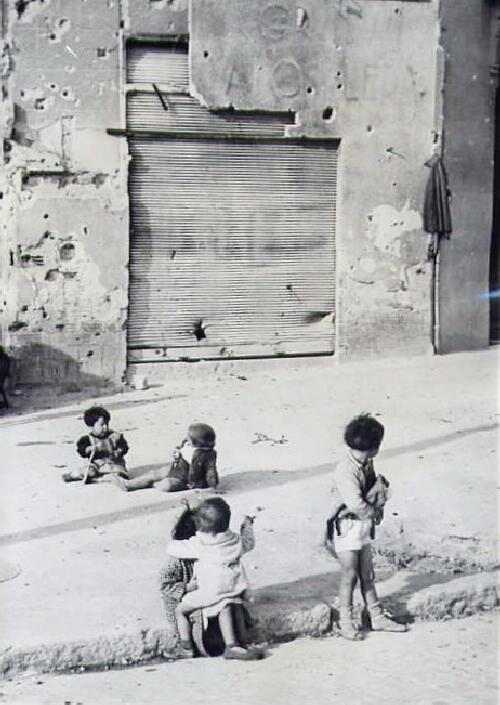
The Spanish Civil War 1936-39) is seen by many as a preview of World War II. It ended (Match 1939) months before World War II broke out in Europe. Spain maintained its neutality and never entered the War. During the first years of the War, Spain sided with the Axis and offered some support. Volunteers participated in the campsaign against the Soviet Union. Franco refused Hitler's demands to let German troops pass through Spain to seize Gibraltar. He also refused German demands to turn over Jews to the NAZI killing machine. Franco kept Spain out of World War II, although it was a close-run thing. He did consider joining Hitler, but was not offered sufficent enducements. In the end it was geographpy that kept Spain out of the War. Its peninsular situation meant it was more exposed to the Royal Navy than any other country on the Continent and thus more threatened. And Hitler's fixation on the East meant that he was not going to delay his plans with a distracting invasion in the West. It also mean that the NAZIs were forced to pay for the resources, espcially wolfram obtained from Spain. While Spain stayed out of the War, children were still affected by the ligering impact of the Civil War.
The Germans beginning in 1936 were active in Spain helping Franco establish a Fascist regime. Fighting began in Spain in July 1936. Spanish Generals Francisco Franco and Quiepo de Llano revolted against a new left-wing Republican Government elected in Madrid. Franco appealed for help. Hitler immeduately ordered Luftwaffe transport plans to transport Franco's loyalist troops in Morroco to participate in the fighting. He saw a left-wing government in Madrid as harful
to the Reich, aiding the French policy of encirclement. [Davidson, pp. 57-58.] Both Italy and Germany were soon sending arms and men to the loyalists and provided important air elements. The defenseless Basque village of Guernica was the first European city to be destroyed by the Luftwaffe. The democracies and League of Nations respnded with an arms embargo. Only the Soviets aided the Republic. The Spanish Civil War finally ended with the surrender of the republican forces in Madrid (March 28, 1939).
Francisco Franco was a Spain's most respected soldier and decided to join a military coup against Spain's democratically electdm but increasinly left-wing governmnt. This led to the Spanish Civil War (1936-39), a run up to Wold War II. Franco is generally seen as a Fascist dictaor because of the support providd by Hitler and Missolini and the regime's trappings. Francisco was born in El Ferrol (1892). His father following a family traitoon was an officer in the Spanish Navy. His mother was a dvoted, upper-middle-class Roman Catholic. Francisco planed to follow the family tradition and enter the Navy as well. The Spanish-Americn War (1898-99) intervened. The Spanish fleet was largely destroyed in the War. With such a reduced fleet, fewer officers were needed which meant reduced admissions were accepted at the Naval Academy. Francisco still bent on a military career decuded instead on the Ary. Francisco at 14 years of age entered the Infantry Academy at Toledo (1907). He graduated 3 years later )1910). He immeitely volunteered for active duty in the campaigns ahinst the Rift Tribes in Spanish Morocco. He was stationed there (1912). This was the only place the army was knvolved in combat and the place for a young officer to make his name. It was dangerous service, but he proved an effective commander an played a key role in the Spnish victory. He rose rapidly and became the youngest general in the army and the most respected Spanish commander. Like many Spanish officers, he found himself, a right-wing Catholic monarchist, in a left-wing, increasing secular republic. Republican officials tried to demote him, but he was appointe chief of staff of the Spanish Army (1935). He used his office to purge the army command of left-wing Reoublican sympathizers. figures and strengthened military institutions. When Republicn authorities began mocing against the right-wing Army, Franco joined a military coup. This led to the Civil War (1936-39). The coup may hve failed with out extensive military support from Hitler and Mussolini. Germany's newLufrtwaffe and Panzers got their first trial in Soain. The Democracies failed to support the Republic, although the Soviet Union provided aid. Franco gained control of Spain, installing a military dictatorship (1939). Many including Hitler, expected Franco to join the Axis. He declined to do so nd unlike other Fascist leaders, protected not only Spanish Jews, but fireign Jews who managed to reach Spain. He ruled spain for neatly four decades until his death in 1975.
Spain was another example of the wave of Fascism that swept Europe in tyhe 1930s. Franco assumed a presidency and proceeded to establish a dictatotrial regime. Spain had been devestated by the War and Franco confronted the task of rebuilding a shatered country. About 0.5 million people, mostly men, who had fought for the Republic fearing reprisals fled the country. The French set up camps for them across the border. Franco set up concentration camps referred to as labor camps for those who has supported the Republic. Thousands were incarcerated. Many died in the camps. There were summary executions that went on for years. Both men and women were incarcerated. Mothers could keep their children with them in prisons until they reached age 5. At that age they were transferred to boarding schools where they were taught to be both Catholic and Fascists. Children could visit their incarcerated fathers two times a year. The autonomous status of Catalonia and the Basque Country was repealed. As part of this process, publication and education in the Catalan language was prohibited. Franco made the Falangist Party the governing party and incorporated a range of right-wing and Catholic groups. Fanco became El Caudillo (the leader) and the Falangists in Fascist traditiion became the Blue Shirts, copying the decives of Italian Fascists and German NAZIs. Franco's rule brought stability to Spain, but the economy was slow to recover.
Stability did not bring economic prosperity to Spain. The edconomy was devestayed by the Civil War. The economy recovered only slowly from the damage to the country's physical infrastructure. There were food shortages that persisted throughout the World War II which followed the Civil War. More than 80 food products were rationed. Milk for children in particular was in short supply. The Franco regime found a variety of excuses for the poor economy: Civuil War damage and drought. The principal reason, however, was mismanagement of the economy by Franco's bureaucracy heavily staffed with military officers with no background or great interest in economic matters. Franco also persued Fascist policvies of autarchy and sponsored expensive and ultimately unsuccessful programs aimed at making Spsain self-sufficient in all economic sectors. Another problem was that skillked workers and engineers, which had largely supported the Republic, were politically suspect and thus largely excluded from giovernmental processes. The poorly run state-controlled economy proved so inefficent that the black market became a flourishing economic sector.
NAZI Germany negotiated the Anti-Cominternn Pact with Japan (1936). Italy also joined the Pact (1937). Franco who saw the Civil War as a struggle against Goldless Communism agreed to join the the Pact (March 1939) This in effect expanded the secret treaties for diplomatic and economic cooperation that had been concluded with the NAZIs during the Civil War (March and July 1937).
World War II began with the German invasion of Poland (September 1, 1939). When the German's launched their Western Offensive, Spain unlike Italy took no overt action against the Allies. The only exception was that as Paris fell, the Spanish seized Tangier, Morocco which had been a free city under international control (June 14, 1940). Franco must have been astonished at the NAZI successes. It also meant that if Franco did not joint Hitler that Spain would also be hreatened by him.
Spain also provided economic support for the German war effort. Spain was not occupied by the NAZIs and thus could not be pilaged as was NAZI policy in occupied countries. Reuch Marshal Herman G�ring and his representative Johannes Bernhardt set up a trading company in Spain, the Sociedad Hispano-Marroqui de Transportes (HISMA), during the early stage of the Civil War (1936). The company managed trade in a manner highly advantageous to the NAZIs. The Germans had military equipment to offer at a time other countries had embargoed shipments to Spain. Franco authorized the shipment of mineral resources and other raw materials to the Germans to pay for the military equipment, much of it obsolete equipment no longer needed by the Germans. As a result of the Civil War, Franco had incurred substantial debts to the Germans. After World War II had begun, Franco approved an economic treaty with Germany. He promised to reserve the greater part of Spain's for trade with Germany (December 22, 1939). Of special oncern to the NAZIs were mineral resources (iron ore, zinc, lead, mercury, and wolfram). Also important were wool, and hides. The German victory in France, meant that Spanish raw materials could be shipped by rail to Germany.
Franco with the staggering German success in France, showed his sympathies with the Axis. He announced Spain's oficial position had changed fron neutraliry to nonbelligerency (June 13, 1940). This was, however, not yet a declaration of war. Nonbelligerency involved self-interested collaboration with the NAZIs, without the dangers of war with the British. It also did not preclude the option of entering the War. Franco seized French Tangier. Franco nindeed was prepared to enter the War--at a price. He informed the Germans that he would bring Spain into the War against Britain, the only country still resisting the NAZIs. But Franco wanted not only Gibraltar which Hitler could have countenanced, but French-controlled Morocco and other African territories. This was a price Hitler was unprepared to pay.
The Battle of Britain was surely a key factor in Franco's decesion about entering the War. Franco mut have noted the NAZI failure to subdue Britain in the Battle of Britain (July-September 1940). We do not know preciseky how he interpreted the British success. Hitler still controlled the Continent. But the British victory was one of tactics abnd technology. It meant that a German victory in the War was by no means a sure thing. It is very likely that a German victory would have changed Franco's calclations. It certainly would have affected his rommom for maneur as there no longer would have been any serious opposition to Germany in western Europe.
Hitlers calculations changed significantly suring the summer and early fall of 1940. After the fall of France it looked like he had won the War and that Britain would soon have the good sence to fall in line. In such aituation, he did not need Spain and given the NAZI dominance would have the leverage to force Spain to dutifully comply. The Battle of Britain changed thos calculation. Spanish participation in the War was now more useful and Franco had more leverage. Hitler despite the German successes did not have a free hand in meeting Spanish demands. He faced a very complicated priblem. His Italian ally was making demands on French North Africa. And there was Vichy to consider. Hitler was now turing his attention on the Soviet Union and Vichy's support for a war in the East would be a huge nenefit. If he turned over French possessions to Spain he wouls alienate P�tain an Vichy. And colonial officials might well switch loyalties from Vicy to the Free French. Further complicating the situation was Germany's own colonial aspirations. German had lost its Africazn colonies after World war I. While he was preoccupied with the East, he and other NAZO officials had mot forgotten the lost colonies. This further affected his willingness to meet Franco's demands.
Franco was willing to enter the War even after the German failure in the Battle of Britain. But he continued to demand substantiual territirial enducenents beyond Gibraltar. Of course, he had to calculate just how much he could stabhd up to Hitler. With the Whermacht on the Spanish border, he had to consider a German invasion to force compliance. Hitler's goals were impaired by several factors. One, the British had defeated the Luftwaffe in the skies over England. This must have given Franco come pause concerning the inevitability of Germnan victory. Two, geographically Spain is a peninsula jutting west into the Atlantic. If Spain entered the War that unlike Germany that it would be exposed to the Royal Navy.
Spain if it entered the War would be exposed to the Royal Navy attaxks and a naval emargo which would damage its still shaky economy. Three, Franco had been briefed by Abwehr (German military intelligence) commander Admiral Canaris. Franco and Canaris had become close during the Civil War. Canaris had been apauled by the NAZI brutality he had witnessed in Poland. He told Franco privately that Hitler was now obsessed with Russia and would not risk any kind of diversion in Spain. Thus Franco refused to be cowed by Hitler. Without substantial German enducements, Franco saw little to be gained by entering the War and a great deal to be lost. He would have been unable to protect the Canary Islands from the Royal Navy.
The German F�hrer traveled by rail to Hendaye on the Franco-Spanish border to meet with Franco. Hitler had made his decession to invade the Soviet Union and wanted to gain the support of his allies. He assumed that Franco, who he had helped to install in power, would join his anti-Bolshevick campaign. When Franco and Hitler met, Franco did not reject Hitler's entreaties to enter the War. He did continued his expansive demands. Franco demanded more colonies in Africa at Vichy's expense. Franco wanted French Morocco, parts of French Algeria and an expansion of Spanish Guinea. Hitler rejected these demands as it would complicated his rellationship with Vicy. The French Vichy Govdrnment was beginning to cooperate with German war effort and Hitler still hoped to gain control over the French fleet. Hitler and Franco also discussed "Operation Felix", a German plan to seize British-held Gibraltar. Franco argued that it made no sence in closing the front door of the Meditterean as long as the British controlled the back door (Suez). In their discussions, Franco went on an on about Spaon's hostoric claims to North Africa. Hitler not suprisingly was unmoved. He saw the Spanish demands as petty at a time Europe's furure was being decided. He refused to make any specific commitments. Hitler was not accustomed to be spoken to as Franco did. He was more than anoyed. Hitler told Musolini that, "I would rathger have three or four teeth extracted than go through that again." [Goda] After the meeting with Franco, he traveled on to meet with Petain and Mussolini which also proved to be frustrating exercizes for the F�hrer.
After the cancellation of Operation Sea Lion raised the question of how to defeat the British if invasion was not possible. Hitler met with Mussolini at the Brenner Pass (October 4, 1940). The two discussed how to best defeat the British. The outcome was a plan to redraw the map of the Mediterranean. The NAZIs pushed Franco to activate the German-designed Operation Felix (February 1941). This involved the seizure of Gibraltar which would have greatly impaired the Royal Navy's ability to operate in the Mediterrean. Without Gibraltar the critical British position at Malta would have been untenable. Franco was, however, disatisfied with the enducements Hitler offered. While anxious to reclaim Gibraltar, Hitler offered little else and Franco correctly assessed the dangers of entering the War. Spanish officials told the NAZIs that their forces were not yet prepared to participate in Operation Felix.
There was not battle fought over Bibraltar soit is not readily apparnt jus how important it was to the llies. Gibraltar was high on the list of what Franco hoped to achieve. But this meant going to war with Britain. Ultimately he did not judge it worth the risk. And alloing the Germans in to assist with an assult on Gibraltar, he understood would would make Spain an ocupied country. Fortunatly for Framco and Spain, Hitler'sfocus was on the East abd he not share Adm. Raeder's assessment of the importance of Gibraltar. The major impact, however, would have been Gibraltar. The British could not have held Gibraltar in the face of a determined Spanish assault as the Germans if necessary would have supported it. And without Gibraltar, the British could not have held Malta. And without Malta, far more supplies would have gotten through to Rommel and the Afrika Korps. Given that Rommel came very close to seizing Suez as it was, with Malta in Axis hands, it is likely that he would have succeeded. Gibraltar was an important British naval base, helping to support Allied convvoys heading into and coming out of the South Atlantic. It was also vital as a staging area in support of Malta, a small island syrrounded by Axis and Vichy territory. Gibraltar also served as an important staging area for Operation Torch.
Spanish Fascists were surprised if not shocked when Franco failed to either join the Axis or enbter the War. They had much wider goals than remaking Spain. They wanted to revive the grandeur of the Spanish Empire. They wanted to mobilize and become part of the forces that that were reshaping Europe. The fall of France seemed to open opportunities to spread abroad. Rafarel Gsrvia Serrano, a key Falange leader, wrote extenively about vthe New Europe. Garcia's New Europe included an impoirtant role for the Church. Falange leaders failed to see as Franco seems o have seen. that Spain in a NAZI-dominated Europe rather than being a major force would be one of many countries subject to NAZI dictates.
The Battle of Britain in many ways changed the course of the War. An invasion of Britain was impossible without air superiority. Hitler, fearing a cross-Channel invasion, decided that the only way to force the British to seek terms was to destroy he Soviet Union. This was his principal goal from the beginning, in that it was in the East he foresaw obtainig the Lebensraum he was convinced Germany needed. He began shifting the Wehrmacht eastward to face the enemy that he had longed to fight from the onset--Soviet Russia. The nature of the War changed decisevely in the second half of 1941. The Germans invaded Russia in
June 1941, launching the most sweeping military campaign in history. Stalin ignored warnings from the British who as a result of Ultra had details on the German preparations. Stalin was convinced that the the British and Americans were trying to draw him into the War and until the actual attack could not believe that Hitler would attack him. The attack was an enormous tactical success. The Soviets were surprised and devestated. While Franco refused to formally enter the War. He did support the NAZI war effort by supplying raw materials and workers to the Germans. He also allowed volunteers to sign up to fight with the Germans. The Blue Division perfomed well on the Eastern Front, but suffered substantial casulalties.
Franco proved to be a much more astute political leader than Mussolini who pinned his star on Germany and entered the War (June 1940). The Failure of Barbarossa before Moscow and the entry of the United States in the War (December 1941) must have seen as further reason for caution. Franco surely wanted to see the Soviet Union destroyed, but after Hendaye he must have seen Hitler as a danger, perhaps a greater danger than the Western Allies. He must have known about Operaion Felix. Franco did not leave a written record of his calculations during this period so we do not have an actual record of his calculation. He must seen as the war progressed the dangers and cost of joining Germany in the war. What may not have been entirely clear in 1940 were the dangers in joining the Axis. Italy would pay dearly for Mussolini's decesion to enter the War as would the other Axis allies. Countries that joined Germany would find it difficult if not impossible to terminate the relationship. Also countries that joined the Axis would find that their economic contribution the the war effort would be uncompensated. As a neutral, Spain could make Germany pay for the war material shipped to the Reich. It is unclear how much detail Franco had azbout economic relations between Germany and its Axis allies.
Franco supported the Axis war effort in a number of ways. After thecfall of France, Franco moved from neutrality to non-belgerancy. lthough pressured by Hitler, Franco decided to stay out of the War. He did offer militry, economic, and cultural support for the NAZI war effort. Franco deployed a division to fight with the Germans on the Eastern Front. Spain was a mahor source of tungsten (wolfram), a critical metal for weapons grade steel.
Despite pressure from Hitler, he refused after he fall of France to declare war on Britain and allow German forces to move through Spaon and seize Gibraltar. Franco supported Hitler's anti-Bolshevick campaign, although he was not prepared to involve Spain in the War without enducements Hitler refused to provide. Franco did allow the formation of a volunteer force, the Division Azul (Blue Divion) which was subsequently remamed the the Blue Legion. The Division was named after the Falangist Blue shirts. It's performance to Hitler's suprise, was impressive. We do not have details on Spanish support for German U-boats. As a neutral, Spain should not have allowed U-boas to resupply in its ports. As far as we can determine this was not done, although there may have been covert operations. Franco ordered that German U-boats not be resupplied in the Canaries (July 1941). Spanish military losses in World War II are estimated at 12,000 military, almost all on the Eastern Front.
Spain also provided the Germans about 100,000 workers to maintain German war production. This was done voluntarily and the Germans had to pay the Spanish workers. About 10,000 civilian war workers died in Germany, most from the Allied strategic bombing campaign. Spain also shipped food and raw material to the Germans. The most important product was wolfram (tungsten) needed for weapons-grade steel. Unlike most other countries cooperating with the Axis, the NAZIs were forced to pay for what they purchased there.
Pilar Primo de Rivera and other Falangests were allowed considerable room to pursue political activity. This even included criticism of the Givernment. Primo de Rivera was the leader of the Women's Section of the Falange. She was stidently pro-Nazi. She was concerned about Franco's appointments, specifically that he was appointing too many monarchists and too few Falangists to his cabinet and other important posts. She openly protested Franco's policies (May 1941). She was too popular for Franco to arrest. As a result, he began appointing more Falangists. Pilar Primo de Rivera pushed for Spain to enter the war. She also attempted to support the NAZIs within Spain and expanded economic and cultural exchanges with Germany. Expanded cultural contacts were opposed by Cardinal Segura and Cardinal Goma, the leaders of the Catholic Church. Both supported Franco, but condemned NAZI Germany. They were not particularly opposed to dictatorship, but the increasingly pagan direction of the NAZIs and actions against the Church horrorfied them. They managed to put a stop to a cultural exchange accord that would have exposed Spanish youth to essentialybanti-Christian NAZI culture.
[Bowen. Spain during ...]
Franco secured from Vichy France the return of Spanish Republicans which had been interned in France. Many were then incarcerated in Spanish concentration camps.
The Spanish like most other neutals had no desire to be burndened with large numbers of refugees. The country was devestated in the Civil War and had major problems dealing with the basic needs of its own people. Another oroblem was that most of the refugees were anti-Fascist or Jewish, As a result there were strict rules on visas and constant changes on those regulations. Many refugees had to be smuggled into Spain. Many anti-NAZI refugees were able to get to Spain. Anti-NAZI French were able to reach the Free French through Spain. Some Allied air crews were also able to escape from occupied France through Spain.
There was one area in which Franco refused to assist the NAZIs. He refused to turn over Jews to them, both Spanish and foreign Jews that had managed tgo cross thge French border. The NAZIs could demand the authorities in occupieec countries turn over their Jews and also did so in countries allied to them. Franco in fact probably saved more saved more Jews than any other Ruropean country. He did close the Spanish border in an act of solidarity with the NAZIs, but allowed Jews and others with Portuguese visas to transit Spain.
Axis military operations achieved considerable success in early 1942. The Japanese after Pear Harbor swept thtought the Pacific and took the British bastion at Singapore. The Japanese defeated the Americans in the Ohilippines, seized the Duthch East Indies with the important oil fields, and defeated the British in Burma. Rommel took Tobruk and moved toward Egypt and Suez. The Germans again achieved spectacular successes in their in their 1942 Summer campaign in Russia. Then the tide tirned. First the America Navy inflicted a devestating defeat on the Imperial Navy at Midway (May 1942). The British Eighth Arnmy defeated the Afrika Koros at El Alemsine (October 1942), American and British forces launched Operation Torch and landed in French-held North Africa (November 1942). The Soviets launched an offensive at Stalingrad (November 1942). The German surrender at Stalingrad (February 1943) and Tunis (May 1943) made it clear that Germany would not win the War, After the Allied seizure of Sicily, Mussolini was ousted (July 1943). Italy asked for an armistace (September 1943).
The Axis reverses in 1942 and esecially 1943 caused Franco to adopt actual neuttral policies. It was clear by 1943 after Stalinngrad that the Germans would not win the War, although it was not yet clear that theu would be totally defeated. Franco did not, however, withdraw the Blue Divion from the Soviet Union until later (August 1944). I am not ure why this was. Franco before D-Day may have been concerned about the NAZI reaction. His hatred of Communism may have been another factor. While Hitler intervened in Italy, he did not do so in Spain, presumably because of the Wehrmacht's diminishing capabilities.
Spain like Switzerland came to be used by top NAZIs as a repository for looted assetts. This began as the NAZI military situation deteriorated. The transactions were, however, much more extebsive in Switzerland. G�ring, Bormann, and other top NAZIs apparently shipped assetts to Spain, although details on these shipments are not available. One journalist claims that Bormann managed the Tierra del Fuego operation to ship NAZI loot to South America, in part through Spain. [Manning, p. 207.] I do not know if this in fact occurred.
The Allied D-Day landings in Normandy and subsequent liberation of France radically changed changed Spain's situation. Franco was cut off from his NAZI associates and the Allies in effect surrounded Spain.
Franco also found his regime diplomatically isolated. The new French Government permitted anti-Franco Spaniards to form a a Spanish Government-in-Exile. The Government was formed by President Jos� Giral. Armed guerilleros crossed the Pyrenees. Don Juan, Count of Barcelona and a descendant of late King Amadeus XIII, demanded that Franco resign. The newly formed United
Bowen, Wayne H. Spain During World War II (2006).
____________. Spainards and NAZI Germany: Collaboration in the New Order (Columbia, Missouri).
Burdick, C. Germany's Military Strategy and Spain in World War II (Syracuse, 1868).
Davidson, Eugene. The Unmaking of Adolf Hitler (Univesity of Missouri: Columbia, 1996), 519p. Goda, N.J.W. "The reluctant belligerant: Franco's Spain and Hitler's War," in C. Kent et. al. eds., The Lion and the Eagle: Interdisplinary Essays on German-Spanish Relations Over the Centuries (London, 2000), pp. 383-96.
Manning, Pauk. Martin Bormann (Stuart, 1981).

Navigate the CIH World War II Section:
[Return to Main World War II S-Z country page]
[Return to Main World War II country page]
[Return to Main World War II page]
[Biographies]
[Campaigns]
[Children]
[Countries]
[Deciding factors]
[Diplomacy]
[Geo-political crisis]
[Economics]
[Home front]
[Intelligence]
[POWs]
[Resistance]
[Race]
[Refugees]
[Technology]
[Totalitarian powers]
[Bibliographies]
[Contributions]
[FAQs]
[Images]
[Links]
[Registration]
[Tools]
[Return to Main World War II page]
[Return to Main war essay page]
[Return to CIH Home page]