|
As the German Panzers cut across France, the British decided to evacuate the BEF. About 400,000 British an French
soldiers began to fall back on French port of Dunkirk on the Belgian border. At this time the BEF was still within Hitler's grasp. It was not just the
number of men that were at stake. The BEF was the professional core--the heart of the British Army. The men of the BEF
would be the officers and NCOs of the British army that would eventually play an important role in defeating the
Germans. The loss of the BEF would have crippled the British war effort if not forced the British to seek terms.
Churchill warned the Commons that it 'should prepare itself for hard and heavy tidings'. The Panzers were only a few
miles south of Dunkirk and facing no serious opposition. Von Rundstedt/Hitler (historians differ) ordered the Panzers to halt. Some believe that Hitler hoped
this gesture would help convince the British to comes to terms, other believe that is was just as it was described at
the time, a needed pause to regroup and prepare for a more coordinated assault. [Davidson, p. 408 and Fest, p. 630.]
What ever the reason, this 48-hour respite allowed the British to organize a defensive perimeter
around Dunkirk and begin an almost miraculous evacuation. Although King Leopold III surrendered the Belgian Army, the French First Army delayed the Germans. The BEF fell back toward Dunkirk, abandoning their equipment along the roads. Nearly 340,000 men were evacuated from Dunkirk, including French and Dutch soldiers. This is even more important that it sounds as almost all if the British soldiers were regulars and would form the corps of the future British Army that would play such an important role in the War. All of the BEF's equipment, however, was lost and there were no
replacements for the lost equipment waiting for them back in England.
The Germans proceeded to conquer virtually all of Western Europe. After a few months of the "Phony War", France's
turn came. The Germans struck on a wide front against the neutral Netherlands, Belgium, and Luxembourg. The terror
bombing of Rotterdam convinced the already hard-pressed Dutch Army to surrender. The British Expeditionary Force (BEF) rushed north to aid the Dutch. The Germans then struck in the Belgian Ardennes which allowed them to avoid the
formidable Maginot Line. The French and Belgians considered the Ardennes impassable to tanks. The Germans managed to
easily penetrate the rough terrine, crossed two substantial rivers, and the XIX Panzer Corps rapidly reached the
English Channel--cutting the BEF off from the French and rendering the Maginot Line useless. The French entrenched
behind the Maginot Line simply could not cope with the explosive highly mobile style of Blitzkrieg warfare. The Panzers
surrounded the Belgian Army which King Leopold III surrendered. The BEF was within Hitler's grasp. Paris soon fell and
the French signed a NAZI imposed armistice. The collapse of France after only a few weeks was a disaster of immense
proportions. It was the French Army that had provided the bulk of the allied War Western Front in World War I. The
German victory was not accomplished with massively superior numbers or weaponry. In fact they had fewer men and tanks.
What they had was a superior tactical doctrine. The Germans were amazed to find, for example, that French tanks were
not even equipped with radios, and a more disciplined fighting force. NAZI propaganda began to describe Hitler as " Der
grösste Feldherr Allerzeiten " (the greatest field commander of all time). [Davidson, p. 483.]
Just as the NAZI blow in the West came, Prime Minister Chamberlain resigned. His position in Parliament had become
untenable. "Go! In the name of God go!" shouted one MP. It was expected that Foreign Minister Lord Halifax would
replace him. But Halifax declined. It is not know why he declined nor has he ever explained. Perhaps he realized he was
not up to the job. Instead the Commons turned to Churchill. Later Churchill wrote, "At last I had the authority to give
direction over the whole scene. I felt as if I were walking with Destiny, and that all my past life had been but a
preparation for this hour and for this trial." Never has a British prime minister taken office in such a crisis. The
news was bad and would get worse. Ambassador Bullit in Paris and Ambassador Kennedy in London cabled Washington with
reports that got worse day by day. Neither had confidence in Churchill or the British. As the weight of the NAZI
offensive fell upon France, Churchill attempted as best he could to keep the French in the War.
Lord John Gort (1886- ), a member of the Anglo-Irish aristocracy and World War I hero, was placed in command of
the British Expeditionary Force (BEF). He was a highly respected officer who had
commanded the Staff College. Interestingly the BEF was the only fully mechanized force involved in the campaign. The
Wehrmacht had a powerful mechanized force, but a substantial part of the Wehrmacht was still not mechanized and relied
on horse-power. (This was still the case a year later when Hitler launched Barbarossa.) fter declaring war, the BEF deployed to France (September 1939). Belgium depite the Workd War I exoerienvce refused to cooperate with the Allies, thinking that this protect them from Hitler. The BEF and French First Army, the most mobile French formation, deployed along the Belgian border. The Allies assumed that any German attack on France would could through Belgium rather than the formidable Maginot Line. Despite the example of Poland, Gort and his command were unprepared for Blitzkrieg when the Germans launched their Western Offensive (May 10). The plan was for the the British and French forces when the Germams struck p advance into Belgium and help defend Belgium. The Germans struck, this time including the Dutch bin their assult. Gort ordered the BEF away from prepared defenses to assist theDutch. The Dutch Army, however, after the bombing of Rotterdam surrendered before the BEF could reach them. This was not, however, the principal German assault. Instead, the Germans attcked through th heanily wooded Ardennes. The French had dismissed this possiubility, judging thev terrain unsuitble for an armoured attack. It wasthus weekly defended. Rather the British abdFrench rushed north into Bdelgium. As planned, the Allies deploye on the Dyle river. But after the Germans attacked in the south withdrew to the Escaut (May 14). The Germabs managed to do the imposible, breking through in the Sedennes and crissingv the Meuse.
The Panzers broke through at Sedan and drove to the Channel. The Panzers were led by legendary German tank
commander General Heinz Guderian. He crossed the Meuse (May 14) and opened a 50-mile gap in the Allied front. The French were just njot prepared fir tge speed of the German azdvnce. It was like botyhing experienced in Wiorld Ear anbd the French were still largekly a Wotld War I army. The Panzers with Rommel in command of one division reached the Channel at Abbeville (May 20). The BEF, Belgians, and French First army, was cut off from the rest of the French Army. This left the position of the BEF untenable. A feeble Allied counter attck failed.
The German drive to the Channel, severed communication between the Allied northern and southern forces. TheGermans had broken out of thed Ardennes and followed the Somme to the Channel at Abbeville. The Allied armies in the north had withdrawn from the Dyle Line which was to be the min Allied line. They had wityhdrawn to the Escaut/Schelde where they were veiung surrounded and cut off from supplies. The British commander, Lord Gortbegsan considering withdrawaing to the Channel. Commanders in London, hoever, were demnding an offensdive avtion. With little preparation or cordination with ther French to the south. He launched an armorefd offensive at Arras to drive through the German corridir cut off the advancing Panzers by reestblishing contvt with the French. No substantial French move toward Aeas materiaslized. It caused some concedrn. Rommel leveled 88mm AA guns and began destroying Vritih tnks. The 88 would bervcome the primary German anti-tank gun throughout the War. The Britisdh just did not have the asrmor strength on their own and the French had spreaf out their tanks rather than concentrting them. Guderian's tanks appeared to have paused a few hours. They reached Boulogne (May 21) and while the battle raged moved toward Calais. Lord Gort decided that the pocket could not be held, and began preparations for a withdrawal of his force (May 23). .
Guderian reaching Abeeville and the Channel (May 20). his had been acguecved in 10 days and only minimal losses. It was an objectibe the Germans Army had been trying to achieve in World War I and failed during 4 yers and the massive loss of men an equipoment. Fully understanding the strategic sutution, he Imediately turned the Pnzers north to seize the Channel ports that the BEF could use for any evacuation effort. These were more tourist and fishing ports than major maritime ports, but they were ports.
The British were rapidky losing Channel ports. The Panzers reached Boulogne (May 21) and while the figting was still going on their they approached Callais (May 22). This was only 22 miles fron Dunkirk. The Germans at this point were closer to Dunkirk than most of the BEF. The Aras offensive appeas to have slowed the drive on Calais. It was just enough time for the British to reinforce the port. The British 30th Infantry Brigade and 3rd Royal Tank Regiment (3rd RTR) reinforced the French and British troops in Calais. It was not enough to hild the port, but it was enbough to mke the Germabs fight for the port and delayed the drive on Dunkirk until the British bf Frenmch had organized defenses and the evacvuation. Even so the Panzers had begun crossing the canal defense line close to Dunkirk when an inexplicable order came from OKW (Msy 24).
Dunkirk was a Channel port in northern France near the Belgian border. It was primarily a fishing port. The
evacuation was conducted from the harbor and beaches near to Dunkirk. Dunkirk because of its relatively small harbor was not the port of choice to evacuate the BEF. The fast moving German Panzers, however, had taken or cut the BEF off from other ports. The Germans seized both Boulogne and Calais with their important ports. The BEF found itself in the position that Dunkirk was the wide beaches nearby as the only remaining coastal area still in Allied hands.
The Panzers were only a few miles south of Dunkirk and facing no serious opposition. Then suddenly the Pamzers not only stopped, but were called back to the canal line just as Guderian was expecting to drive into Dunkirk. He was furious. Von Rundstedt/Hitler (historians differ) ordered the Panzers to halt. Some believe that Hitler hoped this gesture would help convince the British to comes to terms. Or that a BEF surronded in a pocket would be a strong bargaining tool, in essence a hostage. [Costello] Both seem unlikelt. Hitler never seems to have considered a sea evacuation, in part because Göring assured him the Luftwaffe could control the air. Other believe that Von Rundstedt gave the order and Hitler meerly validated it. And that is was just as it was described at the time, a needed pause to regroup and prepare for a more coordinated assault. [Davidson, p. 408 and Fest, p. 630.] This is probably a question which vannot be answered with any surity. Hitler often gave oral orders. And at the time no one in OKW was going to bring up the matter. It would have been a career ender. What ever the reason, this 48-hour respite allowed the British to organize a defensive perimeter around Dunkirk and begin an almost miraculous evacuation. The Luftwaffe was the primary German force attempting to stop the evacuation. The Wehrmacht despite moving on Dunkirk never launched a full-scale attack. Field Marshall Gerd von Rundstadt, the German commander in France at the time, wrote after the War that Hitler's failure to smash the Dunkirk pocket was his first fatal mistake of the war. Rundstadt has to share some of the blame. The Germans after the War had a habit of blaming Hitler for everything that went wrong. He was in fact concerned over the aggressive tactics of Guderian's Panzers. Rommel's Division became known as the Ghost Division because Rundstadt often lost contact with it. Rundstadt wanted the Panzers to slow so the infantry could catch up. Hitler supported Rundstadt. Interestingly Hitler and Rundstadt 4 years later by deploying the Panzers away from the Normandy beachhead and restricting their commitment to the battle which played a major role in the success of the Normandy D-Day invasion (1944).
Meanwhile, the Army was setting up a perimeter around the port. On the 27th, the Germans set up coastal batteries covering part of the main route between Dunkirk and Dover, meaning that transports had to take a longer route. Despite this, the rate of sailings was increased to 2 ships every 3.5 hours. Captain W. G. Tennant was transported to Dunkirk to act as the RN’s representative ashore.
About 400,000 British and French soldiers began to fall back on Dunkirk. As the BEF fell back they abandoned
their equipment along the roads. The British unilaterally decided to evacuate the BEF and French troops fighting
with them. The War Office made the decision to evacuate British forces (May 25). The BEF abd Frencgh Firstr Army was already falling back on Durkirk. Churchill who had just become prime minister 2 weeks earlier ordered the activation of Operation Dynamo.
From the beginning, he was determined to evacuate French as well as British troops. [Churchill, Memoirs, 1959,
p. 278.] Once the decision was made to evacuate, Lord Gort deployed units away from Dunkirk and on the beaches to the
east of the town. His strategy was to hold the Germans away from Dunkirk so the evacuation could proceed. Gort was
re-called to Britain during the evacuation. (Roosevelt would later discuss this with Churchill as he considered
recalling MacArthur from Corregidor.) Gort never received another combat command.
The Admiralty ordered Admiral Bertram Ramsay heading Dover Command to carry out an evacuation , under the code-name Operation Dynamo. Transports had already begun crossing the Channel, removing rear echelon troops. Two ships were crossing between Dunkirk and Dover about every four hours. They were carrying aboutb 1,300 men each time.
Ramsey operated from his headquarters in Diver. Ramsey had been begun gathering shipping (May 20). Ramsey had assembled 693 ships (39 Destroyers, 36 Minesweepers, 77 trawlers, 26 Yachts and a variety of other small craft). Accounts vary. Some authors suggest a somewhat larger force. [Sebag-Montefiore] Most weere British, but Belgian, Dutch, and French ships were involved.
Churchill ordered Admiral Ramsay at Dover to begin amassing small vessels 'in readiness to proceed to ports and inlets on the French coast' (May 20). A wide range of privately owned boats were mobilized for the evacuation. They included motor yachts, fishing boats (smacks and trawlers),cockle boats, lifeboats, paddle steamers, Thames barges, tugs, and many other types of craft. It was without doubt the oddest collection of shipping put together for a World War II operation. The "little ships", many actually boats, are a major part of what has come down as the legend of Dunkirk. Any thing that was serviceable enough to get across the Channel was employed. Many of these ships were commandeered and sailed by Royal Navy personnel. Many of the ships were manned by their owners and other civilians anxious to help the beleaguered BEF and avert disaster.
At this time the BEF was still within Hitler's grasp. It was not just the number of men that were at stake. The BEF was the professional core--the heart of the British Army. The men of the BEF would be the officers and NCOs of the British army that would eventually play an important role in defeating the Germans. The loss of the BEF would have crippled the British war effort if not forced the British to seek terms.
Vice Admiral Ramsay was placed in charge of Operation Dynamo. He dispatched destroyers and transport ships to evacuate the men. Naval planners were not optimistic about what could achieved. They at first thought that only about 30,000 men could be safely brought back across the Channel. [Knowles] Churchill sites an estimate of 45,000 men. He warned the Commons that it "should prepare itself for hard and heavy tidings". [Churchill, Finest,1948, pp. 99-101.]
Many popular accounts of Dunkirk focus on the small boats, undoubtedly an important part of the Dunkirk story. Their heroics, however, would have been for naught had the Dunkirk pocket not have held off the advancing Panzers to give the Royal Navy the tine needed to carry out the evacuation. The British soldiers who held back the Panzers were out-gunned and out-manned, but as one historian maintains, were "the true heroes of Dunkirk". [Sebag-Montefiore] Units defending the pocket were ordered to fight to the last man. And there were considerable casualties. The British suffered 25,000 casualties, killed or wounded. Another 41,000 Britons were captured or missing.
Air power would be a much greater factor in World War II than it had been in World War I. And it began with the Luftwaffe mastery of the skies. The first conflicts were against countries without modern air forces (Poland--September 1939), Denmark--April 1940, and Norway--April 1940). This continued with the Netherlands (May 1940) and Belgium (May 1940). France and Britain had modern air forces, but the conflict on the German border was an unfair test (May 1940). The French spread out their air force so it would not be destroyed on the ground in a surprise attack as was the basic Luftwaffe tactic. That meant when the Germans struck in the Ardennes (May 10 1940), the French air force was not a major factor. The small RAF contingent was likewise overwhelmed because a defensive posture without early warning systems meant certain failure. The air conflict over Dunkirk was the first true test of the RAF and Luftwaffe. They were both operating at a distance from their bases and without early guidance systems--most notably the British Chain Home System. German air chief Göring promised Hitler that he would destroy the British-French pocket on the ground. It was the perfect set up for the Luftwaffe with defenseless men massed together on the beaches. Göring was Hitler's closer associate and victory would have burnished not only Göring's image, but the NAZI image as opposed to the Heer which was not as Nazified as the Luftwaffe headed by Göring. Little noted as the time is how flatly Göring and the Luftwaffe failed the Führer in a operation that the Panzers could have easily accomplished, but in the process lost more aircraft than the RAF. It was the opening phase of the Battle of Britain and the Germans ignored the results, focusing on their victories on the French-German border. Entirely missed ny the Germns was that the Luftwaffe's strength was short range tactical operations, but was not well suited for longer-range strategic operations.
One of the most neglected aspect of the Dunkirk Miracle is the rol of the French First Army in delaying the German advance. It was the the strongest formtion in the French Army and best equipped. It was commanded by General Georges Blanchard nd inckded the Cavalry Corps, and the 3rd, 4th, and 5th Army Corps, as well as the 1re Division Cuirassée (1st DCR, effectively an armoured division with four battalions of tanks and one of infantry, plus supporting units) and 32nd Infantry Division. [Leulliot] Along with the BEF. the First Army moved north to stop the German armies invading the Netherlands and Belgium. Like the BEF, its effectiveness was compromised by Belgiums refusal to cooperate before the Germans attacked. It would be part of the llied force trapped in what became the Dunkirk pocket. Much of the First Army was trpped at Lille, but counterattacked and resisted fiercely. This delating ction was vital to the sucess of the Dunkirk evcuation. Gen. Jean-Baptiste Molinié's with 40,000 men engaged seven German divisions (including the 4th, 5th, and 7th Panzer Divisions, roughly 110,000 men and 800 tanks). An incresible milirary feat. They captured General Fritz Kuhne of the German 253rd Infantry Division. This delsayed the Germns fir san estinared 3 days, One author claimns that the First Army's last battle permitted the evacuation of an additional 100,000 men from Dunkirk. [Shirer, p. 746.] The First Army ceased to exist (May 29), athough some of the men escaped with the BEF and other Frencvh soldiers.
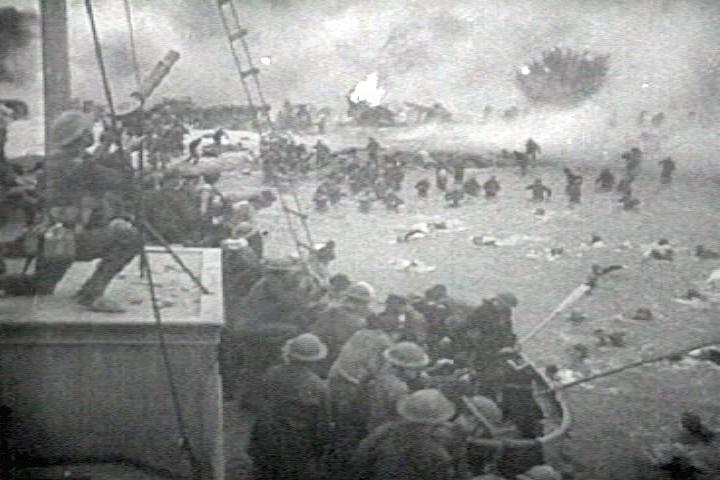
Admiral Ramsey activated Operation Dynamo (May 26). The evacuations were conducted from the Dunkirk port and its adjoining beaches. The first men from the BEF were brought home at night (May 26) reaching Briotain (May 27). The initial evacuations did not go well. Luftwaffe attacks sunk ships in the small harbor. The harbor was thus partially blocked by sunken ships. The Royal Navy had to shift to the surrounding beaches. The next day a call went out for small craft (May 27). The Navy found quite a number. Churchill writes, "... a great tide of small vessels began to flow towards the sea, first to our Channel ports, and thence to the beaches of Dunkirk and the beloved Army." [Churchill, Finest, 1948, p. 101.] Taking the men off the beaches was at first thought to be impossible because the water was so shallow. Here the fleet of little ships proved to be a God-send. The little ships with their shallow draft could go close enough in that the men could wade to them. They ferried the men off to the destroyers and other ships waiting offshore in deeper water. Some of the larger boats were able to taken men back across the Channel on their own.
The Dunkirk evacuation was a unilateral British decision. There were other options. The British and French troops in the Dunkirk pocket could have tried to breakout by attacking o the south. The surrender if the Belgian Army, however, probably made that impossible. The apparent preference the Royal Navy gave to British forces caused complaints by the French and some lingering resentment. Churchill insists that he was concerned from the beginning about embarking French as well as British troops. [Churchill, Memoirs, 1959, p. 278.] He reports this was because the administrative troops behind the front-line combat troops were mostly British. that French Admiral François Darlan agreed that the British troops should be given preference. Churchill flew to Paris and intervened at a meeting in Paris to order that the evacuation should proceed on equal terms and the British would form the rearguard (May 31). [Churchill, Memoirs, 1959, pp. 279-280.] Churchill writes, 'Bras dessus bras dessous." Marshall Pétain showed up at these meetings for the first time. As it turned out, the 35,000 men who finally surrendered to the Germans after protecting the evacuation were largely French French. Their desperate resistance allowed to extend the evacuation effort through June 4 and were the real heroes of Dunkirk.
Britain faced what many felt was certain defeat. At this time Britain could have made a deal with Hitler. Lord
Halifax thought Britain had little choice. Halifax was Britain's Foreign Secretary and had supported Chamberlain's
policy of appeasement to avoid another war with Germany. One of the unanswered questions about the War is why Halifax did not replace Chamberlain as prime minister. He was next in line and could have been prime minister rather than Churchill, yet he declined. No one knows why. Some believe he thought he was not up to the task. It may well be that as the German Wester offensive fell (May 10) that he did not want to be the prime minister presiding over a defeated Britain. Hitler admired the British. He would have offered an arrangement more
attractive than that offered France. Britain could have kept its fleet and much of the Empire. Hitler in the end did not want war with Britain. He wanted to secure his western front so he could focus on the Soviet Union in the east. Churchill refused, however, to treat with Hitler and the NAZIs. He was determined to resist as dire as the
circumstances. Halifax and others in the war Cabinet believed that Britain should deal with Hitler. Churchill was
narrowly able to bring the War Cabinet with him. There would be no British Vichy. There was some support in Britain for reaching an understanding with Hitler. Some of the moneyed class saw Hitler and the NAZIs as a way of controlling the working class and confronting Bolshevism. In the end Britain would be saved, not by the gentry, but the minors, workers, and common people often living in squalid city slums. [Jesson] That commitment was to be shown by London's East End when the Blitz commenced. Churchill after the RAF had defeated the Luftwaffe and
defeat was no longer eminent, replaced Halifax with a close ally, Anthony Eden. Halifax was disposed of by being made ambassador to the United States, a deft political move.
Belgium remained strictly neutral, but was invaded by the Germans for a second time (May 10, 1940). The Germans struck at both the Netherlands and Belgium at the same time. It was the start of the long anticipated German offensive in the West. After a few months of the "Phony War", it was the turn of the Low Lands and France. The German initiated their long awaited western campaign on a wide front against the neutral Netherlands, Belgium, and Luxembourg. The Luftwaffe played a key role in the German success in the west. King Leopold before the War had promoted the construction of important defensive fortifications from Antwerp to Namur in front of the German border. These defenses were quickly taken by the Germans. The British Expeditionary Force rushed north to assist the Dutch. This meant that they were not present in force to opposed the Germans when they broke through in the Ardennes. Leopold, with the bulk of the Belgian Army, was surrounded by the Germans, and capitulated (March 28). Leopold ordered his army to surrender and refused to flee with officials to form a government-in-exile in England. His actions were resented by some Belgians. His surrender at a crucial point in the battle for the low countries left a critical gap in the Allied ring around Dunkirk and could have made the evacuation impossible if the Germans had pressed their attack.
The Admiralty as it began preoarations for an evcuation believed that only a few thousand men could be brought home to dafety. Asit turned out, nearly 340,000 men were evacuated from Dunkirk, mostly British and French and few Dutch soldiers. About 140,000 of the total were French troops. This mneant that something like 85 percent if the BEF was saved. The French evacuees were less important because French authorities demanded they be repatriated. They were, but basiclly marched straight into German POW campos. The evacuation was important not just brcause of the nunbers, but because of who the men were . Almost all of the British soldiers were regulars and would form the corps of the future British Army that would play such an important role in the War. The British War Cabinet decided to continue the War (August 28), but that would have been difficult without the Army. All of the BEF's heavy equipment, however, was lost and there was no replacements for the lost equipment waiting for them back in England. Thus for several months the British had been stripped of their arms, little to resist a German invasion beyond the RAF. There was the Royal Naby, but brining the Royl Naby into the Channel would have neant heavyb losses at a time the Battle if theArklabtuic was shaping up.
World War II images show vast quantities of vehicles and equipment lining the roads into Dunkirk and lining the beaches. All the attention at the time and even today was getting the men to safety. But the vehicles and equipment are important as well. The Brutish Army at the time of World War I was the only fully mobilized army in the world, including the U.S. Army. The French First Army was fighting with the BEF was the most motorized formalin in the French Army. They also left vehicles and equipment behind. The Germany Army was not nearly as mechanized despite a few powerful armored divisions as all of Göebells propaganda films. Most of the German Army was unmotorized infantry using horse-drawn carts. This did not show up in the quick victories achieved in the narrow dimensions in the West. But even before the War, Hitler's mind was focused on the East and soon after the Battle of Britain (July-September 1940) he ordered planning for the invasion of the Soviet Union--Operation Barbarossa. And for Barbarossa vehicles would be needed. As the Germans had been so successful in the West and had such disdain fir the Soviets, they largely ignored the obvious. But they were not unaware of the problem. They used vehicles obtained in the West. And Barbarossa would be the decisive campaign of the War. Thus the question of arises as to how much of the BEF's equipment and vehicles were left in usable condition. We know that much of it was destroyed but we do not have a good feel for how much. The French Army was not as motorized as the British, but they had large numbers of tanks, artillery and vehicles and three weeks after Dunkirk, they signed as armistice, basically a surrender. Much of this equipment and material was turned over to the Germans was of great value. The a href="/essay/war/ww2/camp/axis/ns-coop.html">NAZI-Soviet alliance agreed to by Stalin was based on hiss cynical calculation that the Germans and Allies would fight a debilitating war on the Western Front again as they did in World War I. This would allow him to pick up the pieces. Stalin even supplied Hitler with the oil and critical natural resources needed to fight the battles in the West. When he did not expect was for the Germans to gain easy victories in only weeks and emerge much stronger and now he faced the Germans without a continental western front. As it worked out Hitler would have to divert huge resources to the Ma href="/essay/war/ww2/air/eur/sbc/eco/sbc-gie.html">War in the West, but the Soviet people would play a huge price for Stalin's flirtation with Hitler.
Among the small boats that came to the rescue of the BEF were a number of youths. Perhaps the youngest was Albert Barnes who was only 14 years old at the time. Albert had left school to take a job as a galley boy on the docking tugboat Sun XII. He reported for work one morning and without any advance warning was told the tug was headed to France towing two sailing barges loaded with ammunition and drinking-water. There was no time to tell his parents. When they arrived in Dunkirk, the evacuation was in full swing. Albert reported seeing "sunken vessels everywhere". He describes, "Bodies floating, bombs and shells going off. And the noise - it was absolutely horrific. Till then the loudest bangs I'd heard had been on Bonfire Night. .... We saw some pretty bad sights. .... Mr Barnes recalls the thousands of soldiers trapped on the beach. "And I remember the dead ones too because they were floating everywhere. .... I was very frightened, terrified in fact, because there were German dive-bombers all around us. Being rescue tugs we saw some pretty bad sights, especially seeing tankers go up. That's something I'll never forget - watching a tanker go from a ship to a mass of flames. I was very frightened, terrified in fact, because there were German dive-bombers all around us. But we just got on with the job." Two weeks later Albert returned home. "'Where the hell have you been?' his mother asked. He told her, "I've been to France' because Dunkirk wasn't well known in those days. She looked amazed and said 'You've never been to Dunkirk?' and I said, 'Oh that's it, that's the place.' 'Oh my God' she said." [Lewis]
As the storm broke in France and the Germans launched their Western offendive (May 10). The British people had no idea how bad the developing situaton was. It all hppened so fast. The Germns broke thriugh at Sesan (May 15). Germans forces led by Gen. Erwin Rommel reached Abbeville on the Channel (May 20). A half-hearted 0rtitish-French counter attack failed. The evacuation begn (may 36). The call for small boats went out (May 27). Only st this time did the public begin to become warare of the impending diusaster. Only small numbers oof evacuees arrive (May 27-28), but then reallsubstnyiall numers begn arricing (May 29-June 1). Lesser numbers arrived (June 2-4). Most of the men ewere labded in ports (240,000), but substantil numbers were landed on beaches (nearly 100,000). The nen were exhausted, hungry, and thirsty. There were wounded among them who received emergency care. Most were transported by rail north to receiving centers. They were jubilently received at train stations all the way through London and the north. Women, men, and children cheered them and plyed them with tea (of couse) and eats. This ws not orgabized by the Goverment, it was civilians acting on their own. By this time the public knew what had happened nd how close the BEF had come to distruction. It took several days to the 340,000 north from the Channel mports abd beaches. Units were all jumbled up and had to be put together agin. Many were llowed home leave, but were soon back in their barracks training as Britain now had to begin thinking about the e expected invasion.
The British papers treated Dunkirk was a victory. It was not victory, only a narrow escape. But perhaps the most
important escape in history. Churchill spoke to the Commons a few days later stressing in no uncertain terms what was to come. "Even though large tracts of Europe and many old and famous states have fallen or may fall into the grip of the Gestapo and all the odious apparatus of Nazi rule, we shall not flag or fail. We shall go on to the end. We shall fight in France, we shall fight on the seas and oceans, we shall fight with growing confidence and growing strength in the air, we shall defend our island, whatever the cost may be. We shall fight in the fields and in the streets, we shall fight in the hills, we shall never surrender, and even if, which I do not for a minute believe, this island or a large part of it were subjected and starving, then our Empire beyond the seas, armed and guarded by the British fleet, would carry on the struggle, until, in God's good time, the new world, with all its power and might, steps forth to the rescue and the liberation of the old." (June 4, 1940)
Some 140,000 French troops were evacuated along with the British t Dunkirk, about a third of the men evacuated. After they arrived in Britain they were moved by rail to Army camps scattered throughout southwestern England. Here they were temporarily billeted. We believed that the men were given the choice to remain in Britain and continue the war there, but we do not yet have details on this. Almost all of the French soldiers chose to be repatriated. British ships ferried those French troops choosing to return to France to Brest, Cherbourg, and other ports in Normandy and Brittany still in French hands. The French only deployed about half of the repatriated men against the advancing Germans before they surrendered to the Germans (June 22). Thus the Dunkirk evacuation for the French only delayed becoming POWs by three weeks. Dunkirt did not prove to be a salvation, but represented only a few weeks' delay before being made POWs by the German army after their return in France. [Mordal, p. 496.] Only about 3,000 French troops chose to stay in Britain and continue the War. [Nadeau and Barlow, p. 89.] It is not clear, however, how well they understood that the French Government was about to surrender to the Germans or what instructions they were given by their commanders. Despite this very large influx of French troops, DeGualle at the end of the year was still a very lonely figure with only about 7,000 men joining with him. The French shocked by defeat generally turned Marshall Pétain and his Vichy regime.
About six out of every seven men in the Dunkirk pocket were successfully evacuated. The rest became POWs. Most of these men had to endure forced marches into the Reich. The men after the War reported brutal treatment by their guards. This was overseen by the Wehrmacht, not the SS. There were reports of beatings, starvation, and even executions. The German campaign in the West, with the exception of Luftwaffe terror bombing and strafing of refugees, is generally depicted as observing the rules of war. One author notes that the Germans in the Dunkirk campaign massacred prisoners. [Sebag-Montefiore] The British POWs reported after the War that the French POWs were given preferential treatment. [Longden, p. 367.] The British even complained that the German guards kicked over buckets of water that had been left at the roadside by Belgian civilians. [Longden, p. 361.] Many of the POWs were marched to the town of Trier, across the Moselle from Luxembourg. For many it was a march of 20 days. Some were marched to the river Scheldt and then sent on by barge to the Ruhr. The POWs were then transported rail to POW camps scattered throughout the Reich. Most of the enlisted me under the rank of corporal were forced to worked in German war industry and agriculture in violation of the Geneva Convention.
Dunkirk was central to the Allied World War II victory and even more so to the survival of Western Democracy after the War. The BEF was essentially the British Army. Without the BEF back in England, even the heroics of the RAF might not have been sufficient to save Britain. And it was the BEF that would serve as the experienced skeleton of the British Army that would invade France with the Americans and drive east into the Reich. Without the BEF, even if Britain managed to survive, and that is a big if, Britain would have had to build a new army largely with inexperienced new recruits. The British gradually became a junior ally as America steadily expanded its army. But it was a very important and experienced junior partner. British experience and support was key to the Allied victory in North Africa. Had it not been for the British, America might have attempted an invasion in 1943 which almost certainly would have either failed or have been enormously costly. American commanders came to criticize the British, in part because of ill-will generated by Montgomery. And it is probably true that the British were more cautious than the Americans. Here military historians discuss and debate this in great detail, but the British Army created around the survivors of the BEF was key to the Allied effort in the difficult period before D-Day and before the American Army became an experienced, battle hardened force. And without the BEF and Britain's survival, America would have found it difficult if not impossible to even attempt to reenter the Continent. That would have meant that World War II would have left all of Europe in the hands of either Hitler or Stalin--an outcome that is too frightening to even contemplate.
There were coutless heros whose sacrifice made the Dunkirk evacuatiin possible. Normally the cedit goes to the Royal Navy and the small ships. And they certainly deserve accolades for all that they accomplished. In fact, however, the success was much more of a mixed arms and Allied effort than is commonly reported. Surely the steadfast and disciplined performance of the BEF under enormous German pressure was critical to the evacuation. The RAF was criticised by many of th men on the beaches for being absent. In fact, RAF Fighter Command played a major role in breaking up attacking Luftwaffe formations, preventung them from getting through to the beaches. The RAF did most of this out of sight of the men exposed on the beaches who only saw the German planes that bombed and straffed them after getting through the RAF patrols. The RAF took substanial losses in this effort. The RAF lost 145 aircraft, includung more than 40 Spitfires. This was of great concern to Air Chief Marshal Sir Hugh Dowding, commanding Fighter Command and already preparing for the Luftwaffe assault to come. The performance of the outnumbered and out-gunned French First Army played a major role in slowing down the German advance on Dunkirk. And almost absent from Dnkirk accounts is the performance of the French Navy. The Royal Navy and Fench navies both went in close to protect the men on the beach and and take on men. The Royal Navy lost six destroyers and the smaller French Navy three destroyers (Bourrasque, Sirocco,and Le Foudroyant).
Churchill, Winston. Their Finest Hour (Houghton Mifflin: Boton, 1948), 751p. This is of course Churchill's memoirs on World War II. Churchill summarized the book as "How the British people held the fort ALONE till those who hitherto had been half blind were half ready."
Churchill, Winston S. Memoirs of the Second World War (Bonanza Books: New York, 1978), 1065p. This is the abrudged compendium of his World war II books,
Davidson, Eugene. The Unmaking of Adolf Hitler (Univesity of Missouri: Columbia, 1996), 519p.
Dunkirk, John. Ten Days to Destiny.
Fest, Joachim C. Hitler (Vintage Books: New York, 1974), 844p.
Knowles, David J. Escape From Catastrophe, 1940 Dunkirk.
Leulliot, Nowfel. "1re Armée Order of Battle / Ordre de bataille, 10/05/1940". france1940.free.fr. website.
Lewis, Nigel. "One boy's terrifying mission," BBC News, May 27, 2000.
Longden, Sean. Dunkirk: The Men They Left Behind (London: Constable and Robinson, 2009.)
Mordal, Jacques. Dunkerque (Paris: Editions France Empire, 1968).
Nadeau, Jean-Benoît and Julie Barlow. Sixty million Frenchmen can't be wrong: why we love France but not the French (Sourcebooks, Inc.: 2003).
Sebag-Montefiore, Hugh. Dunkirk: Fight to the Last Man (Harvard, 2006). This is a very British account of Dunkirk focusing on the British fighting to maintain the Dunkirk pocket.
Shirer,. William. L. Rise and Fall pf the Third Reich (1969).

Navigate the CIH World War II Section:
[Return to Main World War II campaign page--first phase]
[Return to Main World War II campaign page]
[Return to Allied military peril]
[About Us]
[Biographies]
[Campaigns]
[Children]
[Countries]
[Deciding factors]
[Diplomacy]
[Geo-political crisis]
[Economics]
[Home front]
[Intelligence]
[Resistance]
[Race]
[Refugees]
[Technology]
[Bibliographies]
[Contributions]
[FAQs]
[Images]
[Links]
[Registration]
[Tools]
[Return to Main World War II page]
[Return to Main war essay page]